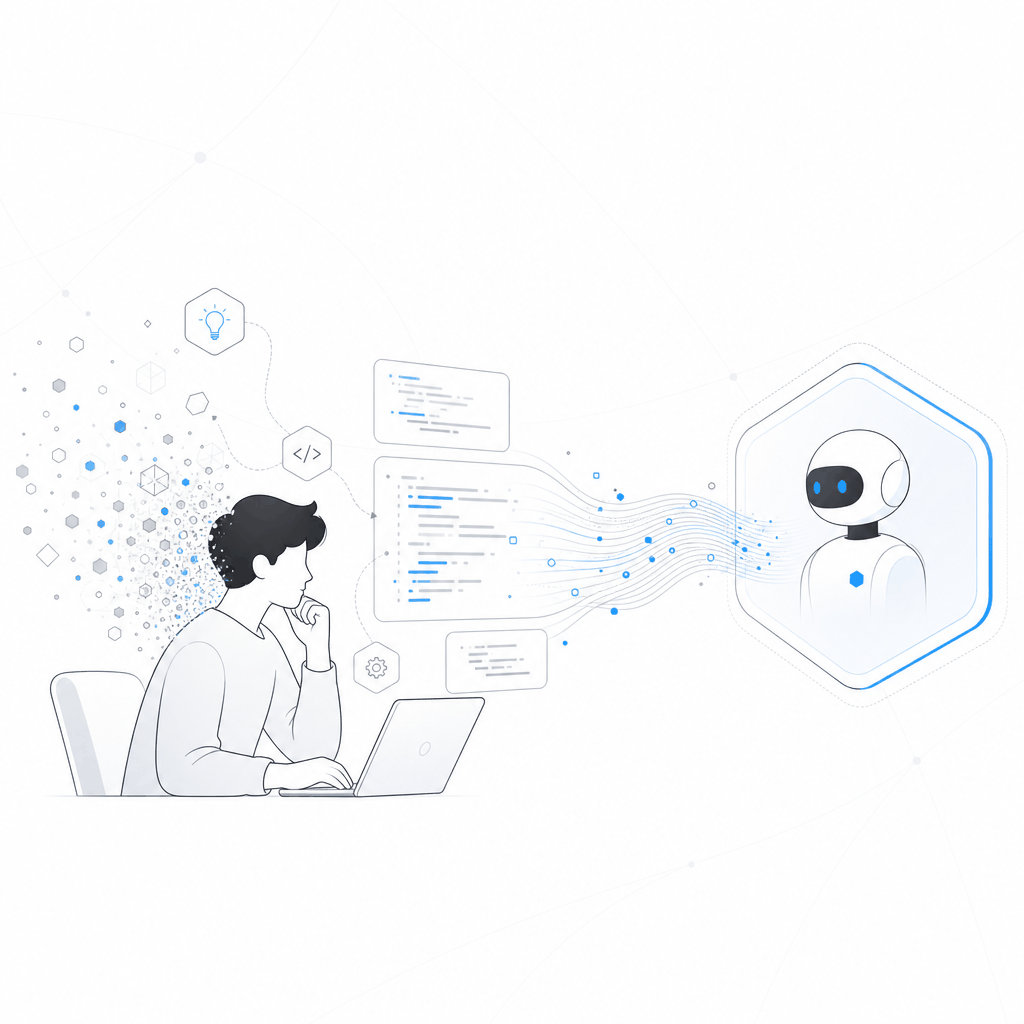
It’s 10 a.m. You open your IDE. Claude Code is already sitting in the sidebar, waiting. The requirement is straightforward: add soft-delete logic to the user table, and update the associated caching strategy. You type a comment describing your intent, press Tab, and the AI spits out thirty lines of code. Looks fine. Run the tests — green. Ten minutes, commit, push, on to the next ticket.
That afternoon, CI screams. A production edge case triggered a deadlock. You stare at the stack trace for five minutes and suddenly realize you have no idea what’s actually happening inside that auto-generated code. The engineer who once could tear apart a concurrency problem bare-handed — that person feels distant now.
This isn’t fiction. On June 18, 2026, Nature published a review titled “Is AI ruining our skills? Early results are in — and they’re not good,” aggregating two recent experimental studies that point to the same conclusion: AI assistance is causing measurable degradation of core skills in trained professionals. The effect isn’t a faint trend line — p-values are significant, effect sizes are medium-to-large. These are statistical facts. The topic subsequently generated over a hundred comments on Lobsters, with veteran users like lcamtuf identifying deeper structural concerns.
What follows is an exploration of the experimental data, paired with evidence from the pro-AI-efficiency side. This question is nowhere near settled. But the existing experimental results are enough to make any knowledge worker who relies on AI daily pause and think.
Doctors: Three Months, Six Percentage Points Lost
The first study comes from a collaboration between the Silesian Academy in Poland and the University of Oslo, published in The Lancet Gastroenterology and Hepatology. The subjects: 19 experienced endoscopists, each with at least 2,000 colonoscopies in their career. The team introduced an AI-assisted system capable of analyzing colonoscopy images in real time and flagging suspicious adenomas (precancerous intestinal lesions). The AI tool was available on some working days and unavailable on others.
The study compared two time windows: the three months before AI introduction (795 procedures) and procedures performed without AI in the three months after introduction (648 procedures). Before AI, the adenoma detection rate was 28.4%. After introduction, when AI was turned off, it dropped to 22.4% — a decline of six percentage points, statistically significant. The authors’ interpretation: sustained exposure to AI assistance may lead clinicians to experience “decreased motivation, reduced attention, and diminished sense of decision-making responsibility” when the AI scaffold is removed.
A methodological detail is worth noting. Lobsters user hyperpape pointed out that after AI introduction, the total number of colonoscopies doubled, and the confidence intervals were wide. This means you can’t simply attribute the entire detection-rate decline to AI dependence — changes in workload alone could dilute attentional resources. Co-author Yuichi Mori also acknowledged that “more research is needed to confirm” and candidly stated that “there are currently no established solutions for skill degradation.”
Still, one fact is clear enough: when AI is intermittently embedded into a high-skill workflow, human operators’ independent performance genuinely deteriorates when the tool is removed. In engineering terms, this points to a judgment: if you treat AI as a “crutch” rather than a “training aid,” the operator’s independent capability may begin to atrophy within weeks. For high-stakes domains — medicine, aviation, nuclear power — where AI downtime is not an option, this decay curve deserves serious attention.
Developers: An RCT, Two Letter Grades Lower
The second study comes from an Anthropic research team (arXiv: 2601.20245), cited by the Nature review as the core evidence for skill degradation in computer science. This is a randomized controlled trial — and one of the most methodologically rigorous studies to date.
The experiment recruited 52 software engineers (mostly junior), all with at least one year of Python experience and all unfamiliar with Trio, an asynchronous programming library for Python. Participants were randomly divided into two groups: one could use a sidebar AI assistant (with access to the codebase and the ability to generate correct answers at any time), the other could only use web search and documentation. Tasks included understanding Trio’s core concepts and implementing two functional features. Everyone was told there would be a quiz afterward, but was encouraged to “complete tasks as quickly as possible.”
The quiz assessed four dimensions: debugging, code reading, code writing, and conceptual understanding. The first three received the most weight — because the research team considers these “core capabilities that humans will still need to retain in a future where an increasing proportion of code is AI-generated.”
The result: the AI group averaged 50% on the quiz, the hand-coding group 67%. The gap is roughly two letter grades (Cohen’s d = 0.738, p = 0.01). The largest gap was in debugging ability — the skill of “determining where something is wrong in the code and why” — which happens to be precisely the meta-skill most needed when supervising AI-generated code. On task completion speed, the AI group was about two minutes faster on average, not reaching statistical significance.
This counterintuitive result deserves unpacking: AI made developers slightly faster, but not significantly so; yet it significantly weakened their depth of understanding of concepts they had just encountered minutes earlier. And the weakening landed precisely on “debugging ability” — arguably the least replaceable human skill in AI-era code production.
Interaction Patterns Matter More Than “Use or Don’t Use”
The most illuminating part of the Anthropic paper is the qualitative analysis that subdivides AI usage patterns. By annotating screen recordings, the research team categorized AI-group participants into six interaction styles:
Low-score patterns (average quiz score under 40%):
- AI Does Everything (n=4): Let the AI write all the code, just copy-paste. Fastest task completion, worst quiz scores.
- Progressive AI Reliance (n=4): Started by asking only one or two questions, then delegated everything to AI. Never grasped the second task’s concepts at all.
- Iterative AI Debugging (n=4): Used AI to help debug, relied on AI to solve problems rather than clarify their own understanding. Not only poor quiz scores, but also slow completion.
High-score patterns (average quiz score above 65%):
- Generate Then Ask Why (n=2): Used AI to generate code first, then asked conceptual questions to deepen understanding.
- Hybrid Code + Explanation (n=3): Simultaneously requested AI to generate code and explain the logic. Spent more time but gained more solid comprehension.
- Pure Conceptual Queries (n=7): Asked only conceptual questions, wrote code independently based on understanding. Fastest among the high-score patterns, second only to “AI Does Everything” overall.
The key insight is disarmingly simple: people who treat LLMs as “answer machines” are experiencing skill degradation; people who treat them as “conversational tutors” are growing. The difference lies in whether you’re willing to spend two extra minutes asking “why” after getting an answer. But this finding also hints at a structural problem: in real workplaces, organizational incentives naturally favor “fast delivery” over “deep learning.” A junior developer facing a deadline choosing “AI Does Everything” is behaving almost rationally. The Anthropic paper itself notes: “Given time constraints and organizational pressures, junior developers may complete tasks as quickly as possible with AI at the expense of skill development — precisely undermining their ability to debug when things go wrong.”
The Other Side: AI Does Boost Efficiency — If You Already Know How
To be fair, the existing literature isn’t one-sided. In the same paper, Anthropic cites an observational study of Claude.ai users finding that AI can shorten task completion time by 80% for certain work. The research team’s interpretation: AI accelerates the execution efficiency of already-mastered skills, but obstructs the learning process for new skills. These two conclusions don’t contradict — they answer different questions. Let an experienced React developer use AI to write a form component, and you save the keystrokes of boilerplate. But let them use AI to write code while learning a new framework, and you weaken the opportunity to build a mental model.
Additionally, METR’s July 2025 RCT provides intriguing data: 16 senior open-source developers (maintaining projects averaging 22,000+ stars) were 19% slower on tasks when using early-2025 AI tools. The direction aligns with Anthropic’s conclusion — AI didn’t bring efficiency gains to experienced developers — but METR focused on productivity rather than skill degradation.
Taken together: AI has positive efficiency evidence for familiar tasks, but RCT-level evidence supports its obstruction of new-skill learning. Neither side is decisive, but together they’re enough to make anyone take seriously the judgment that “how you use it determines whether AI is a tool or a trap.”
Three Layers of Unease: Responsibility, Essence, and Homogenization
Returning to the Lobsters discussion: lcamtuf (a well-known security researcher) received 34 upvotes on a long comment identifying three structural problems that go beyond the experimental data.
First, the fracture of responsibility attribution. Modern society’s legal and professional accountability systems for professionals are built on the premise that “you understand and own your work product.” If LLMs cause diagnostic ability to continuously degrade while medical malpractice liability standards remain unchanged, you get the worst of both worlds — diminished judgment, with the responsibility still nailed to you. This logic applies to every profession where someone signs their name: engineers, accountants, lawyers.
Second, the outsourcing of essentially human skills. “The skills we’re discussing are creating art, expressing ideas, making complex decisions, expressing emotions, teaching others — these are nearly the essence of human existence.” lcamtuf’s question goes deeper than “can AI do this”: if these human activities are eventually all outsourced to LLMs, “what remains worth taking pride in as a human being?” There’s currently no good answer to this question — but precisely because there isn’t, it deserves to be asked repeatedly.
Third, AI as a “homogenization amplifier.” In his own blog, lcamtuf expands on a point: AI can indeed amplify individual capability, but it’s also an astonishing “conformity amplifier” — “these tools give you competitive advantage while simultaneously stripping away all your individuality. When your output is fully interchangeable with that of another billion people who can write a prompt, what do you compete on?”
These three concerns provide a framework for interpreting the experimental data: the experimental evidence of skill degradation is the “what”; the fracture of responsibility, the outsourcing of essence, and homogenization are the “so what.”
A Tool Problem, or a Structural Problem?
Why does this topic make people uneasy? Humans lost their sense of direction after GPS, their memory declined after search engines — and we all accepted it calmly. Why is AI different?
Lobsters user emk’s metaphor offers part of the answer: photography replaced painting skills but didn’t replace the painter’s eye and brain — composition, light, subject selection remained human. LLMs are different: they intrude into the judgment process — debugging ability, design intuition, conceptual understanding. When a tool begins to substitute your decisions rather than execute your steps, its nature shifts from “tool” to “agent.” The longer you use the agent, the more your independent-judgment muscles atrophy.
I’m not arguing against using AI — this very article was written with heavy AI assistance for material organization and translation. The line is in how you use it: treat AI as a conversational partner rather than an answer-output machine, make asking “why” a built-in step in your workflow. But even if individuals can do this, structural problems persist. When performance systems reward delivery speed over code quality, when management equates “AI-assisted” with “headcount reduction possible,” individuals who insist on “understand before you commit” will still get crushed by systemic pressure.
There is no definitive conclusion. The direction of existing experimental evidence is broadly consistent — AI assistance has a significant negative impact on skill learning in the short term, with non-trivial effect sizes. But sample sizes are small (52 and 19 people), experimental environments differ from real workflows, and long-term effects have zero data. What this article can do is lay the experimental evidence and engineering intuition already on the table before you, and invite you to examine your own usage habits with this information in hand.
(This article is based on publicly available information from the Nature review and related original studies; all data and citations are sourced. The author used AI tools to assist with material organization and translation; the article’s judgments and structure were completed by a human. This article does not constitute professional advice of any kind, nor does it represent an overall negative stance on AI technology.)