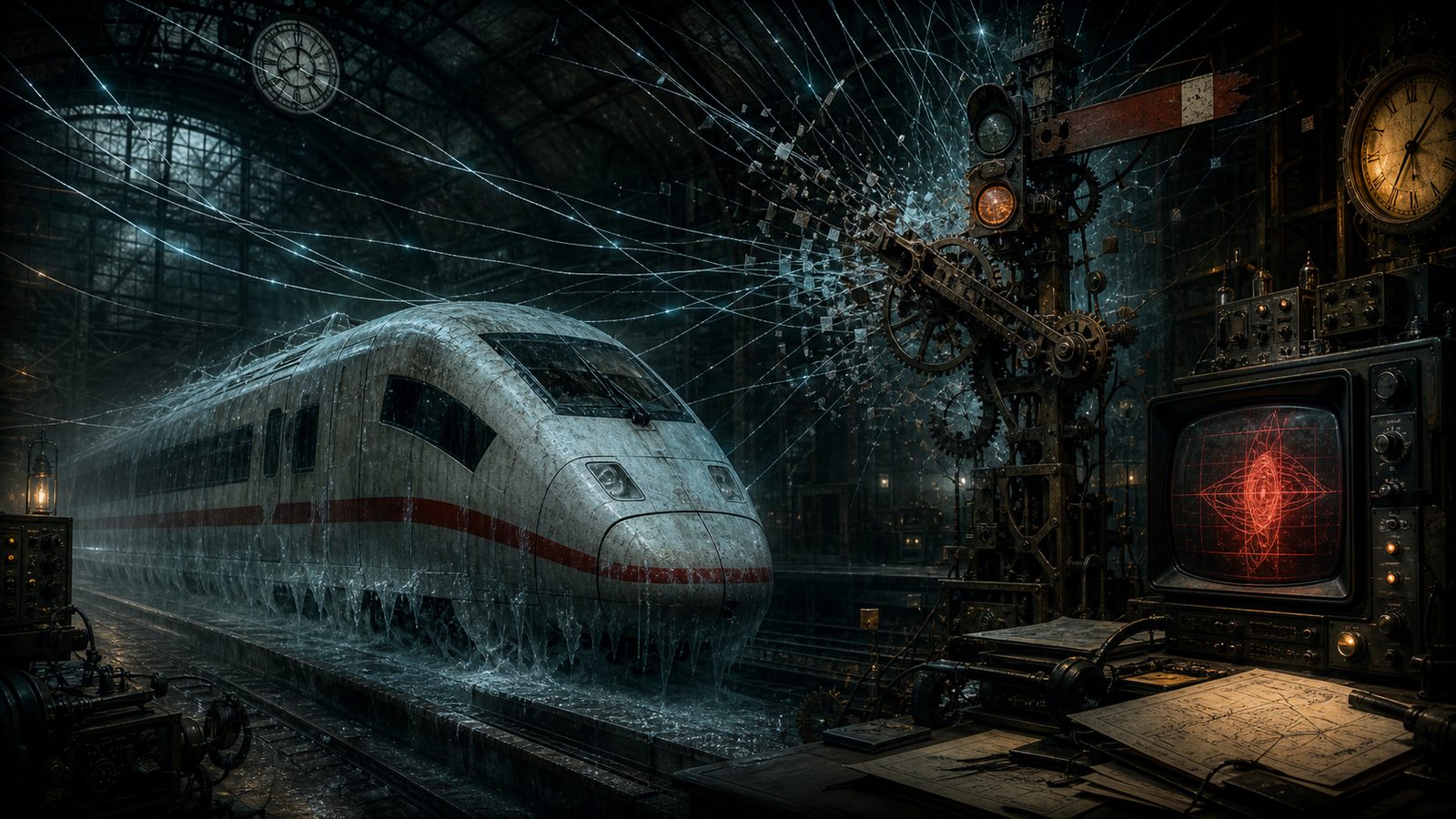
At 10:30 PM on June 23, 2026, Munich Central Station. An ICE high-speed train was preparing to depart for Berlin, the carriages full of passengers wrapping up their day. The announcement came: 30-minute delay, radio system malfunction.
Thirty minutes later, the announcement came again: an additional two-hour delay. Soon, every departure on the station information board flipped to a single word — “Cancelled.”
It wasn’t just Munich. Frankfurt, Hamburg, Cologne, Berlin — every train in Germany stopped at the same moment. This wasn’t a regional signal fault or single-line construction work. The entire railway network of the Federal Republic of Germany fell silent in the same minute.
An HN user, desertrider12, who was sitting in a Munich ICE carriage at the time, wrote: “The conductor first said 30-minute delay because the radio wasn’t working, then revised to 2 hours. They never said it was nationwide.” Another passenger, mcbetz, stranded for 2.5 hours in Erfurt, added: “Engineers were privately messaging each other that a software update had gone wrong.”
The Culprit: A Relic Called GSM-R
Deutsche Bahn quickly confirmed the source: GSM-R (Global System for Mobile Communications - Railway), a railway-specific digital wireless communication system.
What is GSM-R? Simply put, it’s the railway version of the GSM network — the same 2G technology that powered brick phones in the 1990s. GSM-R is built on the same core architecture but customized for railway scenarios. It doesn’t just carry voice calls (communication between dispatchers and drivers); it’s also the data bearer for ETCS (European Train Control System).
ETCS is the core of Europe’s railway signaling system. Under ETCS Level 2, traditional trackside signals are virtualized — trains continuously receive “movement authorities” via the GSM-R network from ground-based Radio Block Centres (RBCs), telling them how far ahead the track is clear and how fast they can go. If this continuous train-to-ground communication is interrupted, the onboard European Vital Computer immediately enters protection mode: no authority, no movement.
HN user lxgr explained the mechanism: “ETCS (from Level 2) does depend on GSM-R, but the core design is fail-safe: communication lost → movement authority lost → train stops. That’s fail-safe.” Another user, NamTaf, was more direct: “It did fail-safe. Network went down, trains stopped — no train collisions.”
The problem is: a country with one of the highest per-capita rail travel rates in Europe, paralyzed nationwide because of a failure in a single core communications system — what kind of “safety” is that?
Technical Anatomy: The Single Point of Pain in GSM Architecture
To understand why a single failure could paralyze an entire country, you need to go back to the GSM network architecture itself.
The central nervous system of any GSM network is a pair of databases: the HLR (Home Location Register) and the VLR (Visitor Location Register). The HLR stores the permanent identity and subscription information for every user (in this case, every train’s onboard radio). The VLR maintains current roaming location data. When a GSM-R handheld terminal or onboard radio initiates a call, the network must query the HLR/VLR for authentication and location — these two databases are the routing hub for all calls and signaling.
HN user mschuster91 offered what is likely the correct diagnosis: “GSM-R is 1990s GSM, probably an HLR or VLR went down — in any GSM network, these two are the core; without them, even public network roaming can’t function.”
More damning was the redundancy design. GSM-R theoretically has extremely high redundancy — Wikipedia even specifically emphasizes “GSM-R has high redundancy.” But in reality, when a software update triggered a cascading failure in the core database, the backup system that was supposed to take over didn’t kick in. Deutsche Bahn CEO Evelyn Palla’s statement to Germany’s Bild newspaper afterward was telling: “We stabilized the situation with an emergency system.” — meaning the normal redundancy wasn’t working; it took the “emergency system” to bring things back.
This is a textbook single point of failure. Not because backup design was absent, but because the backup failed to activate at the critical moment. And at GSM-R’s tier of networking, each European country runs its own core network — there’s no cross-country failover mechanism, because each country’s railway communication numbering and routing plans are different.
Why Are We Still Using 2G in 2026?
Good question. GSM-R was adopted as a standard by the International Union of Railways (UIC) in the 1990s and deployed at scale across Europe in the 2000s. The technology choice was reasonable at the time: GSM was the world’s most mature, most widely deployed wireless communication standard, with the most complete supply chain and lowest cost.
But thirty years later, GSM technology itself is in its twilight. Mobile operators worldwide are gradually shutting down 2G networks — Australia did it in 2018, AT&T in the US in 2017, China plans to clear 2G/3G spectrum around 2025. GSM-R only survives because of the railway industry’s peculiarities: safety certification cycles are long (certifying a signaling system can take 5-10 years), equipment lifecycles are long (locomotives are designed for 30+ years of service), and replacement costs are enormous (swapping onboard radios and ground base stations across all of Europe would cost hundreds of billions of euros).
The problem isn’t just age. GSM-R has several inherent defects:
- Extremely limited bandwidth: GSM provides only 9.6 kbps per channel (later GPRS enhanced to 115 kbps, but still far from sufficient for modern railway needs like real-time video surveillance or train-status big-data backhaul)
- Circuit-switched limitations: Traditional GSM-R relies on circuit switching — a channel is exclusively occupied during a call. ETCS data communication can use GPRS packet switching, but overall capacity bottlenecks persist
- Security generation gap: 2G’s A5/1 encryption algorithm was publicly cracked as early as 2009; while GSM-R adds extra security layers, the underlying protocol’s vulnerability cannot be ignored
- Shrinking supply chain: Fewer and fewer engineers can maintain GSM core network equipment, and spare parts are increasingly hard to find
HN user fnordian_slip’s comment cut to the heart of it: “This is what happens when you neglect critical infrastructure for thirty years.”
The Migration Path: From GSM-R to FRMCS
The railway industry has recognized the problem. The UIC is driving FRMCS (Future Railway Mobile Communication System) as GSM-R’s successor.
FRMCS is based on 5G standards (defined by 3GPP in Release 17/18), and its goal isn’t just a communications upgrade — it’s paving the way for full railway digitalization: autonomous trains, virtual coupling, real-time video surveillance, passenger broadband access. Applications unthinkable in the GSM-R era become technically possible under the 5G framework.
Ericsson published an FRMCS white paper in May 2026, explicitly stating “trials begin in 2026.” Nokia and Huawei are also actively positioning. European GSM-R spectrum licenses will expire between 2030 and 2035, by which time migration must be complete.
But this timeline faces massive implementation risk. FRMCS requires not only entirely new base stations and core network equipment, but also new onboard radios on every locomotive and 5G base stations along all railway lines — an infrastructure project of unprecedented scale. Moreover, integrating ETCS with FRMCS requires SIL 4 (the highest Safety Integrity Level) certification, and the certification cycle alone is 5-8 years.
As one railway signal engineer put it: “GSM-R is like an old dam that’s been in service for 30 years. Everyone knows it needs to retire, but until the new dam is built, nobody dares to drain the water.”
The China Comparison
China’s railway communication evolution offers another reference point.
China adopted GSM-R in the 2000s as its railway communication standard, providing data bearing for CTCS-3 (the Chinese Train Control System, equivalent to ETCS Level 2). The Qinghai-Tibet Railway, Beijing-Shanghai High-Speed Railway, and Wuhan-Guangzhou High-Speed Railway all use GSM-R. China’s GSM-R network is the largest in the world — covering over 100,000 km of railway.
But China’s technical path has already shifted. In 2020, China State Railway Group launched 5G-R R&D and trials. Unlike Europe’s FRMCS, China’s 5G-R chose the 5G NR standard as the underlying layer and developed a dedicated railway application layer. By 2024-2025, the 5G-R test section at the loop test track had completed key performance verification, and spectrum allocation plans are advancing.
China’s pace is noticeably faster than Europe’s — partly because China’s railway operations are more centralized, spectrum allocation doesn’t require coordinating 27 member states, and safety certification processes are more direct. China’s railway target is to complete the GSM-R to 5G-R transition around 2030.
But Germany’s nationwide GSM-R collapse is a wake-up call for Chinese railway communication planning: no matter how fast new technology deploys, single-point-of-failure risks in core network architecture don’t automatically disappear. 5G’s Service-Based Architecture (SBA) introduces more inter-element signaling interactions; without systemic disaster-recovery design, a next-generation network could cascade-collapse on a single node failure just as easily.
Not the Last One
At 12:25 AM, Munich Station’s announcement finally came: radio restored, trains gradually resuming operation. The entire incident lasted roughly 2.5 hours — for a nationwide railway shutdown, that counts as “rapid recovery.” Deutsche Bahn distributed taxi vouchers and hotel vouchers to stranded passengers; the CEO told the media they “need to determine the cause.”
But the fundamental problems won’t disappear with one emergency fix. A core network that hasn’t been updated in 30 years, shrinking operational capability, a migration plan that keeps slipping — this GSM-R collapse wasn’t the first and won’t be the last.
October 2022: railway communication cables in northern Germany were deliberately cut, GSM-R network partially down for hours. 2025: a nationwide GSM-R outage hit the UK. 2023: Poland’s railway signaling system was hacked using simple audio sequences to remotely trigger emergency stops — the vulnerability of European railway communication systems is a lottery ticket that’s been scratched too many times.
One HN comment earned high votes: “For DB, this type of outage is referred to as ‘Tuesday.’” — dfltr
Behind the joke is a grim reality: when an infrastructure system goes down due to a single point of failure, whether you attribute it to “accident” or “management failure” depends on where you’re standing. For the passenger sitting in an ICE carriage for two hours not knowing what’s happening, there’s no difference.
This article draws on publicly available information and community discussions. If you have deeper first-hand experience with this topic, corrections and additions are welcome.