Scanning Layer by Layer, Reading Line by Line
In 79 CE, an eruption of Mount Vesuvius buried the city of Herculaneum in volcanic ash. A private library in the city — later known as the “Villa of the Papyri” — housed hundreds of scrolls of philosophical and literary works. The superheated gases carbonized these scrolls instantly: they were transformed into an extremely fragile structure of nearly pure carbon. For two thousand years, this carbonized state created a cruel paradox: the scrolls were preserved, but they crumble at the slightest touch.
To read one was to destroy it.
On June 25, 2026, the Vesuvius Challenge team made an announcement: scroll PHerc. 1667 — internally designated Scroll 4 — has been fully “virtually unwrapped” and read through. This marks the first time in history that a carbonized scroll has been read from beginning to end without physically touching it.
When I read this news, my first reaction was skepticism: carbon-based ink on carbonized papyrus — X-rays can barely distinguish the density difference. How is this even possible?
The Core Problem: Finding Carbon on Carbon
To understand this project, you need to grasp the central technical challenge.
Conventional X-ray CT imaging relies on density or compositional differences between materials to generate contrast. Metal-based ink on parchment — with high lead content — glows bright white in CT images. But the Herculaneum scrolls used carbon-based ink — lampblack or charcoal powder mixed into a binder — and the papyrus substrate was carbonized by volcanic heat into a near-pure carbon structure. The two have no meaningful difference in X-ray attenuation coefficient. In other words, a CT scan produces a uniform gray spiral; the human eye cannot distinguish where text is.
This is precisely why academia long considered these scrolls “unreadable.” The research team, in public documentation accompanying the paper, put it starkly: “To read one was to destroy it.” Physical unwrapping attempts in the 19th century, 1969, and the 1980s did indeed destroy the outer portions of PHerc. 1667 — a scroll originally 19-24 cm tall now survives as a roughly 8 cm core.
How They Did It: From Synchrotron to Machine Learning
The entire tech stack breaks down into four stages. None of them individually is entirely novel, but stringing them together into a working engineering pipeline is the project’s real contribution.
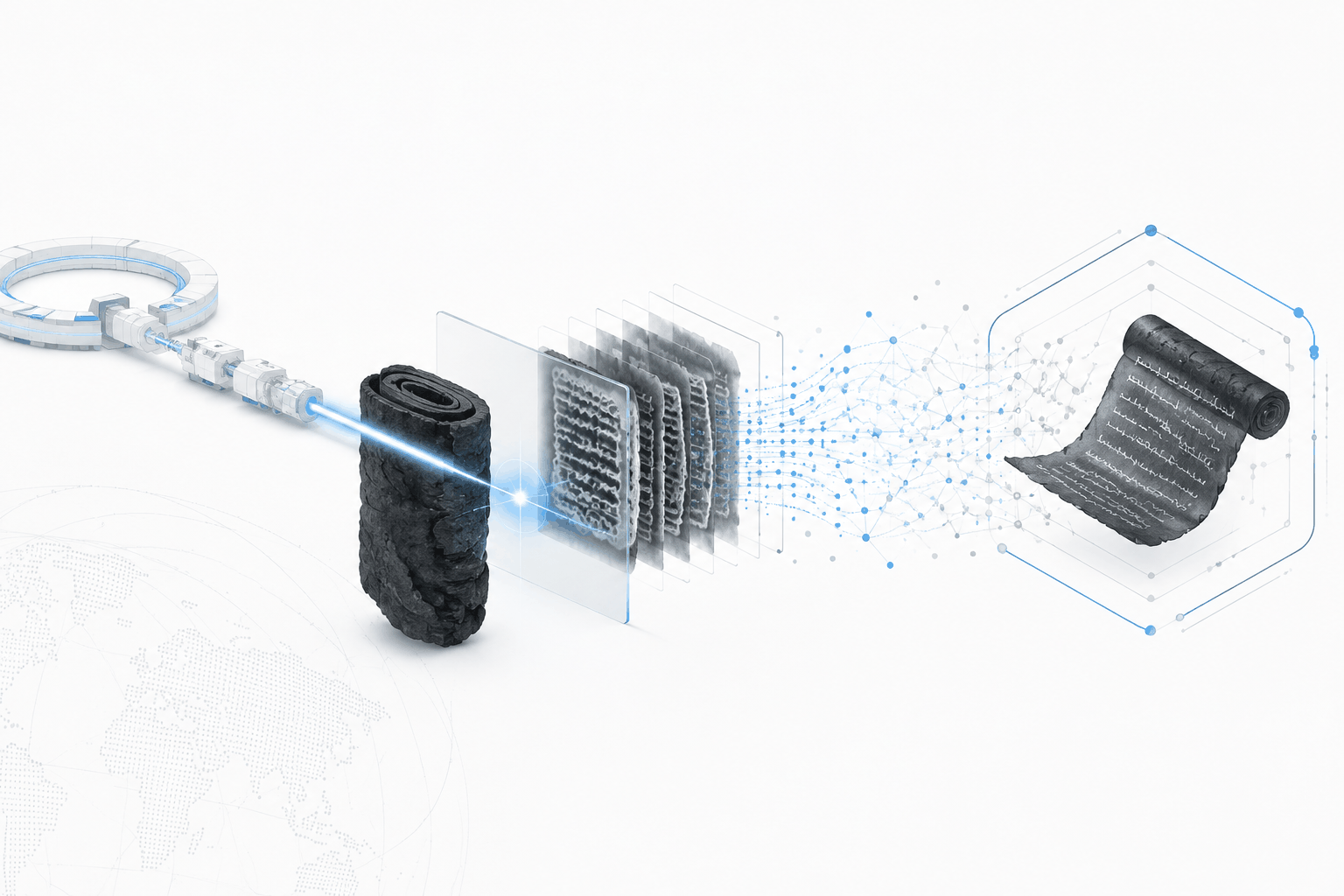
Stage 1: High-quality data acquisition. Scanning was performed at the European Synchrotron Radiation Facility (ESRF) in Grenoble, France, on beamline BM18, with additional beamtime at the UK’s Diamond Light Source. BM18 leverages ESRF’s recently upgraded “Extremely Brilliant Source,” producing an X-ray beam combining extremely high spatial resolution and stability. This is not ordinary CT — phase-contrast microtomography captures microstructural boundaries invisible to conventional absorption contrast. A single scroll generated up to 300TB of data. ESRF officially stated this is the largest dataset ever produced at the facility.
What does that mean? 300TB isn’t just “big.” It means that for a scroll roughly 1.4 meters long, tightly wound layer upon layer, the scan resolution is sufficient to distinguish each paper-thin layer of the spiral structure. Without this resolution, none of the subsequent steps would be possible.
Stage 2: Geometric reconstruction and virtual unwrapping. Tracing the spiral path of the papyrus layers through the 3D volumetric data and mapping it onto a flat 2D surface. This process, called “virtual unwrapping,” was developed over two decades by EduceLab, led by Brent Seales at the University of Kentucky. Identifying papyrus layer boundaries in CT data requires extensive manual annotation — a team member in the HN comments candidly described this work as “extremely tedious and slow and error prone.” What I see here is the truly “human-intensive” part of process engineering: the quality of manual annotations directly determines the accuracy of the unwrapped surface. This isn’t an algorithm problem; it’s an annotation capacity problem.
Stage 3: Ink detection. This is the most fragile and most fascinating part of the pipeline. The unwrapped 2D surface still appears nearly blank to the naked eye — there is no perceptible contrast between carbon-based ink and the carbonized substrate. But the act of writing leaves micron-scale surface morphology changes: the stylus compresses fibers, ink seeps into pores, and the dried ink forms a texture distinct from the surrounding area. These textural differences exist in the phase-contrast data as extremely weak signals — imperceptible to human eyes, but detectable by a properly trained ML model.
The team explained on HN: “Most of the ink we have come across is carbon based. This leaves a certain texture on the scrolls that is recoverable and viewable with fairly basic physically based rendering.” But this is not the same as “directly seeing.” The model learned from labeled data — using known fragments (where ink positions can be confirmed via visible/near-infrared light) as ground truth, training the model to recognize the signal patterns at corresponding positions in CT data, then extrapolating to the interior of sealed scrolls that cannot be verified by any other method.
Stage 4: Papyrologist transcription and verification. The ML model’s ink probability map does not equal readable text. Final transcription is performed by professional papyrologists — who, guided by the model’s ink location hints, combine knowledge of Ancient Greek grammar, scribal conventions, and philology to determine the most probable characters.
What Was Read
The surviving portion of PHerc. 1667 yielded approximately 22 columns of Greek text — a philosophical treatise on ethics. The text discusses core Stoic concepts such as “hormē” (impulse) and “phronēsis” (practical wisdom), and the final column mentions “Aristocreon” — the nephew and disciple of the great Stoic master Chrysippus. Based on linguistic style and thematic content, scholars have dated it as a 2nd-century BCE Stoic work.
ESRF’s coverage noted that papyrologist Federica Nicolardi believes this may be among the oldest scrolls in the Herculaneum collection — possibly dating back to the 2nd or even late 3rd century BCE.
Meanwhile, the team is making progress on two additional scrolls. On PHerc. Paris 4 (Scroll 1), higher-resolution scanning has made ink directly visible in the 3D volumetric data, and its segmentation results align one-to-one with the readings from the 2023 Vesuvius Challenge Grand Prize — an independent verification. PHerc. 139 has been identified by its title: Philodemus, On Gods, Book 8 — a work by the Epicurean philosopher. This is the first confirmation that On Gods spans at least eight books.
Three scrolls advancing in parallel, rather than a single breakthrough — this is more persuasive than “one scroll was read.”
Inside the Black Box: Questions from the HN Comments
The question I care about most: did the ML model actually “see” the ink, or did it “guess” the ink?
The HN discussion thread contains an unusually honest exchange. A former competition participant asked: “Is it possible for the model to hallucinate at the character level, even fabricating writing?”
A member who confirmed they work on the Vesuvius team replied (verbatim):
“Yes, it’s quite possible for ML to hallucinate ink, though it is on a much more local scale, like predicting a slightly longer stroke, filling in more of a character than is actually in the data, etc. Perhaps enough to change a reading of a character or show where ink isn’t.”
They added a crucial qualifier: “It is difficult for ink detection to hallucinate grammatical and idiomatic Greek and Latin.” — The ink detection model cannot conjure grammatically correct, idiomatically appropriate passages of Ancient Greek or Latin out of thin air.
This is among the most candid engineering self-assessments I’ve encountered. It reveals two things: first, the model does not fabricate entire passages — the “high-level judgment” of scroll content has a sufficient reliability foundation; second, at the individual character scale, uncertainty is real. As HN user “167” put it concisely: “Bottom of the paper, in the appendix. Don’t expect much. They only got fragments of text with a lot of missing words.”
The source of ground truth also deserves scrutiny. The same team member explained that training data comes from manual annotation — annotators manually marking papyrus boundaries and ink positions layer by layer. They wrote: “Gathering ground truth is hard, and if you don’t have a lot of good ground truth, it doesn’t matter if your code is perfect, you’ll never get results.” In other words: the quality ceiling of the ground truth sets the performance ceiling of the entire system.
This point is especially critical in the cultural heritage domain. Unlike ImageNet with its million-scale human-labeled samples, the annotation data for carbonized scrolls is constrained by the limited number of known fragments and the extremely high cost of manual labeling. What the model learned, and what it missed — these two questions currently have no quantitative answer.
An Engineering Assessment, Not a Verdict
I’ll attempt a sober assessment of this project, without taking sides, simply laying out facts and judgments.
On the achievement side: this is the first time a complete carbonized scroll’s text has been read using purely non-invasive means, with data types, code, and transcription results all publicly released. Verification methods include one-to-one cross-checking against independently scanned data (PHerc. Paris 4), and a reproducible pipeline across multiple scrolls. Among the 600+ unopened Herculaneum scrolls, PHerc. 1667 is only the first — but the pipeline has proven it can run end to end.
On the limitation side: carbon-based ink detection relies in principle on texture signals, not density signals, and texture signals are weak, local, and easily contaminated by noise. The model outputs a probability map. The papyrologists’ final transcription inherently contains inferential components — especially in judgments about stroke extension or missing strokes, where model bias can influence individual character readings.
I would summarize the situation as: reading is reliable at the scroll level, but character-level interpretation leaves reasonable room for doubt. This is not a dismissal of the work. Quite the opposite — precisely because they have opened all data and code, this doubt can be made specific and testable.
If This Method Can Scale
Back to an engineering perspective. The 300TB scan data and the subsequent unwrapping, detection, and transcription pipeline currently run at the world’s premier synchrotron facilities. But BM18 is a single beamline. For the 600+ unopened Herculaneum scrolls, if each were to go through this process, the core resources required are beamtime and annotation labor (scanning itself is free, accessed through academic proposal).
HN discussions also raised the question of whether the technique can be applied to other contexts. The team responded cautiously but with clear direction: any fragile text rendered unopenable by carbonization, folding, or deformation could theoretically benefit from this pipeline. Medieval palimpsests, fire-damaged archival documents, even older carbonized bamboo slips — these are natural extension scenarios.
The prerequisite: you need scans with sufficient resolution and data volume, and a group of people willing to annotate ground truth pixel by pixel.
This analysis is based on currently available public information and community discussion. Technical details are drawn from the Vesuvius Challenge team’s publicly released preprint and the public responses of team members in the HN discussion thread.