What does a Hacker News comment section normally look like? For any article that hits the front page, odds are someone below is picking it apart — pricing is too high, the approach has flaws, a competitor does it better, the headline is clickbait. That’s HN’s default mode. Oxide Computer’s 3D rack tour post was an exception.
253 points, 107 comments. Scroll through the thread and you’ll notice something: criticism is almost entirely absent.
“This is the only company I can’t find a reason not to want to work at.” “They made me remember why Sun Microsystems once mattered so much.” “This isn’t just hardware — it’s a complete engineering philosophy.”
What They’re Doing, and What Makes Them Different
What Oxide Computer does is simple to describe: they sell cloud servers. But the servers they sell, and the kind AWS rents you, are two fundamentally different things.
The AWS model: you buy VM or bare-metal instances. The underlying hardware is standard Dell/HPE/Supermicro rack servers running standard Linux, layered with virtualization and management software. Hardware compatibility runs on a “good enough” strategy — machines in the same datacenter might come from three or four different vendors, with slightly varying specs. Nobody optimizes code for a specific server, because tomorrow that server might be replaced.
Oxide’s model: you buy an entire rack. Every motherboard, every backplane, every power cable inside that rack was designed by Oxide. The software running on top of the hardware was also written by Oxide. From silicon to UI, “You are buying a whole product, not a parts list.”
Vertical integration isn’t a novel concept in consumer electronics — Apple’s model of chips-to-OS-to-hardware integration has been discussed for years. But in enterprise infrastructure, almost nobody does this. Sun Microsystems was the last company to seriously attempt it (SPARC processors + Solaris OS + Sun servers), and Sun was acquired by Oracle more than fifteen years ago.
HN’s Collective Nostalgia: Why Sun’s Ghost Still Lingers
The phrase “modern Sun Microsystems” appeared repeatedly in the comments, and it’s no accident. Bryan Cantrill — Oxide’s co-founder and CTO — spent years at Sun, working on projects like DTrace and ZFS. He and co-founder Steve Tuck built deep cloud infrastructure experience during their time at Joyent. This team’s resume gives them the standing to ask a question: “If we designed a cloud server from scratch, ignoring every industry convention, what would it look like?”
Oxide’s answer: throw out the out-of-band management network (IPMI/BMC complexity is a pain point across the entire industry), replace it with a custom Root of Trust controller; use AMD EPYC processors instead of Intel (Cantrill’s criticism of Intel ME is well known); run firmware on their own Hubris operating system; engineer the entire rack’s cooling, power, and networking as a single integrated system rather than an assemblage of N independent components.
This isn’t “choose better parts” optimization. It’s a ground-up redefinition of what a cloud server should be.
The 3D Explorer Itself Is a Statement
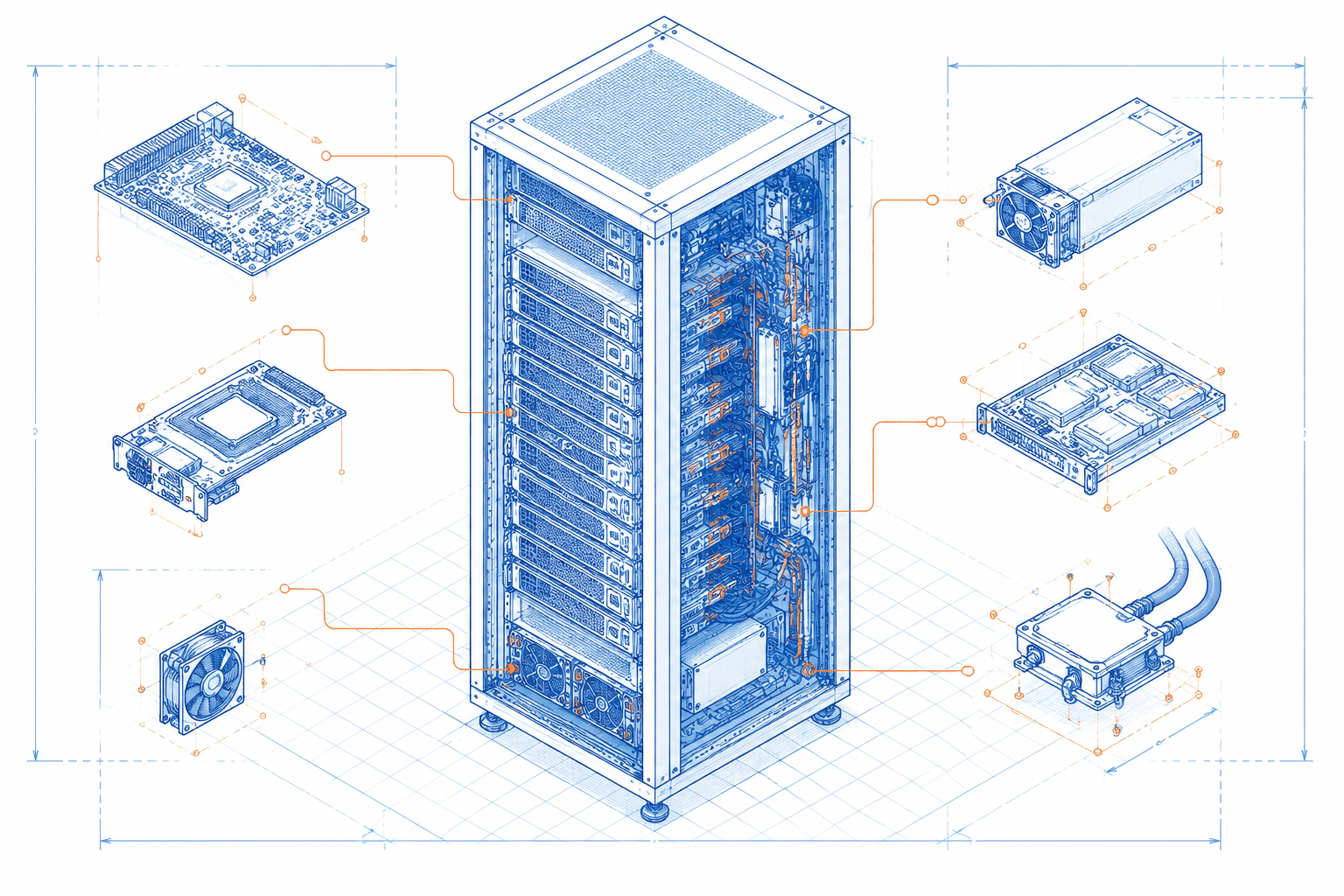
Oxide didn’t release a PDF white paper or a technical blog post. They built an interactive 3D rack browser — you can rotate, zoom, and click on every component to see its technical details. This choice is itself a product declaration: if you want to understand our machine, you shouldn’t just read numbers on a spec sheet. You should enter it.
In the HN comments, multiple engineers mentioned that the 3D tour let them understand Oxide’s physical design decisions — why power runs along the back, why the fan arrangement is asymmetric, why the network cable routing follows a path unlike any existing server. These details, individually, are engineering stories. Taken together, they become product philosophy.
Two Real-World Questions HN Didn’t Fully Address
Price. Oxide’s racks aren’t cheap. The sweet spot is high-density private cloud scenarios — if your workloads are large enough to justify building your own datacenter but not so massive that you’d design your own servers, Oxide may beat buying Dell + integrating your own management stack. But for smaller teams, AWS’s pay-as-you-go financial model won’t easily be outmatched by vertically integrated hardware design.
Lock-in. Buying an Oxide rack means accepting their hardware roadmap, software update cadence, and replacement ecosystem. This is fundamentally different from the openness of buying generic servers + standard Linux. Oxide supporters in the comments addressed this concern with a retort: “AWS lock-in is worse — at least Oxide machines live in your own datacenter.” It’s a fair point, but it sidesteps the question: vertical-integration lock-in and cloud-platform lock-in take different forms, but the depth may not be shallower.
This article is based on Oxide’s public 3D Rack Explorer and the HN discussion. Oxide’s design philosophy and engineering culture are explored in greater depth on the Oxide and Friends podcast.