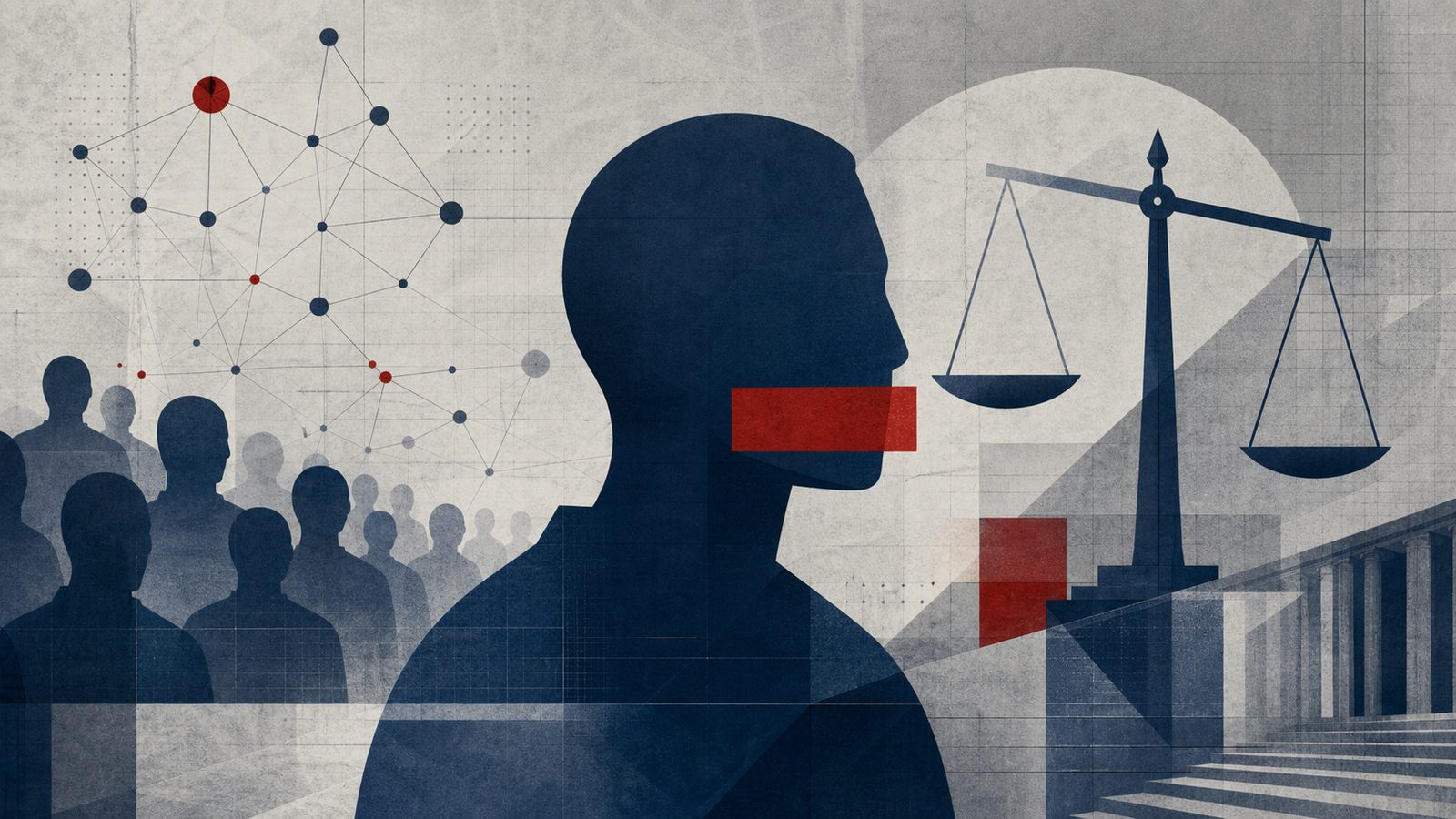
Late May 2025, at the Hay Literary Festival in the UK. A panel on technology and society is underway. Three people sit on stage: former White House technology advisor Tim Wu, investigative journalist Carole Cadwalladr, and former Facebook Global Public Policy Director Sarah Wynn-Williams.
The discussion runs for an hour. Wu and Cadwalladr are animated. Wynn-Williams sits between them and says nothing — not one word. Her face holds a deliberate, neutral blankness. She is present on stage like a witness who has been muted.
It wasn’t because she had nothing to say. Two months earlier, she’d published a memoir called Careless People, chronicling her six and a half years inside Facebook. The book shot to #1 on the New York Times bestseller list. But she had been legally barred from discussing it — or speaking at all — at any public event.
Meta’s legal team had sent a threat to the festival organizers before Hay even began: if Wynn-Williams uttered a single word on stage, she would be in breach of contract. So she chose silence. Meta then notified her that her silent, expressionless presence on that panel itself constituted a further violation. They would pursue additional damages.
This is where the surveillance story begins. On June 25, 2026, Wynn-Williams filed a lawsuit against Meta in US federal court in California, alleging that the trillion-dollar tech company surveilled her for twelve months — with a single objective: to make sure she never opens her mouth again.
What’s in a book that terrifies the world’s seventh-largest company?
Before we get to the surveillance, it’s worth understanding what’s actually in this book.
Sarah Wynn-Williams is a New Zealander, a lawyer by training, and a former diplomat. From 2011 to 2017, she served as Facebook’s Global Public Policy Director — part of the company’s inner leadership circle. She was involved in Facebook’s policy-making and execution across Myanmar, China, Brazil, and other critical markets.
Careless People runs 382 pages. Its core allegations cluster around several themes:
Myanmar genocide. Wynn-Williams details Facebook’s role in the Rohingya ethnic cleansing. Throughout 2016 and 2017, the Myanmar military used Facebook to spread hate speech targeting the Rohingya, incite violence, and drive the ethnic cleansing campaign. At the time, Facebook employed exactly two Burmese-speaking content moderators — both stationed in far-off Dublin. Worse, Wynn-Williams alleges that one of these moderators was actually “letting hate speech through and removing human rights content.” When she escalated her concern that this moderator might be “colluding with the military,” her warning was dismissed by the content moderation team. She tried to push for Facebook’s Community Standards to be translated into Burmese; she was told “Myanmar is not a priority country in this region.”
China censorship infrastructure. The book alleges that Mark Zuckerberg, in pursuit of market access to China, directed teams to build a censorship system specifically for the Chinese market. The system included a “chief editor” role to adjudicate content decisions and automated sensitive-keyword detection. Facebook reportedly considered weakening privacy protections for Hong Kong users and, at the suggestion of a Chinese internet regulator, restricted the account of a Chinese dissident. Wynn-Williams testified before the US Senate in April 2025 that Facebook’s leadership “worked closely” with the Chinese government to censor content on the platform.
Executive behavior. The memoir is equally unsparing about personal conduct at the top. It recounts COO Sheryl Sandberg spending $13,000 on lingerie for her “little cuties” — personal assistants expected to wear negligees and share her bed on the corporate jet. Global Policy VP Joel Kaplan allegedly gave Wynn-Williams a low performance rating while she was nearly incapacitated by severe illness, citing “untimely responses.” Zuckerberg, meanwhile, threw tantrums when he lost at Settlers of Catan on the company jet — a problem subordinates solved by colluding to let him win. He also jeopardized Colombia’s peace process after a 50-year civil war simply because he could not be bothered to get out of bed before noon.
Meta’s response: the book is “divorced from reality, full of slander and false accusations.”
But whether the allegations are true or false isn’t the focus here. The focus is what Meta’s reaction to a former employee’s book reveals about how power operates.
How Meta made someone disappear
When Wynn-Williams left Facebook, she signed a separation agreement. It contained three critical clauses that, together, form an airtight wall:
- A confidentiality clause — barring disclosure of any internal company information.
- A non-disparagement clause — barring any negative statement about the company, its executives, or its employees.
- A mandatory arbitration clause — any dispute must go not to court, but to a private arbitrator selected by the company. The company pays the fees.
Three locks.
Careless People was published on March 11, 2025. Meta launched arbitration immediately. The arbitrator they named, Nicholas Gowen, issued an emergency gag order: Wynn-Williams and her attorneys were forbidden, in any forum and in any manner — “orally, in writing, or otherwise” — from making any “disparaging, critical, or otherwise adverse comments” about Meta and its executives.
This created a total information vacuum.
The gag order’s effects were instant. When Careless People won the “Freedom to Publish” award at the British Book Awards, Wynn-Williams did not take the stage and did not deliver an acceptance speech. The book’s cover was blurred on the venue’s big screen.
Later in 2025, writer Cory Doctorow held a book launch event at London’s Barbican Centre. Wynn-Williams attended as a guest. Whenever the conversation touched Meta, she fell completely silent and kept her face blank. After the event, she did not sign books — even as readers stood before her holding copies of her own work.
There’s a name for this in Silicon Valley: the Streisand Effect. In the 1970s, Barbra Streisand sued a photographer to remove an aerial photo of her Malibu mansion. Nobody knew about the photo. But the lawsuit made it global news, and everyone went searching for it. She went from an anonymous mansion-owner to “the celebrity who didn’t want people to see her house.”
There is no better way to sell a book than to threaten it. Careless People hit #1 on the New York Times bestseller list under a gag order. But read that sentence again: “A book became the #1 national bestseller without its author doing a single piece of promotion.” That fact itself is so absurd it’s unsettling.
Twelve months of surveillance: Meta sent shadows to follow her
According to the lawsuit Wynn-Williams filed on June 25, 2026, Meta didn’t just sue her over the past year. They watched her.
The suit alleges that Meta dispatched company representatives to attend every single one of her public appearances. These people photographed, documented, and filed — with the goal of “proving that, on each occasion, Ms. Wynn-Williams did not talk about Meta or her book.”
Pause and absorb that logic. They were looking for evidence that she was not speaking. And they compiled that evidence into a dossier, to deploy in court someday.
Did they find it? Yes. But it wasn’t enough.
In early 2026, Wynn-Williams attended an arts and literary festival in the UK. She was placed on a panel. She said nothing the entire time. Meta still filed an objection — because other panelists on that session happened to be Meta critics. Meta’s position: her physical presence was itself a violation.
Follow that logic to its conclusion. A person cannot be in the vicinity of anyone who criticizes Meta, even if she doesn’t say a word. Her body, her physical location, her mere existence in a room — all fall under the jurisdiction of a contract.
An arbitration panel had previously ruled that Wynn-Williams must pay Meta $50,000 for each violation of the non-disparagement clause. The accumulated total now exceeds $11 million — more than the combined lifetime assets and future income of Wynn-Williams and her husband, a journalist at the Financial Times. If Meta actually pursues collection, they face total financial ruin.
Cory Doctorow, in his analysis, draws an unsettling parallel: Belarusian dictator Alexander Lukashenko. Years ago, pro-democracy activists in Belarus gathered in public squares — not to chant slogans, just to stand there and eat ice cream. Lukashenko’s secret police beat them and dragged them away. Later, the activists tried silent clapping, silent smiling, silent standing. Every time, they were arrested. Lukashenko knew he’d become an international laughingstock, but he preferred being known as “the tyrant who arrests people for eating ice cream” over letting anyone think his authority could be challenged.
“Zuckerberg knows that threatening Wynn-Williams for sitting silently on a stage makes him look like history’s most guillotine-eligible billionaire,” Doctorow writes. “But Zuckerberg, like Lukashenko, is willing to be seen as a neurotic bully — as long as the people he wants to crush are too terrified to ever question his authority again.”
Deterring everyone else who might speak
The key to understanding why Meta is doing this isn’t about this one book. It’s about what comes next.
In May 2026, Meta announced a massive round of layoffs affecting thousands of employees. The reason: the company had poured enormous sums into AI with returns far below expectations, and it was facing serious cash-flow pressure. That means thousands of former employees are about to walk out the door, each carrying their own version of the “inside story.”
Doctorow proposes a theory: the real purpose of destroying Sarah Wynn-Williams is to send a signal to every departing or already-departed Meta employee. This book has already sold millions of copies — stopping it is meaningless. What Meta actually needs to stop is the next person from writing one.
If you speak, this is what awaits you. A lifetime gag order. Personal bankruptcy. Being followed. Being photographed. Being archived. Where even silence is a crime.
This isn’t law enforcement. This is deterrence engineering.
And that deterrence rests on an institutional loophole: mandatory arbitration. In the United States, more and more large corporations embed forced arbitration clauses into employment contracts. This means employees waive their right to go to court. Any dispute must be decided by a “private arbitrator” paid by the company. The proceedings are sealed, rulings cannot be appealed, and arbitrators have a powerful incentive to please the corporate clients who hire them repeatedly — because if you rule against a company, will that company ever select you again?
Wynn-Williams’s lawsuit doesn’t just ask the court to void the damages. Her core demand is for the court to rule that the separation agreement itself is invalid — because it was signed under duress.
What constitutes duress? The lawsuit discloses a detail: when Wynn-Williams was terminated, she was carrying over $300,000 in unreimbursed company business expenses — money she had paid out of her own pocket for luxury hotels and travel on behalf of Zuckerberg and other executives. Meta told her: sign the separation agreement, or you don’t get reimbursed.
“If I didn’t sign,” she states in the filing, “I wouldn’t get the money back.”
What Meta says
Fairness requires presenting both sides.
Meta’s public statement reads: “Our former employee is attempting to use legal proceedings to sell books, and an arbitrator has already determined that she violated an agreement she signed years ago when she accepted a substantial severance payment. Her book is divorced from reality, full of slander and false accusations.”
Legally, Meta’s position is clear. You signed a contract. You took the money. You accepted the terms. Now you’ve breached the contract by publishing a book. We’re enforcing the contract’s terms. What’s the problem?
That logic holds at the level of law. A person voluntarily signs a non-disparagement agreement and then publishes a book critical of the company. Under contract law, the company’s enforcement actions are not illegal.
But that’s precisely the point: “legally valid” and “morally defensible” have never been the same thing.
When you use an agreement signed under the transactional pressure of recovering $300,000 in out-of-pocket expenses to pursue an individual for over $11 million in damages for writing a book — the charge shifts from “she breached a contract” to “what kind of choice are you making?”
When you dispatch people to photograph and document a writer’s every public appearance for twelve months, and file additional charges simply because she sat near people who criticize you — you stop looking like a publicly traded company protecting legitimate business interests and start looking like a vast apparatus of power erasing a voice it has decided should not exist.
A test case for who gets to speak
This case matters far beyond one former employee’s feud with a tech giant.
It punctures a question that many people prefer not to face: in the United States, free speech is protected by the First Amendment. But the First Amendment only restricts the government from limiting speech. It does not prevent private companies from restricting speech through contract. Which means: if your severance agreement contains a clause saying “don’t say anything negative about the company,” and you signed it — then criticizing the company could leave you liable for tens or hundreds of thousands of dollars.
That’s why non-disparagement clauses are so powerful, and so dangerous. They don’t just silence one person. They silence everyone who worked alongside that person, witnessed the same things, and is now weighing whether to speak.
They say: you think you saw something wrong? You think you should say something? No. You signed a contract. Forget everything you saw and live quietly.
Wynn-Williams’s lawsuit is still being litigated. She is asking the court to lift the gag order and declare the separation agreement void. Meta’s legal team will, of course, fight with everything it has. Whatever the outcome, the process itself has already posed a trillion-dollar question:
When one of the most powerful corporations in the world decides to deploy every legal and gray-zone tool available to silence one person — every single one of us is, in some sense, a potential protagonist in this case.
You may never have worked at Facebook. But you’ve probably signed a separation agreement somewhere. Those “confidentiality” and “non-disparagement” clauses tucked into the last PDF HR sent you — how carefully did you read them? Under what circumstances do you think they should be void? When a company’s actions involve matters of public interest — genocide in Myanmar, building censorship systems for foreign governments — which is bigger: one person’s contractual obligation, or society’s right to know?
These questions have no clean answers. But this case gives us at least one living specimen: a person who signed a contract, wrote a book, got sued, got surveilled, got silenced — and then decided, step by step, to sue back.
As for who’s right and who’s wrong, I won’t presume to judge. The only thing I can confirm is this: a book triggering twelve months of secret surveillance — that fact alone tells you more than any courtroom argument ever could about how afraid the world’s largest companies are of a person holding a pen.
Reference links
- Fortune: ‘Careless People’ author claims Meta surveilled her for a year to enforce her silence — Barbara Ortutay / Associated Press, 2026-06-26
- Pluralistic: Zuckerberg’s increasingly bizarre war on whistleblowers — Cory Doctorow, 2026-06-27
- Hacker News discussion — 156 points, 58 comments
- Wikipedia: Careless People — book background and summary
- The Guardian: Whistleblower Sarah Wynn-Williams sues Meta — 2026-06-25
- Katz Banks Kumin: Wynn-Williams v. Meta lawsuit documents — includes full 285-page complaint