On June 29, 2026, Meta’s AI research division (FAIR) published an update to a project on its official blog. The project is called Brain2Qwerty — a deep learning system that converts brain signals directly into text. Its v1 was published in Nature Neuroscience last year, achieving a character error rate (CER) of 32% — better than any prior non-invasive method, but still a long way from practical use. Now they’ve released v2: nine participants, each wearing a magnetoencephalography (MEG) helmet, typed for 10 hours, producing roughly 22,000 sentences. The trained model reached an average word accuracy of 61%, with the best participant hitting 78%.
The operative word in that description is “wearing.” Not implanted. No skull drilling. No surgery.
The same day, the full training code was open-sourced on GitHub, and the v1 dataset was released by their collaborator BCBL (Basque Center on Cognition, Brain and Language). For the brain-computer interface field, this is the strongest report card the non-invasive route has ever produced.
An Old Enemy Called Signal Attenuation
To understand why this matters, you need to grasp an inescapable physics problem at the heart of the BCI field.
When your brain works, neurons fire, producing weak electrical signals and magnetic fields. Reading “what someone is trying to type” from those signals comes down to two fundamental approaches.
Option one: stick the sensor directly on the brain. Take Neuralink’s N1 implant — 1,024 electrodes, threaded by a surgical robot into the motor cortex (the region that controls finger movement) using wires thinner than human hair. It’s the equivalent of placing a microphone in front of every musician in an orchestra. The signal is clean, the noise is minimal. The trade-off is blunt: a neurosurgeon has to drill a hole in your skull.
Option two: put the sensor outside your head. Think EEG (electroencephalography, electrodes on the scalp) or MEG (magnetoencephalography, wearing a helmet that looks like it belongs in a sci-fi film). This is like standing outside a stadium and trying to follow the game through the walls. You can hear the crowd’s volume and rhythm, but you can’t make out who shouted what. The signal has to pass through skull, scalp, and meninges, attenuating badly along the way, while being drowned out by noise from heartbeats, eye blinks, and muscle movements.
The tension between these two approaches has been the central technical schism in BCI research for decades. On one side: clear signal, requires brain surgery. On the other: safe and non-invasive, but the signal is a mess. The gap used to be despairingly large: the best invasive system today achieves a word error rate (WER) of roughly 2%, while the best non-invasive result before Brain2Qwerty v1 was 52%. A 25x difference.
How Meta Turned a Fuzzy Signal Into Readable Text
What Brain2Qwerty v2 does is chain three stages into a pipeline that makes “listening to the game from outside the stadium” actually work.
Stage one: brain signals to character candidates. Participants wear a 306-channel Megin MEG system, look at sentences on a screen, and type them out on a QWERTY keyboard. What the model doesn’t do — and this is the key improvement — is wait for precise keystroke timing before decoding. That was v1’s dependency, and it’s what made real-time use impossible. v2 uses CTC (Connectionist Temporal Classification) for asynchronous decoding: feed it a continuous chunk of brain signal, get a continuous stream of character predictions. After training on 10 hours of data, the gap between asynchronous and synchronous decoding narrowed to just 2%.
Stage two: character soup to word boundaries. The raw output from the CTC stage is still messy — sequences full of blanks, repeats, and errors. v2 inserts a Word Aligner in between. Its job is akin to “understanding someone with a severe speech impediment” — extracting plausible word boundaries from a chaotic character stream.
Stage three: let a large language model be the proofreader. This is the smartest and most critical part of the pipeline. Meta fine-tuned Qwen3-4B, an open-source model with only 4 billion parameters. LLMs natively understand grammar, semantics, and context. When the brain-signal decoder outputs a garbled word, the LLM corrects it based on surrounding context. Say you meant to type “the weather is nice today,” but the MEG decoder spat out “the weathr is ncie tday.” The LLM sees “weathr” sitting next to “is” and automatically corrects it to “weather” — because it learned from massive text corpora that “weathr” isn’t a word, “weather” is, and “the weather is nice today” is the only sentence that makes sense.
This architecture — encoder → word aligner → fine-tuned LLM — drove the average WER down from v1’s 52% to v2’s 39% (61% word accuracy), with the best participant achieving 22% WER (78% word accuracy). 28% of sentences were perfectly decoded, and 47% had no more than one word wrong.
The research team demonstrated a clean scaling law in the paper: decoding accuracy scales linearly with the logarithm of training data (Pearson r = -0.99), with zero signs of saturation at 90 hours of data. Translation: this road isn’t close to its destination. More data means better results.
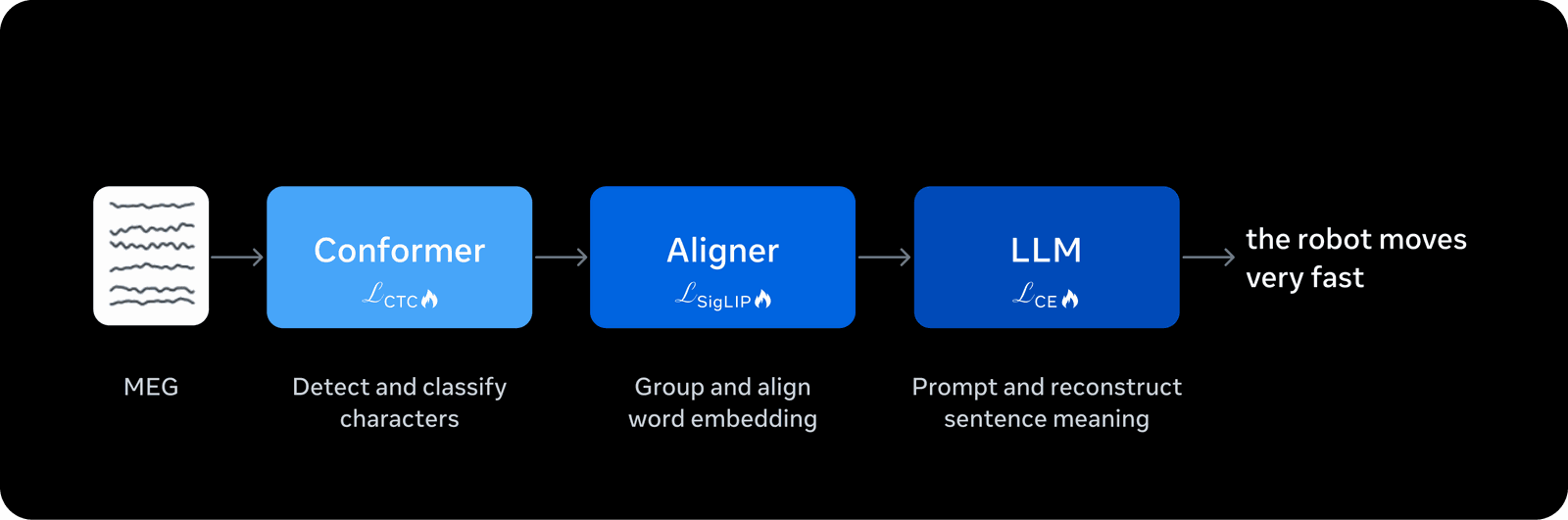 Image: Brain2Qwerty v2 system architecture — CTC encoder → Word Aligner → fine-tuned Qwen3-4B LLM. Source: ai.meta.com
Two Roads, Head to Head
Let’s put the scorecards side by side:
| Metric | Meta Brain2Qwerty v2 (non-invasive) | Best Invasive Systems |
|---|---|---|
| Method | Wear an MEG helmet, no surgery | Surgical electrode implant |
| Avg. Word Error Rate (WER) | 39% | ~2% |
| Best-participant WER | 22% | Lower (single participant) |
| Training data | 9 participants, ~90 hours | Long-term single-patient recording |
| Risk | None | Infection, bleeding, inflammation, signal decay |
| Cost | MEG hardware is expensive but reusable | Surgery + implant + maintenance |
| Scalability | Theoretically usable by anyone | Requires a neurosurgeon; hard to scale |
This table doesn’t yield a simple “who won” verdict. What does 2% WER mean for an invasive system? It means near-viable daily conversation — Neuralink’s participant has achieved typing speeds of 40 words per minute, with error rates approaching human typing. For patients with ALS or locked-in syndrome who’ve lost all communication, every correctly decoded word represents an enormous quality-of-life improvement.
But invasive approaches have two hard, unsolved problems. First, they’re not permanent. The immune response after electrode implantation — microglial cells forming scar tissue around the electrodes — degrades signal quality over months to years. This isn’t an engineering problem; it’s a biological one. Second, they can’t scale. The number of neurosurgeons in the world qualified to perform these implantations is limited. The cost and risk per surgery mean these systems will only ever serve a small number of people who need them most.
Meta’s chosen route — non-invasive + large-scale data + deep learning — is essentially pushing BCI from the domain of “clinical neural prosthetics” toward “consumer-grade device.” That step is still a short one: an MEG machine is a multimillion-dollar behemoth that requires a magnetically shielded room to operate, about as far from “lightweight and wearable” as you can get. But think of a CT scanner from the 1980s versus a smartwatch today. Device miniaturization is a question of engineering timelines, not physics.
My Take
One HN comment reads: “This isn’t new technology. The paper just demonstrates a small but statistically significant improvement using their new method on existing tech.” The commenter has a point — at the technique level, Brain2Qwerty didn’t invent a new signal-acquisition method or new hardware. Its contribution is in “making deep learning work better on limited data.”
But here’s what I’d add: a “small improvement” in this field is not the same thing as a “small improvement” in ordinary software. When your baseline error rate is 52%, a drop to 39% is a 25% relative improvement. And when a scaling law tells you “more data will make this better,” it tells you the technical roadmap is predictable rather than a lottery — which, from an engineering standpoint, is worth more than a single lucky high score.
One more thing worth noting: Meta chose to fully open-source the code and dataset. Large-scale non-invasive brain-signal datasets are desperately scarce — because collection is expensive and ethics-board approvals are arduous. The Brain2Qwerty v1 dataset is one of the largest publicly available of its kind. If your goal is to make non-invasive BCIs an everyday reality — not just a tool for billionaires or severely disabled patients — open-sourcing is the most effective accelerant. This has nothing to do with whether “Meta is good.” It’s pure engineering logic.
On the privacy anxiety — one popular HN comment reads “I don’t trust Mark Zuckerberg anywhere near my brainwaves” — I think this concern is reasonable but incomplete. Brain2Qwerty decodes what you intend to type, not what you’re thinking. There’s a fundamental difference: the former is motor intent (you deliberately decide which key to press), the latter is free thought. Current non-invasive technology can’t even do the former at 100% accuracy. The latter is light-years away. But that doesn’t mean we shouldn’t start discussing the rules now. At the velocity these technologies are moving, ethical frameworks are always playing catch-up, never leading.
The two roads may not end up as an either-or choice. Invasive systems will keep serving those who need them most — patients who’ve lost every avenue of communication. Non-invasive systems, if they keep riding the scaling law, might one day appear in everyday life: switching navigation with a thought while driving, replying to messages with a thought while cooking. Two paths racing in the same direction, with different finish lines — but the further each runs, the closer they get.
Reference Links:
- Meta AI Blog: From Brain Waves to Words — Brain2Qwerty v2
- Brain2Qwerty v2 technical paper (arXiv:2502.17480)
- Nature Neuroscience: Noninvasive decoding of typed sentences from human brain activity
- Open-source code: github.com/facebookresearch/brain2qwerty
- explainx.ai technical breakdown: Meta Brain2Qwerty v2
- Hacker News discussion
- Neuralink PRIME Study progress