
On July 2, 2026, a post on Hacker News climbed to 465 points. The title was understated: 「PeerTube — a free, decentralized video platform.」 But in the comments, a user going by 「djaro」 wrote a paragraph that detonated over 200 replies.
Here’s what they said: 「I’m a professional YouTuber, 100K subscribers, no employees, operating costs a few hundred bucks a month. A decent 20-minute video — even with me doing everything solo — takes about 40 person-hours: scripting, filming, editing, color grading, subtitles. Every step is high-intensity creative labor. On average, a single video needs to bring in $500 to $1,000 just for me to stay afloat.」
Then they pivoted: 「You want me to move my videos to PeerTube and live off $5 or $10 tips from viewers? Not happening.」
What this comment did, in essence, was dump a bucket of ice water on PeerTube’s founding ideal — and the person doing the dumping wasn’t a bystander from the tech world, but someone on the front lines of content production. After reading the entire discussion, I came away thinking this is far more complex than it looks: the technology can be flawless, but economic laws don’t yield to ideals.
 Image: PeerTube’s core vision — enabling everyone to establish their own independent, autonomous video platform. Source: joinpeertube.org
How an 「Anti-YouTube」 Was Built
First, what is PeerTube? When people hear 「decentralized video platform,」 a lot of them picture a geek toy — a small circle of a few hundred users entertaining themselves. But PeerTube isn’t that.
The project is developed by the French nonprofit Framasoft and launched in 2018 — seven years ago as of now. It has accumulated 15,000 stars on GitHub, and the network spans over 1,600 independent sites (called 「instances」 in the jargon), hosting more than one million videos. From the global climate protest group Extinction Rebellion to the open-source 3D software Blender Foundation, organizations are using PeerTube to run their own video channels.
The technical logic isn’t particularly complex, but it’s remarkably clever:
First, anyone can 「run their own mini YouTube.」 You rent a server, install the PeerTube software, and you’ve got a video site that is entirely yours. You set the rules, curate the content, decide what gets shown. No applying to any company for 「creator status.」 No worrying that the platform will suddenly change its algorithm and make your videos invisible overnight.
Second, these 「mini YouTubes」 are interconnected. You sign up on my instance and can still follow channels on neighboring instances, comment, and interact. The underlying technology is ActivityPub — an open protocol that lets different websites 「talk」 to each other. Mastodon (the decentralized Twitter alternative) uses the same protocol. So PeerTube videos can even be played and interacted with directly on Mastodon.
Third, no ads, no algorithmic recommendations. PeerTube’s official stance is unambiguous: you shouldn’t be a user 「fed」 content by a platform, trapped in a filter bubble by an algorithm. You want to watch something? You search for it, you subscribe. The agency is yours.
Fourth, the more people watching, the lighter the server load. PeerTube has built-in P2P (peer-to-peer) technology — when you watch a popular video, your browser automatically 「relays」 video chunks to others watching the same video at the same time. It’s a bit like BitTorrent in the old days: the more people watching, the smoother it is for everyone.
From any technical dimension, PeerTube is a beautifully crafted product. Clean, transparent, no dark patterns, no behavioral data collection. It’s the kind of thing you look at and think, 「this is what the internet was supposed to be.」
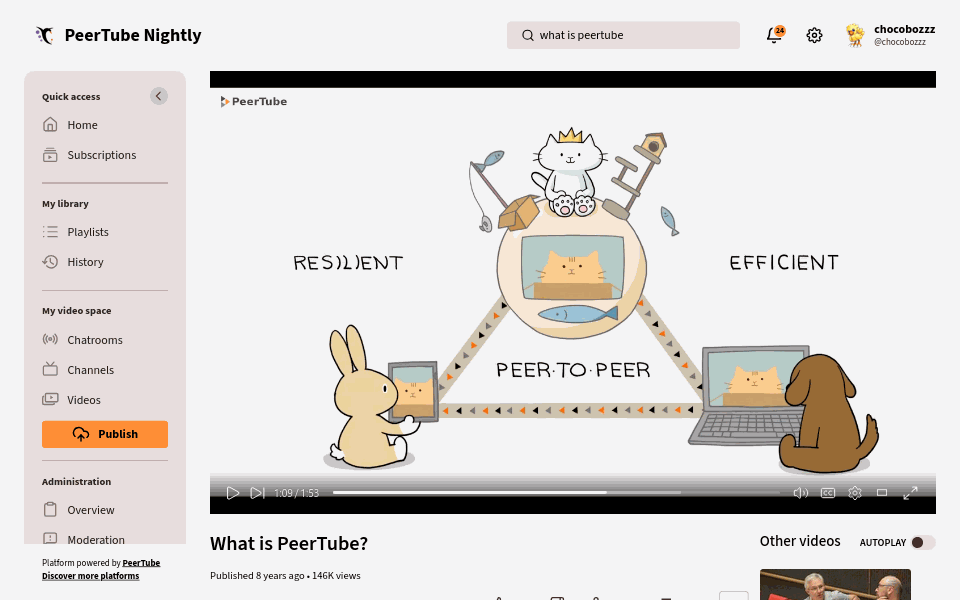 Image: PeerTube’s video browsing interface — clean, ad-free, algorithm-free. Source: Framasoft / PeerTube GitHub
Why That Comment Left Everyone Speechless
But the reason djaro’s comment detonated beneath a 465-point post is that the problem they identified is precisely not a technical one. They were talking about money — how creators stay alive.
Let’s break down the numbers this YouTuber cited. They said a 「decent」 20-minute video requires 40 person-hours. That figure isn’t inflated in video production. Scripting: 4–6 hours (longer if it involves research-heavy content). Filming: 4–8 hours (lighting setup, adjustments, retakes). Editing: 8–12 hours (rough cut, fine cut, transitions, sound design). Add subtitles, thumbnail design, title optimization — 40 hours is if anything conservative. And that’s 「solo mode」 efficiency. Million-subscriber channels typically have a founder plus several full-time staff working 60 to 80 hours a week.
YouTube’s business model is the 「blood」 keeping this ecosystem alive. It collects money from advertisers and distributes it to creators based on views. Large channels can also land brand sponsorships, sell merchandise, run membership programs. The system isn’t perfect — creators complain about high platform cuts and capricious algorithms — but it does provide predictable income.
PeerTube? Its official solution is a 「support」 button beneath each video. Creators can drop in a link pointing to their Patreon, PayPal, Liberapay, or any tipping platform. In plain terms: your viewers think you’ve done good work and voluntarily throw you some cash. No built-in ad system. No platform subsidies. No form of algorithmic traffic distribution whatsoever.
So djaro pointed out a brutal inequality: one video costs 40 person-hours ≈ $500–$1,000 ≈ needs hundreds of people to each chip in a few dollars. At PeerTube’s current user scale — the entire network across all instances has daily active users in the hundreds of thousands at best, while YouTube has over 120 million daily active users — relying on a few hundred tippers to sustain full-time creation simply doesn’t add up.
They also made a deeper observation: creators who make content for free do exist, but the vast majority never scale. The gap between 100 views and 1,000,000 views is four orders of magnitude, and what fills that gap is an entire infrastructure of traffic distribution and monetization — content quality is only one piece of the puzzle.
Between Two Paths, Is There a Third?
Another interesting voice emerged in the discussion. User 「infamia」 proposed a middle-ground solution that gained significant traction in the community: don’t choose. Post to both. Use YouTube as a traffic funnel, keep earning from ads and sponsorships; simultaneously, build your 「home turf」 on PeerTube, cultivating a core audience that follows you for who you are, not what the algorithm serves them.
This idea is already being practiced. Some tech YouTubers premiere videos on YouTube, then sync them to PeerTube weeks later — while posting 「long-tail content」 that YouTube’s algorithm won’t promote on PeerTube: unedited full interviews, behind-the-scenes footage, deep-dive technical explainers. These aren’t earning ad revenue on YouTube anyway, so why not let them accumulate on a platform you fully control?
Another user also noted that YouTube is a fragile dependency for creators. The platform can change policies, ban channels, or adjust revenue splits at any time — in 2023, YouTube modified its ad revenue sharing rules, causing a wave of small and mid-sized creators to see their income cut in half. Having a 「backup base」 on PeerTube at least means you’re not at zero in a worst-case scenario.
But this 「dual-track strategy」 has its own hard limitation: ordinary people simply won’t leave YouTube voluntarily. As one commenter put it bluntly: 「Nobody cares whether YouTube uses an algorithm. What people care about is opening an app and immediately seeing the videos they want to watch. Go try searching on PeerTube — the trending content is either French-language tech lectures or three-year-old re-uploads. It can’t even sort search results properly.」
That’s harsh, but it’s true. PeerTube has one million videos. YouTube has 500 hours of video uploaded every minute. The difference in scale is more than an order of magnitude — it’s a different universe. Content ecosystems aren’t built by a single review article and a couple of idealistic developers.
It’s Not a Technology Problem — It’s an Economic Structure Problem
Stepping back to look at the entire discussion, what I think is truly worth reflecting on is this: PeerTube’s technology is right, end to end. Decentralized, federated, P2P-distributed — it solves the most-criticized problems of centralized platforms (data monopolies, algorithmic manipulation, ad saturation, arbitrary censorship) at the architectural level. It swaps in a fundamentally different model of organization — not just a patch job.
But the problem it runs into sits on a completely different plane: on the internet, technology can be open-source and free, but content never was. Making videos takes time, equipment, and professional skill. On any platform, decentralized or not, someone has to foot that bill. And if the only way to foot it is 「voluntary viewer tips,」 the model is fundamentally powered by passion — sustainable for a few, impossible for most.
Since 2019, PeerTube has had a long-running GitHub thread (Issue #1586) about 「how creators make money,」 still under discussion to this day. The community has proposed various solutions: cryptocurrency tipping, Liberapay recurring donations, decentralized ad networks… but none have matched YouTube’s ad-revenue-sharing system. And the project maintainers have explicitly stated they don’t want to build an ad system into PeerTube — because that would create new centralized power structures (larger instances would attract advertisers more easily than smaller ones, and you’d end up right back at 「winner takes all」), directly contradicting PeerTube’s foundational principles.
This contradiction may be irresolvable. The core idea of decentralization is: don’t let any single node grow too large. The core idea of content economics is: the larger the scale, the lower the unit cost, the higher the profit. These two logics are opposed at the starting line.
What This Teaches Us
At this point, I don’t see PeerTube as a 「failed」 project. Quite the opposite — on the question of 「how to use technology to resist internet centralization,」 it has delivered a remarkably complete answer. Seven years, 15,000 stars, 1,600 instances, one million videos — achieving that without commercial capital, purely on community passion and idealism, is genuinely worthy of respect.
But it also exposes a broader predicament: the internet’s decentralization movement has won several battles at the 「infrastructure」 level, yet has suffered near-total defeat at the 「economic incentive」 level. Mastodon has 15 million users, but not a single content creator can make a living from it. Lemmy (the decentralized Reddit) hosts lively discussions, but every moderator is a volunteer. PeerTube’s technology is more elegant than most commercial video platforms, but it has never answered the question: who pays for content?
So djaro’s comment, in the end, isn’t really a dismissal of PeerTube. It’s a question that every decentralized project wants to dodge: if your system design has no loop for 「creators get paid,」 are you building an alternative, or a hobbyist’s garden?
The most pragmatic answer I’ve seen so far is: both coexist, each serving a different need. Treat YouTube as a 「traffic gateway」 and PeerTube as 「digital sovereignty.」 Don’t expect the latter to pay your bills, but it gives you a microphone that can’t be snatched away by platform tyranny. It’s not an easy path, but it may be the only realistic one right now.
At the very least, PeerTube’s existence has proven one thing: a centralized platform is not the only answer to video sharing. The technology is ready. The remaining problem isn’t in the code — it’s in the wallet.
Reference links: