An hour into a meeting and your brain starts fogging over — most people blame fatigue, a bad night’s sleep, or the colleague who won’t stop talking. But there’s another explanation that may be closer to the truth: the air in the room.
Canadian software consultant Mike Bowler now carries a portable CO₂ monitor everywhere. Outdoor readings hover around 400 ppm. In a closed conference room, he’s watched the numbers climb past 2000. His blog post includes a photo: the monitor displaying 2143 ppm. When I first saw that number, my immediate thought was: how often are the meeting rooms, classrooms, and bedrooms we inhabit every day sitting at that level?
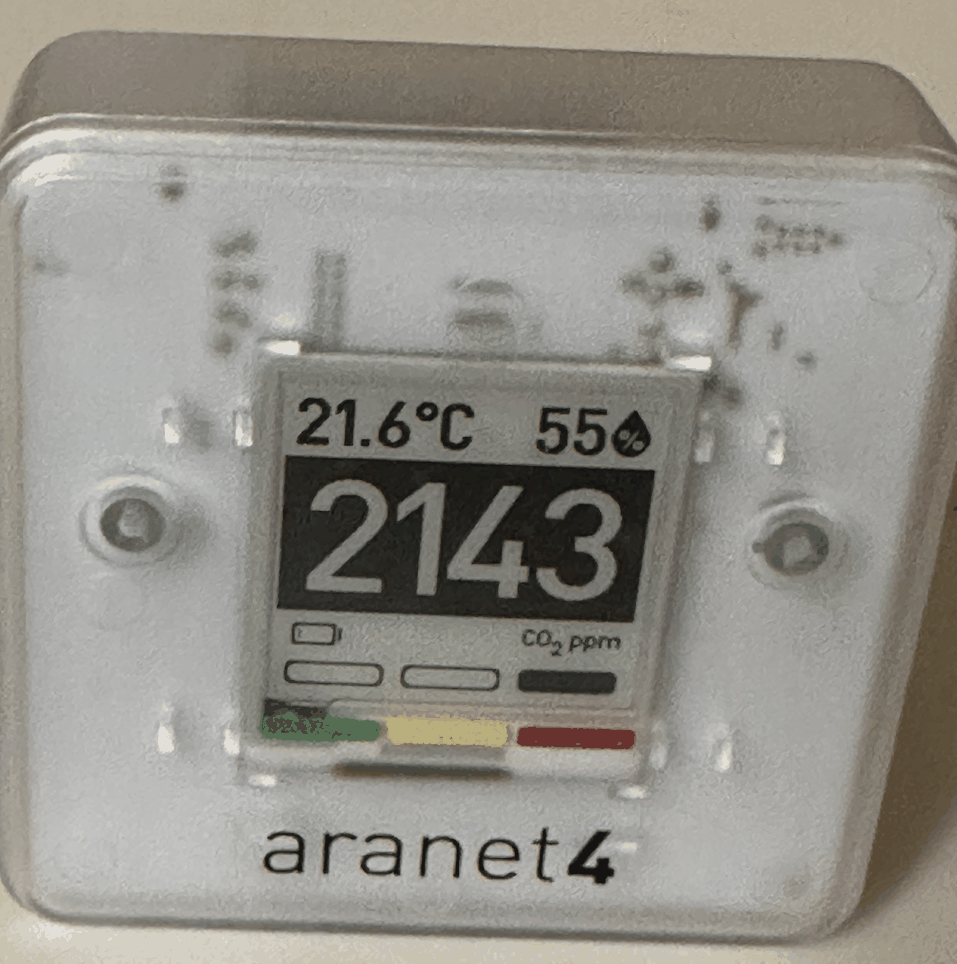 ▲ Mike Bowler’s real-world CO₂ reading in a meeting room: 2143 ppm. Source: blog.mikebowler.ca
Posted on July 3, Bowler’s article racked up over 700 points and 400+ comments on Hacker News. This topic struck a nerve.
What Does 2143 ppm Actually Mean?
This isn’t a vague feeling of “stale air.” There’s hard data behind it.
In 2012, researchers at Lawrence Berkeley National Laboratory placed subjects in an environmental chamber and varied only the CO₂ concentration, keeping all other conditions identical. The results1:
- 600 ppm (near-outdoor fresh air): baseline control.
- 1000 ppm: 6 out of 9 decision-making metrics showed significant decline.
- 2500 ppm: 7 metrics dropped substantially, with some falling into what the researchers described as “dysfunctional” range.
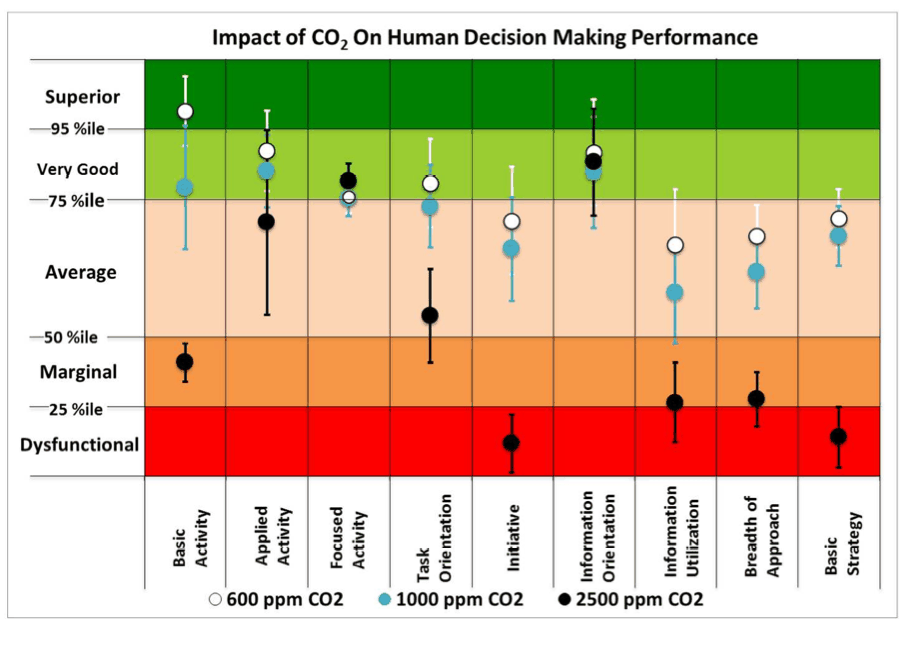 ▲ Lawrence Berkeley Lab chart showing how decision-making scores degrade as CO₂ rises from 600 to 2500 ppm. Source: Lawrence Berkeley National Laboratory
1000 ppm is not an extreme number. Put a few people in a meeting room with the door and windows shut, and you’ll cross that threshold within the first hour. Bowler’s reading of 2143 ppm lands squarely in the zone where decision-making ability is measurably impaired.
A 2016 study from the Harvard T.H. Chan School of Public Health2 reinforced the direction: participants in green building environments (with enhanced ventilation) scored an average of 101% higher on cognitive function tests than those in conventional buildings. Breaking it down:
- Crisis response: 97% higher in green buildings, 131% higher in green buildings with enhanced ventilation
- Information usage: 172% and 299% higher, respectively
- Strategic thinking: 183% and 288% higher, respectively
In other words, ventilation quality doesn’t just affect comfort — it affects whether you can think clearly when it matters.
Why Does Air Quality Affect Your Brain?
Let’s talk mechanism — how exactly does CO₂ make you dumber?
The short version: the CO₂ you exhale accumulates in enclosed spaces. As concentration rises, CO₂ levels in your bloodstream rise with it. This triggers a cascade:
Vasodilation — but not the helpful kind. Your body detects elevated CO₂ and automatically dilates cerebral blood vessels, trying to deliver more oxygen to the brain. But this changes blood flow dynamics in ways that can actually interfere with normal brain oxygenation3.
Subtle shifts in blood pH. CO₂ dissolves in blood to form carbonic acid, slightly altering your blood’s acid-base balance. The brain is exquisitely sensitive to pH; even changes within the normal range can affect the efficiency of neural signal transmission.
Attention and executive function take the first hit. A 2026 study published in Building Services Engineering Research and Technology4 used wearable devices to track real-time heart rate and cognitive accuracy in 54 university students. The researchers found that when CO₂ exceeded 1000 ppm, heart rate variability showed clear alterations — and those physiological changes statistically “mediated” the decline in cognitive accuracy. CO₂ first changes your body’s state, and your body’s state then drags down your brain.
This isn’t poisoning. You won’t faint, won’t get a headache, may not feel anything at all. That’s precisely what makes it dangerous: it operates entirely below your perceptual threshold.
The Silent Tug-of-War: Energy Efficiency vs. Ventilation
There’s an “antagonist” here — and it’s not a person, but a systemic contradiction.
Modern buildings are increasingly sealed for energy efficiency. Glass-walled office towers have windows that don’t open. Central HVAC systems recirculate air according to design specifications. The intentions are good: reduce cooling loss, lower carbon emissions. China’s national indoor air quality standard (GB/T 18883-2022), in effect since 2022, explicitly mandates that indoor CO₂ should not exceed 1000 ppm.
But there’s a vast gulf between “standard” and “reality.”
Bowler’s article includes a telling detail: a client once used the line “our office air is better than your home air” to encourage employees to return to the office. So Bowler walked through the building with his monitor — and found that while some areas did have excellent air quality, the meeting rooms were just as bad as anywhere else. The more people in a space, the worse the problem.
This isn’t just an office issue. The same physics applies to any enclosed space:
- Classrooms: 40 students in a room with closed windows for one lecture period, and CO₂ easily breaks 2000 ppm. A 2025 study in a Nature subsidiary journal5 directly measured the correlation between graduate students’ CO₂ exposure in classrooms and their exam scores — the poorer the ventilation, the worse the test performance.
- Bedrooms: Two people sleeping with the door closed all night, and CO₂ can climb past 1500 ppm. That groggy feeling in the morning might not be about how many hours you slept.
- High-speed train carriages: In 2025, a passenger used a monitor to track CO₂ during a journey, watching it rise from 880 ppm before boarding to over 2000 ppm mid-trip — sparking a wave of discussion.
A Note of Caution: How Solid Is This Conclusion?
In the interest of responsible reporting, it’s worth acknowledging: the effect of CO₂ on cognition is not an airtight consensus.
A 2023 systematic review and meta-analysis published in Building and Environment6 pooled 15 qualifying studies and reached a measured conclusion: short-term exposure to elevated CO₂ is indeed associated with declines in cognitive task performance, but the effect size varies across studies, and some individual studies show inconsistent results.
In plain terms: the direction is clear, but the magnitude isn’t as dramatic as some popular science articles suggest. The widely-circulated claim that “1400 ppm makes you 50% dumber” derives from a particular interpretation of one metric in one study — it’s not a universal law.
Other researchers point out that meeting rooms contain far more than just CO₂ to make you drowsy: rising temperature, humidity changes, volatile organic compounds (off-gassing from new furniture and building materials) — these tend to rise in lockstep with CO₂ and are nearly impossible to disentangle in real-world settings.
But these caveats don’t change the core takeaway: poor ventilation is never good for thinking. Even if CO₂ isn’t the sole culprit, it’s the clearest, most easily measured indicator on the chain of evidence. A $30 handheld monitor can tell you what’s happening, and the fix is even cheaper — open a window, or crack the door. The way I see it: you wouldn’t wait until you’re dehydrated to drink water. By the time the air feels “stuffy,” CO₂ crossed the safety line long ago.
What Do You Do With This Knowledge?
Bowler closes his article with a resonant line: “You already monitor your project cycles, defect rates, build pipelines — you measure your systems because you know that environment shapes output. The air in the room is part of that environment, and it’s the one input variable you’re not measuring right now.”
Translation: you spend a fortune hiring the best people, buying the best equipment, following the best methodologies — but you may have forgotten to give them air they can actually think in.
China’s national standard draws the line at 1000 ppm for indoor air quality. Next time you walk into a meeting room, a classroom, or your own bedroom, take note: is the window open? How long has the door been closed? Does your brain feel like it’s starting to drag?
Sometimes the optimal solution isn’t a more sophisticated workflow, a more expensive tool, or another late night at the desk. It’s two steps away: push open a window.
Reference links:
- https://blog.mikebowler.ca/2026/07/03/co2-and-decision-making/
- https://news.ycombinator.com/item?id=48783117
- https://pmc.ncbi.nlm.nih.gov/articles/PMC3548274/ (Berkeley Lab study, 2012)
- https://pmc.ncbi.nlm.nih.gov/articles/PMC4892924/ (Harvard COGfx study, 2016)
- https://www.sciencedirect.com/science/article/pii/S036013232300358X (2023 systematic review & meta-analysis)
- https://journals.sagepub.com/doi/10.1177/01436244261429218 (2026 heart rate mediation study)
- https://newscenter.lbl.gov/2012/10/17/elevated-indoor-carbon-dioxide-impairs-decision-making-performance/
Footnotes
-
Satish, U., et al. (2012). “Is CO2 an Indoor Pollutant? Direct Effects of Low-to-Moderate CO2 Concentrations on Human Decision-Making Performance.” Environmental Health Perspectives, 120(12), 1671–1677. ↩
-
Allen, J. G., et al. (2016). “Associations of Cognitive Function Scores with Carbon Dioxide, Ventilation, and Volatile Organic Compound Exposures in Office Workers.” Environmental Health Perspectives, 124(6), 805–812. ↩
-
Su, X., & Chen, H. (2024). “A Review of the Effects of Indoor CO₂ on Human Body and Mitigation Measures.” Refrigeration and Air-Conditioning, 24(5), 606–608. ↩
-
Lee, J., et al. (2026). “Exploring the effects of short-term indoor CO2 exposure on cognitive performance via heart rate.” Building Services Engineering Research and Technology. ↩
-
Laurent, J. G. C., et al. (2025). “Associations between indoor air exposures and cognitive test scores among graduate students.” Journal of Exposure Science & Environmental Epidemiology. ↩
-
Fan, Y., et al. (2023). “Short-term exposure to indoor carbon dioxide and cognitive task performance: A systematic review and meta-analysis.” Building and Environment, 238, 110313. ↩