On June 13, 2026, a Chinese AI company called Z.ai released a large model named GLM 5.2.
Three days later, they put the model’s “recipe” — a complete set of model parameter files — on Hugging Face, the open-source AI community. Anyone can download, modify, and even self-host it for free.
At first, this didn’t attract much attention. After all, new AI models drop every month. Chinese companies alone launch dozens a year. But in the weeks that followed, more and more engineers and researchers noticed something that made them sit up:
GLM 5.2 outperforms OpenAI’s most expensive model, GPT-5.5, on coding benchmarks. And its price — if accessed via API — is only one-sixth of GPT-5.5’s.
In my view, this is more than just another “Chinese company ships a new model” story. It’s a signal: AI models are getting stronger and stronger — but the companies selling them are getting less and less profitable. And these two trends are unfolding simultaneously.
Figure 1: GLM 5.2 surpasses GPT-5.5 across multiple coding benchmarks, while its API price is only one-sixth. Source: TechStartups
Six Years to Build a “Killer”
First, let’s establish what caliber of competitor GLM 5.2 actually is.
This model has 753 billion parameters — think of them as the AI’s “brain cells.” However, it uses a Mixture of Experts (MoE) architecture, activating only about 40 billion parameters per inference. It’s like a university with a thousand professors, but only fifty are needed to answer any given question — breadth of knowledge, controlled running costs.
On coding ability — the most profitable use case for AI — GLM 5.2’s report card turns heads:
| Benchmark | GLM 5.2 | GPT-5.5 | Claude Opus 4.8 |
|---|---|---|---|
| SWE-bench Pro (Software Engineering) | 62.1 | 58.6 | 69.2 |
| FrontierSWE (Frontier Tasks) | 74.4% | 72.6% | 75.1% |
SWE-bench Pro is the most authoritative AI coding benchmark today — it tests “find the bug and fix it in a real software project.” A score of 62.1 means GLM 5.2 can independently solve over 60% of real-world software problems, already surpassing GPT-5.5’s 58.6. The gap to the industry leader, Claude Opus 4.8 at 69.2, is 7 points — and to put that in perspective, a year or two ago these gaps routinely ran to 20 or 30 points.
In other words, open-source models are catching up to closed-source frontier models far faster than most people expected.
It’s Not the Capability That’s Deadly — It’s the Price
If it were only about capability, this wouldn’t be fatal. What makes it fatal is the price.
Here are current API prices for mainstream AI models, measured per million tokens (roughly, a token is about a word):
| Model | Input Price (per 1M tokens) | Output Price (per 1M tokens) |
|---|---|---|
| GLM 5.2 (via OpenRouter) | $1.40 | $4.40 |
| GPT-5.5 | $5.00 | $30.00 |
| Claude Opus 4.8 | $5.00 | $25.00 |
| DeepSeek V4 Pro | $0.44 | $0.87 |
A quick comparison: suppose a developer uses AI to write code, with each task generating roughly a $0.10 bill on GLM 5.2. The same task on GPT-5.5 costs about $3.00. For GLM 5.2, that same-quality task costs roughly $0.46 — 85% cheaper.
An 85% cost reduction means a company spending $1 million per month on AI APIs saves over $10 million a year.
Tech blogger Martin Alderson, whose post ignited widespread discussion, wrote that he tried switching his daily AI coding tools from Claude to GLM 5.2 and “could barely tell the difference” — code quality was comparable, and switching required changing exactly one line in a config file. The only downside: GLM 5.2 was a bit slower because it “thinks” more, generating roughly twice the output tokens of competitors. But even with that, the total cost was still less than half.
”Your Margin Is My Opportunity”
At this point, we need to discuss a more fundamental question: Why are AI API margins collapsing?
First, understand how AI companies currently make money. OpenAI’s and Anthropic’s business model goes roughly like this: spend a fortune (hundreds of millions of dollars) to train a model, then host it in the cloud and charge by usage. Training is a one-time fixed cost, but usage — “inference” in industry parlance — has real marginal costs: every time someone asks the AI a question, it consumes GPU compute and electricity.
Here’s the key math: by Martin Alderson’s estimates, when OpenAI or Anthropic charges $25–30 per million tokens, their actual GPU compute and electricity costs account for only about 10–20%. That is, gross margins of 80–90%. (Leaked OpenAI financials show a blended gross margin of about 60%, which includes additional costs like customer support and payment processing.)
This high margin is how they recoup their enormous training investments — like a movie studio spending $200 million to produce a film and then selling tickets at theaters worldwide. As long as ticket prices are high enough and screenings plentiful, they turn a profit.
But here’s the problem: what if another studio makes a comparable film and charges one-sixth the ticket price? And what if that film’s “recipe” is publicly available — other theaters can screen it without paying the studio a cut?
That is the shock GLM 5.2 delivers. Amazon founder Jeff Bezos famously said, “Your margin is my opportunity.” That line is now playing out in the AI industry.
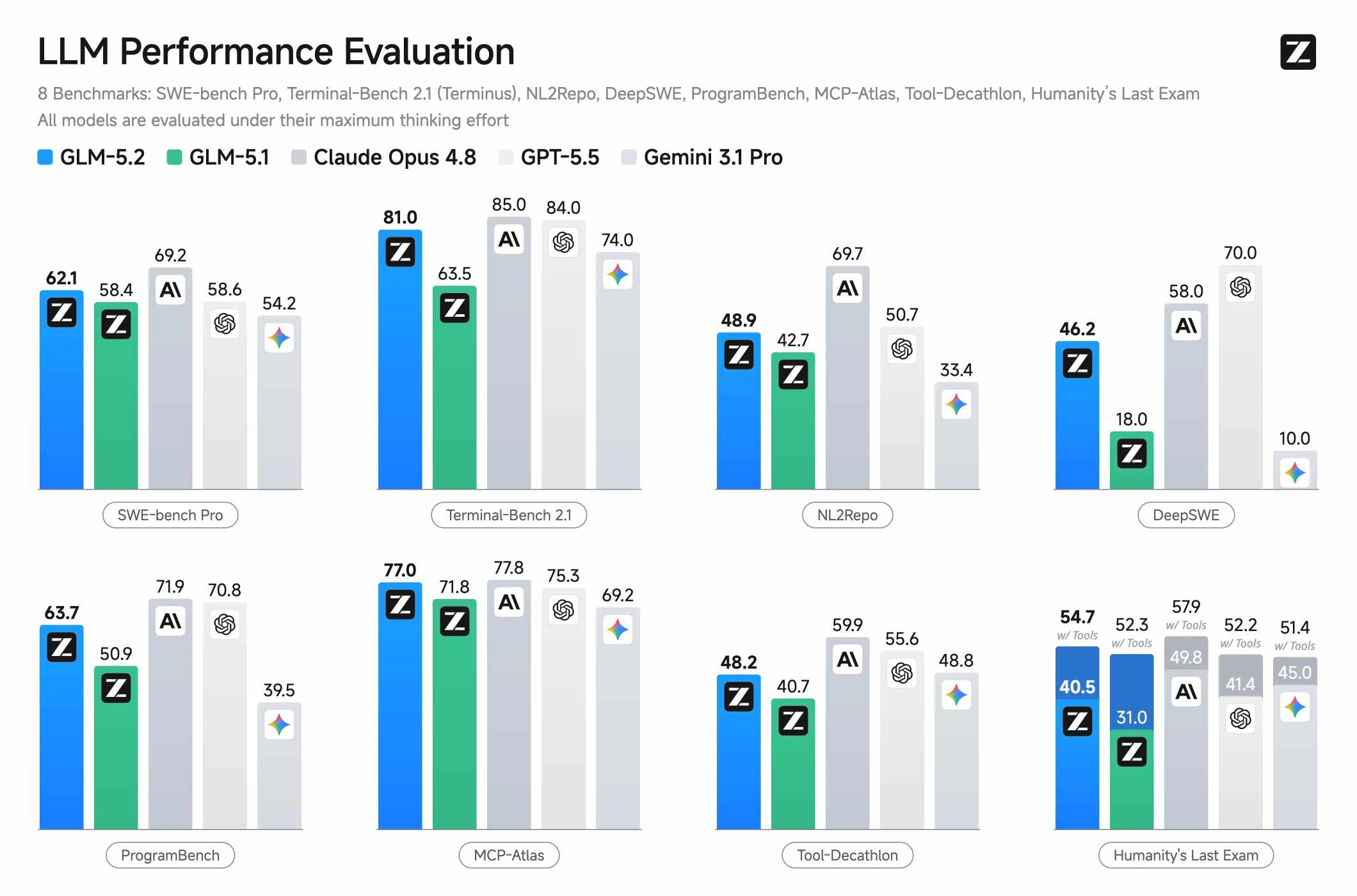
Figure 2: Comprehensive benchmarks show GLM 5.2 approaching or surpassing closed-source frontier models across multiple metrics. Source: TechStartups
Switching Cost: Zero — AI’s Most Fragile Moat
In traditional software, a company cannot easily swap out a core vendor. If a bank builds its entire system on an Oracle database, migrating to another database takes years, costs millions, and carries enormous business risk. That’s “lock-in” — and it’s the foundation of high software margins.
The AI model industry? Completely different.
GLM 5.2’s API is deliberately designed to be fully compatible with OpenAI and Anthropic. What does that mean? A company already using GPT’s API for coding can switch to GLM 5.2 by changing one line of config: point the API endpoint from OpenAI’s servers to Z.ai’s or Fireworks’ servers. Not a single line of application code needs to change.
Alderson writes: “This is not Microsoft- or Salesforce-level lock-in — where you spend years planning a migration. The switching cost here is absurdly low.” In his own test, he went from Claude to GLM 5.2 in under five minutes.
One HN commenter put it even more bluntly: “The future AI API will be like an electric utility. Who cares whether your power comes from an IBM plant or a Texas plant? One amp is one amp.”
If that analogy holds, AI API margins will inevitably converge on utility-level economics — single-digit margins, not 80%+.
Three Curves Converging
In my analysis, the collapse of AI API margins is being driven downward by three simultaneous curves:
Curve one: The catch-up speed of open-source models.
Stanford’s 2025 AI Index Report shows that on the Chatbot Arena leaderboard (a platform where users blindly rate AI responses), the performance gap between open-source and closed-source models shrank from 8% to 1.7% in a single year — closing 6.3 percentage points. At this pace, open-source models will fully match or surpass closed-source models before the end of 2026.
GLM 5.2 is a milestone on that trend line.
Curve two: The cliff-like decline in inference costs.
According to AgentMarketCap research, since GPT-4 launched in 2023 (at $30 per million tokens), the API price of top AI models has fallen more than 300x. The drivers: more efficient chips (AMD’s MI300X reportedly runs GLM 5.2 at only 36% of the cost of NVIDIA Blackwell), smarter model architectures (MoE achieves comparable results with fewer operations), and continuous software-level optimizations.
Curve three: The acceleration of Chinese domestic alternatives.
Z.ai is not alone. DeepSeek V4 Pro’s price is another 10x lower than GLM 5.2 ($0.44 per million tokens), albeit with slightly weaker capability. ByteDance’s Doubao, MiniMax, Zhipu — every Chinese AI company is offering near-SOTA (state-of-the-art) services at prices far below their American counterparts. Behind this are both efficiency innovations forced by chip supply chain restrictions and intense domestic market competition relentlessly driving prices down.
One HN commenter wrote: “We have now switched all our internal AI agents to GLM 5.2. Since it’s open-source, we can even deploy the model in specific regions for extra freedom and data protection.”
Who Wins, Who Loses?
In my judgment, this story resolves in a few directions:
First, the high-margin era of closed-source AI APIs is on the clock. OpenAI’s adjusted gross margin for the first half of 2025 had already dropped from 40% the prior year to 33%, with losses reaching $13.5 billion over the same period. This isn’t a short-term fluctuation — when the quality gap to open-source alternatives narrows to the point where users can barely perceive a difference, a price war is inevitable.
Second, the winners may be companies that don’t make money selling APIs. Chipmakers like NVIDIA and AMD — whoever’s model runs well needs their GPUs. Cloud providers too — the models are open-source, but someone still has to supply the compute to run them. As Alderson puts it: “If you can’t recoup training costs through fat API margins, the entire economic model of the AI industry needs to be rewritten.”
Third, the biggest silent winner may be users. Enterprise customers and individual developers alike are getting increasingly high-quality AI services at prices that halve every year. It’s reminiscent of the PC industry’s history — performance doubled annually while prices stayed flat or fell, and the greatest beneficiaries were everyone who used a computer.
As I finished this article, I noticed that Alderson has already teased “Part 2” — an analysis of how the industry landscape reshapes after margin collapse. Perhaps next time, the question won’t be “how much margin does AI API still have?” but “if selling AI API doesn’t make money at all, how does this industry survive?”
References:
- Martin Alderson, “GLM 5.2 and the coming AI margin collapse (part 1)”, 2026-07-06. https://martinalderson.com/posts/the-upcoming-ai-margin-collapse-part-1-glm-5-2/
- Hacker News discussion, https://news.ycombinator.com/item?id=48809877
- Lobsters discussion, https://lobste.rs/s/ua1gxl/glm_5_2_coming_ai_margin_collapse
- Danilchenko, “GLM-5.2 Review”, 2026-06-18. https://www.danilchenko.dev/posts/glm-5-2-review/
- Thesys, “GLM 5.2: Benchmarks, Pricing, and Features”, 2026-06-19. https://www.thesys.dev/blogs/glm-5-2
- TechStartups, “Z.ai’s GLM-5.2 beats GPT-5.5 on coding benchmarks at one-sixth the cost”, 2026-06-17. https://techstartups.com/2026/06/17/z-ais-open-source-glm-5-2-beats-gpt-5-5-on-coding-benchmarks-at-one-sixth-the-cost/
- AgentMarketCap, “The Token Cost Collapse: LLM Prices Fell 300x in 3 Years”, 2026-04-06. https://agentmarketcap.ai/blog/2026/04/06/model-price-deflation-flywheel-token-costs-llm-api-commoditization
- Philipp Dubach, “AI Models Are the New Rebar”, 2026-03-11. https://philippdubach.com/posts/ai-models-are-the-new-rebar/
- Epsilla, “The DeepSeek Disruption: How Open-Source Commoditization Forces API Margins to Zero”, 2026-04-26. https://www.epsilla.com/blogs/2026-04-26-the-deepseek-disruption-how-open-source-commoditization-forc
- Wafer, “Running GLM 5.2 on AMD Hardware”, https://www.wafer.ai/blog/glm52-amd
- Artificial Analysis, “GLM 5.2 Intelligence, Performance & Price Analysis”, https://artificialanalysis.ai/models/glm-5-2
- Apidog, “How to Use GLM-5.2: $1.40/1M input, $4.40/1M output”, 2026-06-17. https://apidog.com/blog/how-to-use-glm-5-2-for-free/
Image source note: The original post (martinalderson.com) is a text-only blog with no embedded content images, only one OG social-sharing image: https://martinalderson.com/img/og/glm-5-2-and-the-coming-ai-margin-collapse-part-1.png (1200×630px). The two content images in this article are from TechStartups reporting, with sources noted.