
On July 6, 2026, South Korean security researcher Hyunwoo Kim published the full technical details of a Linux vulnerability on GitHub. The CVE is CVE-2026-53359, codenamed Januscape. It was introduced into the Linux kernel on August 1, 2010, and wasn’t patched until June 16, 2026 — lying dormant for a full 16 years.
Why does one vulnerability deserve an entire article? Because its consequences strike at one of the most invisible — and most critical — assumptions underpinning modern society: that cloud isolation is secure.
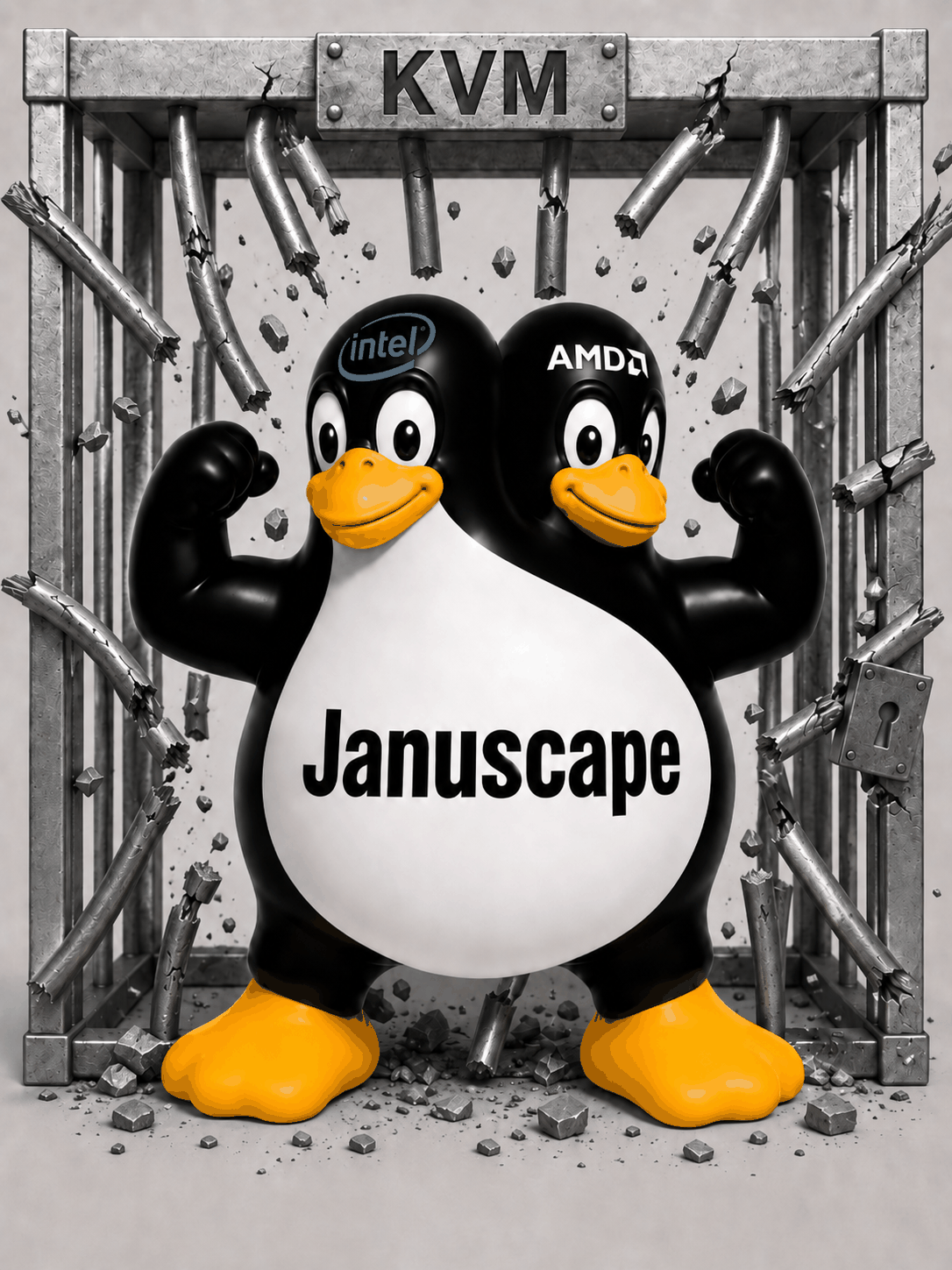
Januscape project cover: Linux mascot Tux trapped inside a virtual machine. Source: GitHub/V4bel/Januscape
When You Use “the Cloud,” What Are You Really Using?
To understand why this vulnerability is terrifying, you have to understand what “the cloud” actually is.
“Save to the cloud,” “running on cloud servers” — we tap a few buttons on our phones, photos upload, enterprise websites spin up, AI chat responds. It sounds weightless. But the essence of “the cloud” is: putting your data on someone else’s computer.
A physical server costs tens of thousands of dollars. Sitting there, why not slice it into many smaller “units” — virtual machines — and rent them to different customers? You use one, the company next door uses another, someone in a different country uses yet another. You all share the same CPU, the same RAM sticks, the same physical hard drive.
Think of it as an apartment building. The building itself is a physical server (called the “host” in industry terms). Each apartment is a virtual machine. The landlord (the cloud provider) installs separate locks on every apartment, promising that you can’t leave your room or see what the neighbor is up to.
This promise is the cornerstone of the entire cloud industry. AWS brings in over $90 billion a year, Google Cloud nearly $40 billion — all built on this subtext: rent a room from us, and we guarantee an impenetrable wall between you and every other tenant.
Januscape punched a hole through that wall.
What Is VM Escape? And Why Did Nobody Find This for 16 Years?
VM escape, simply put: a tenant in one apartment finds a way to leave their room and grab the keys to the entire building.
In technical terms, it means an attacker who has rented a VM from a cloud provider can exploit this vulnerability to break out of the VM boundary and execute their own code on the host machine. Once they control the host, they can see every other tenant’s data, programs, and even intercept their login credentials — all within the same physical server.
Januscape went undetected for 16 years because its trigger conditions are unusually niche.
The vulnerability lives inside a Linux kernel module called KVM (Kernel-based Virtual Machine). KVM was merged into the Linux kernel in 2007 — it turns Linux itself into a super-landlord, capable of managing dozens or hundreds of “apartments” simultaneously. After the cloud computing explosion, KVM became the most widely used underlying technology in public clouds. AWS EC2 and Google Cloud Compute Engine both rely heavily on KVM underneath.
The bug is in KVM’s “shadow memory management” code. In plain terms: KVM needs to translate memory addresses between each VM and the physical hardware. When a VM runs another VM inside it (called “nested virtualization” — like pitching a tent inside your apartment), KVM’s translation work gets complicated. Januscape’s vulnerability hides in this complex translation logic: two different types of translation requests get incorrectly merged and processed together, corrupting the host’s memory.
Using the apartment building analogy: the landlord keeps a room registry. Normally, “rental records” and “personal-use records” are managed separately. But under nested virtualization — this special scenario — the landlord’s software has a bug: it only checks whether the room numbers match, not whether “is this a rental or personal use?” In certain edge cases, the landlord treats a rented room as a personal-use room at the same time. The books get scrambled, the corruption spreads virally — and eventually, the entire building’s management system crashes. Or worse: a malicious tenant takes over.
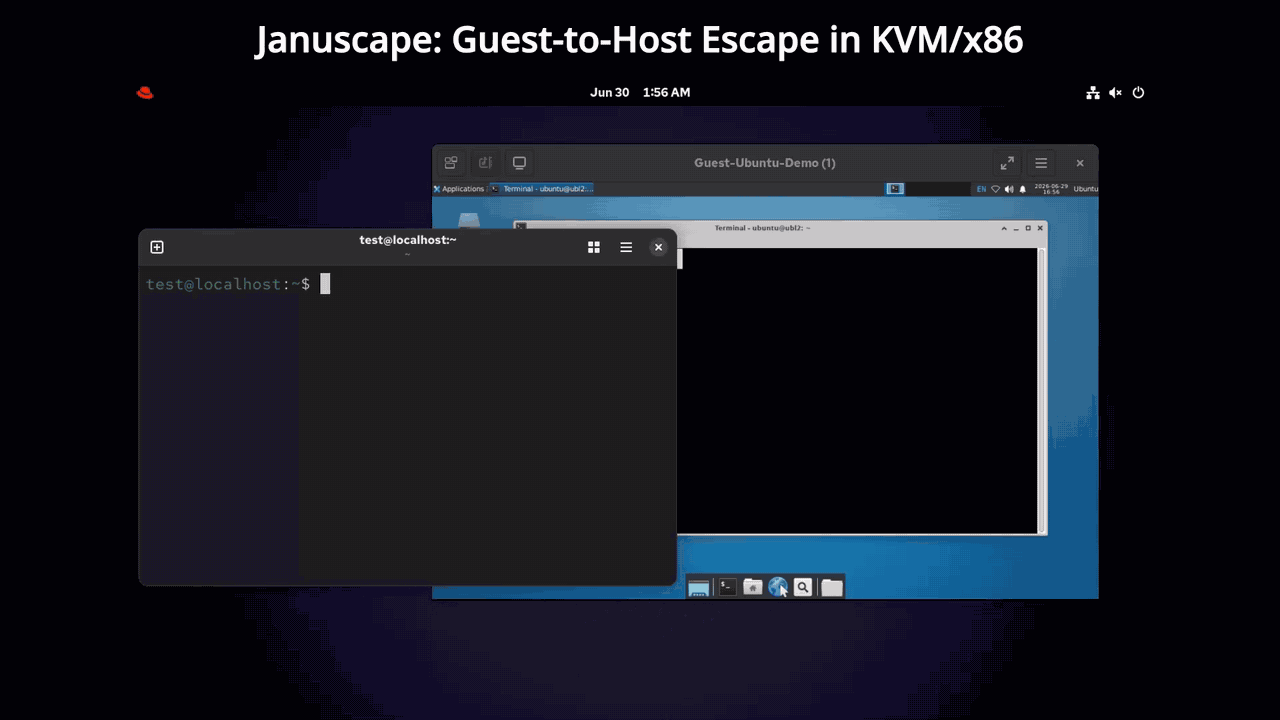
Januscape exploit demo screenshot: running the PoC inside a VM triggers a host kernel crash. Source: GitHub/V4bel/Januscape
The Antagonist Exposed: The “Original Sin” of Shared Infrastructure
Let me pause here to discuss a deeper contradiction behind this story.
The cloud computing industry is built on the word “save.” Resource reuse, on-demand allocation, multi-tenant sharing — these sound like clever business innovations. But sharing and isolation are, at the hardware level, fundamentally opposed.
Physically, you and the neighboring tenant genuinely share the same CPU. Logically, the cloud provider uses software to draw a line between you. If that line has even one flaw — even a single miswritten condition from 16 years ago — the entire isolation collapses.
This is the deeper meaning of vulnerabilities like Januscape: it exposes the structural risk inherent in the cloud’s “shared infrastructure” model. You are not using your own dedicated server. You are using a software-fenced corner of a supercomputer. Who wrote the code that draws that fence? Kernel programmers in 2007, in 2010. At the time, they were probably just trying to “make virtualization work” — they didn’t foresee that 15 years later, this code would become the security perimeter for hundreds of millions of cloud users.
And that 16-year-old oversight wasn’t discovered until 2026, by a South Korean researcher — and, according to public information, it is the first known KVM VM escape vulnerability that works on both Intel and AMD chip architectures simultaneously.
PoC Is Public. A Full Exploit Is Coming.
The currently published code is a Proof of Concept (PoC). Load it into a Linux VM with nested virtualization support, and within seconds to minutes, the host kernel crashes and reboots — and that’s just the “destructive” version, equivalent to pulling the main breaker for the entire building.
But the researcher explicitly stated that a “full escape” version — capable of executing arbitrary code on the host — already exists, just not yet public. Per vulnerability disclosure norms, this typically means they’re waiting until enough cloud providers have deployed patches before releasing it.
The blast radius is significant. According to the disclosure, any multi-tenant host running x86 KVM with nested virtualization enabled is at risk — which essentially covers most instance types on AWS, Google Cloud, and other major public clouds. The good news: the fix was merged into the Linux mainline kernel on June 19, 2026, and major distributions pushed updates in the following weeks.
After the Fix: What’s Left to Discuss?
The fix itself is simple. It adds one more check to the “room-type verification” code: is this room “rental” or “personal use”? The patch is only a few lines.
But in my view, the real value of this story isn’t the patch.
First, it reminds us that the security perimeter of critical infrastructure may rest on a mental oversight by one programmer 16 years ago. Today’s code auditing tools, automated testing, and formal verification didn’t exist back then. That code sat quietly inside millions of lines of Linux kernel, waiting for a talented offensive security researcher to dig it out.
Second, it exposes the inherent security cost of nested virtualization — this “Russian doll” feature. Nested virtualization is a paid premium feature in public clouds — tenants can run VMs inside their VMs. It’s genuinely convenient, but it triggers an older, more complex code execution path (the very shadow memory management code that had the bug). More features mean a larger attack surface.
Third, and most fundamentally: as long as cloud computing remains “multiple people sharing one physical machine,” the risk of escape vulnerabilities will always exist. Patch one Januscape, and the next one may be sleeping in another module, another function. This isn’t alarmism — before Januscape, the same researcher discovered a similar ARM KVM vulnerability called ITScape (CVE-2026-46316), also in 2026.
Should Regular People Worry?
My assessment: no need to panic, but worth paying attention.
If you’re an ordinary cloud service user — storing photos on iCloud, using some SaaS app for work — you’re far removed from this vulnerability. Cloud providers’ operations teams typically deploy patches before public disclosure. Januscape’s fix entered the Linux mainline on June 19, while the public disclosure was July 6 — a window of over two weeks for cloud vendors to upgrade.
But if you’re a technical lead at a company, or you run your own servers, you should check now: does your host kernel include patch 81ccda30b4e8? Do you actually need nested virtualization enabled on your cloud instances? If not, turn it off — it dramatically shrinks the attack surface.
From a broader perspective, Januscape is a landmark event in cloud computing history. It’s the first KVM escape vulnerability to threaten both Intel and AMD platforms simultaneously. The discoverer used this bug to successfully pull off a 0-day attack in Google’s kvmCTF bounty program, proving in practice just how fragile cloud isolation can be.
I’m not trying to manufacture panic — in fact, within 24 hours of the disclosure, AWS and Google Cloud confirmed that affected instances had completed or were completing patch deployment. The genuinely interesting question is: Sixteen years. It was just there. Where is the next 16-year vulnerability sleeping right now?
References
- Januscape full technical documentation (GitHub)
- oss-security mailing list disclosure
- The Hacker News coverage
- Hacker News discussion
- Lobsters discussion
- Linux kernel fix commit (81ccda30b4e8)
- Vulnerability-introducing commit (August 1, 2010)
- Google kvmCTF bounty program
- VEXXHOST: OpenStack KVM security response
Cover image: Linux mascot Tux trapped inside a VM — from the Januscape project repository.