Write more to make AI obey better — this has been the unquestioned gospel fed to virtually every AI user for the past three years. An entire job category, the “prompt engineer,” emerged from this premise. Some people make thousands a month selling “10,000-word prompt templates.” Companies baked prompt-crafting into their employee training manuals.
On July 9, 2026, OpenAI released GPT-5.6. Buried in the accompanying developer guide was a sentence that should send a chill down every “prompt master’s” spine: In internal evaluations, replacing long, detailed system instructions with concise versions improved model scores by approximately 10-15%, reduced word count by 41-66%, and lowered costs by 33-67%.
The news exploded on Hacker News, racking up 952 upvotes and 711 comments in a single day. Some declared “the entire prompt engineering industry needs to reflect.” Others laughed bitterly: “The 10,000-word prompt template I spent half a year optimizing just became a liability overnight.”
 ▲ OpenAI’s official GPT-5.6 launch teaser. The Sol (flagship), Terra (balanced), and Luna (lightweight) models launched simultaneously. (Image: explainx.ai / OpenAI)
This may be the most counterintuitive finding in AI over the past year: the harder we try to “teach” AI what to do, the worse the results.
Three Years of Accumulated “Secrets” Became Baggage Overnight
From ChatGPT’s breakout in 2023, prompt-writing spawned an entire industry chain. At first, people just asked casual questions. Then they discovered “role-playing” worked — “You are a senior attorney; please review this contract.” Soon came “chain-of-thought” — “First consider all dimensions of the problem, analyze each one, then provide a conclusion.”
By 2025, top-tier prompt templates routinely ran hundreds of words: define the role, list execution steps, add a “you must note” constraints section, and append several examples. Enterprise system prompts got even more extreme. I’ve seen one exceed 3,000 words, packed with dozens of “ALWAYS” and “NEVER” directives — “ALWAYS respond in bulleted lists,” “NEVER mention competitors,” “ALWAYS confirm before executing.”
This methodology actually worked for GPT-4 and GPT-5.2. Data validated it. Leadership approved it. Teams invested real money optimizing it.
Then GPT-5.6 arrived.
OpenAI’s developer guide offered advice so simple it’s unsettling: “Start with the shortest prompt — include only what’s needed to reliably complete the task. Add instructions, tools, or examples only when evaluations reveal specific gaps.”
In plain English: try cutting that 3,000-word system prompt to 200 words. It might work better.
 ▲ GPT-5.6 launched globally across ChatGPT, Codex, and the API. (Image: nitromediagroup.com)
Why Saying More Leads to Worse Results
The reason behind this isn’t complicated — it’s just that nobody dared say it this bluntly before.
GPT-5.6 and similar next-generation models have reasoning capabilities an order of magnitude beyond their predecessors. Here’s an analogy: old models were like fresh interns — you had to spell out every step: “First check system A for the data, then cross-reference with system B, and only after confirming, send the email notification.” Skip one step and they’d freeze. GPT-5.6 is more like someone with five years of experience. You say “Check if there’s anything wrong with this order and notify the customer if there is.” It knows where to look, how to judge, and what tone to use.
The problem is: if you still treat an experienced professional like an intern, telling them “step one do this, step two do that, step three do the other,” you’re not helping — you’re tying their hands. The “optimal path” you specify may well be worse than the one they’d chart themselves.
OpenAI’s documentation contains a particularly revealing technical detail: heavier instructions tend to induce additional exploration behavior, repeated verification, and ballooning context. In simple terms, when you stuff the model with too many demands, it ends up weighing competing instructions, self-checking, and double-confirming — all of which consume its “attention budget,” crowding out the compute it should be spending on your actual problem.
In plain words: you give the AI a list of “don’t do this” and “must do that,” and its energy goes into policing its own compliance rather than solving your problem.
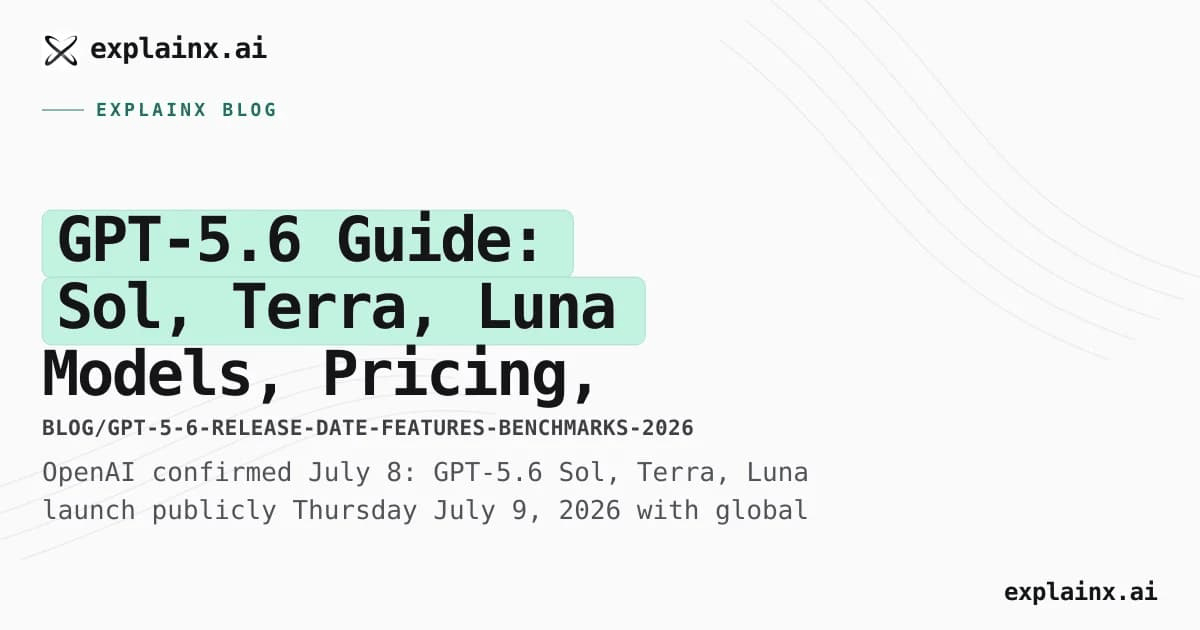 ▲ GPT-5.6’s three-model lineup: Sol (flagship performance), Terra (balanced price-performance), and Luna (lightweight, high-concurrency). (Image: explainx.ai)
“Be Friendlier” Does Nothing for GPT-5.6
Another finding that caught many users off guard: GPT-5.6 does not become meaningfully better when prompted to be broadly friendlier or more empathetic.
OpenAI’s guide states it plainly: “GPT-5.6 does not become meaningfully better when prompted to be broadly friendlier or more empathetic.” A generic directive like “be friendlier” produces no meaningful improvement.
One HN commenter captured this perfectly: it’s like telling a barber “cut it shorter” — they have no idea whether your “short” means 3 millimeters or 3 centimeters. What works is: “fade the sides, leave two fingers’ width on top.”
OpenAI’s recommended alternative: replace vague directives like “be warm and friendly” with concrete descriptions — “Direct but not blunt; acknowledge friction when genuinely needed; avoid formulaic reassurance and unnecessary pleasantries.”
At a deeper level, this finding reveals a key shift: older models, limited in understanding, needed you to repeatedly emphasize “tone.” New models already have enough emotional intelligence to judge what tone fits which context. You just need to tell them where the boundaries are.
”Be Concise” — The Most Dangerous Instruction
This may be the most confusing recommendation in the entire guide.
OpenAI explicitly warns: GPT-5.6 is unusually sensitive to instructions like “be concise,” “keep it brief,” or “fewer words is better” — far more sensitive than GPT-5.5. And the problem is, this “sensitivity” isn’t a good thing.
GPT-5.6 already tends toward shorter responses than its predecessor. Add “be concise” on top, and you get a compounding effect — not only does it strip out the fluff, it also deletes necessary reasoning, critical qualifiers, and even risk caveats you should have been told about.
One HN developer offered a vivid analogy: his barber, upon hearing “cut it shorter,” shaves nearly to the scalp. GPT-5.6’s reaction to “be concise” is about the same — it genuinely gives you the shortest possible answer, whether or not that’s what you wanted.
OpenAI’s recommended alternative: don’t use the vague word “concise.” Use priority descriptions instead — “Lead with the conclusion; follow with supporting evidence, key limitations, and next actions; omit greetings, repetition, formulaic reassurance, and unnecessary background.”
In one sentence: don’t tell the AI how many words to use; tell it what matters and what can be cut.
Three Camps on Hacker News
HN commenters largely fell into three camps.
The “About Time” camp sees this as a sign of AI maturity — the model is finally smart enough that you don’t need to teach it like a child. “If a model can judge for itself how much output each scenario requires, that’s how it should be. The fact that earlier models defaulted to spewing verbosity was itself a defect.”
The “Conflict of Interest” camp remains wary. They point out that both OpenAI and Anthropic, independently and nearly simultaneously, are advising users on their latest models to “give fewer instructions, let the model decide.” There’s an obvious business incentive: letting the model decide output length means it might generate more tokens, and more tokens mean higher API bills. “It’s an admirable goal in principle — let the model automatically determine the optimal response length — but when the people selling by the word advise you to stop worrying about how they sell by the word, you should keep one eye open.”
The “Practical Confusion” camp raises the more grounded question: how short is “short”? What counts as “long”? Is a single sentence enough? OpenAI’s guide offers principles but no clear boundary. It’s reminiscent of “exercise more for better health” — the direction is correct, but execution depends entirely on individual interpretation.
I lean toward the view that all three camps have valid points; there’s no need to rush to pick a side. The one unambiguous takeaway from this developer guide is: if you’re still clinging to prompt templates from last year or the year before, you’re not being “conservative and safe” — you’re actively downgrading your results.
What the “Short Prompt Era” Means
Zoom out and this points to a broader trend: AI is shifting from “needs you to teach it” to “needs you to set the goal.”
Past AI was like a GPS navigator — you had to tell it every turn. Today’s AI is more like an experienced chauffeur — you just say “to the airport,” and it picks the optimal route based on traffic, time of day, and your habits. Insisting on “take the ring road first, then the highway” might actually make the trip longer.
Two groups are most affected.
First, people who make a living from prompt engineering. If the most effective prompt is now the most concise one, the value of “10,000-word prompt templates” collapses. It’s not that the skill becomes useless — it’s that the center of gravity shifts from “volume” to “precision.” Knowing what to leave out matters far more than knowing how much you can write.
Second, everyday users. For a long time, AI has had a hidden barrier to entry: people who could write good prompts got great answers; people who couldn’t, got garbage. GPT-5.6’s friendliness to short prompts effectively lowers that barrier. You no longer need to learn a “prompt-crafting methodology.” Just state what you need clearly.
Of course, nothing changes overnight. GPT-5.6 just launched, and these “guidelines” are still developer reference material, not everyone’s daily experience. But the direction is unmistakable.
Final Thoughts
After reading through all 711 HN comments, my strongest impression isn’t “short prompts are magical.” It’s that we’ve been misplacing our confidence in AI.
For three years, the entire industry has been doing the same thing: finding ways to make AI more obedient, constraining it, guiding it, correcting it with increasingly elaborate instructions. We defaulted to the assumption that AI is the dumb one that needs careful teaching, and humans are the smart ones doing the guiding.
GPT-5.6’s answer is a little ironic: the less you manage it, the better it performs. Every word of instruction you save is headroom it can use to actually think about your problem.
This isn’t to say prompt-writing is obsolete. It’s to say that the most valuable instruction may be the one you know not to write.
Reference links: