In July 2026, a 42-year-old book landed on the Hacker News front page. Digital Deli — with a cover illustration of electronic components laid out on a dining table and the subtitle “A Comprehensive, User-Affectionate Menu of Computer Lore, Culture, and Lifestyles” — is a time capsule from an era when computing meant making every byte count.
Compiled by a group of geeks who called themselves “The Lunch Group,” its contributor list reads like a who’s-who of early computing: Apple co-founder Steve Wozniak, VisiCalc inventor Dan Bricklin, hypertext pioneer Ted Nelson, and a young man living in a hand-built cabin in the Oregon wilderness who powered his computer via 1,200 feet of extension cord — Paul Lutus.
 The original cover of Digital Deli (1984). Source: AtariArchives.org
When the book was posted, something happened that could only happen on Hacker News. A user named lutusp commented, saying he’d contributed a chapter called “Cottage Computer Programming.” The program he wrote was Apple Writer — the bestselling word processor for the Apple II, translated into five languages, an international hit.
Then he dropped a number that stopped me cold.
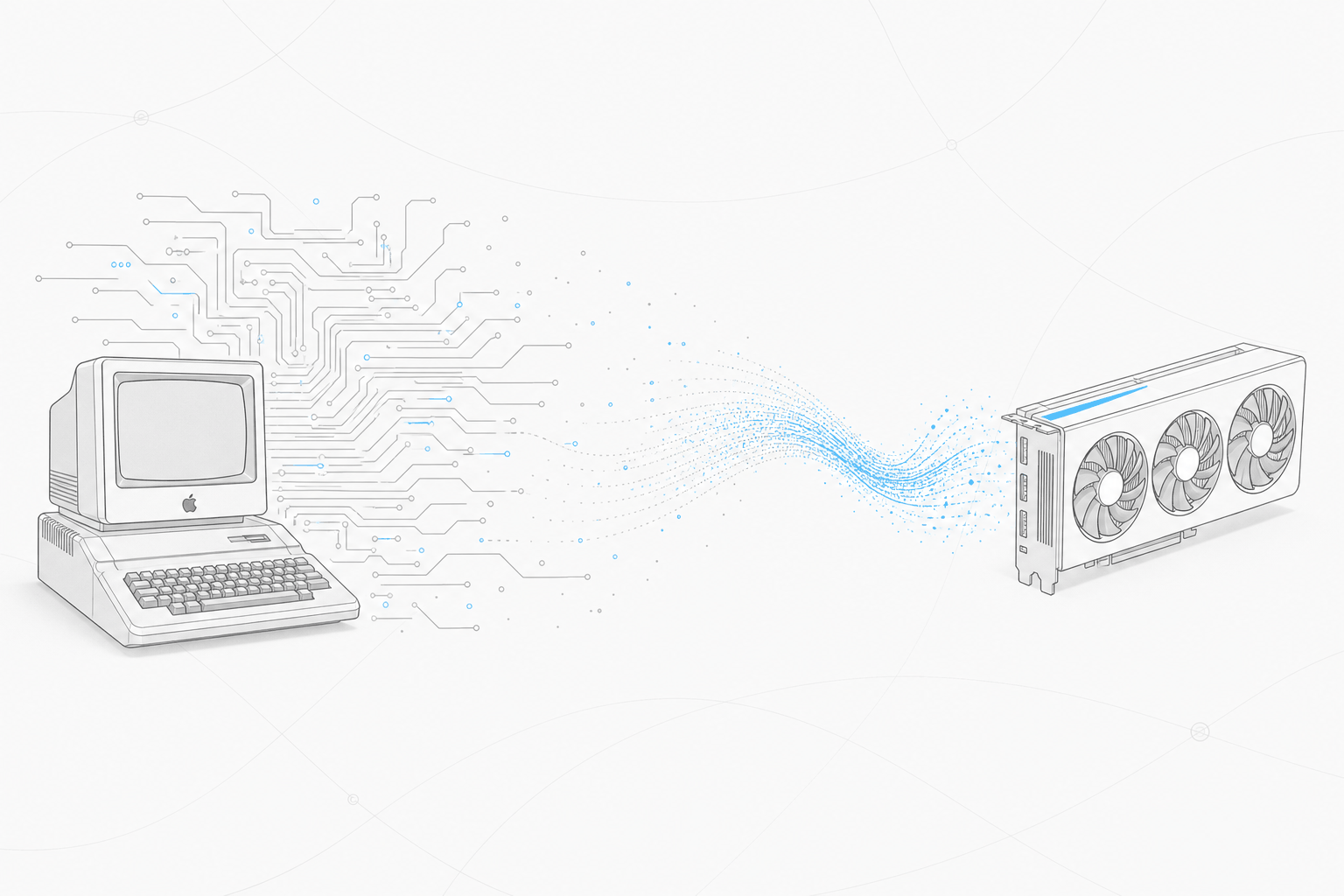
“You ready for this?” he wrote. “I hand-wrote a word processor in assembly language that took up only 8KB of RAM. The Apple II had a total of 32KB. The remaining 24KB was yours for your document.”
“And now, I’m looking at my GPU with 24GB of VRAM complaining about running out of memory. A million times more. And only 36 years have passed.”
A NASA Dropout and a Cabin with No Power
Paul Lutus’s story reads like a documentary waiting to be made.
In 1976, he was at NASA designing electronics for the Space Shuttle — the indicator lights on the shuttle fleet still used circuits he designed. But something felt wrong. So he quit.
He moved to the Oregon wilderness, hauling timber up a 120-meter hill to build a 3.6m × 4.8m cabin. No road. No electricity. He grew vegetables, wrote poetry, played math games in his notebook. At night he read Scientific American by kerosene lamp.
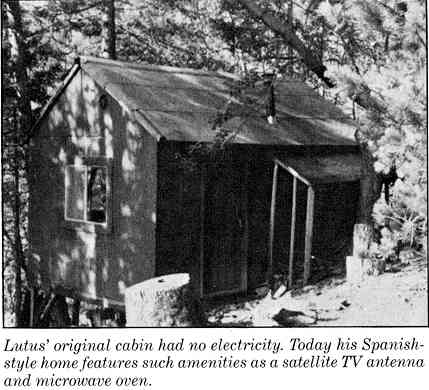 Paul Lutus’s primitive cabin in Oregon, where he powered an Apple II with a 1,200-foot extension cord and wrote Apple Writer. Source: AtariArchives.org
One day he saw an ad for the Apple II. A personal computer! He biked to the nearest payphone and placed an order. Then he ran 1,200 feet of extension cord from a construction site down the hill to power his cabin.
He sent the first version of Apple Writer to Apple in a brown paper envelope. Apple paid him $7,500 — no royalties, he didn’t think to ask. But fate had other plans: Apple’s own engineers couldn’t modify the program. Two years later they renegotiated on royalty terms. By 1984, his daily royalty income exceeded that original buyout price.
He calls himself “the Oregon Hermit.” When asked about the rumors that he went days without eating or sleeping while coding: “They’re all true.”
What Can an 8KB Program Do?
Today’s readers might not have a feel for “8KB.” Here’s a comparison: the plain text of this article is about 15KB. Apple Writer — the entire program — was smaller than the article you’re reading right now.
But it was a complete word processor. Editing, formatting, printing. Plus a built-in macro language — users could write scripts to extend its functionality. Imagine Microsoft Word with a VBA editor embedded inside, all squeezed into 8KB.
How? Two words: assembly language and no choice.
Assembly language is programming at the bare metal — you tell every CPU register what value to hold, every memory address what data to read. No print("hello") shortcuts. Extremely efficient, but every line does only one tiny thing. In Lutus’s own words: “The computer rejects all imperfect things without explanation. When you finally offer it an answer it will accept, its acceptance is total and unshakable.”
He had talent, but the deeper reason he could do it was a hard 32KB ceiling that left no room for laziness. You couldn’t pull in a third-party library — there were none. You couldn’t write redundant code — there wasn’t enough memory. You couldn’t count on “the user will just upgrade” — nobody upgraded. Every byte had to earn its place.
What Did the Hacker World Look Like in 1984?
Digital Deli is a living fossil of that era.
Flip through the table of contents: “The Hacker Ethic,” “Computer User Groups,” “The Homebrew Computer Club and the Birth of the Apple,” “Cottage Computer Programming,” “The War Against Software Piracy.” The contributor list includes nearly every important name that would define the personal computer industry. And the tone of the whole book — to use a word that didn’t exist yet — is “open source spirit.”
In Wozniak’s chapter, he recalls the Homebrew Computer Club — a bunch of geeks assembling circuit boards in garages, meeting every two weeks to exchange schematics, code, and ideas. No trade secrets. No NDAs. Steve Jobs later hated Apple engineers attending these meetings because they’d “give everything away” — and you can feel Woz’s quiet disagreement in his writing.
There’s a chapter called “The Computer Magazine Craze” by Stan Veit. Around 1984, hundreds of computer magazines were circulating across America — BYTE, Creative Computing, Compute! — each issue packed with program listings readers could type into their machines. The magazine-as-distribution-channel model sounds like a fairy tale today.
Lutus wrote a line in his chapter that hits hard in 2026: “There is a lot of talk about the individual cottage programmer dying out. I don’t think so. The best programs are still the product of one person, or at most two. Some experiments in teamwork have been total failures.”
The Real Villain: Not Progress, but Resource Glut
There’s a classic Reddit thread where a programmer discovers their Electron app — a timer, nothing more — consumes 500MB of RAM. The top comment: “The 1985 Amiga 500 had 512KB of RAM and could run a full OS, a GUI, a sound sampler, and a multitasking game.”
This isn’t nostalgia. This is genuine regression.
There’s an economic term for software bloat: Wirth’s Law — software gets slower faster than hardware gets faster. Niklaus Wirth (inventor of Pascal) predicted this in 1995. In 2026, the law is replaying itself in GPU VRAM in the most absurd way imaginable.
When Paul Lutus jokes about “24GB of VRAM not being enough” — it’s not a joke. I looked up the deployment requirements for mainstream open-source AI models: a 7-billion-parameter model needs about 14GB VRAM at standard precision; a 13-billion-parameter model needs around 26GB — just over a single 24GB card’s capacity. A top-tier 72-billion-parameter model needs roughly 144GB.
So in 1984, you could run a fully functional word processor plus your document in 32KB. In 2026, you spend over $1,500 on a top-end graphics card and can’t even run a “medium” AI model.
The core contradiction isn’t technical. It’s attitudinal.
Programmers in 1984 had to manage every byte themselves because no OS did garbage collection, no framework abstracted away the hardware. This forced frugality produced remarkably high code quality. Today, layers of abstraction stacked on abstraction consume memory at every level — the “it’s probably fine” mentality has replaced the old frugality.
One More Thing: Tom Clancy Didn’t Know What a Backup Was
Near the end of his HN comment, Lutus dropped an anecdote that says more than all the numbers above.
In the early 80s, Tom Clancy was writing his breakout novel The Hunt for Red October on Apple Writer. One day he called: a floppy disk had gone bad — the one holding an entire chapter he’d just finished.
Lutus told him the bad news: it couldn’t be recovered. Then he said something that seemed obvious to him: “Use your backup.”
Clancy’s reply: “What’s a backup?”
True story.
The man who would become the world’s best-selling military novelist, while writing The Hunt for Red October, had no idea that “copying a file” was a thing you should do — something every smartphone user today takes for granted.
Lutus used this story as a coda, and it perfectly captures the situation of that 1984 generation of hackers. They were doing something no one in the world knew how to do. They had to invent their own tools, figure out their own workflows, make every possible mistake — and then share the lessons and the code with the next person soldering circuits in a garage.
Not Nostalgia, But a Question
I’m not writing this to glorify “the good old days.” The computer world of 1984 was far from idyllic — Apple II users had to manually type read/write commands every time they swapped disks, CRT monitors flickered hard enough to trigger migraines, and printers could tear a page in half. It was not an easy era.
But it was an honest era.
The 32KB hardware limit was honest. Assembly language was honest — every instruction you wrote, the CPU executed exactly as given. Homebrew Club sharing culture was honest — nobody pretended to have trade secrets because everyone was building wheels from scratch and giving them away.
Today’s software world doesn’t lack memory, or compute, or capital. What it lacks is precisely that compulsory discipline of “you must deliver something usable within 32KB.”
When Lutus watches his 24GB GPU throw an out-of-memory error in 2026, what he’s really lamenting is something more fundamental that’s disappeared: the creativity that constraints produce.
References:
- Hacker News Discussion: Digital Deli, 1984 book by early PC hackers and enthusiasts
- AtariArchives: Digital Deli full text online
- Paul Lutus’s chapter: Cottage Computer Programming
- Internet Archive: Digital Deli full scan
- Wikipedia: Apple Writer