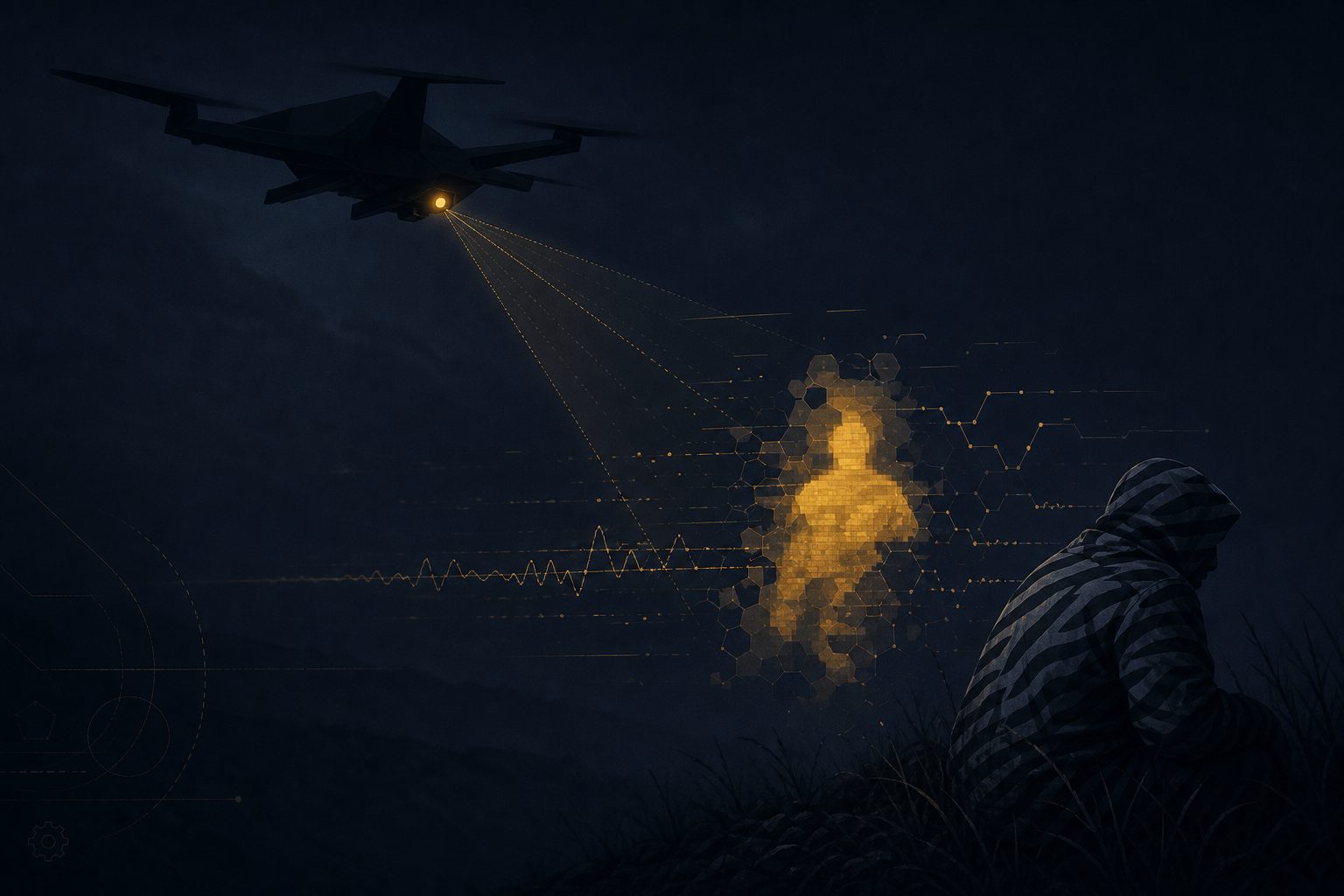

On July 8, 2026, The Economist published an article with a headline that stops you cold: “How to hide from killer drones” — not a metaphor, not a sci-fi premise, but a survival guide based on on-the-ground observation of the Ukrainian battlefield. Three days later, it scored 91 points and 120 comments on Hacker News, with a discussion as intense as any technical breakthrough paper.
The opening image is jarring enough: Russian military transport trucks, in recent months, have been painted with stark black-and-white stripes — against a forest or urban backdrop, to human eyes it’s practically a billboard screaming “I’m here.” This is not a mistake. Its target is the machine vision systems on Ukrainian drones. Human eyes are not the consideration.
This is what The Economist calls “anti-AI tactics” — an arms race unfolding on the Ukrainian front, centered on the question: “How do you make a machine not see you?”
A $500 Drone Can Kill a $10 Million Tank
To understand the urgency, you only need a few numbers.
Ukraine’s FPV (first-person-view) drone production went from roughly 5,000 units in 2022 to 3 million in 2025. By early 2026, annual capacity had passed 8 million, with a target of 10 million for this year. These FPV drones cost between $500 and $1,000 each — cheaper than the iPhone in your pocket.
What can they destroy? In 2025, a roughly $500 Ukrainian FPV drone took down a Russian Mi-8 helicopter — public procurement price: roughly $10–18 million. Return on investment: 20,000x.
This is not an isolated incident. On the Ukrainian front, a multi-million-dollar main battle tank can be killed by a few-hundred-dollar drone strapped with an RPG warhead, hitting the turret roof — the thinnest armor. The traditional logic of military power — “spend more money on thicker armor, faster planes” — is rapidly becoming obsolete in the face of swarms of cheap drones.
How Drones Find You
To hide, you first need to understand how the “enemy” sees the world. Modern battlefield drones typically carry three sensing systems.
Thermal imaging (infrared). This is the primary tracking method at night and in low visibility. The human body runs at roughly 36°C, while the natural environment is typically much cooler — to a thermal camera, you’re a 36-degree “light bulb” in the dark. Vehicle engines are even more obvious — hundreds of degrees, detectable from kilometers away. Thermal imaging doesn’t need light, and smoke or foliage won’t block it — it “sees temperature.”
Visual AI (machine vision). This is the main daytime tracking method. Unlike traditional cameras, these drones run trained AI models that can automatically identify vehicle outlines, human movement patterns, and even distinguish between military uniforms and civilian clothing. The key: these AI models don’t rely on color — they recognize shapes and motion patterns. You can lie still in camouflage, and a human might miss you, but the AI will flag “an elongated heat source stationary at an unnatural angle on the road” as anomalous instantly.
Acoustic sensors. Drones themselves are noisy — their rotors are loud — but some are equipped with microphone arrays that can “hear” ground-level engine sounds, footsteps, even human speech. Acoustic tracking is especially effective in complex environments like forests or behind buildings, where visual and thermal sensors might be blocked but sound can get through. This technology has been used in anti-sniper and counter-mortar systems for over a decade, now miniaturized and cheap enough to fit on a few-hundred-gram drone.
Three sensors layered together create a detection web you can barely escape: spotted by visual AI during the day, locked by thermal imaging at night, caught by acoustic sensors behind buildings. The old tactics of “dig a hole and hide” or “wear camouflage and lie still” no longer cut it.
How to Make a Drone Not See You
Against this detection web, battlefield countermeasures fall into three categories: thermal masking, visual deception, and electronic suppression.
Thermal masking — “disappearing” from infrared. The principle is straightforward: thermal imaging detects temperature differences. If you wrap yourself in material matching the ambient temperature, you blend into the background. Russian soldiers have started using thermal masking blankets — aluminized emergency blanket-like material with insulation layers on the inside. Used correctly, they’re effective. But used wrong, they’re dangerous — in July 2025, reports described Russian soldiers marching at night wrapped in thermal blankets that were actually cooler than the ground, creating moving “cold blocks” on thermal imagery, making them easy targets for Ukrainian drones. The key isn’t “as cold as possible” — it’s matching the ambient temperature.
In March 2026, the US Marine Corps launched a tender for an “invisibility cloak” that shields against thermal imaging, infrared, and night vision simultaneously — making the wearer invisible to all the aforementioned sensors. The technology is still making its way from lab to battlefield.
Visual deception — fooling AI with zebra stripes. This is the core of The Economist’s report. The black-and-white stripes on Russian trucks are called “dazzle camouflage,” first used on naval ships in WWI — then to make it hard for enemies to judge a ship’s heading and speed. Now on trucks, the goal is entirely different: the stripes disrupt AI edge-detection algorithms. Machine vision’s first step in identifying an object is finding “edges” — where color and brightness change sharply. Black-and-white stripes create a flood of fake edges, making the AI “see” a chaotic mess of geometric fragments it can’t assemble into a coherent object outline. The Economist’s caption: “What is the best way to avoid a predator? The zebra shows the way.” — the biological function of zebra stripes is still debated (repel insects? confuse predator depth perception?), but engineers have adopted it as inspiration against AI.
However, effectiveness is debated. HN commenters pointed out that even consumer-grade LLMs can easily identify a zebra-striped truck as “a military truck, just painted like a zebra for some reason.” Modern specialized machine vision models, after adversarial training, lock onto more fundamental features like “a rectangular object moving along a road” — no matter how fancy the stripes, motion trajectory doesn’t lie. And the onboard chips on drones have only the compute power of a circa-2005 phone CPU — too weak for complex models. The compute-and-algorithm arms race between both sides is far from settled.
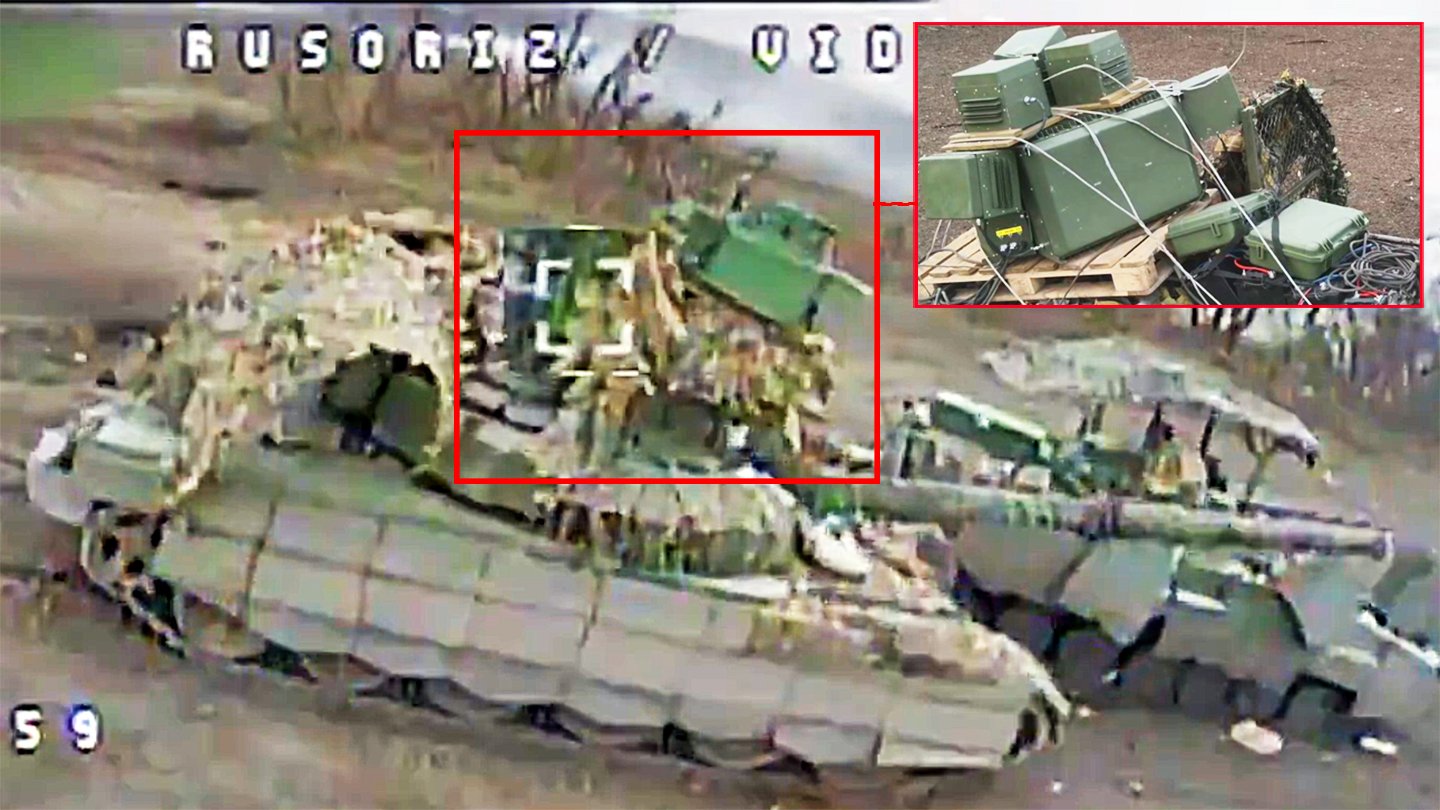
Electronic suppression — cutting the drone’s link to its operator. This is currently the most effective countermeasure. Most cheap FPV drones rely on radio control. Once the signal is jammed, the drone either loiters until its battery dies or triggers “return-to-home” failsafe. At Russia’s anti-drone conference (the 2024 St. Petersburg “Drone Detection and Countermeasures” conference), the overwhelming majority of discussion focused on electronic warfare — detecting drone signals, locating operators, jamming communications. The battlefield is already littered with improvised EW rigs: a welded frame on a tank turret bristling with jamming antennas, looking like a mobile signal tower.
But the cat-and-mouse game continues: next-gen drones are starting to use fiber-optic communications — an ultra-thin fiber-optic cable trails from the drone to the ground station, emitting zero radio waves. Traditional jamming is useless. The only counter is physical interception: catch it with a net, or ram it with another drone.
The Villain: When “Anyone Can Kill” Becomes Reality
I need to name the real villain behind this technological arms race.
It’s not Russia. Not Ukraine. Not any particular country or military. It’s a trend: lethal force is getting cheaper, smaller, and smarter at an exponential rate, and defensive measures can’t keep up.
Twenty years ago, to hit a target from the air with precision, you needed a multi-million-dollar fighter jet, a million-dollar precision-guided bomb, and a whole infrastructure of satellite navigation and intelligence. Today, a drone operator with two weeks of training, a tablet, and VR goggles can fly a $500 drone through a tank’s hatch.
What does this mean? Traditional military advantages — expensive equipment, years of training, complex logistics — are being rapidly eroded by drone swarms. A 2026 US military assessment acknowledged that cheap drones are “shaking the battlefield dominance the US has built over decades.”
But the deeper concern lies beyond the battlefield. The same technology spreading to civilian use is only a matter of time. Infrared sensors, AI vision modules, flight controller chips — all available on Taobao, prices dropping yearly. Drones are already used for smuggling, espionage, and terrorist attacks. In 2025, multiple European airports reported nighttime intrusions by suspected Russian drones. Civilian counter-drone systems are a rapidly growing market — companies like Kaspersky already offer commercial anti-drone solutions for airports, prisons, and government buildings.
The logic of technology is this: it can be used by anyone. When tools are cheap enough and easy enough to use, the user’s moral stance is no longer a barrier.
What Ordinary People Need to Know
I’m not going to provide a “how to survive a drone attack” checklist — that’s not the point of this article, and shouldn’t be needed outside a war zone. But there are a few things worth remembering for anyone who cares about where technology is heading.
First, thermal imaging is no longer exclusive to major militaries. You can buy a phone-attached infrared camera for a few hundred yuan. “Darkness” and “cover” are no longer natural privacy barriers.
Second, AI vision is harder to fool than you think. You think hiding in a bush means nobody sees you — but the AI doesn’t need to “see you,” it just needs to find “a pixel cluster that doesn’t look like a bush.” Modern object detection models are far more sensitive to anomalous shapes than humans — dazzle camouflage might actually make the target more visible.
Third, the electromagnetic spectrum is already a battlefield. You think turning off your phone makes you “invisible” — but your smartwatch, car Bluetooth, even your pacemaker are all emitting electromagnetic signals. The electromagnetic fingerprints of consumer electronics are becoming a new tracking dimension.
The Economist article’s value isn’t in the specific technical solutions it offers — those are evolving fast, effective today and obsolete tomorrow. Its value is in sounding an alarm: when sensing technology is everywhere, “hiding” itself becomes a skill that needs to be relearned. And traditional education doesn’t teach this course.
From zebra stripes to thermal blankets, from electronic jammers to fiber-optic drones — the next round of this cat-and-mouse game could happen in the delivery of your online package, in the lens of that “aerial photography drone” flying overhead.
References:
- The Economist: How to hide from killer drones
- Hacker News Discussion: news.ycombinator.com/item?id=48874357
- United24: How drone warfare is forcing Ukraine to rethink military uniforms
- Business Insider: Marines are looking for a cloak to hide from thermal-imaging drones
- Euromaidan Press: Russian troops are trying to hide from Ukraine’s night-vision drones
- Kyiv Post: $500 FPV drone takes down Russia’s $10M helicopter
- Kyiv Post: Russian anti-drone conference analysis
- TRT World: Ukraine drone production and asymmetric warfare
- STG Defence: How to hide from a thermal imager