2.12%.
That is the English word error rate of the speech recognition engine built into Apple’s latest operating systems (iOS 26 / macOS 26) — nearly half that of Whisper, the most popular open-source option in the community, and four times better than Apple’s own previous-generation product. And it runs entirely on-device, with no network connection required, completely free.
On July 13, 2026, the independent development team Inscribe published a benchmark: they ran Apple’s new engine and three Whisper models of different sizes against the same standard corpus, across 5,559 test samples. The result sent the entire tech community into an uproar — Apple didn’t just win, it won without a contest.
What does this mean for ordinary users? When you transcribe speech to text on your iPhone or Mac, you’ll no longer need to download a third-party app. The system’s built-in keyboard dictation and voice-memo transcription are already more accurate than most paid third-party solutions.
But for the small teams that have spent the past three years shipping paid apps built on “Whisper + a pretty wrapper,” the news hit like a bolt from the blue.
What Exactly Did Apple Do?
In this major system update, Apple quietly swapped out the speech recognition engine it had used for years. The old engine was called SFSpeechRecognizer; the new one is SpeechAnalyzer. Apple held no launch event for it, issued no press release, and published no accuracy figures whatsoever — it simply showed up, silently, on every device that upgraded to the new OS. You’d only notice when you happened to tap the microphone button: “Huh, this seems way more accurate than before?”
The reason the Inscribe team ran this benchmark is precisely that Apple said nothing. Every developer wondering whether to migrate their app to the new engine was guessing in the dark.
The benchmark results speak for themselves:
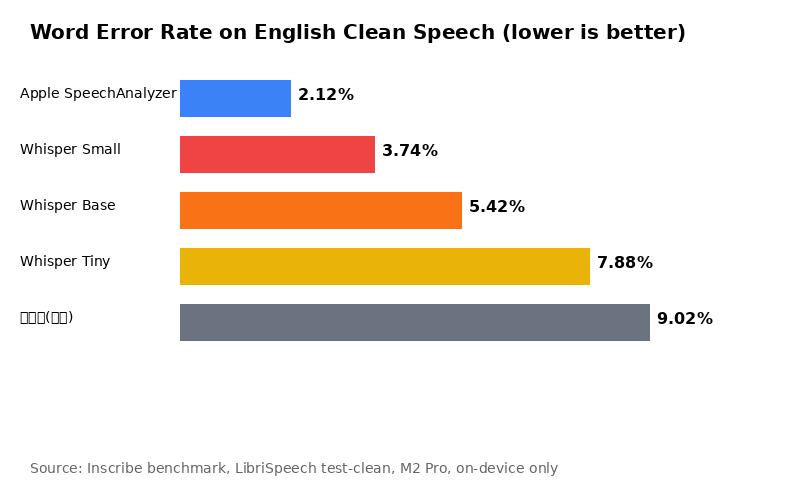
| Engine | Clear-speech error rate | Noisy-environment error rate | Model size |
|---|---|---|---|
| Apple SpeechAnalyzer (new) | 2.12% | 4.56% | Built-in |
| Whisper Small | 3.74% | 7.95% | ~460MB |
| Whisper Base | 5.42% | 12.51% | ~140MB |
| Whisper Tiny | 7.88% | 17.04% | ~40MB |
| Apple old engine SFSpeechRecognizer | 9.02% | 16.25% | Built-in |
Data source: Inscribe team’s measured results on an M2 Pro Mac (macOS 26.5.1), using the LibriSpeech standard English corpus, all running offline. Lower error rate is better.
A few numbers hit harder than any words: the new engine is four times more accurate than the old one, and nearly twice as accurate as the mid-size Whisper model that requires downloading an extra 460MB file. And it’s faster — processing the same audio clip, Apple’s engine takes only about a third of Whisper’s time.
Why Is Free Better Than Paid?
This sounds counterintuitive. But viewed through the lens of the tech ecosystem, a platform vendor baking AI features in-house has several structural advantages over third parties that no independent developer can replicate.
Advantage one: tight hardware-software co-tuning. Apple’s speech recognition engine is custom-built for the “Neural Engine” inside its own chips (the dedicated hardware in Apple devices that runs AI workloads). Third-party developers using Whisper can only do generic adaptation; they can’t write the model straight into the chip’s lower layers the way Apple can. The payoff shows up in the results: not just more accurate, but faster and more power-efficient. Tests show Apple’s engine draws noticeably less power than loading a Whisper model for the same audio — a real, tangible benefit for phone battery life.
Advantage two: zero customer-acquisition cost. A third-party speech-to-text app has to buy ads in the App Store, do content marketing, and fight with competitors over ratings. Apple does none of that — its speech recognition is embedded right in the keyboard, right in Voice Memos. You don’t even need to know the feature’s name; it’s just there. Open any input field and tap the mic. This “zero-cost reach” advantage is something no third party can match.
Advantage three: privacy. Most third-party apps have to send your voice data to cloud servers for processing. Apple’s new engine runs entirely on-device — no network, no data transmission. For privacy-sensitive users like lawyers, doctors, journalists, and business managers, that difference alone can decide which side they pick.
History Keeps Repeating
If you know a bit about Apple’s history, this script — “ship a feature, kill a category of apps” — has played out many times before.
In 2013, iOS 7 added a flashlight button to the Control Center. Overnight, the best-selling utility apps in the App Store — flashlights — were nearly wiped out. Before that, flashlight apps had sat at the top of the charts for years.
In 2015, Apple added a document-scan feature to Notes, and a wave of scanner apps lost their growth.
In 2024, Apple added automatic transcription directly inside Voice Memos. Before that, “export your voice memo to a third-party app for transcription” was the core use case of many paid apps.
In tech circles, this behavior has a name: “Sherlocking” — from 2002, when Apple’s Sherlock search tool absorbed the functionality of the third-party app Watson, driving the latter out of business. More than two decades later, the name hasn’t changed; only the apps getting “Sherlocked” keep cycling.
A Hacker News comment that drew widespread agreement read: “The paid apps that simply wrap Whisper, rest in peace. Apple will surely build a native record-to-text tool that makes these wrappers completely pointless.”
But This Isn’t a “Everyone Dies” Story
Although “Sherlocking” sounds fatalistic, it doesn’t mean every third-party speech recognition vendor will shut down.
The key is what an app is actually selling. If the core value is “press a button → get text,” then yes, it’s in danger — the built-in system already does it better, faster, free, and more private.
But a whole class of apps offer far more than transcription itself:
- Multilingual transcription. Apple has mainly optimized for English and about 30 languages; Whisper supports over 100. Need Urdu transcription? Or Tibetan recognition? Apple doesn’t cover those yet.
- Automatic organization. Turning an hour-long meeting recording into a structured summary with headings, action items, and participant annotations takes it from “speech-to-text” to “speech-to-knowledge.”
- Cross-platform. Doing speech-to-text on Windows or Android? Apple’s solution is completely unusable there.
- Vertical scenarios. Medical terminology, legal jargon, industry-specific vocabulary — these customized scenarios are beyond what a general model can handle.
Inscribe is itself the best example. As a company shipping a speech-to-text product, they didn’t shy away from the benchmark; they adapted it directly into their own product: use Apple’s engine on languages it supports, and stick with Whisper on languages it doesn’t. Their stance is clear: the value of a third-party app lies in “which scenario, which method, which transcription experience it provides” — not in whether it can transcribe at all.
What This Really Means
In my view, the appearance of SpeechAnalyzer is essentially a microcosm of a larger trend: AI capability is shifting from “something you have to actively seek out” to “something the OS ships with.”
Windows has Copilot, Android has Gemini, and Apple has its own intelligence system. Every OS vendor is embedding AI capabilities — text summarization, image generation, speech recognition — into the lowest layers of the system. For users, you no longer need to compare which app is good, which pricing is fair, which one will steal your data. Open the device and it works; turn off the network and it still works; upgrade the system and it just gets better.
For developers, this sends about as clear a signal as possible: if your product is merely a “skin” or “gift box” over a tech model, it can be replaced by the platform with a single line of code. The real moat is “how deeply you understand a specific scenario and a specific type of user” — not “which AI model you can call.”
For the app ecosystem, this may be another form of evolution: the platform provides infrastructure-grade AI capabilities (like the built-in calculator), while third parties innovate above it with more complex, more vertical, more personalized solutions. The apps that only “wrap” get weeded out, freeing up space for genuinely valuable innovation.
Reference Links
- Inscribe blog: Apple Speech API Benchmark against Whisper — the first complete benchmark by an independent team comparing Apple’s new speech recognition engine with Whisper, including test data across 5,559 standard samples and all raw transcription results, freely downloadable for verification
- Hacker News discussion thread (402 points, 170 comments) — in-depth discussion from the global developer community covering model choice, multilingual support, and ecosystem impact
- Argmax official blog: Apple SpeechAnalyzer and Argmax WhisperKit — another speech-recognition tool vendor’s benchmark and feature comparison of Apple’s new API
- Voibe resource site: Apple Dictation vs OpenAI Whisper — a comprehensive comparison of Apple’s built-in dictation versus Whisper across on-device and open-source dimensions