On July 13, 2026, tech outlet Neowin exposed something: the Samsung Health app began showing users a new window containing a toggle labeled “Consent to use health data for AI training and modeling.” It looked like an ordinary privacy option — until someone tried to turn it off. A cold warning flashed on screen: “You will no longer be able to sync health data to your Samsung account, and your health data will be deleted.”
If you don’t agree, we’ll delete everything you’ve accumulated — all your past steps, sleep duration, and heart-rate curves — in one click. It doesn’t care whether you want to keep recording in the future; it’s holding your past hostage.
The message shot to 218 points and 59 comments on Hacker News. In the comments, someone summed up the design in four words: “taking data hostage.”
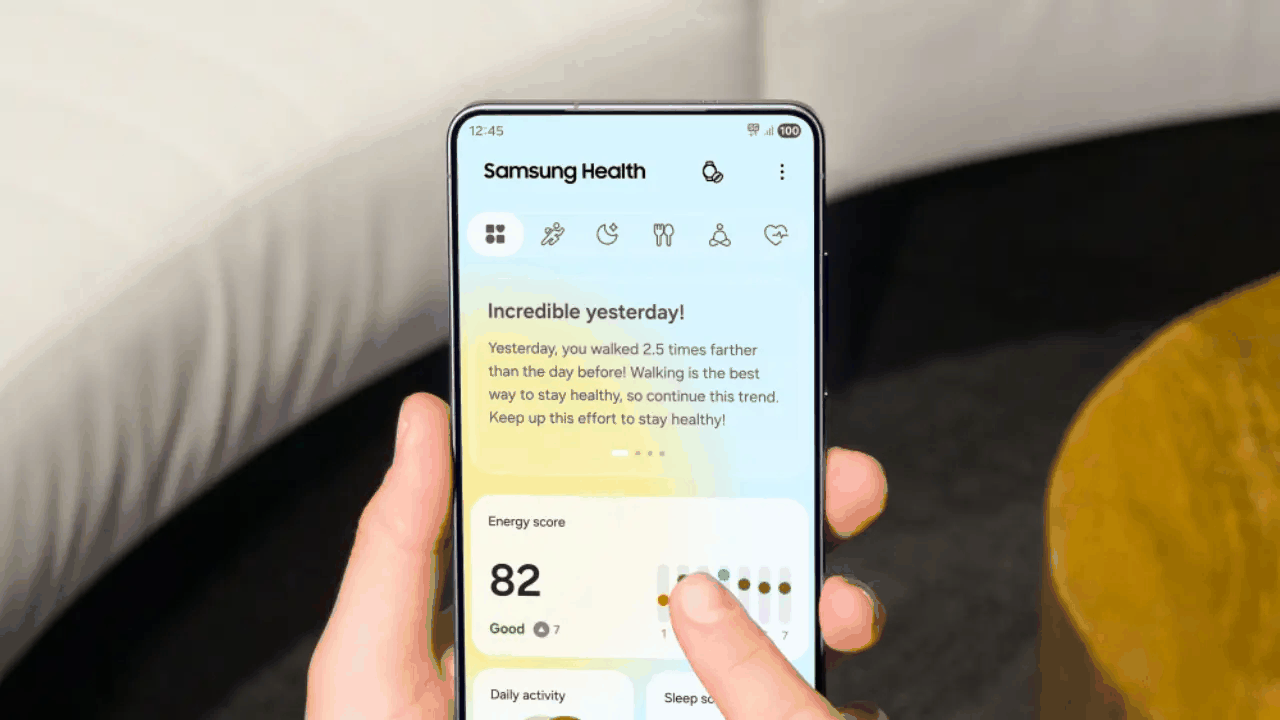
What Does Samsung Actually Want?
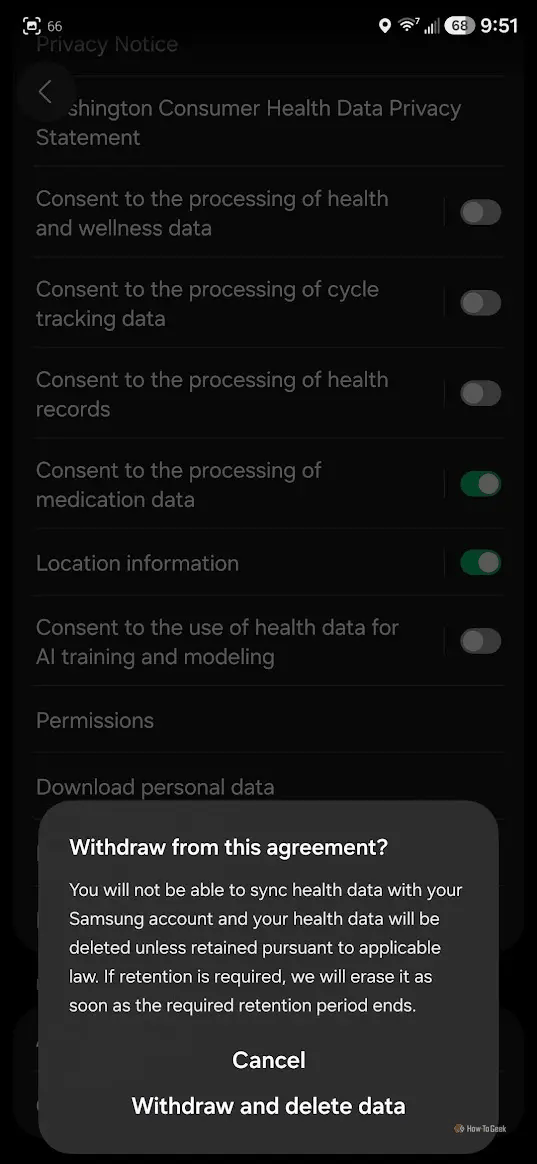
According to Neowin, Samsung quietly added a new toggle in Samsung Health’s privacy settings, with a long name — “Consent to use health data for AI training and modeling.” Flip it on, and Samsung can legally use your personal health metrics to train and improve its own AI models.
What data gets taken? Samsung listed four categories itself: your sleep data, your logged medication information, your imported medical records, and menstrual-cycle tracking records.
And that’s not all. Samsung also states that company employees and third-party contractors may “review” some of the collected data — in other words, it’s not just cold machines looking; real humans will go through your health file.
And through all of this, there is no option to “decline but keep syncing.” Want to keep data sync? You must consent. Decline? Sync stops and cloud data is wiped.
The screenshot comes from tech outlet How-To Geek’s hands-on test — when a user tried to turn the toggle off, here is Samsung’s warning verbatim:
« Withdraw from this agreement? You will not be able to sync health data with your Samsung account and your health data will be deleted unless retained pursuant to applicable law. If retention is required, we will erase it as soon as the required retention period ends. »
In plain terms: “Want to withdraw? Then you lose data sync, and your health data gets deleted — unless the law requires us to retain it.” It’s the exact same logic as “trick-or-treat” — except this time it’s Samsung at the door, and what it wants is your heartbeat and sleep curves.
Where Should the Boundary of “Consent” Be?
The real controversy here isn’t “should AI training collect data” — the real problem is on a different axis: can consent be obtained through threats?
In the world of digital products, this design has a name: the “Dark Pattern.” Its defining trait is giving you the form of “a choice” while in reality leaving you no choice — and Samsung’s move lands squarely on the worst kind of dark pattern: bundled consent.
What is bundled consent? You want feature A, but you must also agree to condition B, which has nothing to do with A. In Samsung Health’s case, A is “sync your steps and sleep data to the cloud so you don’t lose it when you switch phones,” while B is “allow Samsung to take your entire health file to train AI models.” These two things have no technical necessity linking them — you could perfectly well keep enjoying cloud sync without consenting to lend out your data. Samsung deliberately捆绑 them together for one purpose: to force you to nod yes.
A more extreme comparison helps ordinary people grasp how absurd this is: it’s as if the convenience store on your corner suddenly posted a notice — “From today, everyone who shops here must agree to let us install a camera in your home, or all your past loyalty points are voided.” Would you call that giving you a “choice”?
Why GDPR Forbids This
Under the EU’s General Data Protection Regulation (GDPR), Samsung’s move is practically textbook violation material.
GDPR defines “consent” extremely strictly, with essentially one core requirement: consent must be freely given. What does “freely given” mean? Recital 43 spells it out clearly: consent should not be regarded as freely given where the performance of a contract, including the provision of a service, is dependent on the consent despite such consent not being necessary for such performance.
The core point is simple: you may require my consent for data processing that is “necessary for the service to function normally” (for instance, if you store my steps in the cloud, Samsung obviously needs the right to store that data). But you cannot bundle “training AI” — something entirely unrelated to the service itself — into the consent terms, and threaten “decline and we delete your data.”
In 2023, Meta ran a similar play in Europe: users had to consent to having their tracking data used for ad targeting, or they couldn’t use Facebook and Instagram for free. The EU court ultimately ruled the model illegal, on the grounds that users had no real choice between “consent” and “lose the service.”
Samsung’s problem is worse than Meta’s. At least Meta left users a back door of “pay to remove ads” (though the court found the fee exorbitant). Samsung doesn’t even have that back door — the only options before you are: consent to everything, or have your data deleted. This isn’t a multiple-choice question; it’s a dead end.
Hacker News user benjiro29 wrote in the comments: “If you’re in the EU, contact the consumer protection organization in the region where you bought the device and file a complaint immediately. This violates dozens of EU laws. If enough people in each country complain, it becomes a national-level issue — we’ve succeeded with this method many times before.”
Big Tech’s Dark-Pattern Toolkit
Samsung’s move isn’t isolated in the broader tech industry. Over the past few years, the major companies have evolved a mature playbook for “how to make users click consent somewhat reluctantly.”
Hide the “Reject” button. Make “Consent” a big, bright, colorful button, and make “Reject” small gray text hidden at the very bottom of the page, requiring you to scroll to find it. Chances are you’ll hit “Consent” before you ever dig it out.
Nag with repeated popups. You decline today; tomorrow the app pops it up again. The day after, again. It won’t stop until it gets its way. Many people’s psychological defenses are worn down day by day like this.
Scare-tactic wording. “If you refuse, you will lose the following features” — then it lists a long string of things that sound serious but are actually completely unrelated to data collection.
Pre-checked boxes. Pre-tick the consent checkbox, exploiting your “too lazy to change the default” psychology.
Samsung’s “decline and we delete your data” can be counted as the newest weapon in the dark-pattern arsenal — I’ll tentatively call it “self-destruct coercion.” The chip it holds hostage is unusual: not future convenience, but the sweat you’ve accumulated in your band over three years. Your step line chart, the menstrual cycle you marked for half a year, the two months of sleep quality you recorded — all of it becomes a deletable bargaining chip in Samsung’s hand.
Another HN user, rdtsc, cut to the heart of it: “You bought a device but can’t use half its functions normally unless you agree to hand over your medical records? Then if I refuse, will they refund me 50% of the device price?”
Don’t Panic Yet — the Data on Your Phone Is Still There
One easily misunderstood point needs clarifying: the “delete data” Samsung refers to means the synced copy stored on Samsung’s cloud servers. The health records stored locally on your phone will not be deleted — your steps are still there, your sleep curves are still there; it just can’t multi-device sync anymore.
But the problem remains sharp. For Galaxy Watch wearers, the data sync between watch and phone is a core experience. Cut off cloud sync, and the entire ecosystem’s value drops sharply. You bought a set of linked wearables; what Samsung hands you is a product that’s crippled without syncing. Who exactly is breaching the contract here?
Something even more thought-provoking lurks at a deeper level: if your health data has sat safely on Samsung’s servers for the past few years, why is it suddenly “decline and it disappears”? Who ultimately decides whether this data lives or dies?
”Don’t Threaten Me With the Good Thing”
Among the dozens of HN comments, one voice recurs, summing up to a single line: “Don’t threaten me with something I should be thanking you for.”
Many pointed out: having Samsung delete your own health data should originally be a reassuring thing — “you decline, we delete” sounds like respecting privacy. But when the premise of that deletion is “because you won’t let us train AI for free,” the flavor changes completely. It’s no longer privacy protection; it’s punishment.
A widely agreed-upon comment put it this way: “Don’t threaten me with the good thing. I’m tired of tech companies shoving AI into everything.”
That line points to a deeper sentiment: ordinary users aren’t opposed to technological progress; what they resent is being treated as free fuel. Your steps, your sleep, your heart rate are independent personal data, not an oil card bundled into the phone you bought.
Who Owns Your Health Data, Really?
Back to the original question: who owns the history in Samsung Health?
Technically, this data was collected by you with your device. Legally, GDPR and other privacy laws make clear you are the data subject, with rights to erasure, portability, and correction. But from Samsung’s behavior this time, in its business logic these data look more like its assets — it can choose to keep storing them, or choose to delete them, and all of it hinges on whether you’ll let it monetize them.
This isn’t a loophole in the statutes. It’s a true reflection of the power structure. When a company holds your years of health data, it gains leverage to negotiate with you. And the reason GDPR requires consent to be “freely given” is precisely to prevent this unequal negotiation from becoming legal plunder.
One more HN comment is worth pondering: a user mentioned he’d bought a Samsung phone years ago that had a blood-oxygen feature. One day a window popped up telling him he had to consent to sending the data to Samsung to keep using the sensor. “So I never used it again,” he said. “Samsung’s history of squeezing users is far longer than we imagine.”
This time, Samsung’s calculus is louder — it wants not just present and future data, but everything you’ve accumulated over the past few years. And the data hunger of the AI era is making this “give it or we destroy it” logic more brazen by the day.
As of this writing, Samsung has yet to issue a public response to media and community questions. But the trend of the HN discussion points to an almost certain path: GDPR complaints, an FTC investigation, or both at once. For ordinary users, though, a more urgent question than waiting for regulators may be to first check your Samsung Health sync toggle — and see whether the data you’ve accumulated over years has already reached the point where you must choose.
Reference links:
- Neowin: Samsung will delete your health data if you don’t let them use it to train AI (original breaking report)
- Hacker News discussion thread (item?id=48897991, 218 points / 59 comments)
- How-To Geek: Samsung is pushing users to train AI with their personal health data (with hands-on screenshots)
- 9to5Google: Samsung Health will delete your data without AI training consent
- Android Police: Samsung is deleting your health data if you refuse to let it train AI
- GDPR official text: Recital 43 (definition of “freely given consent”)
This article’s material comes from Neowin’s original reporting, the Hacker News community discussion, and follow-up reports from multiple tech outlets. All factual descriptions are drawn from publicly available reporting and community discussion, and contain no personal experience or subjective speculation by the author.