On July 13, 2026, hundreds of millions of Telegram users worldwide suddenly discovered something strange: every share link beginning with t.me stopped opening. Whether it was a channel invite sent in a group, a message link shared on a feed, or the Telegram jump-in入口 pinned on major websites — click it and the browser went blank.
This wasn’t a network outage, nor was it Telegram’s servers crashing. It was the domain registry of Montenegro that suspended the t.me domain.
A small European country most Chinese people have never heard of, with a population under 630,000, rendered hundreds of millions of Telegram short links worldwide invalid overnight. And the life-or-death switch for that link you thought would “always open” rests in the hands of a country you may never visit in your life.
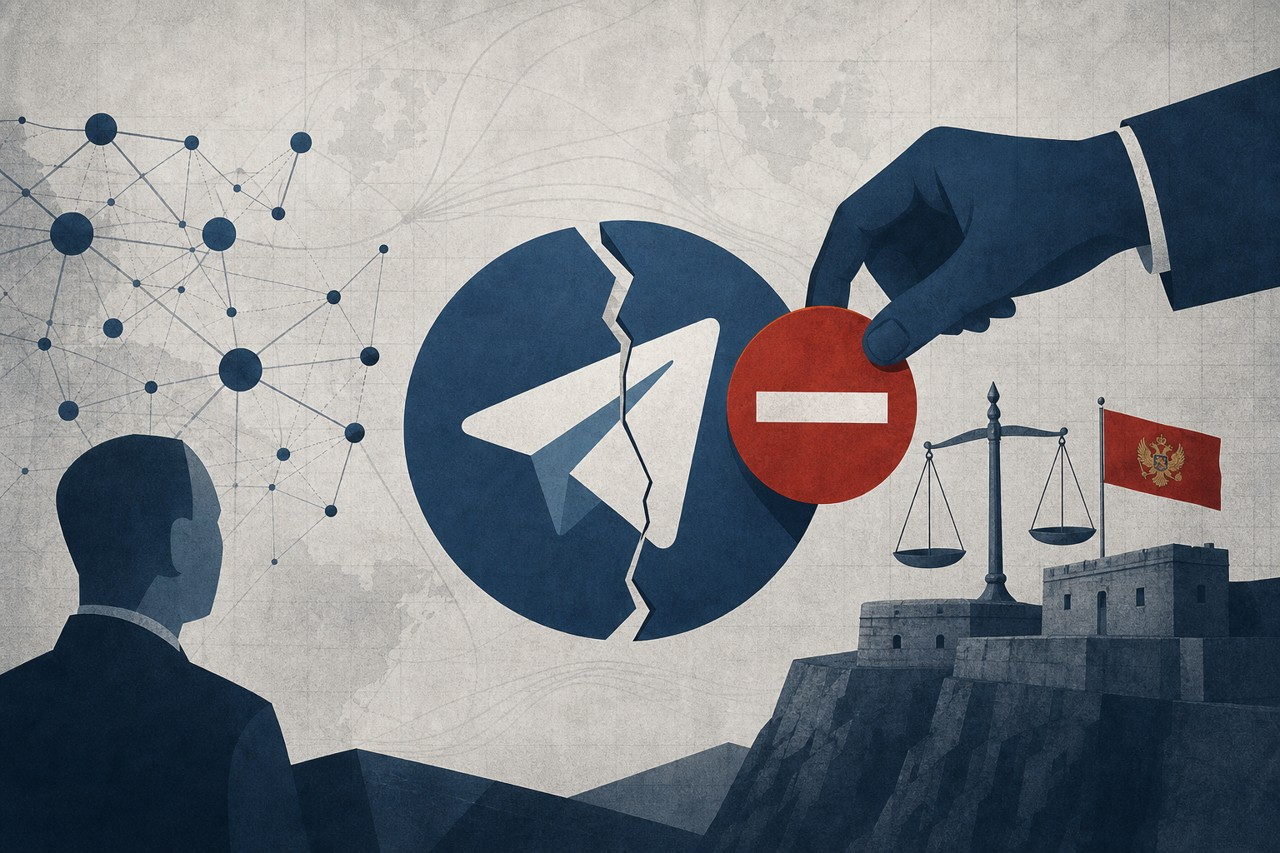 Figure: WHOIS query results show the t.me domain status as serverHold — i.e., suspended from resolution by the registry. Source: whois.com
What Is t.me? Why Does Suspending It Break Everything?
Let’s spend a minute explaining what t.me means to Telegram.
Telegram is a global messaging app with over 900 million users. Any public channel, group, or message you create on Telegram automatically generates a short link, always in the format t.me/xxxxx. For example, Telegram’s official channel link is t.me/telegram, and a blogger you follow might be t.me/some-name.
These links are scattered across the entire internet: in WeChat Moments, on Weibo, on Twitter, and on all the websites and social accounts you follow. Telegram’s founder once said that t.me is one of their most core digital assets in global distribution.
And on July 13, all those links scattered in every corner of the globe died overnight.
But one thing is worth noting: the Telegram app itself was unaffected. You can still open the app, send and receive messages, join groups — as long as you can find the content through in-app search. What actually broke was that link you thought would “always open with one click.”
Montenegro: A Country You’ve Never Heard Of Holds the Switch for Hundreds of Millions of Global Links
The most alarming part of this is who pulled the trigger: not Telegram itself, not U.S. internet regulators, not even the EU. It was Montenegro — a Balkan country that gained independence from the former Yugoslavia in 2006, with a land area smaller than Beijing’s.
This reveals a fact almost no ordinary netizen knows: many of those domain suffixes that look “global” actually belong to a specific country. .me is Montenegro’s country-code top-level domain (ccTLD).
What is a ccTLD? Simply put, every sovereign state is assigned a two-letter exclusive domain suffix: China is .cn, the U.S. is .us, the UK is .uk, Japan is .jp. The assignment is handled by the international organization ICANN (Internet Corporation for Assigned Names and Numbers), but ICANN only assigns — it doesn’t operate. Each country’s ccTLD is operated autonomously by an institution designated by that country. China’s .cn is managed by CNNIC (China Internet Network Information Center); Montenegro’s .me is jointly operated by a local company called doMEn and the U.S. domain service provider Identity Digital.
Here’s the key: the operating institution holds final control over every registered domain under that suffix. It can set rules, raise prices, and — without notifying the registrant — suspend the resolution of any domain. That is the “serverHold” status t.me encountered this time.
From the WHOIS database records, a glaring term appeared in t.me’s domain status field: serverHold. Under ICANN’s definition, this status means “the domain has been removed from the global DNS system; no matter how correctly your server is configured, browsers cannot find the server address corresponding to t.me.” This operation was applied directly by the registry — the operator of .me — bypassing the domain registrar GoDaddy.
Figure: WHOIS database raw record, with serverHold and multiple lock statuses explicitly listed under the Domain Status field. Source: whois.com
An Unavoidable Question: Why Did Montenegro Shut Down t.me?
As of this writing, Telegram has issued no official statement, the Montenegro domain registry doMEn has offered not a word of explanation, and Identity Digital has likewise remained silent.
But speculation from the global tech community and media points in one general direction: it relates to the long-standing problem of illegal content distribution on Telegram’s platform. A highly upvoted Hacker News comment noted that Telegram has in recent years faced enormous pressure from the EU and multiple member governments for failing to effectively control illegal content on its platform (including child sexual abuse material and terrorist propaganda). As an EU candidate country, the action by Montenegro’s domain registry looks to some observers like an “informal diplomatic signal.”
However, no official channel has confirmed this, and I will not present speculation as fact. Yet it is precisely this “shut it down with zero explanation” approach that constitutes the most dangerous part of the affair.
The Borderless Ideal of the Internet Meets the Wall of National Sovereignty
The t.me incident exposes a structural problem: the globality of the internet is built atop an underlying system that depends on national sovereignty.
The domain-resolution chain has a clear power hierarchy: ICANN assigns the top-level domain → the country-designated institution operates the ccTLD → the registrar proxies registrations → the user holds the domain. At any link in this chain, the power can be great enough to catch end users off guard. And the ccTLD operator is especially special — it is both a technical manager and an extension of national sovereignty. When a government deems a domain “contrary to its national interest,” it can make that domain vanish from the global internet without any international judicial process.
The HN discussion compared this structure to “every house being built on someone else’s land — no matter how beautifully you renovate, the deed is in someone else’s hands.” A top comment read: “There are no global enforcers of ccTLD registry behavior. It is completely up to that country.”
This contradiction plays out starkly across different ccTLDs. In the discussion, someone compared Iceland’s .is with Montenegro’s .me: Iceland’s registry ISNIC is known for resisting global legal pressure — the well-known site archive.is has weathered countless legal threats and takedown requests and still stands rock-solid today. Montenegro, a Balkan country with a small population and tiny economy, may have a completely different range of options when facing external pressure. One user summarized it succinctly: “Which country’s ccTLD you choose is, in effect, choosing the level of protection that jurisdiction’s legal system affords you.”
The Two Faces of “Small-Country Domains”: Cheap and Pretty vs. Precarious
.me was originally an extremely successful marketing case. Montenegro obtained the .me domain after its 2006 independence, and .me happens to mean “me” in English — naturally suited to personal-branding and social-site domains. The reason Telegram originally chose t.me over t.com or t.org was largely because of its brevity — three letters plus a dot, among the shortest social links in the world. Spotify also used spotify.me for its annual personalized summary pages.
But this incident made everyone realize: a domain suffix’s “good looks” and its “safety” are two completely independent things. Your short link is beautifully short, but its ultimate switch sits in a country whose legal system you’ve never examined.
This isn’t an isolated case. Several “small-country domains” are used at massive commercial scale worldwide: the Pacific island nation Tuvalu’s .tv (a favorite suffix for global TV and video sites, including Twitch); Anguilla’s .ai (the standard for AI companies); Tonga’s .to (a darling of URL-shortening services). These countries have even smaller economies than Montenegro, and their domain operations are often outsourced to U.S. companies like GoDaddy or Identity Digital. Technically they run on U.S. servers, but legally they remain someone else’s sovereign asset.
One Hacker News user wrote with near-anger: “It’s absurd that corners of the entire internet depend on these ‘micro-states’ that sell domains for quick cash, then years later suffer reputational blows or get dragged down by serving foreigners who don’t care whether they live or die. These ccTLDs were always a gimmick; any organization that takes stability and reputation seriously should avoid them.”
Sharp as the view is, it points to a truth: when you build a digital asset on the sovereign tool of a country whose political ecology you completely fail to understand, you’re not investing — you’re gambling.
What Can Telegram Do? — And the Lesson for Ordinary People
For Telegram, the short-term应急 plan is obvious: route traffic back to telegram.org or telegram.me (the latter is also a .me domain but hasn’t been suspended so far — further evidence that this action targeted t.me specifically, rather than the entire .me domain being caught in the crossfire). But in the long run, the risk of depending a single ccTLD for core infrastructure was laid completely bare by this incident.
For ordinary people, this seems far away but is actually close. Every link in your company, your favorite blogger, the WeChat groups and Telegram groups you’ve bookmarked — their “lifespan” may be completely different from what you imagine. A Hacker News comment that drew wide agreement came from an operator who had just launched a Telegram channel: “I’ve had a fifteen-year rule — never use a third-party domain directly as a link in email or public pages; always use my own domain for redirection. This time I spent five minutes changing one line of redirect code, while everyone who used t.me directly can now only wait.”
That is the lesson t.me taught everyone: the internet has never had any “no-man’s-land.” Every service you take for granted rests on a complex and fragile sovereign contract behind it. And the final right of interpretation over that contract may lie in a country you’ve never visited or even heard of.
As of publication, the t.me domain remains in serverHold status. Neither Telegram nor the Montenegro domain registry has disclosed any communication progress. When — or whether — the hundreds of millions of links will be restored, no one knows.
Reference links:
- WHOIS database: t.me domain status query result (showing serverHold and multiple lock statuses)
- Hacker News discussion thread (item?id=48897878, 224 points / 153 comments)
- ICANN EPP status code description: definition of serverHold (domain removed from the global DNS resolution system)
- dev.ua report: technical analysis of Telegram’s global short-link failure
- Greek City Times report: Telegram t.me domain placed in serverHold
- Multilingual media roundup: independent confirmation from Russian-language outlets such as Lenta.ru and 78.ru
This article’s material comes from publicly available WHOIS database records, the Hacker News community discussion, dev.ua, and independent reports from multiple international media. It cites representative viewpoints from community comments and labels their sources. The author had no direct communication with Telegram or the Montenegro domain registry; all speculation about the cause of the incident is presented on the premise of being “unconfirmed.”