At a San Francisco startup event, a man wore a metal capsule about two fingers wide pinned to his chest. A friend asked what it was; the man said it was a microphone — he records himself all day and drops the audio into AI each night for summary and analysis. Warming to the topic, he said something chilling: “I think Claude is smarter than me, its critical thinking is better than mine, so I now hand all my thinking over to it.”
This isn’t science fiction. This is a real observation recorded by AI researcher Yennie Jun on July 14, 2026, in her article “Are we offloading too much of our thinking to AI?” The piece hit the top of Hacker News the day it was published — 353 upvotes, 356 comments, the day’s hottest topic. The top-voted comment read: “If you use a calculator to add, you’re still you. But if you use AI for most of your thinking — what’s left of you?”
That question hangs over a lot of heads; most people just haven’t started asking it of themselves yet.
The Calculator Didn’t Make You Dumber — So Why Would AI?
The most common analogy opponents use is the calculator. “When calculators came out, people said students would get dumb too. What happened? Math education shifted from rote memorization to conceptual understanding.” That logic sounds reasonable — since the calculator didn’t destroy human math ability, AI naturally won’t destroy human thinking ability.
But there’s a key distinction being buried here.
What the calculator does for you is arithmetic — a set of operations with clear rules and sharp boundaries. 2 plus 2 is 4, sin(30°) is 0.5, no gray area. More importantly, the calculator makes no judgments about “what to calculate,” “why to calculate,” or “what the result means.” Those judgments, reasonings, tradeoffs — the core of thinking — stay in your head.
What AI does for you is something entirely different. It evaluates information sources for you, judges which arguments are stronger for you, organizes the argument structure for you, decides the direction of the conclusion for you. These aren’t auxiliary operations — they are thinking itself.
Researchers at the University of Western Australia systematically dismantled the “calculator analogy” in a 2025 article, identifying five flaws. The most central: the calculator works only in the narrow domain of math, while language models have no fixed boundary — “in principle, you could delegate any kind of cognitive task to it.” Another equally key point: the calculator doesn’t hallucinate, doesn’t confidently fabricate non-existent facts, and doesn’t embed the cultural biases of its training data in its output.
I reviewed an empirical study published in 2025 in the MDPI journal Societies. The research team surveyed and deeply interviewed 666 participants and found a statistically significant negative correlation between AI tool usage frequency and self-reported critical-thinking ability. Specifically, the more frequently someone used AI tools, the lower their self-ratings on three dimensions: “assessing information credibility,” “identifying argument flaws,” and “forming independent judgments.” The study’s authors defined this phenomenon as the mediating effect of cognitive offloading — AI completes the intermediate steps of thinking for you, and you lose the opportunity to practice those steps.
It’s like someone who never runs being suddenly asked to run five kilometers — their muscles atrophied from disuse, and their running ability vanished with them. The muscle of thought follows the same use-it-or-lose-it rule. The frightening part is that physical decline is something you can feel (breathlessness, sore legs), but mental decline is often imperceptible until something goes wrong — until the moment you need to make a judgment on your own, with no AI present, and you realize you no longer know how to think.
A Teacher’s Window: When Every Student Gets an A, but Learns Nothing
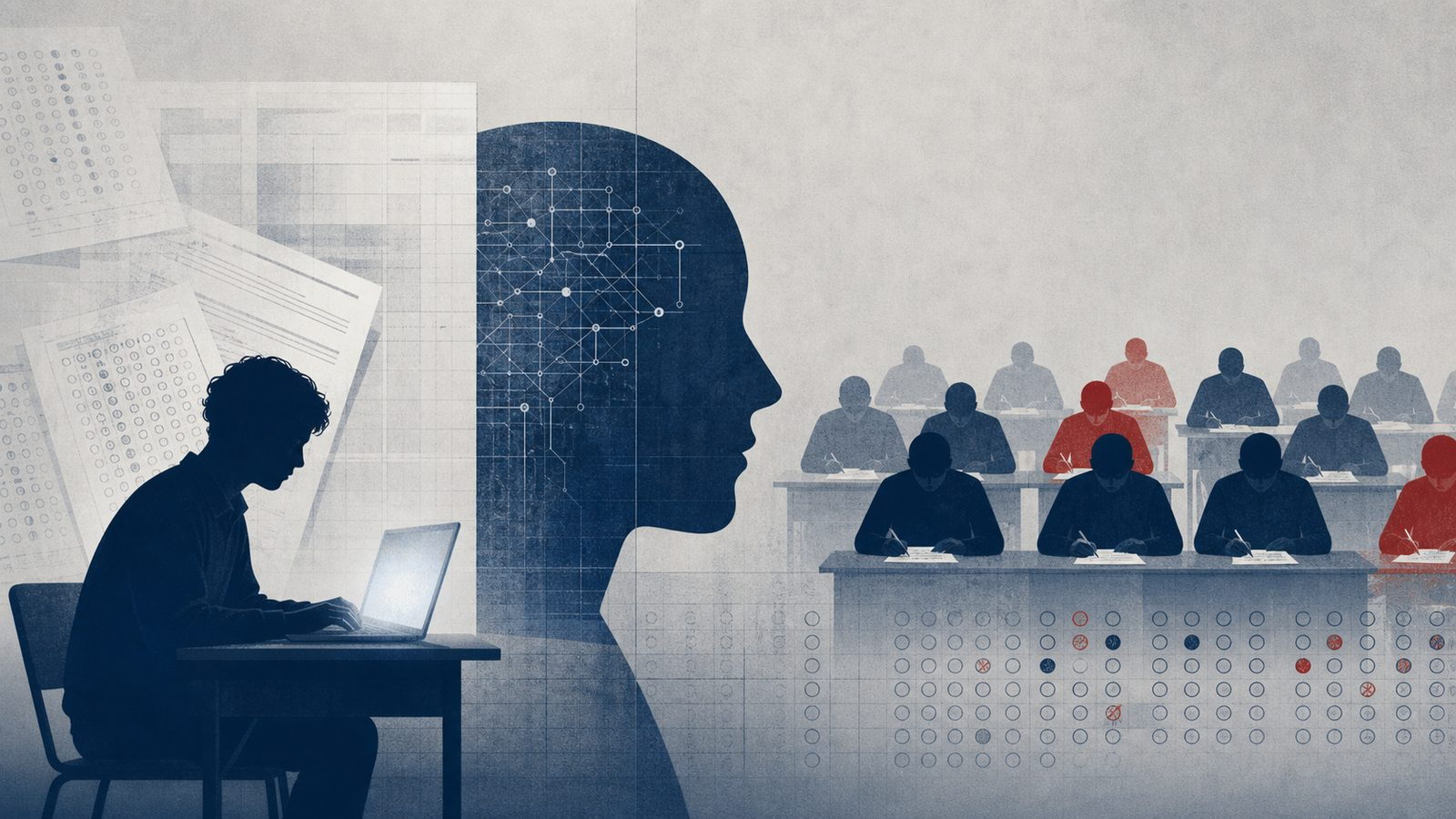
Yennie Jun shared a detail in her article. Her mother teaches physics at an online university and recently noticed a disturbing pattern: most students’ homework answers were nearly identical — as if everyone had pasted the same problem into the same AI tool and copied it back verbatim. The answers were quite comprehensive; by the grading rubric, no fault could be found, so most students got an A. But she knew in her heart these students had learned nothing.
AI can produce a perfect answer, but in the process it doesn’t teach you how to derive that answer. Which formula? Why this formula? Are there other paths? What are the boundary conditions? What happens if you change a variable? — these questions are the core of physics education, and AI’s output skips all of them.
The “stronger the AI, the weaker the learning” phenomenon isn’t isolated. A 2025 Harvard study found that in courses permitting AI assistance, students’ final exam scores dropped by about half a letter grade on average, and the decline was proportional to students’ dependence on AI. Notably, students who “felt they’d learned a lot from AI” actually scored worse — AI’s fluent explanations manufactured a false sense of “I get it,” but that sense doesn’t survive a real test requiring independent reasoning.

An Experiment: Think First, Then Ask
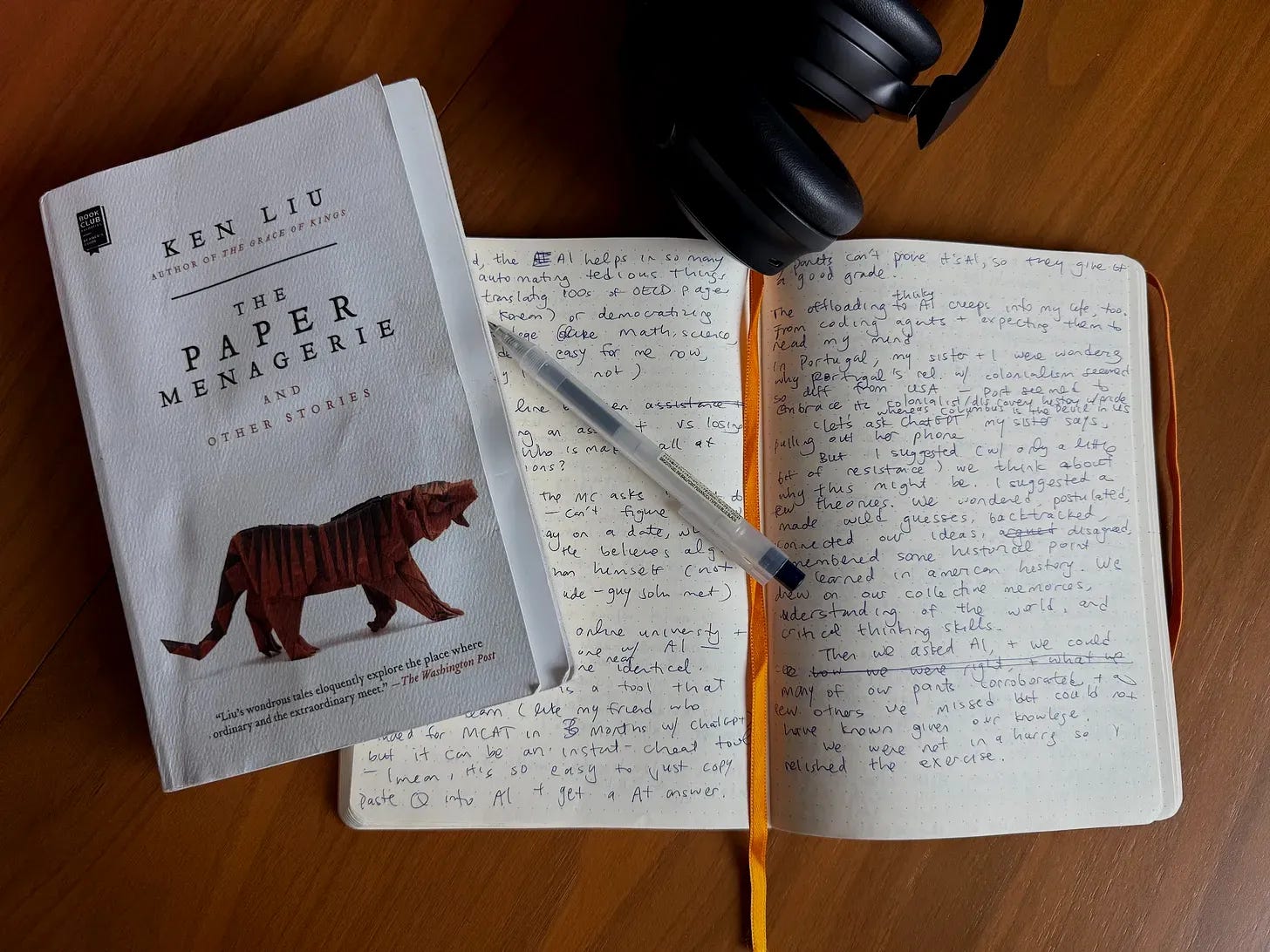
Yennie Jun shared a personal experience in her article. While traveling in Portugal, she and her sister visited the Monument to the Discoveries — a landmark commemorating Portugal’s Age of Exploration. They were puzzled: why is Portugal so proud of its colonial history? In the US, Columbus has long been “canceled,” but the Portuguese seem to revere Prince Henry.
Her sister pulled out her phone: “Ask ChatGPT.”
Yennie suggested not asking yet, and thinking it through first. The two began speculating: is it because Portugal is more homogeneous and more religious than the US? Is “the Age of Discovery” the shiniest chapter in Portugal’s national narrative, so they selectively beautified that history? They guessed, reasoned, rebutted each other, recalled history details from high school. They knew many guesses might be wrong — which is exactly part of the practice.
Finally they asked AI. Its answer confirmed most of their guesses, added a few angles they hadn’t thought of, and also missed some possibilities they still considered reasonable.
The value of this experiment isn’t in the final answer. The value is in the “guess first” process. If you ask AI directly, the answer appears on screen within a second; you read it, nod, and forget it. But when you’ve thought it through yourself first — even with gaping holes — AI’s answer is no longer a conclusion but an object you can converse with: here I’d thought of this, here I hadn’t considered that, this explanation I’m not quite convinced by.
A frequently quoted Hacker News comment proposed a useful framework. Commenter jvanderbot divided AI use into two modes: “whisper earring” and “exoskeleton.” The whisper-earring mode is when you seek direction from AI — “what should I do now?” “where do you think the problem is?” — you surrender the initiative of thinking, and AI makes the judgments for you. The exoskeleton mode is when you already have a clear idea and let AI accelerate execution — “implement that algorithm with this structure,” “translate that passage in this style” — you retain the judgment, and AI merely extends your hand.
The whisper earring makes you shrink. The exoskeleton makes you stronger. The difference: whether you’ve used your own brain before stuffing AI into it.
The Other Side of the Coin: AI Really Did Help a Lot
To be fair, AI’s productivity gains are real. Yennie Jun listed several examples in her article: her cousin used Gemini to translate long English reports into Korean, dramatically improving work efficiency; a friend used ChatGPT as a personalized tutor and learned biochemistry from scratch in months; she herself used AI to analyze personal data and surface patterns hard to find through manual analysis.
These examples share one thing: AI accelerates the execution efficiency of skills you’ve already mastered, rather than learning “not-yet-mastered skills” for you. The cousin already knows Korean and English; AI just saved her the grunt work of word-by-word translation. Yennie herself knows clearly what data to analyze and what questions to ask; AI is just an execution-level accelerator.
The problem appears when you put AI into areas you’re unfamiliar with.
For instance, using AI to review a legal contract you don’t really understand. AI can fluently tell you “this clause might be risky,” but you haven’t read the clause text yourself, haven’t reasoned through the risk path within the legal framework, haven’t compared the differences in wording. What you get is a feeling about the risk, not an understanding of it. Next time you encounter a similar clause structure in another scenario, you might not recognize it at all — because last time you didn’t actually “learn” what risk looks like; you merely received a conclusion.
This also explains why heavy AI users, when asked “what did you learn,” often can’t say clearly — they did “complete” a lot, but the knowledge didn’t settle in their brains. Productivity isn’t the same as learning. These two things are accelerating apart in the AI era.
”I’m No Good at Running — Thinking Is the Only Thing I Have Left”
A Hacker News comment drew massive resonance. Commenter zerobees wrote: “I’m no good at lifting weights or running. So thinking is the only thing I have left.” Behind this line lies a deeper anxiety: if even thinking — the capability the entire human civilization is built upon — can be easily outsourced, what’s left of human uniqueness as a species?
My judgment is that the answer may lie in “at what level you use it.” Current research is sketching a blurry but directional boundary line: use AI on things you’ve already mastered, as an efficiency amplifier; when using AI on things you haven’t mastered yet, maintain the discipline of “think first, then ask.”
This isn’t a black-and-white question. You can’t and needn’t reject all AI assistance. But you can choose, before letting it answer for you, to give yourself thirty seconds — think: if it were just me, how would I answer?
That San Francisco microphone man — if one day his device dies, or the AI service goes down, will he still know what to say to the person in front of him?
The material for this article comes from Yennie Jun’s original piece on Art Fish Intelligence, the related Hacker News discussion, and several published cognitive-science empirical studies. The author did not directly participate in the above research projects; some judgments are based on interpretations of public information and may contain bias. If you have firsthand experience or a different perspective on this topic, we welcome the discussion.
Reference Links
- Yennie Jun, “Are we offloading too much of our thinking to AI?”, Art Fish Intelligence (Substack), 2026-07-14
- Hacker News discussion thread
- Gerlich, M., “AI Tools in Society: Impacts on Cognitive Offloading and the Future of Critical Thinking”, Societies (MDPI), 2025
- “Generative AI is not a ‘calculator for words’. 5 reasons why this idea is misleading”, The Conversation, 2025-08-18
- Javier Santana, “AI and the calculator analogy”, Kognitivo (Substack), 2025-08-07
- METR, “Task-Completion Time Horizons of Frontier AI Models”, 2025
- Florida State University, “Study on AI-frequent words seeping into human speech”, 2025