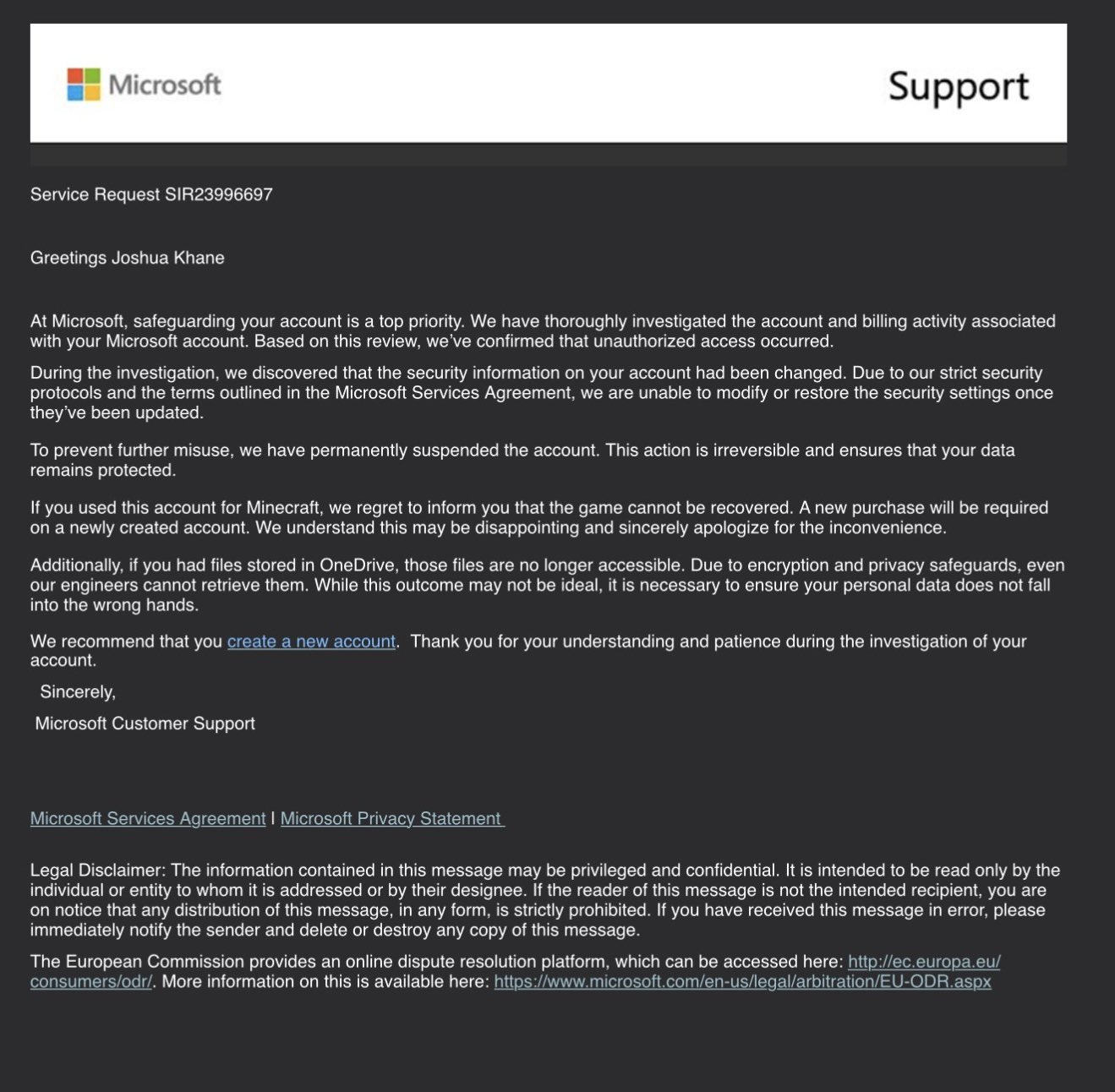
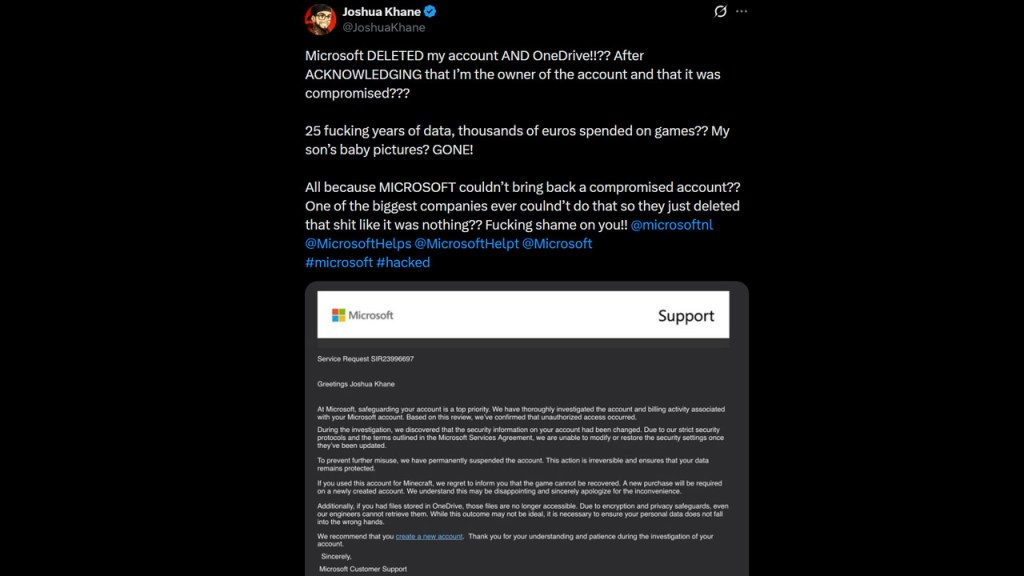
On July 13, 2026, Dutch Twitch streamer Joshua Khane posted on X. He wrote: Microsoft admitted his account had been hacked, admitted he was the account’s owner — and then deleted his entire account along with his OneDrive. Twenty-five years of data. Thousands of euros of digital games. Photos of his son as a baby. “One of the world’s largest tech companies couldn’t manage to recover a stolen account, so it simply deleted all of it, as if nothing had happened.”
Within 48 hours, the post racked up 33,000 reposts, 59,000 likes, and over 3.5 million views. On Hacker News, two threads about the incident combined for 136 upvotes and 63 comments. Readers weren’t rubbernecking — they were afraid. Because everyone has a “digital life” tied to a tech company’s servers.
What You “Bought” Isn’t a Game — It’s a License That Can Be Torn Up Anytime
The most infuriating detail of the whole affair was buried in an unassuming reply. Khane explained that Microsoft support staff had confirmed to him that his identity verification passed — they knew he was the true owner. But support told him: because the security info had been altered by the hacker, recovery was technically impossible. What was the solution? Permanently delete the account.
Here a legal fault line appears: in Microsoft’s eyes, Khane didn’t “lose” property worth thousands of euros, because he never “owned” those games to begin with. What he owned was an access license — a license Microsoft can revoke at any time, without court approval.
Flip to Article 12 of Microsoft’s Services Agreement, and it’s written in black and white: Microsoft reserves the right to terminate your account “at any time, for any reason, with or without notice.” Your content — games, music, photos, documents, all the things you paid real money for — “may be deleted without notice.”
This isn’t a clause unique to Microsoft. Steam’s subscriber agreement is written almost identically. Apple’s iTunes terms have followed this logic since the Jobs era. Google’s terms of service grant the same unilateral termination right. The e-books you “buy” on Amazon Kindle, the digital games you “buy” in the PlayStation Store, the movies you “rent” on Netflix — these verbs “buy” and “rent” are just wrapping paper for the consumption experience. The legal substance inside is one sentence: you paid money and got in return an access permit that can be voided at any moment.
A Brazilian Player Went to Court — and Shook the Entire Gaming World
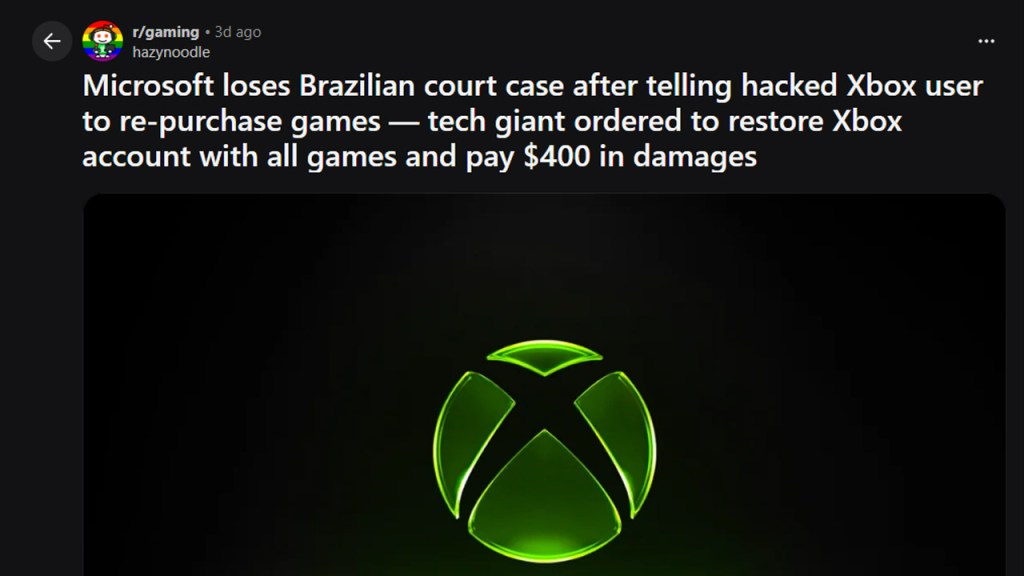
Khane’s ordeal wasn’t the first. Three days before he posted, a Brazilian Xbox player named Ordo_Liberal won a lawsuit against Microsoft.
The cause was almost identical to Khane’s: account hacked, security info changed, Microsoft told him “your account is permanently banned; if you want to play, register a new account and buy everything again.” The difference: this Brazilian player didn’t just vent on social media and move on — he sued Microsoft.
On July 10, 2026, the Brazilian court ruled: Microsoft must restore the player’s account and full digital game library within 15 days, and pay about $400 in damages. What’s more, reports say Microsoft sent 12 lawyers to defend this seemingly trivial small-claims case — but Brazil’s consumer-protection law is famously tough, and the court’s judgment didn’t waver.
This case was repeatedly cited on Reddit and Hacker News. It tells all digital consumers one thing: the power asymmetry between you and tech companies can vary enormously across jurisdictions. Lose your account in the Netherlands or the US, and you’ll most likely have to swallow it. In Brazil, a court might actually get your account back for you.
Why Platforms “Must” Have the Right to Delete — and Why That Became a Problem
I don’t want to frame this as a simple “big corporations are devils” narrative. Platforms do genuinely need the power to ban accounts.
Microsoft’s Xbox network handles tens of millions of login requests daily. Among them are inevitably large numbers of accounts for fraud, credit-card theft, child harassment, and cheating that ruins the gaming environment. If Microsoft had to complete a judicial process for every banned account before acting, Xbox Live would be reduced to an unusable wasteland by malicious actors within 48 hours. Steam’s anti-cheat system, Apple’s App Store review, Google’s anti-spam system — their very existence relies on platforms being able to remove users without going to court.
But the problem isn’t at the extreme end of this debate. The problem is the middle ground.
Khane’s case clearly isn’t on the “malicious user” side. Microsoft itself confirmed his identity. The hack wasn’t his fault. But Microsoft’s handling logic is binary: either restore the account (but technically can’t / won’t), or delete it. There’s no middle option of “temporarily freezing your assets until we can resolve this.”
A highly upvoted Hacker News comment hit the nail on the head: “If a bank canceled all your savings because your card was stolen and told you to ‘open a new account and redeposit,’ nobody would accept that. But when a gaming platform does the same to digital assets, the consumer can only post a tweet.”
Digital Ownership: A Fight Twenty Years Long With No Verdict Yet
To understand today’s predicament, you have to pull the timeline back a bit.
When Valve launched the Steam platform in 2004, digital distribution was told as a progress narrative: no more discs, no more trips to physical stores, play from home on launch day. What that narrative left out was a subtext: the physical disc you bought could be resold, lent to a friend, or dug out of the attic twenty years later to slot into an old machine and revisit. The digital game you “bought” can do none of those things.
More unsettling still, even the “physical” escape route is narrowing. In 2026, Sony announced PlayStation will stop producing physical game discs after 2028. Microsoft’s Xbox Series S has long been disc-free. Nintendo is the last major game maker to hold onto cartridges — but its digital-store sales share climbs year after year.
This isn’t just a gaming-industry problem. The music industry completed its shift from CD to streaming in the 2010s. Film and TV is moving from Blu-ray to subscription. Publishing is moving from paper books to Kindle and Audible. Every content industry is quietly swapping “ownership” for “access” — and consumers don’t discover the chasm between the two until the day they lose everything.
Some Counterattacks Underway
Two things are worth noting; they may be slowly reshaping the battlefield.
The first is California’s AB 2426, passed in 2024. From January 1, 2025, companies selling digital goods in California that use words like “buy” or “purchase” must simultaneously and prominently inform consumers: what you’re getting is a limited-use license, not ownership. The bill’s direct trigger was game publishers revoking consumers’ access to digital games without sufficient reason — when consumers tried to seek recourse, they found the courts could offer almost no relief.
AB 2426 didn’t change the legal substance of “license instead of ownership,” but it at least forces companies to tell the truth at the point of sale. If every digital “purchase” confirmation page carried a line of small print saying “this is a rental, not a purchase,” consumer expectations would shift slowly but irreversibly.
The second is Mexico. On July 13, 2026 — the same day Khane posted — Mexican lawmakers announced they were preparing a legal challenge against Sony’s all-digital strategy. If Mexico’s consumer-protection agency determines that “selling only digital, not physical” constitutes an improper restriction on consumer choice, it could force Sony to reconsider its strategy in the Latin American market.
Together, these two point to a slow but clearly directed trend: regulation is waking up. It’s just that this awakening is far slower than the rate at which consumers are losing out.
Back to Joshua Khane: Can His Digital Life Come Back?
As of this writing, Microsoft has yet to publicly respond to Khane’s ordeal. In a follow-up post, Khane said he’s prepared to sue — “I’m tired, but this is the last step.”
Whether his account is ultimately restored or not, this controversy has already done its job of public education. It made the millions who saw that tweet aware of a question: the hundreds of games in your Steam library, the dozens of books on your Kindle shelf, the carefully curated playlist in your Apple Music — they aren’t as safe as the physical books on your shelf or the old game cartridges in your drawer. They live on a server you can’t control, managed by a company that can decide to delete them at any time.
This is the most fundamental yet most overlooked vulnerability of the digital age. Understanding it won’t help you recover what’s already lost, but at least before you press “buy” next time, it can make you ask a question consumers shouldn’t have to ask: what exactly am I buying?
Reference Links:
- Joshua Khane’s original X post (X / @JoshuaKhane)
- Hacker News discussion thread
- VICE report: Microsoft deletes a gamer’s 25-year account
- PowerUpGaming report: the Brazilian player’s lawsuit
- FTC consumer alert: “Do you really own the digital items you paid for?”
- California AB 2426 (California Assembly Bill 2426, 2024)
- Microsoft Services Agreement