
In June 2026, an engineer named Ryan Findley squeezed Google’s newly released large model, Gemma 4 (26 billion parameters), into a 2013-vintage server in his basement — no graphics card, no AI accelerator chip, purely two aging Intel Xeon CPUs. Result: 5 tokens per second.
Yes, you read that right. Five tokens. By the time you finish reading this sentence, it has just spit out the next word.
But the machine ran. It pulled 209 upvotes and 139 comments on HN. What excited everyone was: can discarded hardware really run the latest AI?
How Old Is This Machine?
First, the “old-timer’s” specs. It started life as an HP storage server — the kind enterprises bought specifically to store files, designed to “stuff hard drives,” not “do math.” Two Xeon E5-2690 v2 CPUs from 2013, with memory still on the previous-previous-generation DDR3 spec. The whole box goes for under $300 on the used market (around 2,000 yuan).
More critically, it lacks an instruction set that nearly all modern AI software assumes you “should have” — AVX2. This is a set of acceleration instructions Intel only added to CPUs in 2014, built for large-scale vector operations. Without it, it’s like asking an elementary-schooler who only does single-digit addition to solve calculus — it can be done, but every step has to be broken into countless tiny ones.
The original author failed at first, too. He tried the method another tech blogger used to get it running on a 2016-era Xeon, and the program crashed outright. In his own words: “It didn’t run.”
So How Did It Run?
Here’s a detail that may be the most intriguing part of the whole story.
The author isn’t a C++ programmer. He can’t read the dense vector instructions in that low-level code. But he did one thing: he threw the error messages at the AI assistant Claude and asked, “Why is it crashing?”
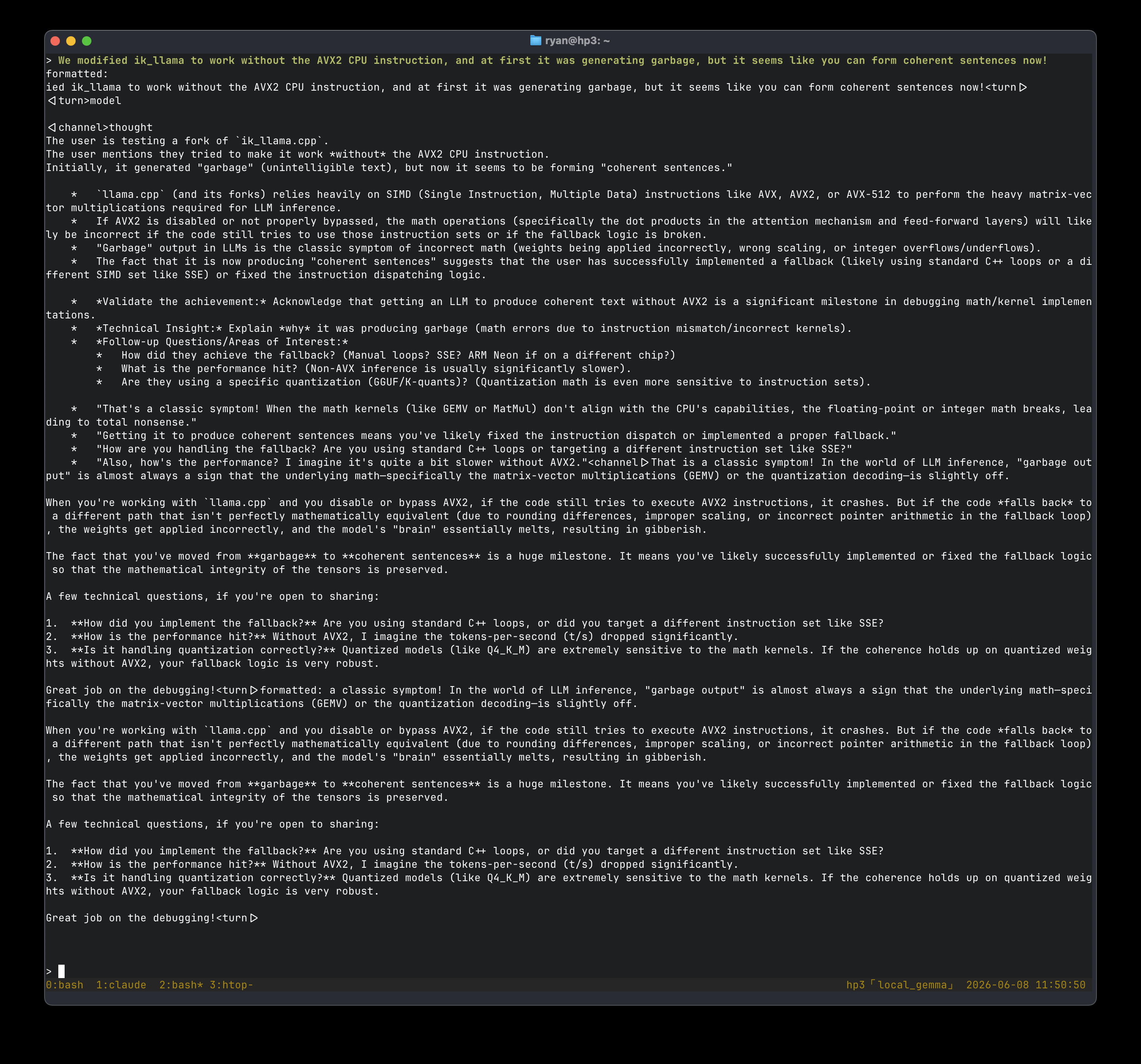
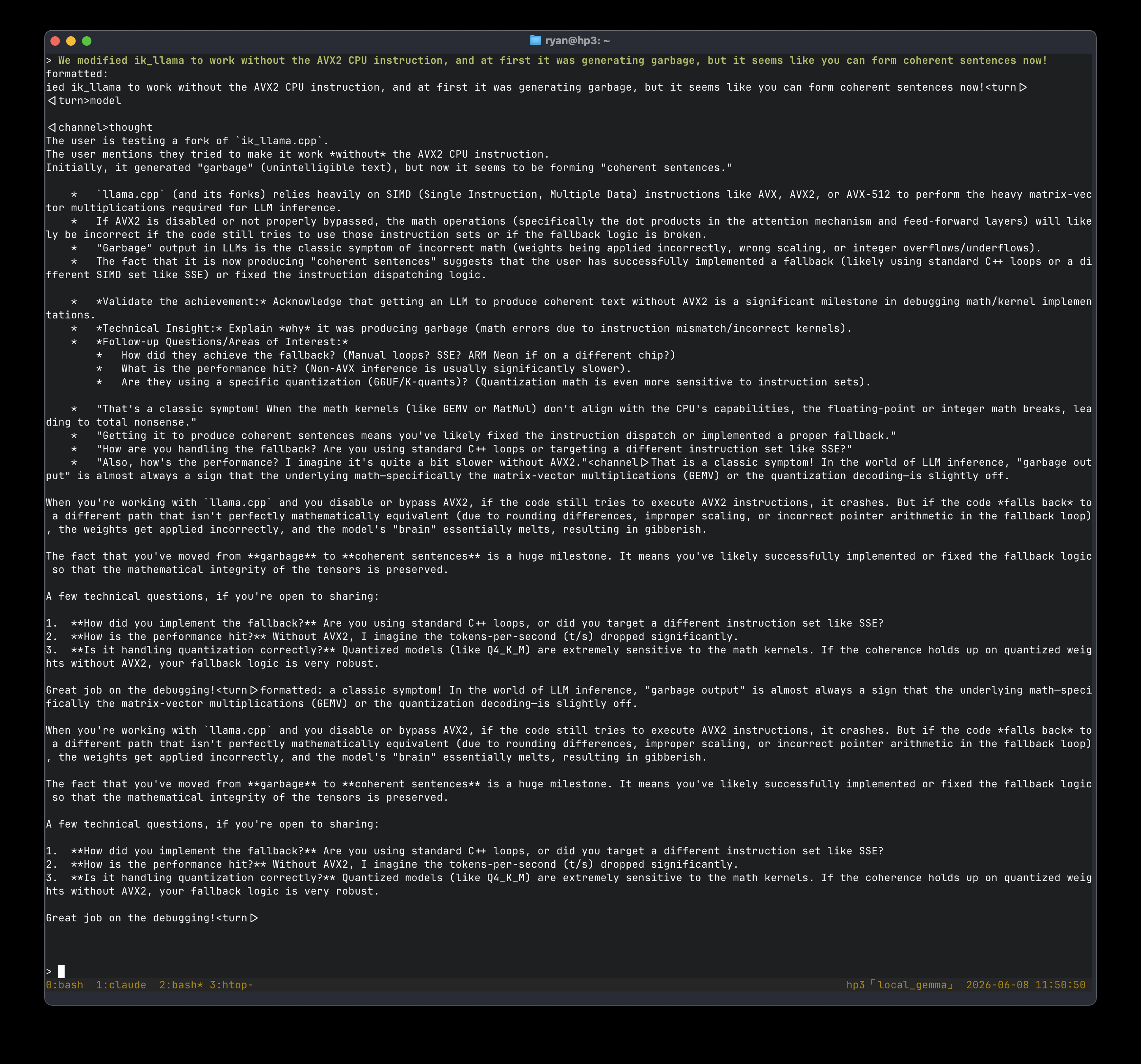
Claude read someone else’s code, diagnosed the cause — his CPU was an older generation than the other person’s and lacked AVX2, and two critical compute paths in the code were hard-coded to “require AVX2 to proceed.” Worse, those two paths would silently skip — the program looked like it was running normally, but its output was already gibberish. Claude’s description of the phenomenon is delightful: “The model outputs Thai, Korean, garbage tokens, and fragments of English with equal cheer.” Like someone whose brain has been addled with paste — it’ll say anything, but nothing it says is right.
Then the author did something rarer still: he had Claude rewrite those two code sections, changing the hard “must have AVX2” requirement into “use it if present, otherwise take the slow fallback path.” Three patches later, the model went from gibberish to clear, fluent English answers.
Throughout, the author played the role of “experimenter” and “judge” — running tests, watching output, judging “is this result correct.” The one actually editing the code was another AI, on another machine.
One AI fixed another AI’s code on old hardware. A CPU from thirteen years ago and a model released months ago reached a truce, brokered by a middleman.
Slow, But Good Enough
What does 5 tokens per second mean? ChatGPT’s paid tier typically outputs 30 to 60 tokens per second, sometimes over 100 at peak. Five tokens is roughly the speed at which you’d slowly read an article on the subway.
For everyday chat it’s obviously not enough — you could brew a cup of tea while waiting for its reply. But the author proposed a few realistic scenarios: a fallback when a paid API (programmatic interface) goes down; or running unhurried batch jobs — say, letting it process a batch of documents overnight and checking the results the next morning. In those scenarios, slowness isn’t the problem — whether it can run at all is.
In the HN community, someone offered a more optimistic prediction: by mid-2027, models above 200 billion parameters will be able to run on ordinary consumer hardware. Skeptics cautioned that more parameters doesn’t equal more capable — an over-compressed model’s quality suffers. But both sides shared a clear consensus: large models are sinking down from the cloud faster than most people expected.
Sky-High GPUs vs. Discarded CPUs
For the past two years, an unspoken equation in AI circles has been: do AI = buy GPUs = burn money. NVIDIA’s H100 accelerator sells for thirty to forty thousand dollars a card, and enterprises buy them by the hundreds and thousands. The entry ticket to AI comes with a price tag.
But this blog post opened a different window. A $300 pile of scrap, with no accelerator card plugged in, still ran a 26-billion-parameter model. It isn’t a replacement — at 5 tokens per second, it’s far from cloud service in speed and quality. It’s more of a proof of existence: proof that the barrier isn’t as high as imagined, proof that “you must have the latest hardware” isn’t absolute truth.
That tension runs through the entire discussion. On one side, the cloud-AI empire propped up by sky-high GPUs — fast, powerful, expensive. On the other, the old server in the basement — slow, clumsy, but free. It overturns nothing, and hardly counts as a revolution, but it does temporarily detach AI from the default option of “pay for a subscription,” showing another possibility.
What Does This Have to Do With Us?
You probably won’t go buy a thirteen-year-old server to run AI at home. But the real signal this blog post sends has little to do with that $300 price tag.
What’s truly worth noting is the process that brought the 13-year-old machine back to life. A person who can’t write low-level code, with help from another AI, read a stranger’s code, located a deeply hidden bug, and wrote a patch. This isn’t “one-click fix” magic — the author repeatedly ran experiments, compared outputs, and removed confounding factors until he was sure the result was correct. The AI did the hardest mental labor, but the one deciding “is this actually right” was always a human.
I’d argue this is the quietest yet most important part of the whole affair. As AI’s reasoning grows stronger, the gap is widening between “can you write code” and “can you make the machine do the right thing.” That latter ability is sometimes just a person willing to stare at an error log at 2 a.m.
And that person doesn’t have to sit in a Silicon Valley office. He can be in a basement, keeping watch over a server that should have been retired thirteen years ago.
References:
- NeoMind Labs: Running Gemma 4 26B on a 13-year-old Xeon
- HN discussion (item?id=48922434)
- “A 10 year old Xeon is all you need” (the project that inspired this article)