
On September 30, 2026, Margaret Hamilton, the computer scientist who led the flight software development for NASA’s Apollo missions, passed away at the age of 90. On July 20, 1969, as the Apollo 11 Lunar Module Eagle was just minutes from touching down on the lunar surface, its onboard Apollo Guidance Computer flashed a 1202 overload alarm. A misplaced rendezvous radar switch flooded the computer’s memory with an avalanche of extraneous cycle-stealing data, threatening to choke the landing sequence. Yet the alarm never turned into an abort command. The software had been designed in advance to know exactly what to shed under severe overload—it dropped low-priority tasks and reserved its processing cycles for thruster and attitude control.
The architect behind this priority-scheduling logic was Margaret Hamilton. She was the Apollo project’s very first programming hire, and by 1968 she led a 400-person software team at the MIT Instrumentation Laboratory responsible for the flight code governing both the Command and Lunar Modules. That the Lunar Module was able to continue its descent in those harrowing final minutes was because Hamilton had codified an unyielding reality into the system’s design premise: humans will inevitably make mistakes.
Weather Forecasting and Radar Defense: Laying the Foundations of Error Prevention
Hamilton’s obsession with fault tolerance was forged long before she joined Apollo. In 1958, she earned a bachelor’s degree in mathematics from Earlham College. She subsequently joined MIT’s Department of Meteorology, working alongside Edward N. Lorenz to develop software for numerical weather forecasting. Meteorological calculations were acutely sensitive: tiny initial errors compounded through iterative cycles into wildly divergent outcomes, laying the empirical groundwork for chaos theory. Writing code for that environment gave Hamilton an intuitive grasp of how fundamentally fragile complex systems are when exposed to unexpected input variations.
In 1961, she moved to MIT Lincoln Laboratory to work on SAGE (Semi-Automatic Ground Environment), the United States’ first continental air defense system. Developing radar data processing software for the massive AN/FSQ-7 prototype computer raised the stakes dramatically: a software crash no longer meant an inaccurate weather prediction, but a potential military catastrophe. In an era when engineering culture remained almost entirely preoccupied with hardware manufacturing and treated software reliability as an afterthought, these high-stakes experiences convinced Hamilton that code could never assume ideal operating conditions. Engineers had to treat anomalous, unpredictable input data as the primary failure mode to guard against.
In 1965, answering a newspaper advertisement, Hamilton became the first software hire for the Apollo program. Bringing a pragmatic, deeply skeptical perspective on system reliability honed across meteorology and air defense, she began injecting strict fault-tolerance principles into an aerospace program that still favored booster rockets over lines of code.
A Four-Year-Old Crashes the Simulator: Forcing Defensive Programming into Reality
The core fault-tolerant logic that later made history during Apollo 11 originated from a classic instance of user error. Hamilton occasionally brought her four-year-old daughter, Lauren, to the lab during late-night sessions. One evening, while playing with the Command Module simulator’s display and keyboard (DSKY), the young girl pressed a key sequence that triggered program P01—the pre-launch initialization routine—while the simulated spacecraft was already in flight. The simulator crashed immediately.
The incident exposed an alarming architectural vulnerability. Yet when Hamilton proposed adding defensive checks to intercept and block illegal flight commands like P01 during flight, NASA management and hardware engineers pushed back. Their reasoning was straightforward: Apollo astronauts were elite, exhaustively trained professionals who would never press the wrong switch. They rejected her proposal, dismissing the defensive routines as unnecessary code bloat.
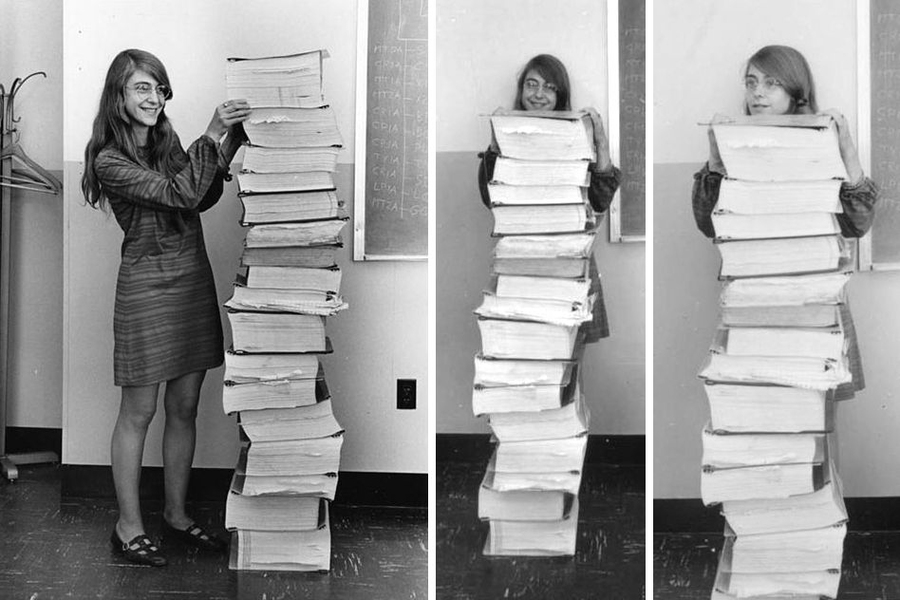 Figure: In 1969 at MIT, a young Margaret Hamilton stands beside the towering stack of printed Apollo flight software listings. Source: MIT News
Blind faith in human execution did not last long. In December 1968, during the Apollo 8 mission, astronaut Jim Lovell accidentally executed P01 while navigating in translunar space, wiping the spacecraft’s critical navigation and alignment data. Mission controllers scrambled for hours to reconstruct the state vectors and upload them back to the spacecraft. The near-disaster forced NASA to reverse its stance: Hamilton’s defensive safeguards were promptly approved and integrated into the flight software. It stood as one of the earliest and most consequential victories for defensive programming in software history.
Coining “Software Engineering”: Fighting for Architectural Parity
In the mainstream engineering culture of the 1960s, software development was barely recognized as an engineering discipline. To NASA and the broader aerospace establishment, the Apollo program was about massive Saturn V boosters and intricate mechanical gyroscopes; writing code was often relegated to clerical work, viewed as little more than secretarial punch-card typing.
To secure the resources, rigorous verification cycles, and parity required for software that controlled human lives, Hamilton coined the term “software engineering.” She argued tirelessly across meetings and reviews that software deserved equal weight to hardware, demanding matching testing pipelines and formal validation processes. In a 2018 interview, she recalled that colleagues initially treated the concept as an inside joke—the idea of equating programming with “engineering” sounded absurd to traditional engineers.
The sheer scale of Apollo quickly silenced skepticism. As Hamilton’s software team swelled to more than 400 engineers, every line of logic woven into core rope memory governed the nervous system of the spacecraft. The immense volume of code and unforgiving real-time requirements forced the industry to abandon its biases, defining the rigorous disciplines and standards that underpin modern software engineering.
Shedding Non-Critical Work: The Algorithmic Grace of the Lunar Landing
The ultimate validation of Hamilton’s architecture came in the final minutes of Apollo 11. As Neil Armstrong and Buzz Aldrin guided the Eagle toward the lunar surface, 1202 and 1208 program alarms repeatedly sounded. A hardware anomaly—the rendezvous radar switch was left in an unintended position—flooded the Apollo Guidance Computer with stolen cycles, threatening to saturate the CPU’s limited computational queue.
Here, the asynchronous executive and priority-scheduling architecture built by Hamilton’s team proved decisive. The computer recognized that it was overloaded, dropped low-priority tasks like the radar calculations, and dedicated its processor cycles exclusively to critical landing operations: thruster commands and attitude control. Mission Control in Houston, confident in the software’s priority recovery routines, called “GO.” Minutes later, humanity touched down on the Moon.
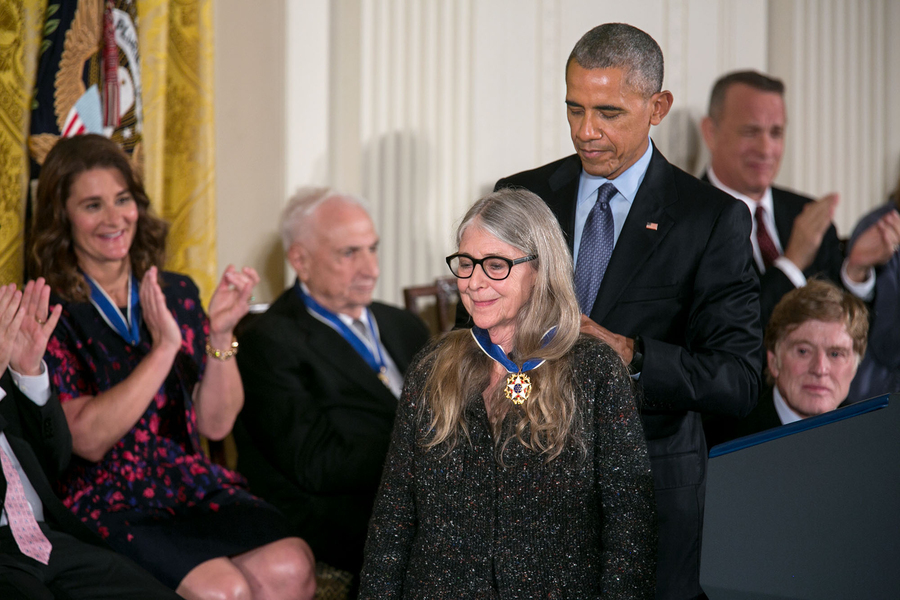 Figure: On November 22, 2016, President Barack Obama awards Margaret Hamilton the Presidential Medal of Freedom in the East Room of the White House. Source: The White House
Refusing to Gamble on Human Perfection: A Resilient Legacy
Following the triumph of the Apollo program, Hamilton continued her pioneering work in fault tolerance and formal systems. In 1976, she co-founded Higher Order Software (HOS), and later established Hamilton Technologies, creating the Universal Systems Language (USL) to eliminate software vulnerabilities before implementation begins. Over her career, she published more than 130 scientific papers, advancing the principles of error prevention throughout the technology industry.
Beyond the Presidential Medal of Freedom awarded by President Obama in 2016 and her immortalization in a 2017 LEGO minifigure, Hamilton’s most enduring legacy remains the lucid design philosophy embedded in her code. As Olivier de Weck, interim head of MIT’s Department of Aeronautics and Astronautics, remarked, calling her a pioneer is an understatement.
Her enduring contribution was an uncompromising design premise: systems must assume that hardware will fail and humans will make mistakes—and must decide in advance what to drop and what to preserve. The final descent of Apollo 11 remains the definitive real-world proof of that principle.
References:
- MIT News Obituary
- Hacker News Discussion
- El País 2018 Interview
- MIT News 2009 Apollo Oral History