📰 Tech Trends Daily — Monday, June 22, 2026
Today’s Keywords: Claude identity verification, CORS misconceptions, AI skill degradation, the craftsmanship counterstrike Data sources: HN Top 30 + Lobsters Top 25, 25 clustered items
🔥 Today’s Focus
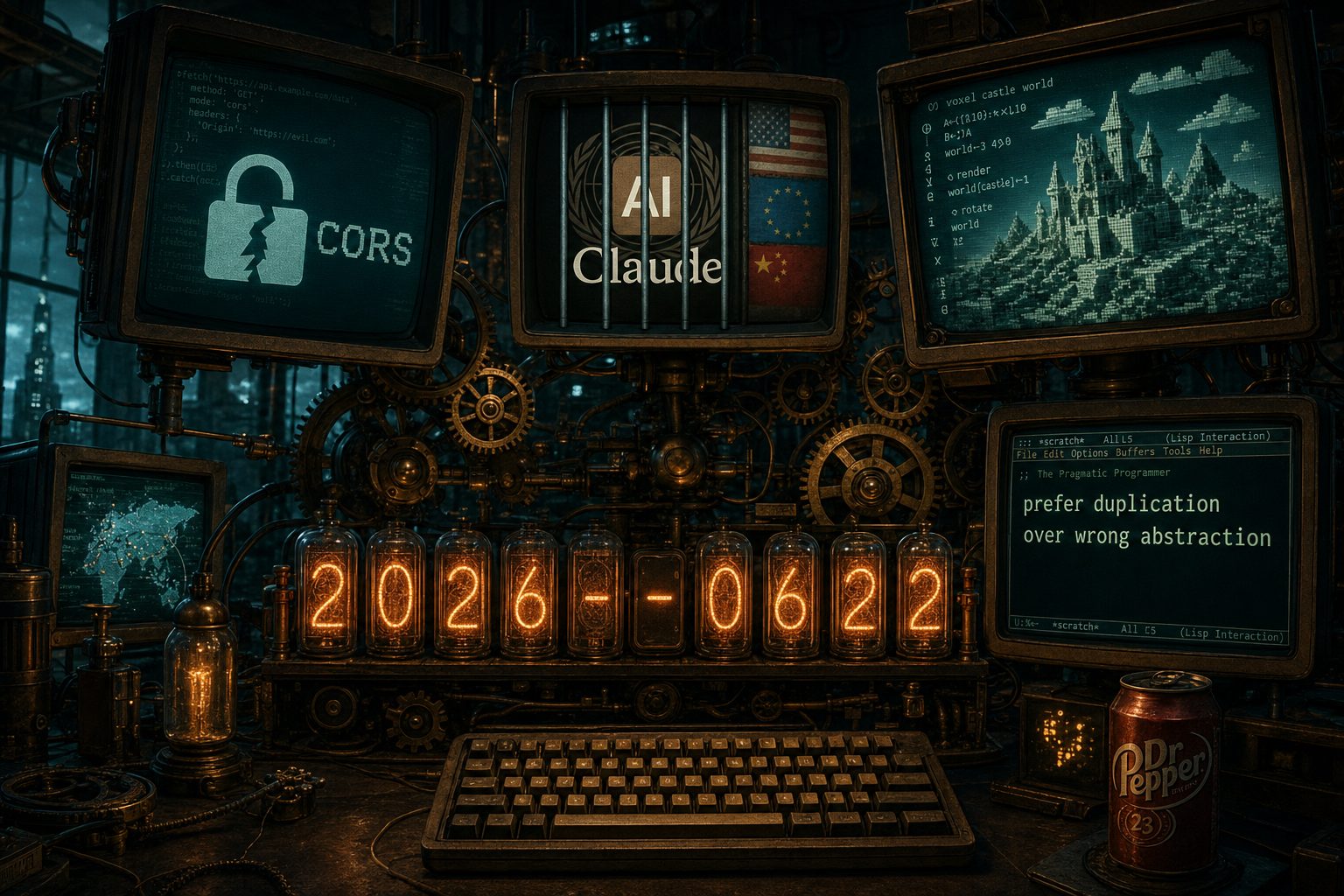
Two parallel currents collided on HN’s front page today. On one side: Claude’s mandatory identity verification — Anthropic integrated Persona for US identity checks, triggering a mass exodus of non-US users to Mistral Vibe, turning the comment section into a live alternative-evaluation forum. On the other: a 2019 article about CORS misconceptions racking up 505 points — twenty years later, even the author of a CORS explainer conflates “CORS blocks the request” with “CORS blocks reading the response,” and two hundred comments later, there’s still no consensus. The common thread: infrastructure-level design flaws are being exposed at scale, whether it’s the geopolitical fallout of AI region-locking or the cognitive debt of the web security model.
🤖 AI & LLMs
-
Claude Begins Mandatory Identity Verification — Non-US Users Flee En Masse — 490 pts / 449 comments (HN). Anthropic integrated Persona for identity checks, locking out non-US users.
- 💬 The thread: a highly-upvoted user detailed their migration from Claude to Mistral Vibe — Mistral is actually stronger on writing tasks, though still behind on code. The conclusion: “The US is breeding its own international competitors through region-locking.”
-
Apertus: Open Foundation Model for Sovereign AI — 93 pts / 22 comments (HN). The mirror image of Claude’s region-lock — non-US powers accelerating their own open model efforts.
-
Is AI Ruining Our Skills? Early Results Are In and They’re Not Good — 63 pts / 38 comments (Lobsters). Nature published preliminary evidence that AI assistance causes skill degradation.
- 💬 The thread: lcamtuf identified three layers of concern — accountability (skills degrade but legal liability doesn’t), outsourcing of fundamentally human abilities, and AI as a “homogenization amplifier” — you gain efficiency, but you lose all individual differentiation.
-
Effective Use-Cases for LLMs — 14 pts / 12 comments (Lobsters). A sober, neither-hype-nor-doomer inventory of where LLMs actually help.
-
Recall: Stop Re-Explaining Your Project Between Sessions — 39 pts / 29 comments (HN). A project context memory tool for coding agents — solves the pain of re-introducing your codebase from scratch every new conversation.
-
What’s the Advice for LLM Poisoning of Artwork These Days? — 10 pts / 9 comments (Lobsters). A reality check on Glaze/Nightshade effectiveness — community consensus is that these tools offer very limited protection.
🌐 Web & Security
-
Developers Don’t Understand CORS (2019) 🔥 — 505 pts / 250 comments (HN). A 2019 article resurfaces, and 505 points confirms the pit is still swallowing developers two decades in.
- 💬 The thread: the top comment points out the author themselves got it wrong —
Access-Control-Allow-Origindoesn’t block requests, it only controls whether the response can be read. But the runner-up immediately counters: for non-idempotent requests, the preflight does indeed block the request from being issued. These two camps fought for two hundred comments. A correct mental model of CORS still has no consensus.
- 💬 The thread: the top comment points out the author themselves got it wrong —
-
JSON-LD Explained for Personal Websites — 129 pts / 34 comments (HN). A clean, structured JSON-LD tutorial with practical takeaways.
-
Loupe: An iOS App That Reveals What Native Apps Can See — 245 pts / 143 comments (HN). Mysk’s privacy auditing tool exposes the range of sensitive data system apps can access.
-
Improvements to std::format in C++26 — 10 pts (Lobsters).
std::formatgains native formatting support for ranges,std::expected, and more in C++26. -
What Can Wonky APIs Tell Us About the Web? — 1 pt (Lobsters). Reverse-engineering platform constraints and trade-offs from poorly designed web APIs.
💻 Programming Languages & Development Practice
-
Prefer Duplication Over the Wrong Abstraction (2016) 🔥 — 400 pts / 269 comments (HN). Sandi Metz’s classic resurfaces — at a moment when AI is churning out code that “looks right,” “wait before you abstract” has never been more relevant.
- 💬 The thread: high-scoring comments wrestled with the tension between the “single source of truth” principle and the argument that “locality is the only property that matters.” The core conflict: when are two blocks of code that look the same actually the same?
-
(How to Write a (Lisp) Interpreter (In Python)) (2010) — 158 pts / 46 comments (HN). Peter Norvig’s classic tutorial keeps getting voted to the front page — the community is actively rejecting AI slop with its actions.
-
OCaml 5.5.0 Released — 91 pts / 2 comments (Lobsters). Major improvements in runtime and performance; continued multicore refinement.
-
Is Anyone Still Using Emacs? — 71 pts / 58 comments (Lobsters). The author’s motive for writing this is interesting — it’s not a genuine question, but a jab at management’s recent “discovery” of CLI tools.
- 💬 The thread: the author explained that coding agents are forcing management to touch the command line. tmux is their first stop; Vim and Emacs will be next. “These tools have existed for decades. Maybe there’s a reason those ‘10x developers’ kept using them.” Another comment: “This is the one silver lining of the slop bubble — plain text is becoming a viable medium again.”
-
A 3D Voxel Game Engine Written in APL 🔥 — 349 pts / 250 comments (HN). A complete voxel rendering engine built in APL’s symbol-dense syntax — community reaction split perfectly down the middle: half marveled at its elegance, half admitted they couldn’t read a single line.
-
cl-bbs: A SchemeBBS-Like Textboard Rewritten in Common Lisp — 9 pts / 2 comments (Lobsters). A retro BBS-style text forum implemented in Common Lisp.
-
Optimizing #[sqlx::test] Rebuild Time — 9 pts (Lobsters). A practical Rust sqlx test macro recompilation optimization — from 45 seconds down to 3.
🛠️ Tools & Infrastructure
-
postmarketOS v26.06 (Alpen Avocado) Released — 26 pts / 6 comments (Lobsters). The Alpine Linux-based mobile OS improves support for multiple older Android devices.
-
An Embedded Linux on a Single Floppy — 50 pts / 21 comments (HN). A complete Linux system (kernel + busybox) fitting on a single 1.44 MB floppy — minimalism taken to its logical extreme.
-
Announcing the Next Generation of Distrobox — 25 pts / 3 comments (Lobsters). A major upgrade to the containerized Linux distro-switching tool, now rewritten in Go.
-
Performance Improvements in libffi — 20 pts / 3 comments (Lobsters). Trampoline optimizations for FFI calls — critical for JIT and dynamic language runtimes.
-
Robust Jobserver — 14 pts / 1 comment (Lobsters). A modern Rust reimplementation of the GNU Make jobserver protocol.
🎮 Fun & Offbeat
-
Beyond All Reason: Free Total Annihilation-Inspired RTS 🔥 — 409 pts / 242 comments (HN). A free, open-source, Total Annihilation-style RTS with an astonishing technical implementation.
- 💬 The thread: the community manager personally responded to complaints about player toxicity, acknowledging some lobbies are hyper-competitive and recommending newcomers try “rotato” mode rooms — rotating maps, more forgiving play.
-
Minecraft Java Edition 26.2: First Version With Vulkan 1.2 — 42 pts / 4 comments (HN). Minecraft Java Edition finally migrates from OpenGL to Vulkan.
-
Show HN: TownSquare — A Tiny Presence Layer for Websites — 204 pts / 143 comments (HN). Adds a micro-presence layer to any website so visitors can see each other’s presence.
📝 Daily Wrap
Today’s HN felt like a laboratory being pulled in two opposite directions. One force is the anxiety of AI acceleration — Claude region-locking, skill atrophy data, LLM homogenization — none of these are hypothetical anymore. The other is a craftsmanship renaissance — Sandi Metz’s “prefer duplication over the wrong abstraction” resurfacing to 400 points, an APL voxel engine at 349 points, Norvig’s Lisp tutorial and the Emacs discussion both charting simultaneously. This isn’t coincidence: the community is telling the AI era, in the language of classics, “before you abstract, understand what you’re actually doing.” Recommended reading order: the CORS mega-thread (505 points — understand the cognitive debt of web security) → the Claude region-lock discussion (grasp a turning point in AI geopolitics) → AI skill degradation (Nature, data-backed fears, not vibes). A cross-cutting signal worth noting: the Emacs thread’s observation that “coding agents are forcing management to learn the CLI” — AI tools are, in a deeply unexpected way, bringing the command line back into the mainstream.