🔥 Today’s Focus
Friday’s HN was dominated by the deciphering of a 2,000-year-old scroll — 820 points, the only post to break 800 today. The Vesuvius Challenge team successfully read an entire Herculaneum papyrus using synchrotron X-ray scanning and ML, with team members showing up in the comments to answer questions in real time — an unusually rich technical deep-dive. Meanwhile, two economic signals ran in parallel: Apple raised prices across its entire product line by 15–25% (567 pts, 823 comments igniting heated debate), and OpenAI delayed its IPO until next year (614 pts). The former is part of a broader consumer electronics price wave — commenters noted Microsoft’s Xbox also saw its third price hike on the same day, and Sony’s PlayStation had gone up two months earlier — with tariffs and memory chip costs as the common drivers. The latter exposed growing divergence in market confidence around AI valuations: Anthropic is seen as having momentum, while OpenAI is perceived to have peaked. Lobsters’ vibecoding reflection wave rolled into its fourth straight day — “The Joy and Power of Understanding” at 66 pts, “The Exhaustion of Talking to a Tool” at 28 pts — combined with Armin Ronacher’s “The Coming Cycle” from earlier in the week, the coding community’s collective rumination on AI-assisted development has become a sustained narrative.
🤖 AI / LLM / Vibecoding
-
OpenAI Leans Toward Waiting Until Next Year for IPO — 614pts / 143💬 (HN). NYT reports: SpaceX’s stock volatility serves as a cautionary tale, and Sam Altman’s advisory team recommends waiting for market sentiment to improve. 💬 Comments suggest the window has largely closed — the business math doesn’t support the valuation. But unless Anthropic also cancels its IPO, the core issue isn’t the industry — it’s OpenAI itself. The market sees Anthropic as having momentum; OpenAI is seen as having peaked.
-
Political bias in AI: Where the AI models stand — 48pts / 23💬 (HN). A quantitative test of political leanings across major AI models, presented as a coordinate distribution map. The methodology of this kind of research is deeply contested — prompt phrasing, classification frameworks, and test set selection all influence results.
-
The Exhaustion of Talking to a Tool — Lobsters 28pts / 12💬 (Lobsters). A new name for a familiar symptom of vibecoding fatigue: the cognitive burden of continuously describing requirements to an AI, especially when the tool fails to grasp context, becomes exhausting in itself.
-
The Joy and Power of Understanding — Lobsters 66pts / 21💬 (Lobsters). A direct pushback against vibecoding worship: true understanding of underlying principles is what makes you competitive. 💬 The author responds in the thread. Another sharp comment notes that AI labs have economic incentives to erode user skills — dependency is the foundation of valuation. Someone quotes Fred Brooks’ “The Joys of Programming” in support of the article.
-
Vibecoding gets Emacs patch rejected — Lobsters 19pts / 35💬 (Lobsters). The submitter honestly noted the patch was AI-generated, and the Emacs maintainer rejected it outright — “We’re reviewing your thinking, not the model’s output.” 35 comments discuss how open-source maintainers should handle the influx of AI-generated contributions.
-
tropius: detect AI tropes in prose — Lobsters 18pts / 11💬 (Lobsters). A Rust-written AI text detection tool, specifically trained to flag telltale AI vocabulary like “delve,” “tapestry,” and “testament.”
-
Echoes of the AI Winter — Lobsters 2pts / 0💬 (Lobsters). Examines the current LLM boom through the lens of Lisp and AI history, reminding readers that past AI winters often arrived right after the loudest hype cycles.
🔬 Science & Tech Breakthroughs
-
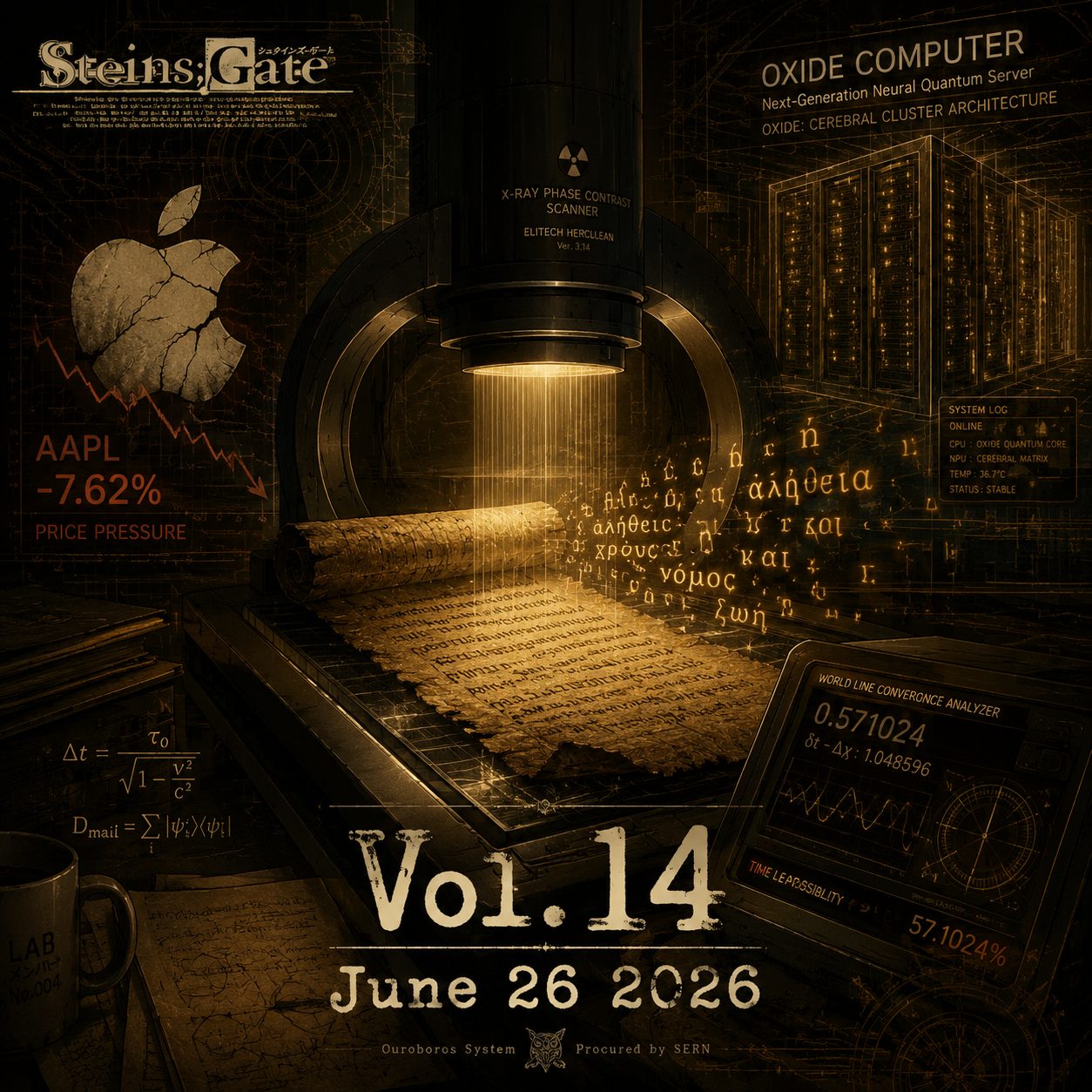
An entire Herculaneum scroll has been read for the first time — 820pts / 190💬 (HN). 🔥 Highest score of the day. The Vesuvius Challenge team used synchrotron X-rays to layer-scan carbonized scrolls, with ML models identifying texture differences left by carbon-based ink, successfully reconstructing Philodemus’ philosophical text. 💬 Team members answered questions live — carbon-based ink creates measurable micro-texture differences detectable through physical rendering models. The ML model has hallucination risks at the individual character level (filling in strokes, extending brush marks) but cannot fabricate full paragraphs. Methodologically similar to the CT-scan restoration of the Dead Sea Scrolls, but an order of magnitude more difficult.
-
IBM debuts sub-1 nanometer chip technology — 236pts / 138💬 (HN). IBM claims a breakthrough past the 1nm physical limit, though few process details were disclosed. 💬 EE practitioners in the comments are skeptical — “1nm” in semiconductor marketing has long since detached from physical gate length, becoming a node naming convention.
-
Un-0: Generating Images with Coupled Oscillators — 66pts / 6💬 (HN). A non-neural-network image generation approach: using physics simulations of coupled oscillator systems to produce visual patterns, with zero backpropagation. Closer to computational art than a practical tool, but a fascinating line of thinking.
-
How physicists track and trap the elusive neutrino — 20pts / 23💬 (HN). Quanta Magazine’s in-depth explainer on cutting-edge neutrino detection technologies.
🍎 Companies & Business
-
Apple raises prices of MacBooks, iPads across the board — 567pts / 823💬 (HN). Increases of 15–25%: MacBook Air from $1,099 to $1,299, base iPad from $349 to $449, Mac Studio M3 Ultra from $3,999 to $5,299. 💬 Key context from comments: This isn’t an Apple-exclusive story. Microsoft’s Xbox saw its third price hike on the same day ($100–$150), Sony’s PlayStation went up two months ago, and the Switch 2 won’t escape either. RAM and storage chip costs have risen 2.5x since late 2025 and are projected to rise another 2.5x by the end of 2027. This is an industry-wide tsunami of tariffs and supply chain costs hitting all of consumer electronics.
-
Om Malik has died — 220pts / 21💬 (HN). Om Malik, founder of GigaOM and pioneer of tech media, passed away at age 60. One of the earliest independent bloggers to cover Silicon Valley seriously, his influence spanned from the Web 2.0 era through the age of AI.
🛠️ Tools & Infrastructure
-
Oxide computer 3D rack guided tour — 253pts / 107💬 (HN). Oxide released an interactive 3D rack browser for its cloud servers. 💬 Remarkable comment sentiment: multiple engineers noted this is “the only company I can’t find a reason not to want to work for.” Some compared Oxide to “modern Sun Microsystems” — vertically integrated hardware engineering culture that’s nearly extinct in the AWS era.
-
Show HN: OpenKnowledge – open source AI-first alternative to Obsidian/Notion — 151pts / 74💬 (HN). A local-first, AI-integrated knowledge management tool directly targeting Obsidian and Notion. Open-source is the differentiator, but the real moat for this category has never been features — it’s user migration costs.
-
RRB-Trees: Efficient Immutable Vectors (2012) — 164pts / 82💬 (HN). A classic 2012 data structures paper resurfacing on the front page. RRB-Trees form the theoretical foundation for persistent vectors in Clojure and Scala. 💬 Discussion around why it took a decade for this to get widespread attention — likely because immutable data structures’ practical utility in modern concurrent programming is finally being broadly recognized.
-
I built a GPU back end for Emacs — 78pts / 30💬 (HN). Using GPU acceleration for Emacs rendering — sounds like using a sledgehammer to crack a nut, but the author demonstrates significant improvements in scrolling and redraw performance.
-
Tw-fade: pure CSS scroll-driven edge masking — 124pts / 101💬 (HN). An elegant Tailwind plugin that uses CSS scroll-driven animations to create gradient fade-out effects at content edges, with zero JavaScript. Another expansion of CSS’s capability boundaries.
-
GloriousEggroll’s Proton has been rebased on Proton 11 — 44pts / 9💬 (HN). A significant update to the Linux gaming compatibility layer — GE-Proton11-1 syncs with all improvements from Valve’s upstream Proton 11.
-
Deno Desktop — Lobsters 16pts / 2💬 (Lobsters). Exploring cross-platform desktop application development with Deno, going head-to-head with Electron but leveraging Deno’s permission model and security sandbox.
-
Announcing Silk: a silky smooth fiber runtime for ClickHouse — Lobsters 2pts / 0💬 (Lobsters). ClickHouse built a custom user-space thread scheduler for its C++ codebase, using fibers to replace traditional thread pools and reduce context-switching overhead.
💻 Programming & Development
-
You can’t unit test for taste — 230pts / 113💬 (HN). Argues that “taste” in code review cannot be automated — type checking, linting, and test coverage can ensure correctness, but elegance, readability, and architectural intuition still require human judgment. In an era of AI coding tools flooding the landscape, this article’s resonance suggests people are acutely aware of the taste problem in auto-generated code.
-
Zig’s new bitCast semantics and LLVM back end improvements — 201pts / 78💬 (HN). Zig development log:
@bitCastsemantics shift from “reinterpret bits” to stricter type-safety constraints, alongside multiple LLVM backend optimizations improving compile-time performance. -
An oral history of Bank Python (2021) — 38pts / 8💬 (HN). A retrospective on how Python evolved inside investment banks — why bank Python looks so different from open-source Python (custom ORMs, custom schedulers, internal package indices) and how these systems accumulated billions of dollars in technical debt.
-
Parallel Parentheses Matching — 31pts / 4💬 (HN). Using parallel algorithms to accelerate parentheses matching — a textbook algorithm engineering case study showing how to parallelize what seems like an inherently sequential problem.
-
The annotated PyTorch training loop — 47pts / 9💬 (HN). A line-by-line annotation of every step in the PyTorch training loop, from
zero_grad()tooptimizer.step()— ideal for anyone wanting to understand the underlying training mechanics. -
Free-threaded Python: past, present, and future — Lobsters 20pts / 0💬 (Lobsters). A comprehensive technical assessment of the free-threaded (GIL-free) mode introduced in Python 3.13.
-
Porting WINE to a new Hobby OS — Lobsters 49pts / 4💬 (Lobsters). A technical journey of porting WINE to a custom operating system, covering PE loaders, NT syscall emulation, and extensive compatibility layer work. A watershed milestone for hobby OS developers.
-
Scaling Rails: 41M Req/Hour, 8 DBs, disable_joins: true — Lobsters 16pts / 8💬 (Lobsters). Production practices for pushing a Rails monolith to 41 million requests per hour — banning JOINs, splitting across 8 databases, and doing application-level aggregation.
-
How to Write an Effective Software Design Document — Lobsters 30pts / 4💬 (Lobsters). A guide to writing Google-style design documents, providing a complete framework from problem statements to alternative evaluation.
🔒 Security & Privacy
-
The ‘papers, please’ era of the internet will decimate your privacy — 116pts / 34💬 (HN). FIRE’s (Foundation for Individual Rights and Expression) analysis: age verification laws being rapidly adopted worldwide are turning the internet into a “papers, please” border checkpoint. The loss of privacy and anonymity isn’t a side effect — it’s the design goal.
-
Ignore DNSSEC if you like MITM attacks — Lobsters 19pts / 20💬 (Lobsters). The title says it all. A detailed breakdown of the real-world attack surface of DNS spoofing and man-in-the-middle attacks when DNSSEC validation is not enabled.
🎮 Light / Fun / Culture
-
Show HN: Chess-Inspired Roguelike — 177pts / 66💬 (HN). Integrates chess piece movement rules into roguelike dungeon exploration — knights move in L-shapes, bishops on diagonals. A delightful fusion of board game strategy and dungeon crawling.
-
OS9Map: OpenStreetMap on Mac OS 9 — 155pts / 21💬 (HN). A nostalgia project rendering modern map tiles on System 9. The appeal of retro computing: running today’s services on yesterday’s hardware and software.
-
The disappearance of Japan’s animators — 92pts / 193💬 (HN). The Economist’s investigation into Japan’s animation talent crisis — low pay, overwork, and AI replacement anxiety are driving practitioners away in droves.
-
A game where you’re an OS and have to manage processes, memory and I/O events — 27pts / 7💬 (HN). A game simulating OS scheduling — manually manage processes, allocate memory, handle I/O interrupts. An OS teaching tool disguised as a game.
-
Advanced Nintendo Entertainment System (ANES) – NES Modded to Use 2 PPUs — 59pts / 36💬 (HN). Adding a second Picture Processing Unit to the NES, breaking through the original hardware’s sprite and layer limitations. Hardware modding at its finest.
-
Show HN: I made Google Trends for Hacker News by indexing 18 years of comments — 27pts / 6💬 (HN). Indexes 18 years of HN comments, allowing users to track discussion heat and trend changes for any technical keyword.
-
The anxiety of the perfect loaf: the illusion of culinary precision — 72pts / 30💬 (HN). Using baking as a lens to critique the culture of quantification — flour humidity, ambient temperature, yeast activity — uncontrollable variables that make “precise recipes” an illusion. Engineering thinking invading the kitchen, redux.
-
Show HN: Turn native language audio into flashcards and shadowing practice — HN (HN). A language learning tool that auto-segments real native speaker audio into repeatable practice clips.
-
The Xteink X4 E-Ink Reader — Lobsters 56pts / 41💬 (Lobsters). An in-depth review of a niche E-Ink reader, sparking broad discussion about the state of the E-Ink device ecosystem.
-
Can I texture 3D objects with oil paint? — Lobsters 11pts / 0💬 (Lobsters). An experiment at the intersection of digital art and traditional painting — scanning real oil paintings as 3D textures.
-
AOL was down (1996) (2026) — Lobsters 37pts / 6💬 (Lobsters). Ngrok team’s nostalgic look back at AOL’s infamous 19-hour nationwide outage in 1996 and the distributed systems lessons learned. Three decades later, the root causes of that outage remain disturbingly common.
-
font-family recommendations — Lobsters 34pts / 27💬 (Lobsters). A carefully curated system font stack recommendation, selecting optimal fallback font combinations for each platform.
🏛️ Society & Labor
- UK Wikipedia Workers seek union recognition — Lobsters 73pts / 10💬 (Lobsters). 💬 Notable comment: Nonprofit labor practices are often worse than for-profit companies — mission-driven employees overextend themselves until burnout, then get replaced by new hires, in a relentless cycle. Unions don’t just protect workers; they protect the organization itself from this unsustainable churn.
🔧 Systems & Operations
-
Migrating from Proxmox to NixOS and Incus — 19pts / 4💬 (HN). (Lobsters 1pt). A migration report from the Proxmox stack to NixOS + Incus containers, complete with configuration snippets and pitfall summaries. Nix’s penetration into the homelab scene continues to grow.
-
Are We GlobalShortcuts Yet? — Lobsters 35pts / 9💬 (Lobsters). Tracking the progress of global shortcut standardization on Linux desktops — in the Wayland era, every app implementing its own keyboard shortcut strategy is increasingly unsustainable.
-
Structured Primary Keys — Lobsters 9pts / 0💬 (Lobsters). Examines the engineering tradeoffs and best practices for structured primary keys in database design — compound keys, ULID, Snowflake IDs, and more.
-
Flatpak.org Rewrite — Lobsters 3pts / 0💬 (Lobsters). The Flatpak website has been fully rewritten using modern web technologies.
📝 Summary
Friday’s community mood had a sense of historical depth — physics (neutrinos), archaeology (Herculaneum), media history (AOL’s outage), and retro hardware (OS9Map, dual-PPU NES) coexisting in a single day’s feed. The tech community briefly lifted its gaze to longer time scales than usual. But that didn’t stop two economic signals from drawing enormous attention: Apple’s price hike isn’t an isolated event but a symptom of an industry-wide cost tsunami, while OpenAI’s IPO delay marks the first visible crack in the AI bubble narrative. On Lobsters, the vibecoding discussion entered its fourth day without cooling — “The Joy and Power of Understanding,” a direct counter-narrative to AI dependency culture, continued to earn high scores as the coding community begins to pivot back from tool worship toward craft.
Must-read Top 3: Herculaneum Scroll (820pts — a technological miracle meets a human story), Apple Price Hike (567pts — a systemic shock to consumer electronics), Oxide 3D Tour (253pts — an alternative vision for modern hardware engineering).