Data sources: HN Top 30 + Lobsters Top 25. Browser is fine, comment section coverage includes HN Top 5 + Lobsters Top 5.
🔥 Today’s Focus
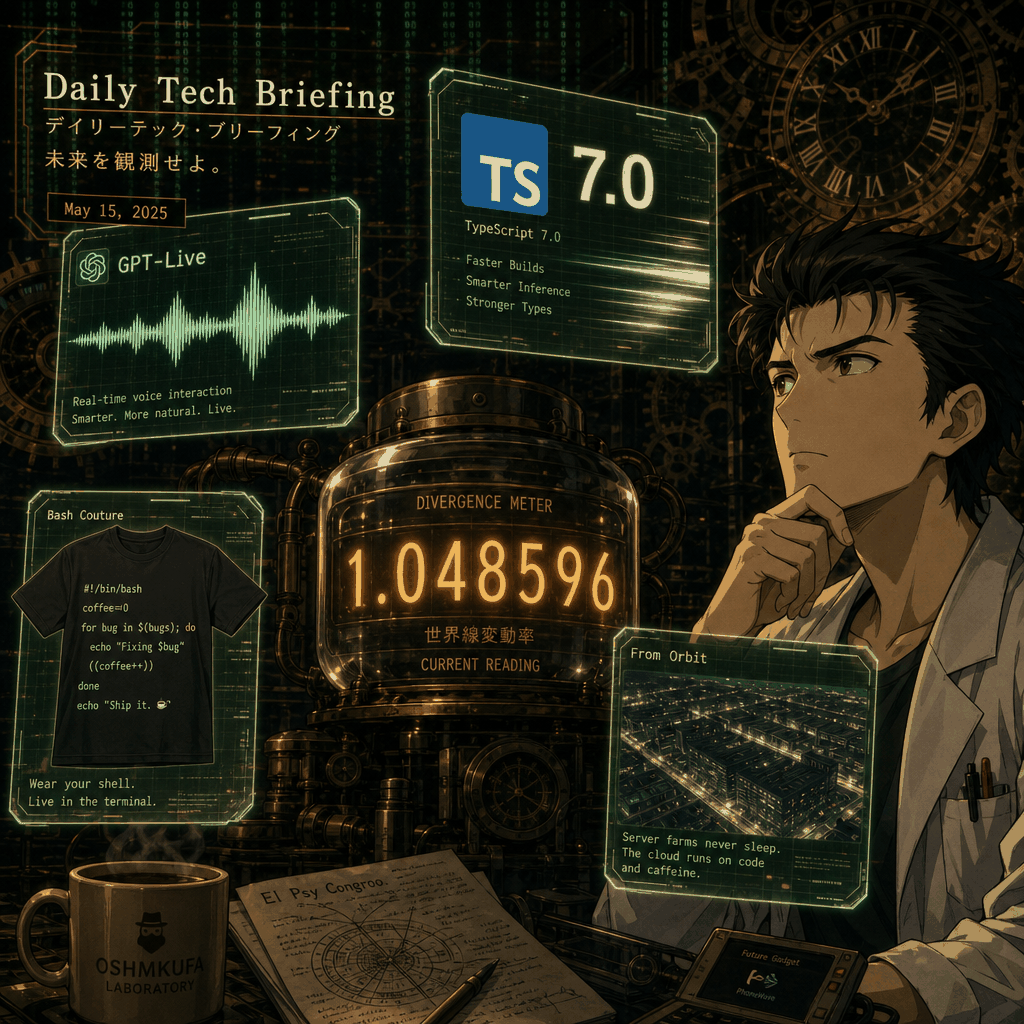
Today’s HN front page was divided by three main threads: a concentrated wave of AI voice/Agent product launches (GPT-Live, Grok 4.5, Robostral, and SWE-1.7 all hit the front page on the same day), the compiler earthquake brought by TypeScript 7’s official release (VS Code build times crushed from 125s to 10s), and an obfuscated Bash script printed on a Uniqlo T-shirt topping the charts at 1249 points — together, these signals form a perfect snapshot of the tech community’s spirit in July 2026: the first half is all about pushing AI interaction and language toolchains, the second half is a reminder not to take everything too seriously.
The TypeScript 7 comment thread had one recurring comparison: Microsoft’s team spent years on an incremental Rust rewrite, while Bun’s Zig→Rust migration was called a “vibecoding-level throwaway rewrite” by the community. This isn’t a debate about tech stack choices — it’s a public collision of two engineering cultures.
🤖 AI & LLM
- GPT-Live: OpenAI’s next-generation voice assistant — GPT-Live. 547 pts / 371 comments (HN). The core pitch: silently delegates complex questions to GPT-5.5 in the background — the voice model no longer lags behind the frontier text model. 💬 simonw (early tester) revealed a now-fixed bug where the model would interrupt the user mid-sentence and laugh, which “felt both rude and condescending.” Community concerns about “excessive personification” are also prominent — some want a Star Trek computer style, but the product leans more toward AI-friend interaction.
- Grok 4.5 released — Grok 4.5. 399 pts / 352 comments (HN). xAI’s latest model. Under 30% of the 352 comments are technical discussion — most of the thread devolved into debating model political bias. xAI’s credibility problem is becoming a real barrier to model adoption.
- Cognition releases SWE-1.7: approaching GPT-5.5 and Opus Intelligence — SWE-1.7 Reach Near GPT 5.5 and Opus Intelligence. 239 pts / 122 comments (HN). Cognition continues pushing forward on SWE-bench, with the latest version claiming to approach GPT-5.5 levels — but the comment section is questioning the possibility of benchmark hacking.
- Mistral releases Robostral Navigate: robot navigation model — Mistral’s Robostral Navigate. 381 pts / 89 comments (HN). Mistral enters the embodied AI race, releasing a SOTA robot navigation model. The lateral expansion path from LLMs to robot control is clear.
- Anthropic’s Fable safety classifiers are too zealous — The classifiers Anthropic puts in front of Fable are too zealous. 169 pts / 153 comments (HN). An independent research team found that Fable’s pre-filter safety classifiers have an excessively high rejection rate, making the model unusable for many normal tasks — an empirical case study of the “dark guardrails” problem.
- Separating signal from noise in coding evaluations — Separating signal from noise in coding evaluations. 108 pts / 44 comments (HN). OpenAI’s meta-analysis of LLM coding benchmarks — pointing out systematic flaws in current evaluation methods for distinguishing real capability from data contamination.
🔧 Languages / Compilers
- TypeScript 7 officially released — Announcing TypeScript 7.0. 412 pts / 151 comments (HN). Lobsters △36 / 9 comments. Compiler rewritten in Rust: VS Code build 11.9x faster (125.7s → 10.6s), Sentry 8.9x, Bluesky 8.7x. 💬 DanRosenwasser personally responded to toolchain compatibility concerns: esbuild is unaffected, tsdown can coexist with TS6 side-by-side. Community contrasts with Bun’s vibecoding rewrite: “One spent years on incremental migration, the other switched from Zig to Rust overnight — the former has benchmarks, the latter has yet to prove reliability.”
- Odin language releases 1.0 — Odin 1.0 Announcement. Lobsters △148 / 44 comments (Lobsters). The C-family systems programming language Odin officially ships 1.0. 💬 Community assessment: “One of the few languages that balances pragmatism with design depth,” “The 1.0 label signals production-readiness to big companies, which puts pressure on competitors like Jai, C3, Zig, and Hare.” Highlight: the announcement video was edited with software written in Odin.
- Bun rewritten in Rust — Rewriting Bun in Rust. 65 pts / 12 comments (HN). Lobsters △7 / 1 comment. Bun’s official announcement of the Zig-to-Rust migration. Landing on the same day as TypeScript 7 makes for a stark contrast — one is “we spent years doing it right,” the other is “we decided to switch languages overnight.” Community sentiment is almost unanimously mocking.
- Towards a healthier Clippy — Together for a healthier Clippy. Lobsters △83 / 13 comments (Lobsters). A collaborative improvement initiative for Rust’s official lint tool Clippy — reducing false positives, raising lint quality, and getting more developers comfortable enabling
clippy::all. - Almost Always Unsigned — Almost Always Unsigned. 15 pts / 9 comments (HN). Lobsters △9 / 2 comments. A long-form argument that integer types should default to unsigned, sparking cross-site discussion about C’s type design philosophy.
🔒 Security & Privacy
- EU now one step away from reviving private message scanning rules — EU now one step away from reviving private message scanning rules. 320 pts / 126 comments (HN). A new version of the Chat Control bill advances in the European Parliament. The tone of the 126 comments shifted from technical analysis to genuine political outrage — end-to-end encryption exemptions have been significantly weakened.
- OpenBSD local privilege escalation (use-after-free → root) — OpenBSD has a use-after-free allowing local privilege escalation to root. 237 pts / 115 comments (HN). Lobsters △32. OpenBSD 7.9 and earlier have a UAF vulnerability enabling local privilege escalation to root. A platform renowned for security producing this kind of bug — the word that keeps appearing in the discussion is “irony.”
- GitLost: How we tricked GitHub’s AI Agent into leaking private repos — GitLost: How We Tricked GitHub’s AI Agent into Leaking Private Repos. Lobsters △11 / 1 comment (Lobsters). Security research: carefully crafted prompt injection induces GitHub’s AI coding agent to leak private repository contents. The permission boundary problem for AI agents has been empirically exploited in a code-hosting context for the first time.
- You shouldn’t trust Trusted Publishing — You shouldn’t trust Trusted Publishing. Lobsters △35 (Lobsters). A security audit of Trusted Publishing (OIDC tokenless publishing) mechanisms on PyPI and similar platforms — pointing out that the trust assumptions in CI/CD environments are too lax.
- OpenMandriva distribution sabotaged by former contributor — OpenMandriva: Statement regarding attempted distribution sabotage. 63 pts / 10 comments (HN). Lobsters △2. A former contributor attempted to inject malicious code into the distribution’s repositories — another exposure of the fragility of open-source trust models in the face of personal grudges.
🛠️ Tools & Infrastructure
- Chatto goes open source: self-hosted chat app — Chatto is now open source. 631 pts / 178 comments (HN). A self-hosted chat service packaged as a single binary, with built-in NATS message broker + LiveKit audio/video calling + S3 storage. 💬 Community praise centers on deployment friendliness: an enthusiastic user has already wrapped a desktop client with Tauri. This “single binary that does everything” design is becoming the new standard paradigm for self-hosted tools.
- Cloudflare Meerkat: globally distributed consensus — Cloudflare Meerkat - Globally distributed consensus. 195 pts / 42 comments (HN). Cloudflare open-sourced its internally-used globally distributed consensus system — achieving low-latency leader election and state synchronization across the edge network.
- Cloudflare Drop — Cloudflare Drop. 149 pts / 84 comments (HN). Cloudflare dropped two products in one day — Drop’s specific functionality is still in the speculation phase, but a domain registered at
cloudflare.com/drop/is enough to capture attention. - Microsoft Flint: a visualization language for AI agents — Show HN: Microsoft releases Flint, a visualization language for AI agents. 150 pts / 64 comments (HN). Microsoft releases a declarative visualization language for AI agent workflows, used to describe data flow and state transitions between agents.
🏢 Companies & Environment
- Google’s exponential path to climate-wrecking digital bloat — Google’s exponential path to climate-wrecking digital bloat. Lobsters △131 / 22 comments (Lobsters). Uses hard data to argue that Google’s search page weight has ballooned from 50KB in 2010 to 5MB+ in 2026, positively correlated with carbon emissions. 💬 A top-voted comment hits the nail on the head: “They themselves admit ‘AI infrastructure buildout is outpacing grid decarbonization’ — we don’t have to do these things. We are wrecking the planet for a tool nobody asked for.”
🎮 Open Source / Gaming
- EVE Online’s Carbon engine is now open source — EVE Online’s Carbon engine is now open source. 369 pts / 123 comments (HN). Lobsters △14 / 1 comment. The space MMO running for over 20 years has released its in-house Carbon engine as open source. Fenris Creations (a new studio formed by ex-CCP employees) drove this decision — the comment section largely views it as a positive example of “gaming industry technical heritage preservation.”
🎨 Light / Fun
- Decoding the obfuscated Bash script on a Uniqlo T-shirt — Decoding the obfuscated bash script on a Uniqlo t-shirt. 1249 pts / 200 comments (HN). Lobsters △38 / 2 comments. Today’s highest-scoring post. A Uniqlo and Akamai collaboration T-shirt features an obfuscated Bash script — the blogger spent an entire day reverse-engineering it. The comment section comedians went all out: “Return reason — syntax error on line 37, I worry passersby will think I endorse unsafe Bash programming” / “It runs fine on my torso.”
- FAANG Simulator — FAANG Simulator. 142 pts / 53 comments (HN). A browser game simulating the FAANG work experience — meetings, writing TPS reports, surviving PIP. Half the 53 comments are laughter, the other half are “this is way too real.”
- A bug which only affected left-handed users — A bug which affected only left handed users. 64 pts / 35 comments (HN). Lobsters △39 / 19 comments. A UI bug that only triggers when the user operates with their left hand — a classic case study in testing coverage blind spots. Discussion extended from the specific bug to “what if your entire QA team is right-handed?”
- Jim’s TrueType QR Code Font — Jim’s TrueType QR Code Font. Lobsters △95 / 14 comments (Lobsters). Implements QR codes as a TrueType font — type text and it renders directly into a scannable QR code. Clever design, with discussion centered on the creative abuse of OpenType ligature mechanisms.
📝 Summary
Today wasn’t dominated by a single tech event — instead, multiple threads surfaced simultaneously: AI voice interaction is entering a usable phase (GPT-Live’s GPT-5.5 background delegation mechanism is a real product breakthrough, not just benchmark optimization), TypeScript 7 demonstrates the power of compiler engineering on the right path (VS Code building in 10 seconds was unimaginable five years ago), and the Bash script on a Uniqlo T-shirt, topping the charts at 1249 points, reminds everyone — this community’s passion for “taking silly things seriously” has never faded.
Must-read Top 3: TypeScript 7’s speed benchmarks and the community comparison (understanding two engineering cultures in the Rust rewrite wave), GPT-Live’s simonw review (understanding the real experience and boundaries of OpenAI’s voice product), and the Google climate bloat post (understanding how AI boom’s environmental costs are moving from abstract concepts to concrete numbers).
Cross-cutting signal: AI product launch density is increasing (today alone saw GPT-Live, Grok 4.5, SWE-1.7, and Robostral all hit the front page), but the community’s skepticism on security, privacy, and environmental issues is amplifying in lockstep — this isn’t a simple optimism vs. pessimism divide, but the tech community shifting from “what can AI do?” to “what should AI do?”