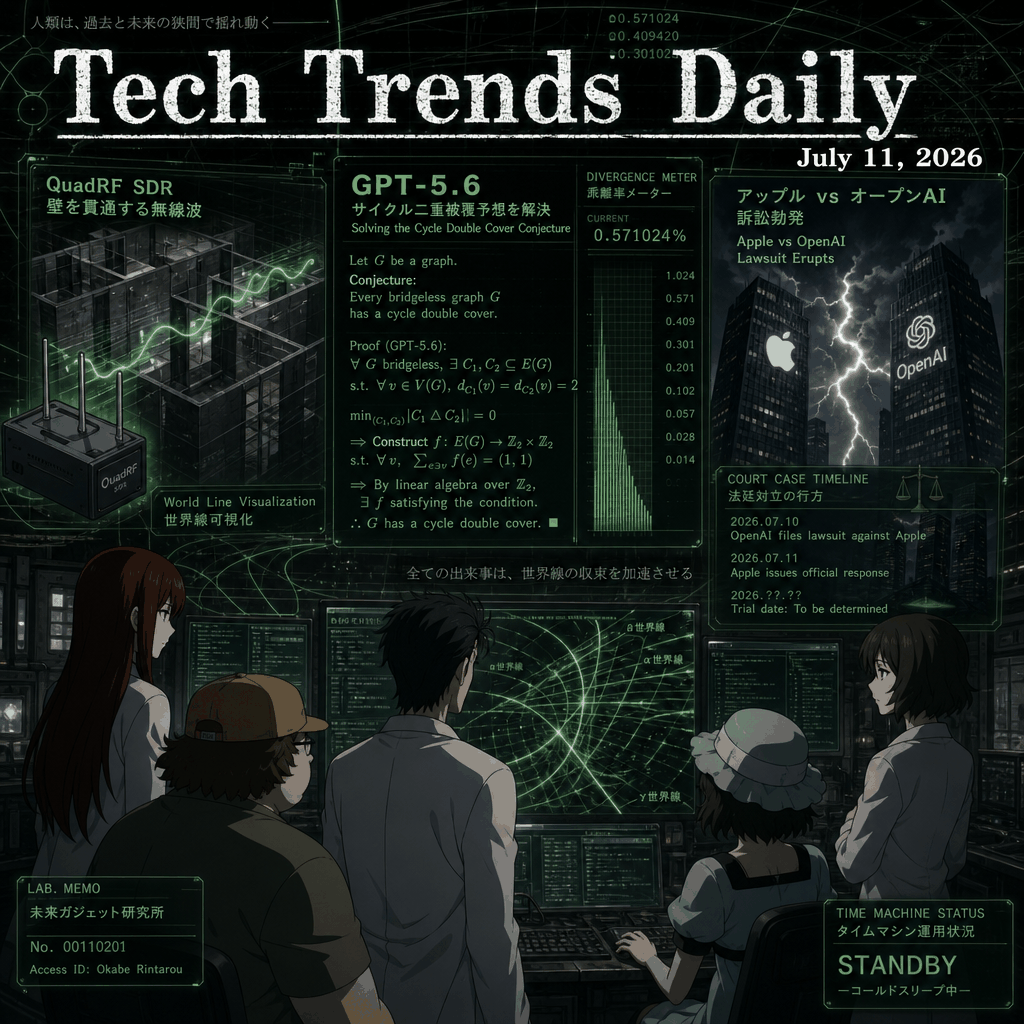
Data source: HN Top 30 + Lobsters Top 25. Browser functioning normally; comment-section exploration covers HN Top 5 + Lobsters Top 5.
🔥 Today’s Focus
Today’s HN front page was dominated by two ultra-high-scoring posts — GPT-5.6 (922 points) and EU Chat Control 1.0 forced through (895 points) — representing a simultaneous escalation in both AI capability and digital rights. GPT-5.6’s developer guide reveals a counterintuitive signal: shorter prompts yield better results, using fewer tokens for higher accuracy — a wake-up call for every team that’s over-invested in prompt engineering. Meanwhile, Chat Control, already rejected twice by Parliament, was pushed through using an “urgency procedure” on the last day before summer recess, exploiting low attendance — 314 votes against, 276 in favor, but the opposition failed to reach the absolute majority threshold, and the bill passed. Lay these two stories side by side, and you have the backdrop of July 2026: technology accelerating, privacy receding.
On the other side, the announcement of Bun’s migration from Zig to Rust and Andrew Kelley’s (Zig creator) response article were merged into a single discussion on Lobsters — 146 comments centered on the core disagreement: is this a vibecoding-style hasty rewrite, or a sound engineering decision? TypeScript 7.0’s Go rewrite provides a counterpoint from the opposite direction — the compiler moves from self-hosting to non-self-hosting, and the community debate shifts from “can we?” to “should we?”
🤖 AI & LLM
- GPT-5.6 Released — GPT-5.6. 922 points / 686 comments (HN). OpenAI’s latest flagship model. 💬 The most counterintuitive advice from the developer guide: use shorter prompts instead of long system prompts; internal evals show 10–15% score improvement with 41–66% fewer tokens. The model is more sensitive to “be concise”-type instructions; it’s not recommended to ask the model to be friendlier or more empathetic — it won’t actually get better at those things.
- Tencent Hy3 Open-Source Model — Hy3. 339 points / 75 comments (HN). Apache 2.0 license, free trial via OpenRouter (until July 21). 💬 simonw verified generation capabilities using the classic SVG pelican test — the community broadly sees this as a significant step for Chinese open-source models in code and vision generation.
- Meta Muse Spark 1.1 — Muse Spark 1.1. 300 points / 164 comments (HN). Meta’s new model API release, positioned for creative generation. Comment consensus: the open-weight strategy is allowing Meta to keep eroding OpenAI’s developer mindshare.
- Show HN: Getting GLM 5.2 running on my slow computer — Show HN: Getting GLM 5.2 running on my slow computer. 221 points / 54 comments (HN). A practical solution for running GLM 5.2 locally — no A100 needed to run a 70B-class model; inference optimization is the core highlight.
- AI content is everywhere on social media, especially LinkedIn — AI content is everywhere on social media, especially LinkedIn. 304 points / 147 comments (HN). 💬 redsymbol posted “don’t write with AI” on LinkedIn a year ago and got swarmed — “Writing is hard because thinking is hard. When you outsource your writing, you lose more than you realize.” This comment resonated deeply on HN.
- ChatGPT Work — ChatGPT Work. (HN). OpenAI’s new product line targeting workplace scenarios; details not yet fully revealed, but the “ambitious work” in the title suggests this is GPT-5.6’s companion enterprise offering.
🔒 Security / Privacy / Policy
- EU Parliament Greenlights Chat Control 1.0 — EU Parliament greenlights Chat Control 1.0. 895 points / 434 comments (HN). 💬 Two key procedural vulnerabilities: ① The vote was scheduled for the last day before Parliament’s summer recess, with 112 MEPs absent; ② The bill was submitted under “Rule 170 urgency procedure” with only two days’ notice — normal procedure takes months. The actual vote was 314 against vs. 276 in favor, but because it failed to reach the 361-vote absolute majority threshold, the opposition motion failed and the bill passed. Commenters’ outrage at “democratic process being procedurally manipulated” overwhelmed discussion of technical details. End-to-end encryption exemptions were substantially weakened, and mass scanning was authorized through 2028.
- TLS certificates for internal services done right — TLS certificates for internal services done right. 288 points / 206 comments (HN). A long-form engineering practice article on internal infrastructure certificate management — from CA selection to automated renewal, a complete approach. 206 comments suggest this problem is far more complex than it appears on the surface.
🦀 Rust Rewrite Wave & Compiler Earthquake
- Rewriting Bun in Rust — Rewriting Bun in Rust. Lobsters △108 / 146 comments + Andrew Kelley’s response (Lobsters). HN 65 points / 12 comments. 💬 Lobsters merged this post with Zig creator Andrew Kelley’s response “My Thoughts on the Bun Rust Rewrite” — the 146 comments feature a rare meta-discussion: merging the two posts made the comment section chaotic, and the top-voted comment was literally complaining about this merge behavior. Kelley’s core argument: many of the Zig technical deficiencies claimed by the Bun team were the product of their incomplete understanding of the language. The label “vibecoding” was frequently invoked by the community — implying the migration may have relied too heavily on AI assistance.
- Postgres rewritten in Rust, now passing 100% of regression tests — Postgres rewritten in Rust, now passing 100% of the Postgres regression tests. 258 points / 313 comments (HN). This is an insane project — line-by-line reimplementation of PostgreSQL in Rust, passing all regression tests. The core debate in the comments: is this merely an academic exercise, or could it actually become a production-grade replacement?
- Announcing TypeScript 7.0 — Announcing TypeScript 7.0. Lobsters △91 / 31 comments (Lobsters). 💬 The compiler migrated from TypeScript self-hosting to Go — a rare case of reverse bootstrapping. The top-voted comment (63 points): “Self-hosting imposes an evolutionary pressure on the language to optimize for compiler writing, which isn’t necessarily right. We should see more choices like this.” VSCode build time dropped from 125 seconds to 10 seconds.
- Announcing Rust 1.97.0 — Announcing Rust 1.97.0. Lobsters △33 / 3 comments (Lobsters). Rust’s latest stable release, echoing the Bun/Postgres rewrites — Rust adoption in the infrastructure layer is entering a self-accelerating phase.
👤 People & Interviews
- Interview with Mitchell Hashimoto about Ghostty and Zig — Interview with Mitchell Hashimoto about Ghostty and Zig. HN 46 points / 7 comments (HN). Lobsters △106 / 6 comments. HashiCorp founder (Vagrant, Terraform, Vault) is now working full-time on the Ghostty terminal emulator. He revealed a key detail: Ghostty was originally just a personal project he used to learn Zig and understand terminal internals — the goal was to run vim and a compiler, then throw it away. But because friends found it great for daily use, it slowly became a product. His vision for the terminal’s future: introduce an n-screen API so Neovim tabs become native windows — the terminal emulator should become an application platform on par with browsers and desktops.
- Interview: Drew DeVault on an AI-free version of Vim — Interview: Drew DeVault on an AI-free version of Vim. Lobsters △50 / 26 comments (Lobsters). The creator of SourceHut and the Hare language on why he’s maintaining an editor with zero AI features in 2026 — this isn’t technical nostalgia; it’s an explicit rejection of the “AI integration by default” trend.
🛠️ Tools & Infrastructure
- Launch HN: Context.dev (YC S26) — API to extract structured data from any website — Launch HN: Context.dev. 64 points / 52 comments (HN). YC’s latest batch: a web scraping API product — positioned to let developers get structured data from any website with a single line of code, competing against the complexity of traditional scraping frameworks.
- SpaceWASM: NASA/JPL’s Wasm interpreter for spacecraft sequencing — SpaceWASM: NASA/JPL’s Wasm interpreter for spacecraft sequencing. Lobsters △33 / 1 comment (Lobsters). NASA’s Jet Propulsion Laboratory uses WebAssembly as an interpreter for spacecraft command sequences — WASM’s sandbox isolation properties make this a technically sound choice for deep-space environments.
- Chatto is now Open Source — Chatto is now Open Source. Lobsters △14 / 4 comments (Lobsters). A real-time chat application now fully open-sourced — frontend and backend in one codebase; the tech stack is worth a look.
- Meta reuses old RAM in new servers with custom bridge chip — Meta reuses old RAM in new servers with custom bridge chip. 28 points / 28 comments (HN). A custom CXL ASIC chip lets DDR4 memory keep serving in new servers — clever engineering that also reveals the hardware cost pressures inside hyperscale data centers.
💻 Programming Languages / Development
- A road to Lisp: Why Lisp — A road to Lisp: Why Lisp. 88 points / 81 comments (HN). An article re-arguing the value of Lisp from a modern developer’s perspective — the macro system and code-as-data paradigm have become more relevant in the AI-assisted programming era.
- Almost Always Unsigned — Almost Always Unsigned. 157 points / 138 comments (HN). A long-form argument that integer types should default to unsigned — 138 comments means this topic still has massive room for disagreement in the C/C++ community.
- Girls just wanna have fast MPMC queues with bounded waiting — Girls just wanna have fast MPMC queues with bounded waiting. 112 points / 22 comments (HN). An in-depth technical article on multi-producer multi-consumer lock-free queues — the 22 comments are high quality, focused on the gap between bounded waiting’s theoretical guarantees and real-world latency.
- two case studies of NaN — two case studies of NaN. Lobsters △18 / 6 comments (Lobsters). Two real-world bug analyses caused by NaN’s bizarre behavior — how floating-point spec counterintuitive design bites in production.
- Experimenting with random() in CSS — Experimenting with random() in CSS. Lobsters △6 / 4 comments (Lobsters). Experimental exploration of CSS’s native random() function — commenters split into two camps on the question “does CSS really need random numbers?”
🎮 Light / Fun / Curiosities
- Show HN: 18 Words — Show HN: 18 Words. 761 points / 273 comments (HN). A word-combination web game that took third place today at 761 points — 273 comments are almost entirely players sharing high scores and strategies, driven by pure fun.
- Train sim created by just one person is being called the best ever made — Train sim created by just one person is being called the best ever made. 175 points / 64 comments (HN). A solo-developed train simulation game earning extremely high praise — the comment section saw real train drivers and railway engineers showing up to verify its physics accuracy.
- Obfuscated bash script by Akamai being supplied to consumers via retail stores — Obfuscated bash script by Akamai being supplied to consumers via retail stores. Lobsters △74 / 3 comments (Lobsters). A heavily obfuscated Akamai CDN self-executing script printed on retail T-shirts — the author used three OCR methods (Android Circle to Search, Tesseract, Claude) plus manual proofreading to reconstruct the full script. This “tech archaeology” process is more interesting than the story’s outcome.
- A bug which only affected left-handed users — A bug which only affected left-handed users. Lobsters △52 / 27 comments (Lobsters). A bug caused by a UI designed with only right-handed use in mind — the comment section is full of similar cases, from scissors to VR controllers; left-handed users are systematically overlooked.
- Patterncollider: Generate and explore quasiperiodic tiling patterns — Patterncollider: Generate and explore quasiperiodic tiling patterns. 233 points / 149 comments (HN). An open-source tool for generating and exploring quasiperiodic tiling patterns — 149 comments of mathematicians and designers passionately discussing Penrose tilings and aperiodicity.
📝 Summary: Friday’s HN front page presented a classic multi-sector landscape — AI model releases (GPT-5.6, Hy3, Muse Spark) and a policy earthquake (Chat Control) each claimed nearly 900 points, while the infrastructure-layer Rust rewrite wave (Bun, Postgres) and compiler renovation (TypeScript 7) sparked a deep discussion in the technical community about “what makes a good rewrite.” Three must-reads today: ① The prompt advice in the GPT-5.6 developer guide — the era of short prompts may genuinely be upon us; ② The procedural analysis of Chat Control — 314 votes against and it still passed; this is a textbook case of democratic process being hollowed out; ③ Mitchell Hashimoto’s interview vision of the terminal as an independent application platform — while everyone’s chasing AI, some people choose to add an n-screen API to the terminal; both directions have value. Looking across today’s stories, the strongest resonance signal is “Rust is eating all the infrastructure” — Bun switching over from Zig, Postgres being rewritten, and even though the TypeScript compiler chose Go, the community kept bringing up Rust in the discussion threads. This is not a coincidence.