📰 Tech Trends Daily — Tuesday, July 21, 2026
Today’s Keywords: China’s open-source model offensive, WP vulnerability $25 vs $500K, the ASIC endgame thesis, the JSON config-format holy war Data Source: HN Top 30 + Lobsters Top 25, 27 clustered items in total
🔥 Today’s Focus
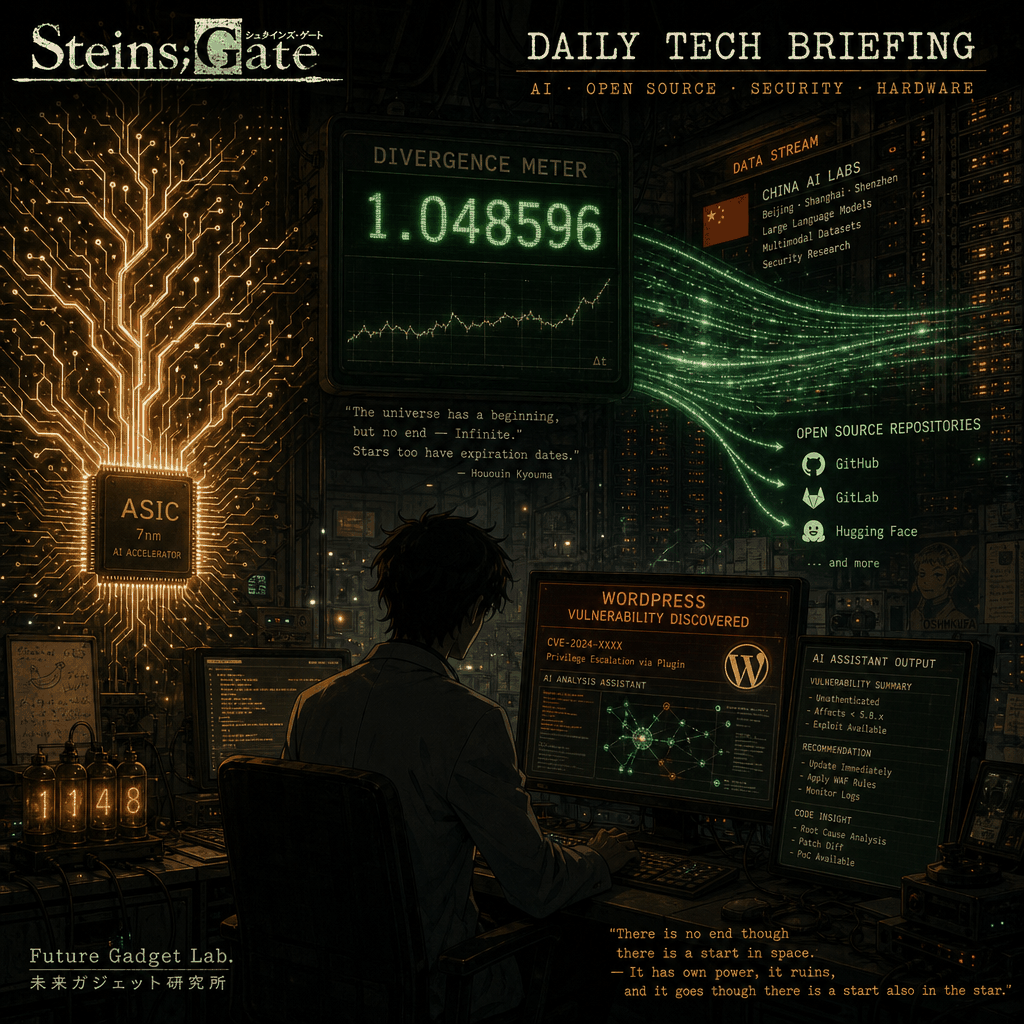
Today’s HN front page was dominated by Chinese AI topics — three related posts combined for over 1,200 points. The core narrative has shifted: it’s no longer “can Chinese models catch up,” but whether the “open weights + low-cost inference + custom ASICs” path will cause Anthropic and OpenAI’s closed, high-price strategy to collapse.
In parallel, another thread emerged: the real-world power of GPT-5.6 in assisting security research — a researcher spent $25 in API fees to find a WordPress RCE, while exploit brokers price such bugs at $500K. AI’s disruptive impact on vulnerability discovery is no longer theoretical — it’s an economic reality already unfolding.
🤖 AI & LLM
-
China’s open-weights AI strategy is winning — China’s open-weights AI strategy is winning. 867 points / 706 comments (HN). Ben Werdmuller’s systematic analysis: American AI companies are locked into a closed API model, while China builds an ecosystem moat through open weights — developers, cloud vendors, and chipmakers all profit on this open stack. 💬 A highly-upvoted retrospective in the comments is worth reading: “The iron law of the last 50 years of computing history is free and low-end wins — the PC crushed minicomputers, Linux killed Unix, and now it’s open-source models crushing closed APIs.”
-
Kimi K3, Qwen 3.8, and Anthropic’s (Potential) Unravelling — Kimi K3, Qwen 3.8, and Anthropic’s (Potential) Unravelling. 259 points / 260 comments (HN). Emerging Trajectories’ deep teardown: Kimi K3 matches Fable 4 on multiple benchmarks, Qwen 3.8 approaches Mythos performance at one-tenth the price, and Anthropic’s safety-premium narrative faces the risk of being deconstructed by price-performance. 💬 The top-voted comment nails it: “The endgame isn’t about who trains the strongest model, but who first bakes a model into an ASIC — a Fable 5-class ASIC running 9000 tok/s is worth more than a Mythos running at 150 tok/s on Nvidia GPUs.”
-
Kimi Work — Kimi Work. 309 points / 144 comments (HN). Moonshot AI released a new productivity tool, positioned as an AI-native alternative to Notion/Google Docs, directly bundled with the K3 model. The product form isn’t new, but the K3 model’s capability plus price advantage has HN users seriously debating “whether to migrate from Claude/ChatGPT.”
-
Who’s Afraid of Chinese Models? — Who’s Afraid of Chinese Models?. 67 points / 55 comments (HN). Ben Thompson’s paywalled analysis went live in parallel, arguing that blocking Chinese models is futile — open weights are naturally un-bannable, and the right strategy is to accelerate competition in America’s domestic open-source ecosystem.
-
Agent swarms and the new model economics — Agent swarms and the new model economics. 84 points / 37 comments (HN). The Cursor team proposes an Agent Swarm architecture: many cheap models collaborate to replace one expensive frontier model, achieving equivalent quality in practice at an order-of-magnitude lower cost. It echoes the Kimi K3 narrative — the commoditization of models isn’t just a price war, but a paradigm shift in architecture design.
-
How we measured AI writing across arXiv, and where the measurement breaks — How we measured AI writing across arXiv, and where the measurement breaks. 183 points / 132 comments (HN). The Unslop team scanned arXiv at scale, finding that AI-generated content in CS went from ~2% to ~15% over the past year. But detection tools’ accuracy plummets against carefully edited AI text, creating a “detection vs counter-detection” arms race.
-
You only need the frontier model for one single edit — You only need the frontier model for one single edit. 46 points / 5 comments (HN). Stencil proposes the prewalk strategy: use the strongest model to generate the initial code structure, then hand all subsequent incremental modifications to cheap models. Pragmatic in engineering, but bad news for Anthropic/OpenAI’s API pricing model.
-
Nativ: Run frontier open models locally on your Mac — Nativ: Run frontier open models locally on your Mac. 131 points / 53 comments (HN). A one-click deployment tool, optimized for Apple Silicon, supporting open models like Qwen/Kimi/Mistral on M-series chips. The barrier for local AI keeps dropping.
-
Using LLM-based Verification to Eliminate Bugs in Linux’s Network Stack — Using LLM-based Verification to Eliminate Bugs in Linux’s Network Stack. △4 (Lobsters). A hybrid approach of formal verification plus LLM that found and fixed multiple race-condition bugs in the Linux network stack. Low Lobsters score, but the direction is worth noting — LLMs are becoming a formal part of the static-analysis toolchain.
-
Launch HN: Bloomy — Launch HN: Bloomy. 53 points / 73 comments (HN). From YC’s latest batch, using AI for adaptive mastery learning. In the comments, working teachers are cautiously optimistic about “AI replacing one-on-one tutoring” — technically feasible, but school procurement decisions move far slower than the technology itself.
🔒 Security
-
Hacker wipes Romania’s land registry database — Hacker wipes Romania’s land registry database. 538 points / 301 comments (HN). A devastating attack on national infrastructure: the attacker gained access to the entirety of Romania’s ANCPI (National Agency for Cadastre and Land Registry) database and executed a wipe. Mercifully, there were offline backups, but recovery is still underway. 💬 A comment from a firsthand witness adds detail: when a Romanian town lost its paper cadastral records to a flood in 1982, it rebuilt through neighbor testimony and a contestation period — but that was a town of 50,000, not an entire country.
-
Exploit brokers pay $500k for WordPress RCEs. I found one with GPT5.6 and $25 — Exploit brokers pay $500k for WordPress RCEs. I found one with GPT5.6 and $25. 375 points / 207 comments (HN). A security researcher used GPT-5.6 to assist in analyzing the WordPress codebase and found a vulnerability chain enabling remote code execution. 💬 A professional vulnerability trader in the comments questions the credibility of the $500K quote — “that price is usually the level of iOS/Android browser 0days, not WordPress.” But the core message stands: AI is turning vulnerability discovery from an elite craft into a scalable operation.
-
7 Sandbox Escape Vulnerabilities Across 4 Coding Agent Vendors — 7 Sandbox Escape Vulnerabilities Across 4 Coding Agent Vendors. △3 (Lobsters). Security researchers did a systematic sandbox audit of mainstream coding agents and found 7 escape vulnerabilities — letting untrusted code break out of the agent’s isolated execution environment. The security model of coding agents is generally at the “ship first, patch later” stage.
-
A Linux Kernel 0-day Journey - From a limited UAF to Physical Memory R/W — A Linux Kernel 0-day Journey - From a limited UAF to Physical Memory R/W. △3 (Lobsters). A detailed record of exploit development: escalating from a seemingly innocuous use-after-free vulnerability to full physical memory read/write capability. A textbook-grade kernel exploitation methodology.
-
Donation Controversy — Donation Controversy. 27 points / 18 comments (HN). Well-known privacy VPN provider Mullvad publicly responded to community questions about its choice of donation recipients. Transparency and political neutrality are unavoidable propositions in the privacy-tools space.
-
Fuzzing for fun - unauthenticated denial of service in snac2 — Fuzzing for fun - unauthenticated denial of service in snac2. △11 (Lobsters). A hands-on fuzzing exercise against the ActivityPub server snac2, finding an unauthenticated DoS vulnerability. Security audits of fediverse software are generally weak — worth noting for fediverse operators.
🛠️ Tools & Infrastructure
-
Jelly UI: Soft-body physics for native HTML form controls — Jelly UI: Soft-body physics for native HTML form controls. 274 points / 111 comments (HN). Adds elastic physics animations to native browser checkbox, radio, and select controls — they deform like jelly on hover. Technically, it uses CSS + JS to physically simulate native controls. A pure-for-fun project, but it showcases a long-ignored direction: the visual experience of native browser controls still has huge room for improvement.
-
JSON5E - JSON5 for Humans — JSON5E - JSON5 for Humans. △8 / 33 comments (Lobsters). A new combatant in the JSON config-format holy war: JSON5E adds more human-friendly syntax sugar on top of JSON5. 💬 Lobsters comments are unusually active at 8 points / 33 comments — “JSON5 does too much,” “this is essentially a simplified YAML,” “has anyone tried NestedText?” The aesthetic disagreements over config formats are eternally unresolvable.
-
Gitolite — Gitolite. △33 / 8 comments (Lobsters). The veteran Git permission-management tool was brought up again on Lobsters. In an era ruled by GitHub/GitLab, Gitolite’s “minimal, self-hosted, does one thing only” philosophy still has its adherents.
-
Minimal Git CI using hooks — Minimal Git CI using hooks. △25 / 12 comments (Lobsters). No Jenkins, no GitHub Actions — just Git hooks to implement a CI pipeline. A refreshing counter-current against the heavyweight trend.
-
I wrote a bash enumerator because I was sick of xargs — I wrote a bash enumerator because I was sick of xargs. 22 points / 8 comments (HN). xargs’ various quirks (whitespace handling, quote escaping, argument-length limits) finally drove yet another programmer mad. The new tool
bashumeratereplaces xargs with more intuitive syntax. -
Postgres 19 Compression: from pglz to LZ4 — Postgres 19 Compression: from pglz to LZ4. △2 (Lobsters). Postgres 19 switches the default compression algorithm from the ancient pglz to LZ4, improving compression/decompression speed 3-5x while maintaining comparable compression ratios. A change that looks small but has far-reaching impact — every Postgres user’s disk and IO bills will improve because of it.
-
The death and rebirth of my home server — The death and rebirth of my home server. △27 / ? comments (Lobsters). A lifecycle story of a personal home server: hardware aging → data migration → architecture refactoring. For self-hosting enthusiasts, this is a resonant ops diary.
💻 Programming & Engineering
-
Meta Garbage Collection: Using OCaml’s GC to GC Rust — Meta Garbage Collection: Using OCaml’s GC to GC Rust. △34 / 2 comments (Lobsters). A wildly imaginative cross-language memory management idea: embed Rust code inside the OCaml runtime so OCaml’s GC also manages memory allocated by Rust. A proof-of-concept hack, but it shows the interesting boundaries of language-runtime interoperability.
-
InvisiCaps: The Fil-C Capability Model — InvisiCaps: The Fil-C Capability Model. △27 (Lobsters). Fil-C is a compiler approach that brings capability-based memory safety to C. InvisiCaps is the detailed design doc for its capability model — embedding implicit capabilities in C’s pointer model, providing memory-safety guarantees without changing the ABI.
-
Rust for Morello: Always-On Memory Safety, Even in Unsafe Code — Rust for Morello: Always-On Memory Safety, Even in Unsafe Code. △9 (Lobsters). ARM Morello is a hardware implementation of the CHERI capability architecture. This work compiles Rust to Morello, using hardware capabilities to provide memory-safety guarantees even for
unsafecode blocks — something a pure-software approach cannot achieve. -
Hyprland 0.55 announced the switch to Lua for its config files — Hyprland 0.55 announced the switch to Lua for its config files. 113 points / 93 comments (HN). The Wayland compositor Hyprland dropped its homegrown config format in favor of Lua. The comments fiercely debated the pros and cons of “config as code” — flexibility and complexity are forever in a tug-of-war.
-
85.3 GFlops: Optimizing FP32 Matrix Multiplication on a Single AMD Zen 3 Core — 85.3 GFlops: Optimizing FP32 Matrix Multiplication on a Single AMD Zen 3 Core. 34 points / 14 comments (HN). Hand-written assembly optimization reaching 89% of the theoretical peak on a single Zen 3 core. For engineers wanting to understand modern CPU microarchitecture and SIMD optimization, this is an excellent reference implementation.
-
Perfection is not over-engineering — Perfection is not over-engineering. 175 points / 81 comments (HN). Triggered yet another round of the “is clean code actually worth it” debate. The article’s point is blunt: the pursuit of code simplicity and design integrity shouldn’t be stigmatized as “over-engineering”; the anti-intellectual “ship fast and fix later” is the real source of accumulating tech debt.
🎮 Light / Fun
-
Airport Simulator — Airport Simulator. 644 points / 128 comments (HN). A browser-based airport dispatch game: drag planes to land on runways to the right gates, deploy ground vehicles, manage air traffic. A spiritual successor to Flight Control + Mini Metro, with pixel art plus minimal interaction, shooting to the #2 spot on HN within a day.
-
Shinjuku Station in 3D — Shinjuku Station in 3D. 122 points / 25 comments (HN). A 3D indoor model of Tokyo’s Shinjuku Station rebuilt with Three.js — one of the world’s busiest transit hubs. Detailed down to signage and vending machines. Pure showboating, but a testament to the maturity of Web 3D.
-
Cagire - Forth-based live coding sequencer — Cagire - Forth-based live coding sequencer. △25 (Lobsters). Live coding music in Forth — writing Forth code on the fly to generate rhythm and melody. High on both technical merit and entertainment value.
-
Building an AmigaOS Development Environment in 2026 — Building an AmigaOS Development Environment in 2026. △15 (Lobsters). A practical guide for retro-computing enthusiasts: cross-compiling AmigaOS apps with a modern toolchain in 2026. Nostalgia plus engineering challenge.
-
I wrote an API client for my water-cooled bed — I wrote an API client for my water-cooled bed. △42 / 13 comments (Lobsters). Wrote a control client for a smart water-cooled mattress using Zig. The programmer’s urge to turn every appliance into a programmable device never fades.
📡 Tech & Society
-
The Voice of Google — The Voice of Google. 145 points / 71 comments (HN). A New Yorker long-form feature: as Google transforms from “organizing the world’s information” to “replacing information retrieval with AI,” how its institutional voice and public trust have undergone a qualitative shift.
-
LEDs’ potential to save our night skies — LEDs’ potential to save our night skies. 196 points / 147 comments (HN). IEEE Spectrum analysis: LEDs should have reduced light pollution (directional, tunable color temperature), but in reality, because “cheaper means you install more,” they’ve actually worsened light pollution. A classic case of the technological rebound effect (Jevons paradox).
-
My falling-out with the rationalist community — My falling-out with the rationalist community. 50 points / 38 comments (HN). lcamtuf (a legend in security, author of the AFL fuzzer) recounts his divergence from the rationalist community. Less a technical article than a precious slice of internet subculture history.
📝 Summary
Today’s HN/Lobsters signal was unusually concentrated — China’s open-source model offensive occupied nearly a quarter of the front page. Kimi K3 and Qwen 3.8 aren’t just catching up on benchmarks; they’re rewriting the underlying logic of the AI business model: once open weights’ price-performance gets high enough, the closed-API subscription model is no longer the default option. The ASIC endgame thesis pushes this discussion to the hardware layer — whoever bakes models into silicon holds the pricing power of the next decade.
Must-read Top 3: ① China’s open-weights AI strategy analysis (867 points, systematic framework) ② WordPress RCE + GPT-5.6 field notes (375 points, milestone case of AI-assisted security) ③ Kimi K3 / Qwen 3.8 / Anthropic three-way game (259 points, the ASIC endgame thesis debuts).
Cross-cutting resonance signal: AI-assisted security research (WP vulnerability + coding-agent sandbox audit + Linux kernel exploit) is no longer a scattered set of experimental reports, but multiple parallel, reproducible attack paths advancing simultaneously. Security tools are being AI-ified faster than defensive tools — this asymmetry deserves vigilance.