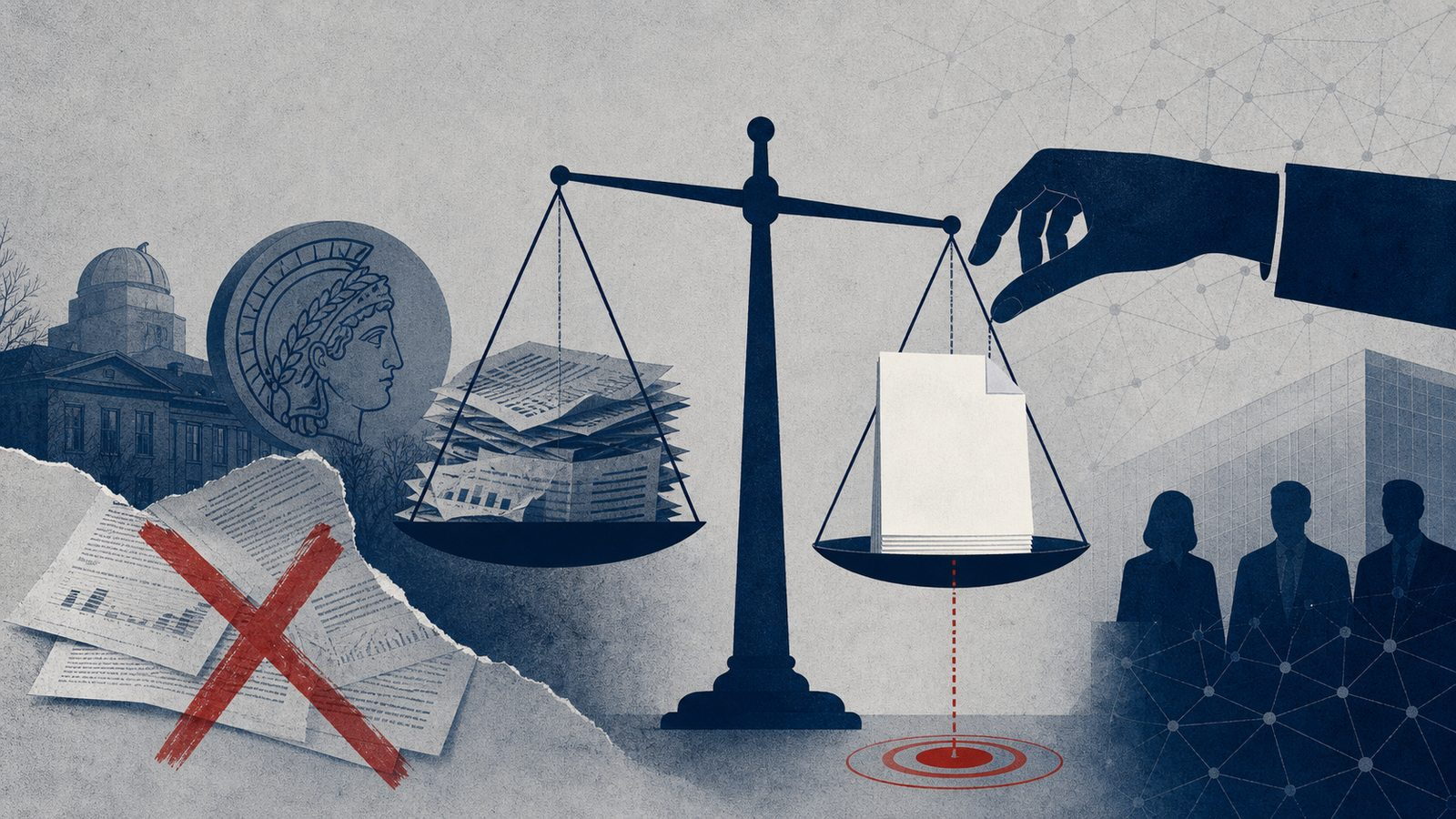
You clicked the purchase button. $39.95 — charged to your credit card. The browser begins downloading a PDF, its filename a string of numbers and letters.
You open the file. A single blank page.
On it, one line: “This article has been withdrawn due to article violation.”
Behind that line are two papers. The author is Max Planck, founding father of quantum physics, winner of the 1918 Nobel Prize in Physics. The two papers were published in 1940 and 1942, respectively, in the journal Naturwissenschaften.
Planck died in 1947. His papers entered the public domain. One day in 2026, someone clicked on those two papers on Springer Nature’s digital platform and saw only blank pages.
The publisher did not notify Planck’s descendants. It did not consult historians. There was no human review. An automated copyright detection algorithm determined that Planck’s papers were “in violation.”
The algorithm’s logic went like this: In November 1940, the philosopher Aloys Müller published an article in the same journal criticizing Planck’s views, titled “Naturwissenschaft und reale Außenwelt.” A month later, Planck published a response under the exact same title. Different content, identical title. The algorithm flagged this as “duplicate publication.”
Retracted. Today, the blank PDFs remain for sale. At the same price.
A Hammer in the Hands of an Algorithm
The absurdity of this story needs no embellishment. What needs explaining is the structure beneath the absurdity.
Yves Gingras and Mahdi Khelfaoui, in an investigation published on arXiv, reconstructed the chain of events. In early 20th-century academic publishing culture, the same paper routinely appeared across multiple venues — journals, conference proceedings, commemorative volumes — because different audiences accessed knowledge through different channels. In the print era, this was a dissemination strategy, not misconduct. “Duplicate publication” and “self-plagiarism” as normative concepts were only institutionalized in the second half of the 20th century, alongside the rise of bibliometrics and commercial academic publishing.
The problem is that Springer Nature’s algorithm was not equipped with a historical context layer. It applied 21st-century copyright compliance frameworks to 1940s publishing conventions, producing a conclusion that was mechanically precise and historically absurd. To borrow an engineering phrase: the algorithm achieved perfect internal consistency scores, but its training set lacked the feature “era.”
Gingras and Khelfaoui point to an ironic coda: the two papers blocked by a commercial publishing platform are now freely available on the nonprofit Internet Archive. The custodian of the public knowledge heritage, it turns out, is the pirate library.
The Structural Anatomy of a Parasitic Model
One of the top-voted comments on the HN thread, from user stncls, was unadorned: “I can’t wait for this parasitic business model to collapse for good.” Across 165 comments, the word “parasitic” appeared more than once. This anger is directed at a repeatedly validated pattern of behavior — not an isolated incident.
The so-called “parasitic model,” in the context of academic publishing, refers to a specific structure of value extraction. Drawing from the community discussion, I’ll attempt to distill its core characteristics:
First, the core factors of production are supplied by outsiders, free of charge. Research is funded by public money. Papers are written by researchers. Peer review is performed by other researchers, unpaid. Editorial work is contributed by members of the academic community on a volunteer basis. The publisher’s investment is concentrated in typesetting, hosting, subscription management — and legal.
Second, pricing is decoupled from costs. A single paper costs the reader $39.95. The author-side article processing charge (APC) runs into thousands of dollars. Meanwhile, the marginal cost of distribution approaches zero. RELX Group (Elsevier’s parent) reports a net profit margin of approximately 39% for its scientific publishing business; Springer Nature, about 28%; Wiley, about 18%.
For reference: Apple’s net profit margin in 2024 was about 26%. Academic publishers consistently outperform the consumer electronics industry.
Third, monopoly rents are protected by institutional moats. The academic journal market is not a price-competition market — you cannot substitute Nature with a cheaper journal, because a journal’s brand is itself currency within the academic evaluation system. Researchers need to publish in “high-impact journals” to secure positions, funding, and tenure. The lock-in effect of this evaluation mechanism has enabled the five major publishing groups (Elsevier, Springer Nature, Wiley, Taylor & Francis, Sage/ACS) to control over 50% of global academic paper output — a figure that stood at only 20% in 1973.
Fourth, the retraction mechanism suffers from severe incentive misalignment. Retraction is a career stigma for the researcher. For the publisher, it is a zero-cost operation. Springer Nature declined to comment on the Planck retraction, stating only that “detailed retraction information is typically confidential and can only be shared with the relevant authors.” The applicability of this policy to an author who has been dead for 79 years and whose papers are in the public domain speaks for itself.
The Publishers’ Arguments — and the Community’s Responses
To be fair, academic publishers are not without their own narratives. In tracing the industry discussion, I found their core arguments cluster around the following points:
Publishers claim their fees cover the administrative costs of peer review. It is true that organizing the review workflow — matching reviewers, handling appeals, maintaining submission systems — involves labor costs. But an early cost analysis by the arXiv team offers a comparative data point: nonprofit journals (such as Physical Review) incur per-paper management costs of roughly $3–$5, primarily spent on “appeals and other reviewer exception handling.” Commercial journals charge two orders of magnitude more per paper.
Publishers emphasize the quality-signaling function of their brands. This argument has historical merit — Nature and Science have indeed surfaced world-changing research. But HN user jrumbut posed a widely endorsed counter-question: “If publishers have so much work to do — like staffing subject-matter editors who actually know the field, developing open-source format validation libraries, launching multimedia attachment support — why don’t they do it?”
His observation: there are many ways to prove these companies are worth the price. They choose not to pursue them. The implied judgment: the profit-maximizing path is to defend the monopoly position, not to improve the product. Investing in quality would compress margins.
Publishers also note that the open-access transition takes time. Plan S and cOAlition S have indeed made progress: as of 2025, research funding agencies in multiple European countries require immediate open access for funded papers. But during the same period, one of the publishers’ counter-strategies has been to raise open-access APCs — shifting the loss of subscription revenue onto authors. The total cost of academic publishing has not decreased; the payer has simply moved from libraries to research grants.
A System That Cannot Self-Correct
Back to the Planck retraction. The deepest problem this incident exposes is not that an algorithm had a bug. Algorithms having bugs is normal. The problem is that after the bug was discovered and publicly reported, the system had no mechanism to correct it.
A self-correcting system requires at least three conditions: transparent post-hoc review, positive incentives for error correction, and accessible channels for affected stakeholders to seek redress. In the Planck incident, all three conditions were absent.
The retraction reason is confidential. Springer Nature declined to comment. Planck himself is deceased; his descendants were never notified, let alone given a chance to appeal. The blank PDF continues to be sold at $39.95 — the system has no incentive to take the product down, because it bears none of the externality costs.
A comment appeared in the HN discussion, plainspoken but precise: “The purpose of a system is what it does.” The line comes from management cyberneticist Stafford Beer. A system that consistently produces blank-page charges, refuses correction, and refuses explanation — its function, inferred from observable behavior, is not to disseminate knowledge or uphold academic integrity. Its function is to maximize rent extraction and minimize accountability.
This judgment is not absolute. I have not investigated the complete information behind Springer Nature’s internal decision-making. But the observable pattern of behavior — no notification to the author, no explanation provided, no error corrected, no charges halted — is verifiable in the public record.
From Pirate Libraries to Antitrust Litigation
Institutional tension is releasing in multiple directions. On one side: Sci-Hub and Anna’s Archive, bypassing paywalls through technical means, providing free access to roughly 90 million papers. In Planck’s case, the Internet Archive played a similar role — preserving content that the publisher had abandoned.
On the other side: legal counteroffensives. In 2025, US researchers filed a class-action antitrust lawsuit against six major publishers including Elsevier and Springer Nature, alleging industry-coordinated manipulation of unpaid peer review, mandatory single-submission rules, and academic confidentiality clauses.
These developments point to a trend: academic publishing’s value-extraction model is being challenged from multiple dimensions. But models have inertia. As HN user vitally3643’s comment summarized, the publisher’s logic is simple: if you can maintain subscription revenue without investing, why invest?
The retraction of Planck’s papers was not an accident. It was an output of institutional design. The design logic is clear: when maintaining knowledge integrity costs something and neglecting it carries no penalty, the system will choose the latter.
I have not worked in the academic publishing industry. The analysis above is based on publicly available data and community discussion. I have no firsthand experience with the internal operational details of the industry. This article offers an outside observer’s perspective — using an extreme case to attempt to surface the contradictions embedded in institutional arrangements.