In 2020, in Florida, a man named Zachary went for a bike ride. He rode past a house. A few hours after he passed, that house was burglarized.
Zachary had nothing to do with it. He was just someone who happened to bike by.
A year later, he got an email from Google. It told him: law enforcement has obtained your location data. If you want to prevent them from seeing your name and account information, you have 7 days to go to court and file a motion to block it.
He wasn’t told what case this was about. He had no clue. He couldn’t even remember where he’d been cycling that day, a year ago. The only thing he knew: if he didn’t hire a lawyer, the police would get his entire location history and his real identity.
Zachary’s story had a decent ending — after his lawyer got involved, prosecutors informed the police that this man was not a suspect. But the legal fees he paid, the fear of “I did nothing wrong and yet I have to prove my innocence” — nobody can give him that back.
And the tool that nearly made Zachary a suspect is the subject of this article: the geofence warrant. Yesterday, on June 29, 2026, the U.S. Supreme Court ruled 6–3 that this kind of warrant violates the privacy protected by the Fourth Amendment. Police can no longer casually demand your location data this way.
I
First, let’s explain what it actually is.
Most people’s understanding of phone location tracking goes like this: police identify a suspect — say, John Doe. They want to know where John went on the day of the crime. So they get a warrant and request John’s location data.
That’s a “forward search” — suspect first, then his movements.
A geofence warrant does the exact opposite.
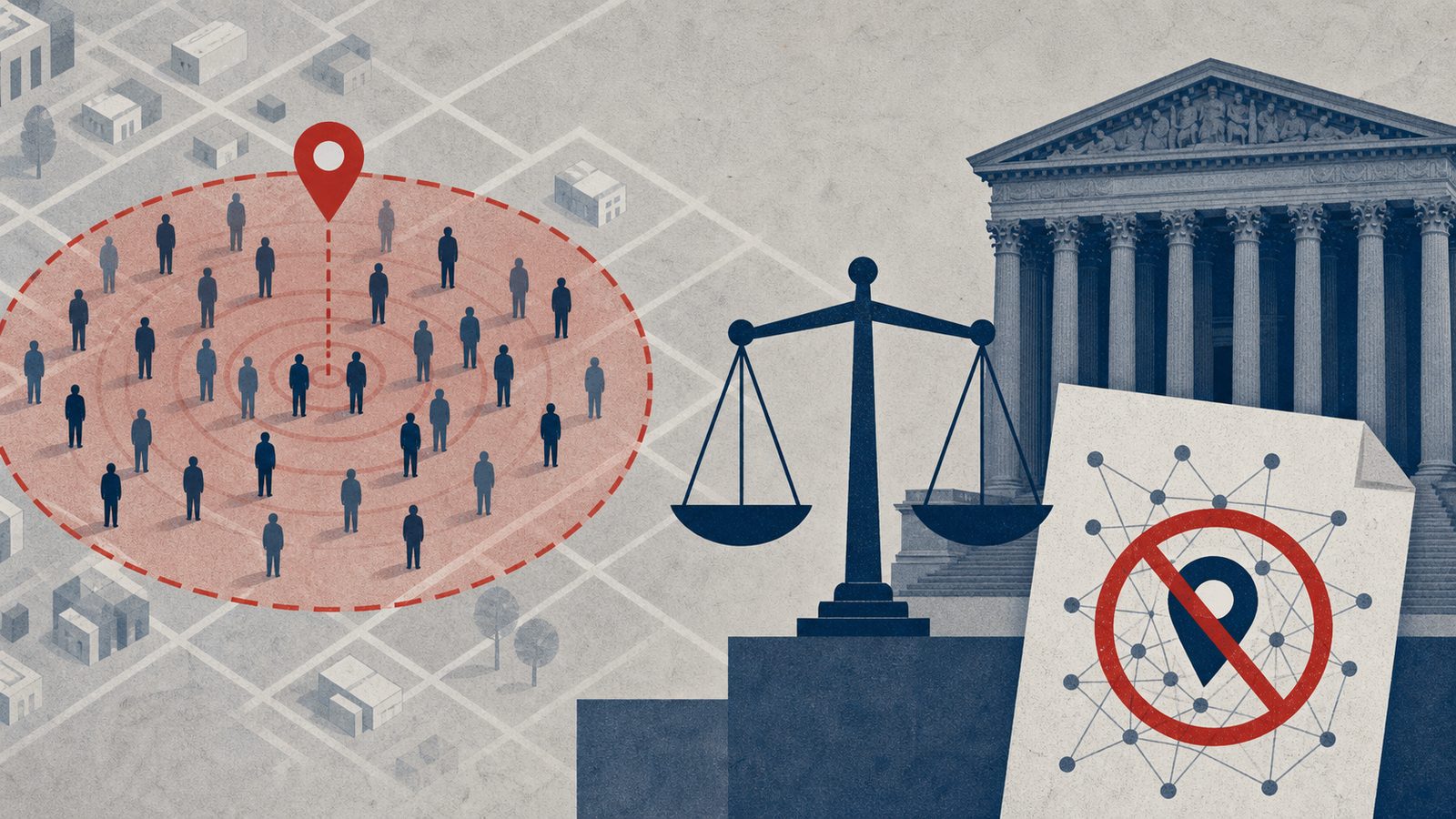
Police draw a circle around a crime scene — radius 150 meters, time window 30 minutes before and after — and then tell Google: give us the location data of every single person who passed through this circle during this window.
Notice the difference. It’s not “where did John go?” It’s “of the people who were there, is one of them John?”
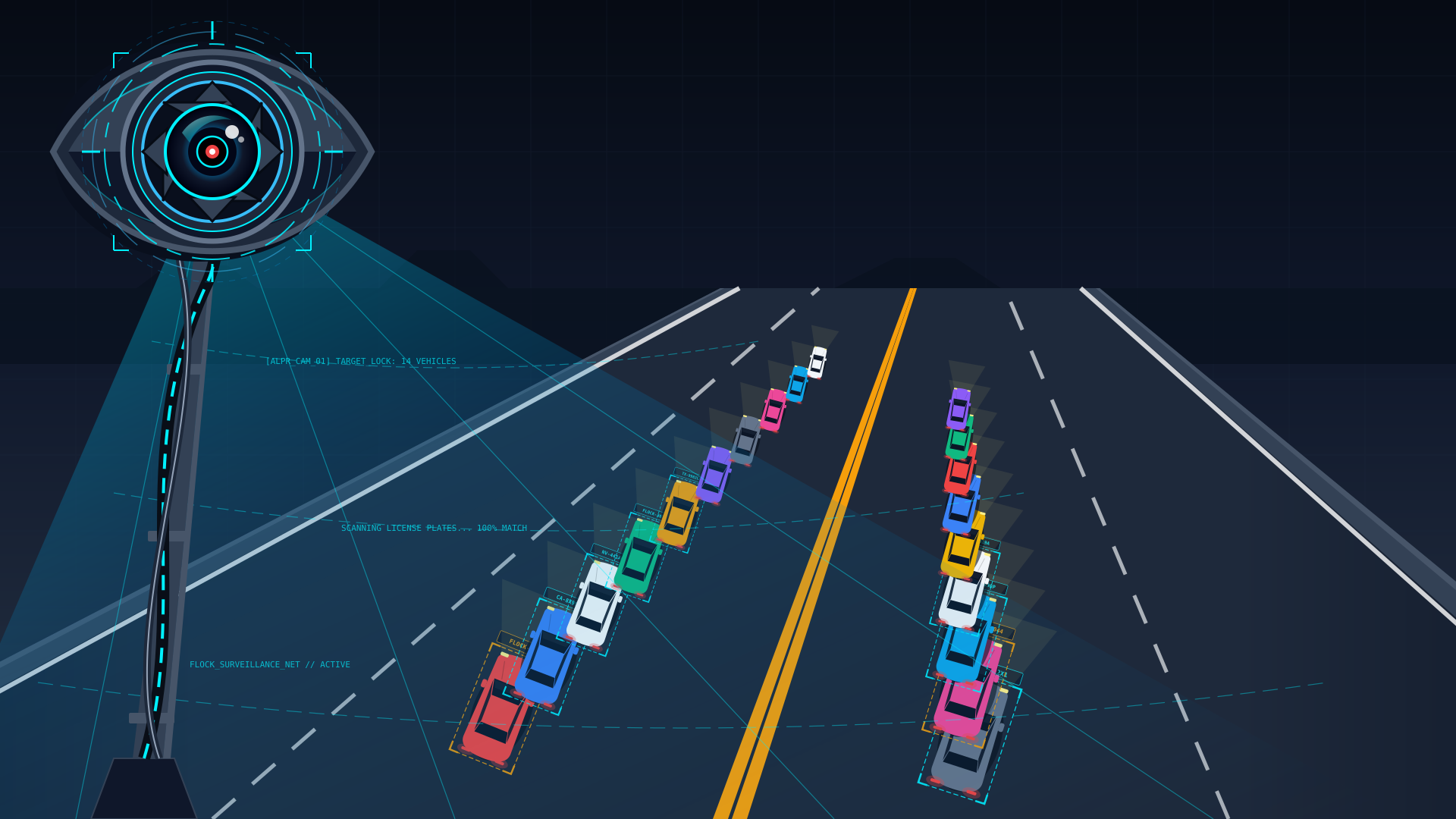
How many people’s location data does Google hold? Hundreds of millions of Android users, plus any iPhone user who uses Google Maps, Google Search, or other Google services on their phone. If your phone’s “Location History” setting is on — and many people don’t even know they’ve turned it on — Google records your precise location every few minutes.
This volume of data means: at any given moment, at any given location, Google has a list of “who is here.” And all police need is one warrant to get it.
In the case at hand, the police’s initial list contained 19 accounts — 19 people who were within 150 meters of a bank around the time of a robbery. They then progressively narrowed it down, from 19 accounts to 9, then to 3. One of those three was Okello Chatrie, who had robbed the bank of $195,000 at gunpoint.
Chatrie was ultimately sentenced to 12 years. He was a criminal, and that outcome seems unobjectionable. The problem: the location data of those other 18 people was also obtained and examined by police. The movements of 16 people were scrutinized. These people did nothing — they just happened to pass by a bank.
And as Zachary’s story shows: the moment your data appears on that initial list, you automatically become a suspect. No evidence required. No reason needed. Just the bad luck of geography.
II
Why did the Supreme Court find this unconstitutional?
This goes back to the Fourth Amendment. Its core meaning is straightforward: the government cannot conduct “unreasonable searches and seizures.” To search you, police must first get a warrant, and that warrant must satisfy two conditions — probable cause to believe you are connected to a crime, and particularity in describing what is to be searched and seized.
The history behind this is older than the United States itself. In 18th-century British colonies, the King could issue something called a “general warrant” — no specific target, no specific scope, search whoever you want. America’s founders hated this, so they wrote the prohibition into the Bill of Rights: you can’t do that.
Now look back at geofence warrants.
When police apply for one, they don’t know who the criminal is. They have no evidence pointing to any specific person. Their logic is: the perpetrator must be among these 19 people. So let’s get everyone’s data first, then find the perpetrator.
This is structurally identical to a “general warrant” — cast the net first, find the target later.
Justice Elena Kagan, writing for the majority, was blunt: “An individual has a reasonable expectation of privacy in his phone’s location records. When police demand this information, they intrude upon a constitutionally protected interest — even for a short period of time, even when demanding it from a third-party technology company.”
Kagan also dismantled one of the government’s core arguments. The government had said: Chatrie voluntarily turned on Google Location History, so he had no reasonable expectation of privacy in that data.
Kagan’s response: voluntariness has little to do with it. Google repeatedly nags users to turn on Location History, warns that “the device may not work properly without it,” and simultaneously does not make clear how frequently location data is recorded, how precise it is, or that it could be handed to the government. “Cell phone users are just doing the normal things that people with cell phones do.”
The logic of “because you use a phone, you have no privacy right in the data your phone generates” is equivalent to saying: by living in modern society, you automatically forfeit Fourth Amendment protections.
The Court didn’t buy it.
III
In the Hacker News discussion, one user offered a brilliant illustration of the difference between a “normal search” and a “geofence search.” The example is the Paula Broadwell case.
In 2012, the FBI discovered that someone was using multiple anonymous email accounts to send harassing messages to Paula Broadwell, the biographer of General David Petraeus (then CIA Director). The FBI traced the emails to their originating IP addresses, which pointed to three different hotels. The FBI then requested guest lists from each of those three hotels.
Cross-referencing revealed that only one name appeared on all three lists: Paula Broadwell.
Do you see the difference?
The FBI started with a clear target (the person sending the harassing emails), then obtained specific leads (three IP addresses), then requested limited information from three hotels (their guest lists), then used cross-referencing to identify the suspect. Every step was focused. Every step narrowed the scope rather than expanding it.
A geofence warrant is the complete inversion: draw a circle around a location, sweep everyone inside into the net, then look for a target within. No evidence pointing to any specific person? Doesn’t matter — get everyone’s data first and sort it out later. Too much data to sift through, but filtering will surface a few suspicious candidates? Doesn’t matter — get the data first.
Another HN commenter put it even more directly:
“Imagine if the police’s approach were ‘hey, your company might have a small subset of cell phone location data, can we take a look?’ That’s absurd. It’s entirely different from ‘we have reasonable suspicion that a specific person may have committed a crime, please give us this person’s relevant data.’”
This “search in reverse” logic has a legal term: “reverse location search” — searching for who was at a location, rather than searching for where a person went. Technologically, it depends on one precondition: a company is continuously recording every person’s every movement. Before smartphones existed, that precondition didn’t hold. Before Google built its Location History database, police couldn’t execute this kind of operation.
Now that technology makes it possible, the law must answer a question: what do the Constitution’s “probable cause” standard and the prohibition on general warrants mean in the digital age?
The Supreme Court’s answer: they mean the same thing. The technology changed. The principles didn’t.
IV
But this didn’t end with a total ban on geofence warrants. The Court ruled that they constitute a “search,” but it hasn’t yet ruled that they are “unreasonable” — that question is remanded to the lower courts.
This is not a clean, total victory. The three dissenting justices (Alito, Thomas, and Barrett) argued the Court shouldn’t have taken the case at all. Their dissenting opinion raised a very practical point: Google has already changed how Location History works — data is no longer stored centrally in the cloud but is kept on users’ individual devices. This means the three-stage progressive geofence warrant used in this case is technically no longer possible to execute.
That’s true. Google did change how Location History operates in 2024 — partly because it got tired of receiving these warrants.
But that doesn’t mean the privacy problem is solved. Data not being in Google’s hands doesn’t mean it doesn’t exist. It just lives somewhere else now. And there are countless other apps — ride-hailing, food delivery, weather, social media — that continuously record your location. Where is that data? Who can get it? What happens when police send a warrant to a different company?
The Supreme Court’s ruling this time gives a principled answer: no matter which company holds the data, the government’s demand for it constitutes a “search” — and must be constrained by the Fourth Amendment.
That answer, by itself, is a foundational piece of digital-age privacy.
V
I don’t want to frame this as a “good guys beat the bad guys” story. The reality is more complicated.
Okello Chatrie, the defendant at the center of this case, really did rob a bank. Without the geofence warrant, he may well have never been caught. The nearly $100,000 in stolen cash recovered from his residence, the gun, the demand notes used in the robbery — were those the fruits of some fishing expedition? No. They were real, physical evidence.
The argument in favor of geofence warrants isn’t baseless: if a technology is genuinely effective at catching criminals, why not use it? Bank robbers, murderers, rapists — if Google’s data can help police catch them, isn’t sacrificing a bit of anonymity for most of us an acceptable trade-off?
But this argument misses a crucial question: who draws the line?
If you accept “catching bad guys justifies searching everyone’s location data,” what do you refuse next? “Catching bad guys justifies searching everyone’s search history”? “Catching bad guys justifies reading everyone’s chat logs”? “Catching bad guys justifies tapping every public camera’s facial recognition database”?
Without a principled line, every concession becomes the stepping stone for the next one. The function of a constitution is precisely to draw that line before any specific case comes along: without particularized evidence against you, the government cannot go through your things.
On Hacker News, a widely upvoted comment from a user named Terr_ offered a devastatingly simple analogy for why geofence data is more dangerous than people assume:
“Even with noisy location data, knowing where a phone ‘works’ and where it ‘sleeps’ is usually enough to uniquely identify a single person. Almost nobody both works in the same office building as me AND lives in the same apartment complex as me.”
In other words, you don’t need to be a bank robber. You’re just an ordinary person commuting between home and work. But those two points alone are enough to distinguish you from every other person on Earth. And the power to make that distinction currently sits on Google’s servers, theoretically available to police at any time with the stroke of a warrant.
VI
So what does this mean for ordinary people?
First, police can no longer “cast a net to find fish.” Put plainly: if police don’t know who the criminal is, they can’t pull everyone’s phone data from the crime scene to find a target. They must first have evidence pointing to a specific person before they can search that person’s location.
Second, your phone’s location history now has constitutional protection. This is the first time the Supreme Court has explicitly ruled: your phone’s location history — even when stored on a third-party company’s servers like Google — enjoys a reasonable expectation of privacy under the Fourth Amendment. When the government obtains it, that’s a “search” and must meet constitutional standards.
Third, it’s not full protection yet. The Court hasn’t said such searches are always “unreasonable.” Lower courts must still determine whether the specific geofence warrant in the Chatrie case satisfied the “probable cause” and “particularity” requirements. In other words, this ruling closes the door — but hasn’t locked it.
Fourth, the most critical line of defense isn’t in the courts — it’s in your phone’s settings. Google no longer stores Location History in the cloud, but plenty of other apps still collect and upload your location. If you don’t want your movements to become a candidate entry in a police database, turn off location permissions for apps that don’t need them. Saving battery aside, you’re also protecting yourself from the “cost of passing by.”
The Fourth Amendment was written in 1791. The people who drafted it could not imagine a “cell phone,” “GPS,” or “cloud storage.” But the principle they wrote down — the government cannot search you without particularized justification — still protects a man who rode his bicycle past a crime scene, 235 years later.
That might be why a dusty old constitution still matters to so many people today.
Reference links:
- The Guardian, “US supreme court rules geofence warrants require constitutional privacy protections”, 2026-06-29, https://www.theguardian.com/us-news/2026/jun/29/supreme-court-geofence-warrants-case-decision
- SCOTUSblog, “Court rules that law enforcement’s use of ‘geofence warrant’ was a ‘search’”, 2026-06-29, https://www.scotusblog.com/2026/06/court-rules-that-law-enforcements-use-of-geofence-warrant-was-a-search/
- Hacker News discussion (384 points, 176 comments), https://news.ycombinator.com/item?id=48720924
- Ars Technica, “Supreme Court ruling guts government’s use of geofence warrants”, 2026-06-29, https://arstechnica.com/tech-policy/2026/06/supreme-court-ruling-guts-governments-use-of-geofence-warrants/
- NBC News, “Google tracked his bike ride past a burglarized home. That made him a suspect.”, https://www.nbcnews.com/news/us-news/google-tracked-his-bike-ride-past-burglarized-home-made-him-rcna19236
- Wikipedia, “Paula Broadwell — Petraeus affair investigation”, https://en.wikipedia.org/wiki/Paula_Broadwell#Petraeus_affair_investigation