In 2025, the streaming platform Tidal positioned 「24-bit/192kHz high-resolution lossless」 as a premium selling point, charging double the price of standard-quality subscriptions. Apple Music’s 「Lossless Audio」 badge, Sony’s 「Hi-Res Audio」 gold sticker, and the 「supports 24-bit/192kHz decoding」 claims plastered across headphone product pages — these numbers have become a kind of status marker: bigger numbers, better sound, more money well spent.
But here’s a counterintuitive fact: as a playback device, your human ears derive zero benefit from digital music beyond 16-bit/48kHz. This is a hard boundary jointly defined by the physical structure of the human ear and the mathematical theorems of signal processing. Subjective claims about 「hearing the difference」 don’t apply here. The extra money you’re spending buys data your ears literally cannot accommodate.
Your Ears Are Fixed-Spec Hardware
Before we talk about numbers, let’s look at how your ears actually work.
Inside the cochlea of the inner ear lies a structure called the basilar membrane. Lined with thousands of hair cells, each tuned to a specific frequency — like a radio where every 「station」 receives only one band. High-frequency hair cells sit near the base of the cochlea, low-frequency cells near the apex. If a sound’s frequency falls outside the reception range of every hair cell, you cannot hear it, no matter how loud it is.
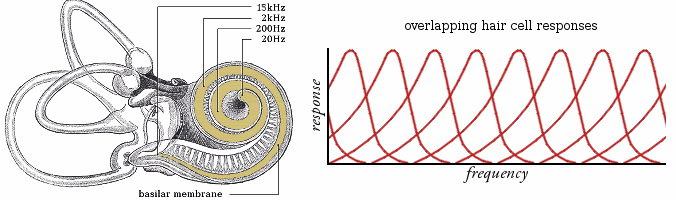
Above: Human cochlea anatomy. Different positions along the basilar membrane correspond to different frequency responses.
After nearly a century of measurement and statistics, the scientific consensus is clear: the hearing range of a healthy young human is approximately 20 Hz to 20 kHz. This number isn’t arbitrary — researchers spent hundreds of hours in anechoic chambers with precision-calibrated equipment, measuring the 「absolute threshold of hearing」 (the quietest sound you can just barely detect) and the 「threshold of pain」 (the volume at which sound causes physical pain). The intersection of these two curves defines the upper limit of human hearing.
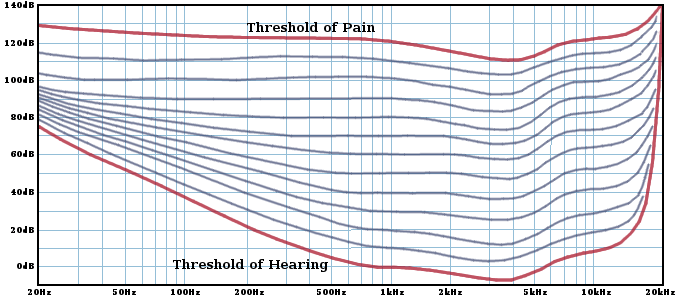
Above: Human equal-loudness contours. Red curves show the hearing threshold and pain threshold. Beyond 20 kHz, hearing a sound would require your ears to endure unbearable pain — effectively making it inaudible.
Are there 「golden ears」 that can hear above 20 kHz? A century of hearing research has failed to find a single such person. So-called 「golden ears」 refers to trained listening skills — the ability to discern subtle timbral differences or mixing flaws — not to a hearing range that transcends physical limits.
192 kHz Sampling Rate: Why It’s Oversampling
Now that we understand the 20 kHz upper limit of human hearing, let’s look at what sampling rate actually means.
In digital audio, 「sampling rate」 is the number of 「snapshots」 taken of an analog sound wave per second. 44.1 kHz (the CD standard) means 44,100 samples per second. 192 kHz means 192,000 samples per second.
Here we encounter a critical theorem: the Nyquist-Shannon sampling theorem. This theorem proves that as long as the sampling rate exceeds twice the highest frequency in the signal, the original signal can be perfectly, losslessly reconstructed. Not 「approximately.」 Not 「close enough.」 Mathematically perfect. A 44.1 kHz sampling rate can fully capture and reconstruct all sounds from 0 to 22.05 kHz — which already covers the 20 kHz upper limit of human hearing, with 2 kHz of headroom to spare.
So what does 192 kHz get you? It theoretically captures ultrasonic frequencies up to 96 kHz. And ultrasound is to your ears what infrared light is to your eyes — your retina has no photoreceptor cells for infrared, and your cochlea has no hair cells for 96 kHz sound. You’re paying for data you will never, ever hear.
Worse still, 192 kHz music isn’t just useless — it may slightly degrade sound quality. The culprit is intermodulation distortion: when ultrasonic frequencies and audible frequencies are played simultaneously through your speakers, the nonlinear characteristics of speakers and amplifiers can 「pull」 those ultrasonic components back down into the audible range, generating noise that wasn’t in the original recording. This is why many professional audio engineers will tell you: 192 kHz is not merely useless for playback — it’s potentially harmful.
Some readers might ask: then why do recording studios use high sampling rates? Because production and playback are two different things. High sampling rates give recording and mixing engineers more operational headroom — effects processing, time-stretching, and pitch-shifting all benefit from higher sampling rates to avoid introducing audible artifacts. But none of this has anything to do with you sitting at home listening to music. Once production is complete and the final master is rendered, downsampling to 44.1 kHz or 48 kHz already contains every bit of information human ears can perceive.
16-bit vs. 24-bit: What Does Bit Depth Actually Determine?
Another minefield of marketing rhetoric is 「bit depth.」
Many people take the term at face value: 16-bit means the sound wave is divided into 65,536 「steps,」 while 24-bit divides it into 16,777,216 「steps」 — more steps, 「smoother」 waveform. And 24-bit offers 256 times as many steps as 16-bit! Sounds like a huge difference, right?
This understanding is wrong. Bit depth does not determine the 「smoothness」 or 「fineness」 of a waveform. The sampling theorem already proves: as long as the sampling rate is sufficient, whether 16-bit or 24-bit, the reconstructed waveform is a perfectly smooth curve — there are no 「steps」 to speak of.1

Above: Discrete sample points (the red staircase) are often mistaken for a crude approximation of the original waveform (the blue smooth curve). In reality, mathematical reconstruction perfectly recovers the original waveform — there is no 「staircase.」
What bit depth actually determines is dynamic range — the gap between the quietest possible sound and the loudest possible sound. Each additional bit adds roughly 6 dB of dynamic range.
16-bit has a theoretical dynamic range of about 96 dB. But with dithering — a signal processing technique that deliberately adds a tiny amount of noise during quantization — the usable dynamic range of 16-bit audio reaches approximately 120 dB.
What does 120 dB actually mean?
- The difference between a mosquito flying around your room and a jackhammer operating at your feet is roughly 100–110 dB.
- The gap between a silent recording studio (about 20 dB SPL) and a sound loud enough to cause permanent hearing damage within seconds (about 140 dB SPL) is also 120 dB.
In other words, 16-bit dynamic range already covers the entire usable range of your ears — from 「barely audible」 to 「loud enough to deafen you.」 24-bit extends dynamic range — lowering the noise floor from 「a level you can’t hear」 to 「a level you even-more-can’t hear.」 It has nothing to do with 「fineness」 that you can perceive. It’s like reducing the brightness of a lamp from 「barely invisible in a pitch-black room」 to 「also invisible in an even-pitch-blacker room」 — utterly meaningless in practice.
The Marketing Psychology of 「Bigger Numbers Are Better」
So here’s the question: if 16-bit/48kHz is already more than enough, why is the entire industry pushing 24-bit/192kHz?
Because it’s a nearly perfect marketing loop: consumers broadly believe 「bigger numbers are better,」 and the audio industry can raise prices simply by raising those numbers. Slap 「supports 24-bit/192kHz high-resolution audio decoding」 on a pair of headphones, and they immediately look 「premium」 compared to ordinary ones. Put 24-bit/192kHz in a more expensive streaming tier, and you’ve just given users a reason to upgrade. Re-release old albums in 24-bit/192kHz format, and you can charge people again for music they already own.2
This isn’t to say all music labeled 「high-resolution」 is fake — the bit depth and sampling rate of the data genuinely are 24-bit and 192 kHz. The problem is: as a human on the playback end, you have absolutely no use for that extra data. You’re buying spec sheets, not listening experiences.
Here’s an analogy: it’s like buying a television that can display ultraviolet and X-ray wavelengths. The screen genuinely can emit those wavelengths, but your eyes can’t see them. The manufacturer can truthfully claim 「our TV’s spectral range is 4x the competition!」 — and the statement isn’t a lie. But it delivers exactly zero practical benefit to you. Similarly, a DAC can decode 192 kHz, and headphones can respond up to 40 kHz, but your ears can only receive up to 20 kHz.
What’s Actually Worth Spending Money On
At this point, I’m not here to tell you 「expensive audio gear is all a scam.」 Quite the opposite — sound quality can be significantly improved. It’s just that the direction of improvement has nothing to do with those 「big numbers」 that exceed the limits of human hearing.
First, get better headphones. This is the highest-ROI upgrade you can make. A pair of headphones with proper acoustic design and a balanced frequency response will improve your listening experience far more than upgrading your source from 16-bit to 24-bit ever will. But note: good headphones aren’t necessarily expensive headphones. Some are priced for brand cachet and industrial design; their sound quality may not match 「ugly headphones」 that cost a third as much. Do your research, not your price-comparison.
Second, seek out better masters. Different releases of the same album can sound dramatically different — because they used different mastering — and the sampling rate or bit depth is not the reason. In 2015, a double-blind study by the Boston Audio Society found that SACD (a high-resolution format) recordings did indeed sound better than CD releases — but when the researchers downsampled the SACD version to 16-bit/44.1 kHz and burned it onto a CD-R, it still sounded better than the original CD. The difference came from the quality of the master itself, not the format parameters.
Third, use lossless formats, but don’t chase 「high-resolution.」 Lossless formats like FLAC ensure your music isn’t degraded by encoder-induced compression artifacts — which matters far more than debating 16-bit versus 24-bit.
Conclusion
In 2012, digital audio engineer Monty Montgomery wrote in his famous essay 「24/192 Music Downloads are Very Silly Indeed」: 「The push for 24/192 is a solution to a problem that doesn’t exist, a business model based on ignorance and deception.」
Twelve years later, his arguments remain as solid as ever — because the physiology of the human ear hasn’t changed, the mathematical proof of the Nyquist theorem hasn’t changed, and the fundamentals of signal processing haven’t changed. What has changed is the variety of marketing language: from 「lossless audio」 to 「master-quality sound」 to 「spatial audio,」 new concepts emerge endlessly, but the underlying physical facts remain constant.
You don’t need to pay for data your ears can’t hear. The next time you see an audio product touting 24-bit/192kHz, ask yourself one question: does it make the 20 Hz to 20 kHz that I can actually hear sound better? If the answer is no, those extra zeros and ones are nothing more than spec-sheet vanity gathering dust on your hard drive.
Reference Links
- Monty Montgomery (Xiph.Org), 「24/192 Music Downloads are Very Silly Indeed」, 2012 — [https://people.xiph.org/~xiphmont/demo/neil-young.html)
- Benjamin Zwickel (Mojo Audio), 「The 24-Bit Delusion」, 2015/2023 — [https://www.mojo-audio.com/blog/the-24bit-delusion/)
- E. Brad Meyer & David R. Moran (Boston Audio Society), 「Audibility of a CD-Standard A/D/A Loop Inserted into High-Resolution Audio Playback」, 2007
- Xiph.Org, 「Digital Show & Tell」 (video demonstration) — [https://xiph.org/video/vid2.shtml)
- Hacker News discussion — [https://news.ycombinator.com/item?id=48763790)
- Tonalyst, 「High Resolution Audio vs. Standard: The Science of Sampling」, 2025 — [https://tonalyst.com/high-res-audio-vs-standard)
Footnotes
-
If you’re curious about how discrete samples can perfectly reconstruct a continuous waveform, I strongly recommend watching Xiph.Org’s educational video Digital Show & Tell, which uses real oscilloscopes and spectrum analyzers to demonstrate the sampling theorem in action with physical equipment. ↩
-
To be fair, 24-bit is genuinely useful during recording and mixing — it provides engineers with ample dynamic headroom to avoid accidental clipping. 32-bit float recording is even becoming the new standard for on-location film and TV audio capture. But these advantages belong to the 「production side」 and have nothing to do with the 「consumer-side」 listening experience. ↩