According to the standard cosmological model (ΛCDM), the first billion years after the Big Bang should have produced a fairly modest universe — small galaxies, fledgling black holes, nothing too ambitious. But the James Webb Space Telescope (JWST) has been telling a very different story.
Just 300 million years into the universe’s “infancy,” Webb sees large, bright, mature galaxies. At 700 million years post-Big Bang, it photographs a supermassive black hole with the mass of 50 million suns. These objects shouldn’t be there — not this early, not this big, not this many.
On Thursday, July 2, 2026, Quanta Magazine published a deep-dive feature systematically laying out the “existential crisis” that Webb has brought to cosmology. The article quickly hit 181 points on Hacker News. But what’s actually keeping astronomers up at night is the data itself.

Why Webb Sees What Hubble Couldn’t
To understand how this crisis unfolded, you need to grasp one key concept: redshift.
The universe is expanding. As light travels through expanding space, its wavelength gets stretched — like a rubber band pulled longer. Blue light shifts to green, green to red, red eventually stretches beyond the visible spectrum into infrared, invisible to the human eye. The farther an object is from us, the more its light gets stretched, and the higher we say its “redshift” is.
The Hubble Space Telescope primarily observed visible and near-ultraviolet light. When a target galaxy’s redshift exceeds a certain threshold, its visible light has been stretched entirely into the infrared by the time it reaches us — and Hubble goes blind. Webb was purpose-built for the infrared. It’s like putting on a pair of infrared night-vision goggles, letting us peer into the universe’s most distant, most ancient corners.
Thanks to that capability, Webb pushed humanity’s gaze hundreds of millions of years deeper — from roughly 500 million years after the Big Bang all the way to less than 300 million. And it’s in this newly opened territory that the trouble began.
The Rebellious Data: Three Mysteries
I see the challenge Webb presents as unfolding on three levels.
Mystery 1: Black holes grew too fast. According to existing theory, black holes need time. First, a massive star dies and collapses into a “seed black hole” (roughly 100 solar masses). Then, that seed grows by consuming surrounding matter. But a black hole’s “feeding rate” has a theoretical ceiling called the Eddington limit: eat faster, and the radiation pressure from all that furious consumption pushes the food away — a built-in brake. Yet just a few hundred million years after the Big Bang, Webb sees supermassive black holes with a billion solar masses. Even if one had been eating at maximum speed from the universe’s first day, it couldn’t have grown that large. Either the seeds were born huge, or the feeding rate far exceeded the theoretical limit — or both.
Mystery 2: The galaxies are too “precocious.” ΛCDM predicts that early-universe galaxies should be small and dim. Matter needs time to clump together under gravity. The first stars need to ignite, and then hundreds of millions of years of mergers and evolution are needed before anything resembling a proper galaxy can form. Yet Webb has found fully-formed galaxies at just 280 million years after the Big Bang — at least hundreds of millions of years earlier than most models predict. Worse, these early galaxies aren’t just present; they’re abundant and bright, as though they’ve already been evolving for billions of years.
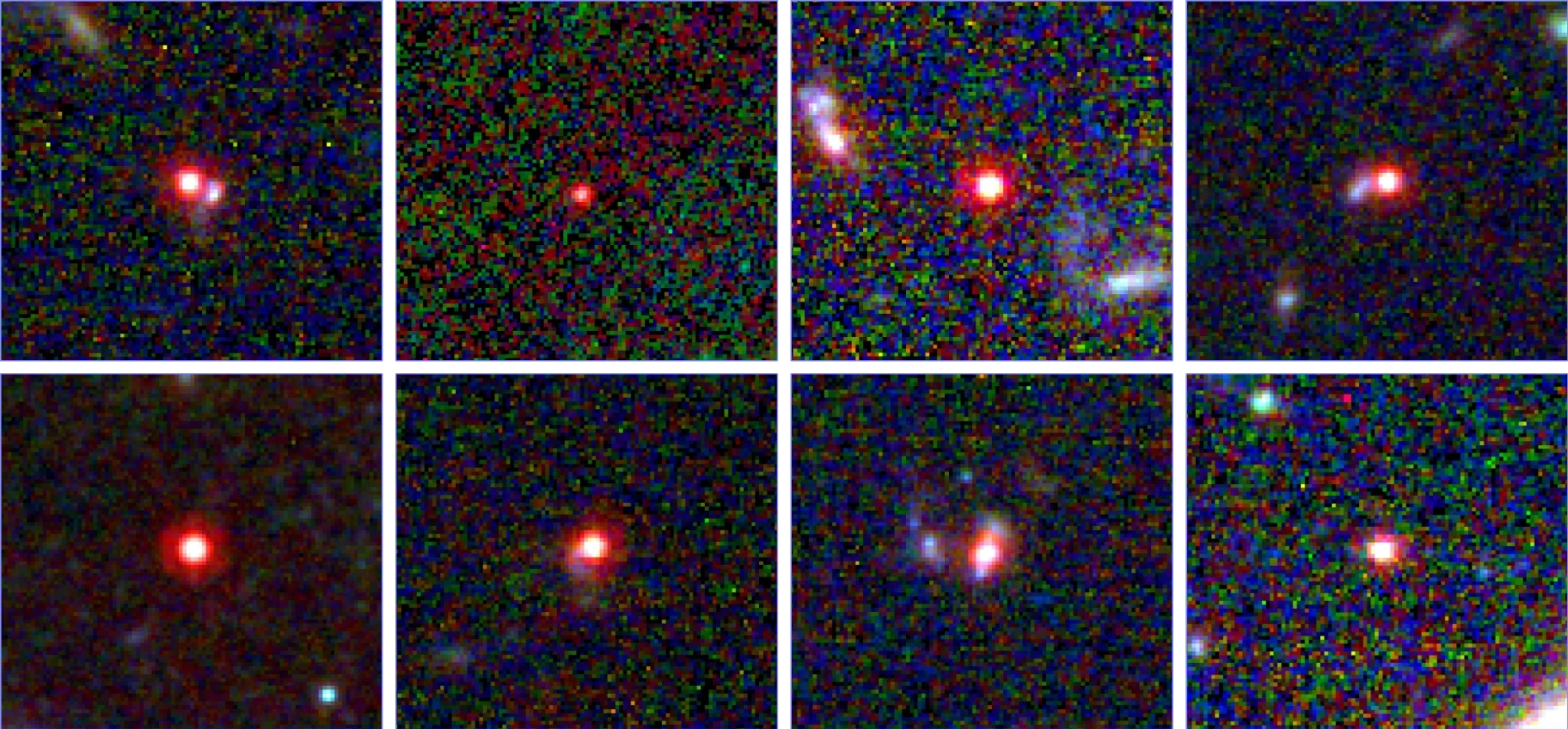
Mystery 3: The “Little Red Dots.” These are a Webb-unique discovery — they appear in no previous telescope data. They’re a class of objects that begin appearing in large numbers around 650 million years after the Big Bang: extremely compact, extremely red (meaning extremely high redshift). Nobody knows for sure what they are. The leading guess is “black hole stars” — a supermassive black hole wrapped in such dense gas that the pressure triggers nuclear fusion, making the whole thing shine like a star, but with a black hole at its core.
What Do Scientists Say? Three Camps
Faced with this unruly data, the field has largely divided into three positions.
Camp 1: Don’t change cosmology — change astrophysics. This is the current mainstream view. Proponents argue that ΛCDM’s big-picture framework — dark matter, dark energy, the expansion history of the universe — is correct. What needs fixing is our understanding of “small-scale” processes like star formation and black hole accretion. Maybe the early universe’s gas was denser than we thought, making star formation more efficient. Maybe black holes can feed via “super-Eddington accretion” — and in 2024, Webb did observe a black hole consuming matter at 40 times the Eddington limit, proving that back door exists. Princeton astrophysicist Jenny Greene told Quanta: “Clearly there is something about the way black holes grow that we don’t fully understand yet.”
Camp 2: ΛCDM may need revision. This camp argues that even after tuning every astrophysical “parameter knob,” you still can’t fully explain everything Webb sees. The simultaneous mismatch in brightness, abundance, and large-scale structure of early galaxies might hint that dark matter doesn’t behave exactly as the standard model assumes — perhaps dark matter particles have subtle self-interactions, or the primordial density fluctuation spectrum of the early universe differs from our assumptions. At an April 2026 conference in Helsingør, Flatiron Institute researcher Rachel Somerville summarized: “We’ve gone from ‘there are too many early galaxies’ to ‘there are too many theories to explain them.’”
Camp 3: The data itself needs a second look. Some researchers urge caution: our estimates of mass, distance, and age for high-redshift objects depend on many assumptions, and those assumptions may carry systematic errors. Astrophysicist Hakim Atek emphasizes that Webb’s Mid-Infrared Instrument (MIRI) has revealed an unexpected truth: the “diversity” of early galaxies far exceeds expectations — “You’d think they should all look roughly the same, but that’s not the case.” This means we may be incorrectly grouping galaxies at different evolutionary stages into the same category, overestimating how “precocious” they appear.
This Isn’t a “Crisis.” This Is Science.
One HN comment stuck with me. User “phyzix5761” took issue with Quanta’s subheading, which read: “Scientists have proposed a slew of new theories to explain them — now they just need to figure out which one is right.”
“The goal of science isn’t to find ‘the right one,’” he wrote. “The goal of science is to find what is wrong, and then build models for what remains. We can never be certain we’ve found ‘the truth,’ because that would close the door on future science overturning our beliefs.”
He may be overstating it, but the core insight is sound. This “crisis” that Webb has triggered is, at bottom, a description of the scientific method working as designed: you build a better instrument, you see things you couldn’t see before, the old models no longer suffice, so you propose new ideas, run new simulations, wait for new data — and the cycle continues.
As Charlotte Mason of the Cosmic Dawn Center in Copenhagen put it, sketching diagrams mid-interview: “Now what? Start over.”
And that, more than any settled answer, is when a discipline is at its most alive.
Further Reading & Data
For readers who want to go deeper:
- NASA Webb Telescope Official Image Gallery: Raw data and scientific explanations for all public Webb images. https://science.nasa.gov/mission/webb/multimedia/images/
- Webb “Little Red Dots” Feature Page: STScI’s dedicated page on the Little Red Dots, including original NIRCam imagery. https://webbtelescope.org/contents/media/images/2025/101/01JFJYMX2QBF2WGEEXB6M1MR8P
- Big Think In-Depth Analysis: A cosmology explainer that walks through the JWST early-galaxy problem from a ΛCDM perspective. https://bigthink.com/starts-with-a-bang/jwst-sense-bright-early-galaxies/
Reference links:
This article is based on Jay Bennett’s July 2, 2026 Quanta Magazine feature “Astrophysicists Puzzle Over Webb’s New Universe,” the Hacker News community discussion, and publicly available scientific data from NASA/ESA/CSA. All scientist quotes are sourced from the original Quanta article. All image copyrights belong to their respective original sources.