On July 7, 2026, Microsoft Xbox’s new CEO Asha Sharma sent an email to all employees: Xbox would undergo “the largest restructuring in its history,” cutting approximately 3,200 positions across the 2027 fiscal year. On the same day, four studios — Compulsion Games, Double Fine, Ninja Theory, and Undead Labs — were spun off from Xbox and handed to new management.
But what truly detonated the global game development community was a piece of news from id Software: the idTech engine team was almost entirely laid off.
Thirty Seconds to Understand “Game Engine”: The Foundation and Scaffolding of a Building
For readers who don’t write code, the term “game engine” might be unfamiliar. But it’s not hard to grasp.
When you construct a building, you need a foundation, load-bearing walls, plumbing and electrical lines, and scaffolding. This infrastructure determines how tall the building can rise, how well it withstands earthquakes, and what each room can be used for. A game engine is that infrastructure for a game world. It determines how realistic the visuals can be, how authentic the physics feel, how intelligent the enemy AI can be, and how vast the environments can stretch.
Most game studios around the world don’t build their own engines. They “buy” off-the-shelf ones — just as a developer doesn’t fire their own bricks and smelt their own steel but sources from a building supply market. The two dominant “suppliers” today are Epic Games’ Unreal Engine and Unity. Think of them as two enormous hardware superstores — most developers push a shopping cart in, grab what they need, and go.
But id Software — the company that created Doom and Quake — is different. For over thirty years, they’ve fired their own bricks, smelted their own steel, and designed their own load-bearing structures. The engine they built themselves is called idTech, and it hasn’t just powered their own games — it has been licensed to countless others, and traces of idTech’s DNA can be found in many of today’s most popular titles.
That’s why the gutting of the idTech team sent shockwaves through the gaming world that went far beyond “another company did layoffs.”
 ▲ Apogee founder Scott Miller confirms the idTech team layoffs on social media (source: gamefromscratch.com)
Why idTech Matters: It’s Not Just Code — It’s Thirty Years of Gaming History
id Software was founded in 1991 by a group of brilliant programmers, most famously John Carmack — a programmer many in the industry regard as the “Thomas Edison of gaming.”
In 1993, Carmack wrote the Doom engine. Before this, 3D games were either crude wireframes or employed various trickery to simulate 3D effects. Carmack built the first genuinely smooth, textured, lit 3D game engine. On the day Doom launched, university networks across America buckled under the weight of demo downloads.
In 1996, Carmack wrote the Quake engine — the first fully true-3D game engine in history. Before Quake, 3D games were “tricking” the player’s eyes; from Quake onward, every object, every corner in the game world existed in genuine three-dimensional space.
These two engines didn’t just create the first-person shooter (FPS) genre. More critically, id Software consistently practiced openness with its technology: they would release the engine’s source code publicly, allowing developers worldwide to study, modify, and build upon it. Valve’s renowned Source engine — which powered masterpieces like Half-Life, Counter-Strike, and Portal — evolved directly from idTech code. Early Call of Duty titles ran on engines also derived from idTech 3.
Put simply: a significant portion of the modern game industry’s genetic code comes from id Software’s technical legacy.
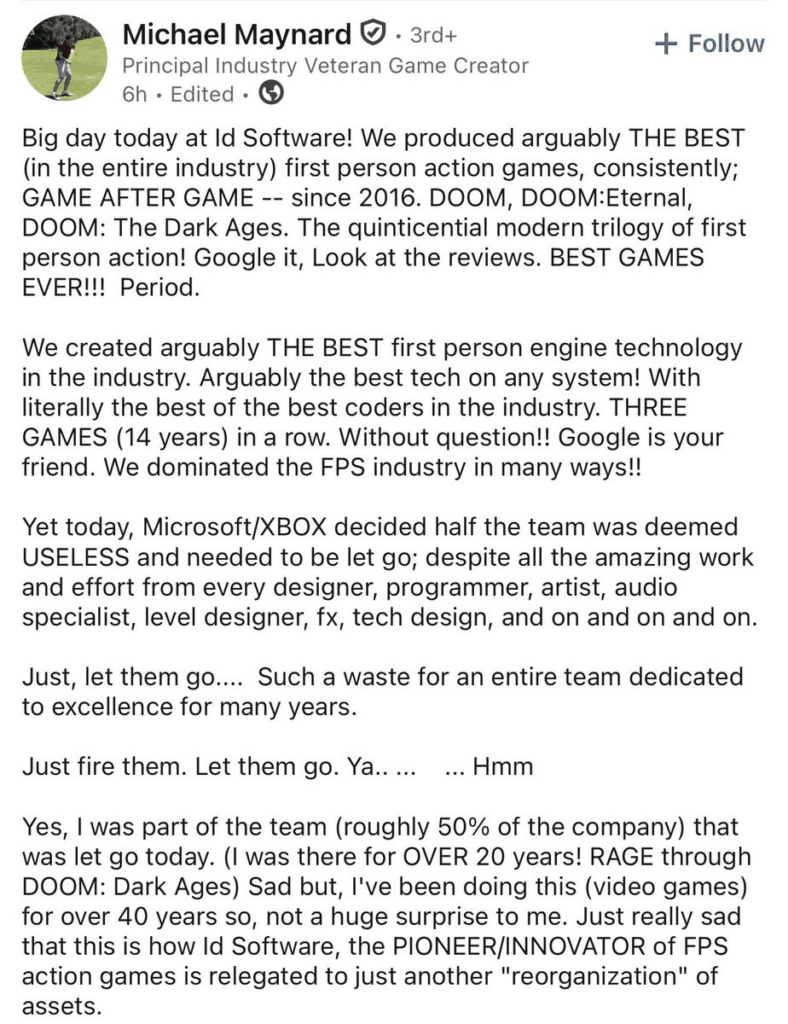 ▲ Michael Maynard, who worked at id Software for over 20 years, posted on LinkedIn confirming he was affected by the layoffs (source: gamefromscratch.com)
The Puzzle: Why Would Microsoft, With Xbox and Game Pass, Dismantle Its Own Core Asset?
Let’s think about this from an ordinary person’s perspective:
Microsoft owns Xbox consoles, Game Pass (a “Netflix for games” — a monthly subscription gives you access to hundreds of titles), and legendary game franchises like Doom, Quake, and Wolfenstein. The idTech engine is the “motor” that drives these games — and it’s a motor exclusive to Microsoft, one nobody else has.
It’s as if Toyota, while selling cars around the world, fired its engine R&D team and decided to buy all its engines from third parties going forward.
There’s a certain business logic to it — buying engines off the shelf might be cheaper, and hiring engineers who already know that engine is easier. But you’ve also lost control of your “heart.” Your cars and everyone else’s cars will start to drive more and more alike.
A highly-upvoted comment on Hacker News cut to the core:
“Owning your own engine means you have to cultivate specialists in internal tools. Your employees know this and will demand higher salaries knowing it’s hard to replace them. By contrast, firing the entire engine team and moving to Unreal Engine 5 means you can access a massive pool of low-cost outsourced workers familiar with UE5. You can hire a batch at the start of a project, fire them all when it ends, rinse and repeat. This turns employees into a replaceable commodity rather than a cohesive team of craftspeople.”
In other words, the deeper signal of these layoffs is: Microsoft no longer sees itself as a company that “cultivates technical craftsmanship,” but as one that “efficiently assembles content.”
The Comment Section’s Industry Analysis: Three Forces in Tension
The 400+ comments on HN can be roughly grouped into three camps, reflecting three forces locked in a fierce industry struggle.
Camp One: Engine Homogenization — When All Games “Look the Same”
Players who’ve experienced games built on Unreal Engine often note they have an “indescribable similarity” — the same visual texture, the same stutter issues, the same movement feel.
Developers on HN pointed out this isn’t a conspiracy theory. Every engine has its “default settings,” and most development teams — especially those on tight budgets and tighter deadlines — don’t deeply customize those defaults. The result is that a vast number of Unreal Engine games on the market look and play like they came out of the same mold.
idTech is the opposite. Its FPS feel — that crisp, tight, high-framerate, every-shot-lands-with-impact sensation — is the product of id Software spending thirty years sharpening a single blade. You can’t replicate that by tweaking a few parameters in Unreal Engine.
One veteran player’s HN comment captured what many are worried about: “I can spot a Creation Engine game vs. an Unreal Engine game from a mile away. The ‘flavor’ of an engine is real. idTech has its own unique flavor — that buttery-smooth, high-framerate shooting experience that nothing else quite matches.”
Camp Two: AI-Generated Content vs. Hand-Built Technology
This is the deeper rift. Multiple HN commenters argue that the real purpose of Microsoft’s restructuring isn’t saving money — it’s making room for AI.
Microsoft’s strategy in 2026 is crystal clear: all-in on AI. From Windows to Office to Azure cloud services, AI is permeating every product line. Gaming is no exception.
But here’s the problem: AI tools — like auto-generating game environments, characters, and animations — integrate most easily with platforms that have enormous user bases and mature ecosystems (i.e., Unreal and Unity), not with a custom in-house engine understood by only a few dozen people.
One HN user put it bluntly: “Microsoft doesn’t need an expensive engine R&D team. They need a standardized pipeline that can plug into AI-generated content infinitely. A handcrafted engine like idTech has no place in that new world.”
In other words, on Microsoft’s AI strategy chessboard, the idTech team isn’t an asset — it’s an obstacle.
Camp Three: Game Pass Is a “Sweet Trap”
This angle is the most ironic, and also the one that best explains Microsoft’s apparent self-contradiction.
id Software’s recent games — Doom Eternal, Doom: The Dark Ages — were critically acclaimed but “sold poorly.” The problem is, the “poor sales” were caused by Microsoft itself: these games launched day one on Game Pass. Players could access them for a dozen dollars a month, so there was no need to spend $60 on a standalone purchase.
As one HN commenter put it: “You can’t shove games into a bargain-basement subscription service and then use sales numbers to prove the studio isn’t profitable.”
This isn’t a failure of id Software. It’s an internal contradiction in Microsoft’s business model — and the idTech team became the casualty of that contradiction.
My Take: This Is a Signal, and It’s Not Just About Gaming
To be fair, Microsoft’s business logic isn’t baseless. Maintaining an in-house engine team is extremely expensive — you need senior graphics engineers, physics simulation experts, toolchain developers, and these people in Silicon Valley easily command over $300,000 a year. By contrast, developers who know Unreal Engine are a dime a dozen on the market, labor costs are far lower, and project timelines are more predictable.
But here’s the problem: some things can’t be valued by short-term cost calculations.
The idTech engine represented Microsoft/Xbox’s “moat” in gaming performance — a technical advantage that other console platforms (like Sony PlayStation) and third-party publishers couldn’t access. Gutting this team is, in essence, filling in your own moat.
What’s more unsettling is the trend this represents. If even Microsoft — with Xbox, Game Pass, and a market cap north of two trillion — has decided that “building your own engine isn’t worth it,” what about small companies? Independent studios? The teams still insisting on building their own tech — will they fall one by one under capital’s pressure?
When only two or three engines remain on the market, when all games are assembled from the same building materials, what players ultimately get may be an increasingly boring game world.
Reference links: