
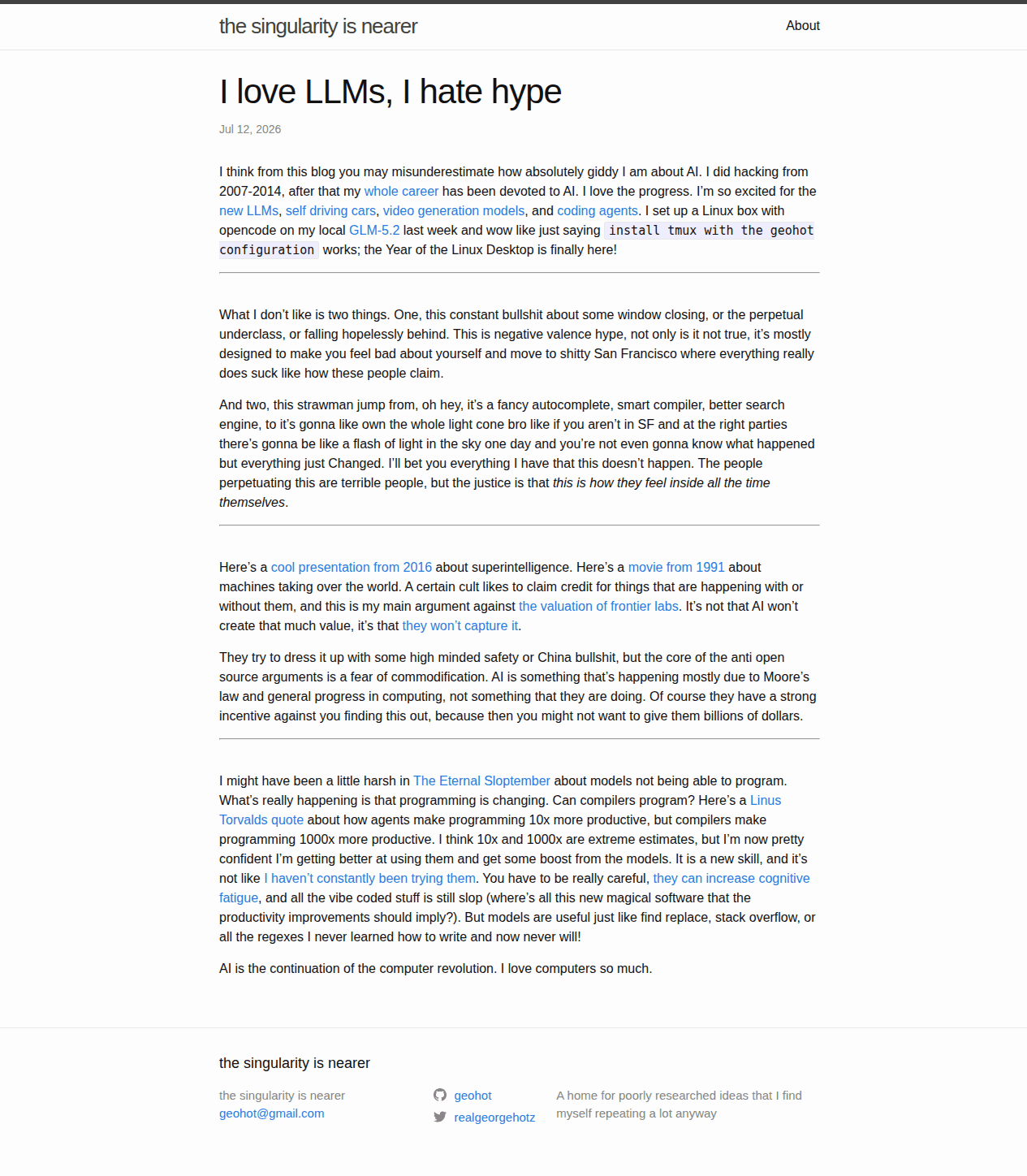
On July 12, 2026, George Hotz published a blog post under 800 words titled “I love LLMs, I hate hype.” Within 24 hours it had gathered more than 280 upvotes and 160-plus comments on Hacker News.
Who is George Hotz? In short, he’s the kind of person Silicon Valley both admires and finds exhausting. He became the first person to unlock the iPhone at 17, later cracked the PS3, and went on to found the self-driving car company comma.ai. In tech circles his handle “Geohot” is a symbol — of untamed talent and a natural suspicion of authority.
But this time he wasn’t cracking a device. He was taking apart a valuation system.
A remarkably clean valuation paradox
There’s one line in Hotz’s post that HN users called “the most precise one-sentence explanation of everything”:
My core objection to frontier lab valuations is this: they can’t capture that value. AI creating enormous value is one thing; the companies creating it actually making money is another.
Pull that apart and you get two questions. First: will AI create enormous value? Hotz’s answer is unambiguous: yes. He opens the post by saying his whole career has been in AI, and “I love this progress.” Second: can the frontier AI companies that create that value turn it into their own revenue and profit? That’s the part he actually questions.
Let me explain the distinction with a less technical analogy. The invention of electricity created incalculable value — without it, modern civilization wouldn’t exist. But the power plant itself is not the world’s most profitable business. Aviation contributes trillions of dollars a year to the global economy, yet airline stocks have not been great long-term investments — as one HN commenter wrote: “Delta is jokingly called a bank that happens to run an airline, because so much of their revenue comes from credit-card fees.”
Creating value and capturing value are two entirely different things.
LLMs are becoming “water from the tap”
Why might frontier AI labs fail to capture value? Three core reasons.
First, the performance gap between models is shrinking. The same week Hotz posted, he ran a local model called GLM-5.2 on his Linux machine to install and configure tmux. His verdict: “magically good.” And GLM-5.2 is an open-source model — not OpenAI’s or Anthropic’s paid product. One HN user wrote: “We can’t ignore the power of ‘good enough.’ GLM-5.2 may not match the strongest closed model, but for most people and most needs it’s already plenty good.”
This isn’t an isolated case. Alibaba’s Qwen open-source models passed 1 billion downloads back in January 2026. Open-weight models now compete with closed frontier models on coding tasks — at a fraction of the cost.
Second, switching costs approach zero. In software, switching vendors usually means data migration, retraining, and business disruption. But switching LLMs? You change one API endpoint, or open another webpage. One HN user described the market reality: “Anthropic is really pushing users toward Fable’s metered billing. But OpenAI shipped 5.6 Sol, close enough in performance to Fable, and — note this — it’s included in the $20/month subscription tier. If Anthropic really kills Fable’s subscription access in a few days, I predict users will flood back to OpenAI.” As Hotz wrote in an earlier post, “AI has no moat”: AI has no moat.
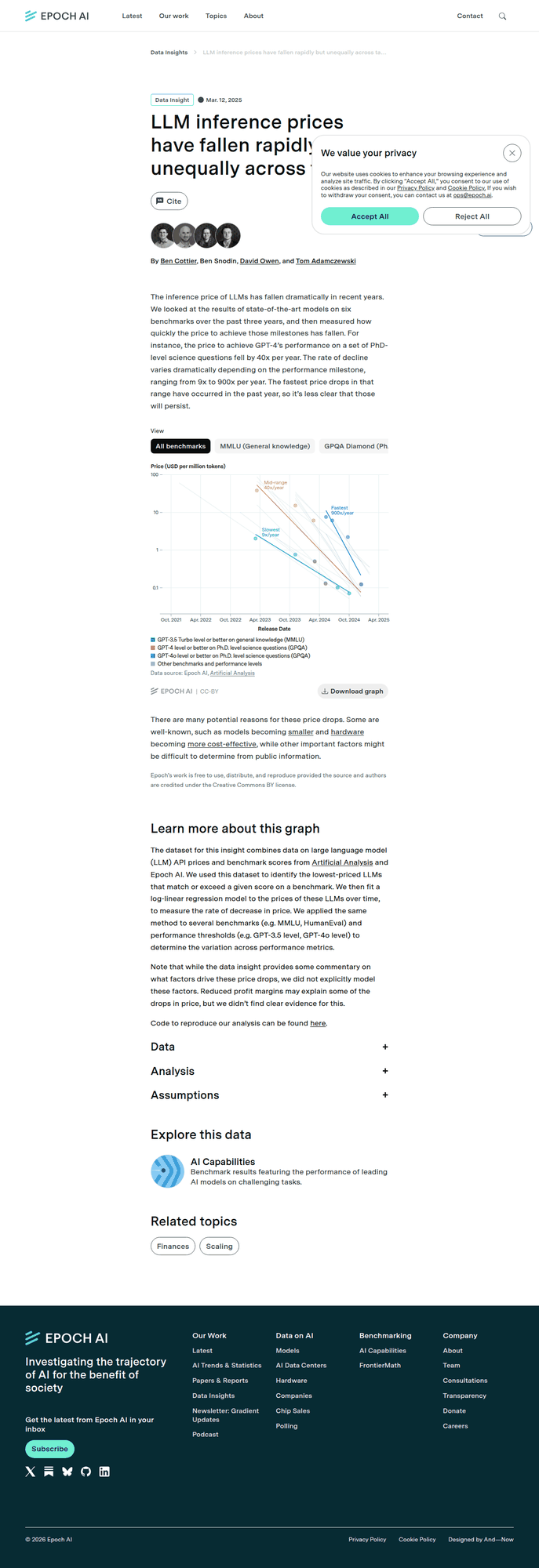
Third, a price war is already underway. This is happening right now. Early 2026, Anthropic cut Claude’s prices by 67%. A model that once charged $60 per million tokens now costs just $1 to $2. DeepSeek’s entry pushed the trend to its extreme. The Wall Street Journal reported this June that soon-to-IPO OpenAI is considering steep token price cuts to defend its enterprise market — and soon-to-IPO Anthropic is preparing to do the same.
Epoch AI’s research team tracked the decline in LLM inference prices over the past three years. Their conclusion: on tasks like PhD-level science Q&A (GPQA Diamond), the cost of reaching GPT-4-level performance falls about 40x per year. The rate varies by task, from 9x to 900x. Behind the trend are hardware efficiency gains, model miniaturization, and optimization — but whatever the cause, the result is the same: LLM output keeps getting cheaper, cheap enough to be like tap water.
Anthropic and OpenAI: two diverging paths
Facing the wave of commoditization, the two frontier labs are heading in different directions — and that split happens to reflect the central tension in Hotz’s argument.
Anthropic chose metered billing. Their logic: the most powerful models (like Fable) are expensive and can’t be covered by a flat subscription fee — so users should pay for the tokens they actually consume. That sounds reasonable, but here’s the problem: under subscription, $20–$200 a month gets you the best models; switch to metered billing and the same usage can become $1,000 to $10,000.
One HN user who manages an AI budget at a company ran the numbers: “I definitely wouldn’t pay $1,000 a month for the best model, let alone $10,000. My company might pay $1,000 a month, but absolutely not $10,000.” He went on: “Frontier labs need everyone to answer ‘I’d gladly pay 100x what I pay now’ — and that’s impossible, because everyone now knows how to build these models.”
OpenAI chose differently. They put GPT-5.6 Sol — a model close enough in performance to Fable — into the $20/month subscription tier. A completely different strategy: not chasing high per-user revenue, but chasing the scale effects of user count and market share.
It’s too early to say which strategy is right. But Hotz’s judgment is clear: Anthropic pushing metered billing is “digging its own grave” — because under subscription, the value of frontier models has already been anchored to a relatively low price point. Once users get used to “the best AI” for $20 a month, asking them to accept a bill that balloons with usage is psychologically and economically unrealistic.
The doom narrative and the valuation story
Hotz’s post is actually a continuation of another blog he wrote two weeks earlier. That one had a sharper title: “The doom justifies the valuation.”
In that piece he wrote that he’d spent two weeks in Berkeley and found a strange mood in the AI world: a kind of mind virus, not a technology. He quoted another author, “schizoposting”: “The only possible conclusion is that this narrative was designed to manufacture panic. In fact, it is optimized to manufacture panic: no description of an actual product could stir up more of a psychological whirlpool in the media and public than ‘AI doom.’ It provides a news cycle that lasts years and infinitely renewable controversy — and its main function is to shift the reference frame for AI industry valuations from reality onto hypothetical future value.”
In other words, if you just honestly write a tech blog — “hey, our model improved 3 percentage points on some benchmark” — nobody gives you a hundreds-of-billions valuation. But if you say “this technology may alter the course of human civilization, and we must control it before it ‘runs away’” — then the high price gets a story.
This is the other side of Hotz’s “valuation paradox”: frontier labs may not only fail to capture the value AI creates — their valuations themselves rest on a narrative grander than the technology. And when a narrative has to keep escalating to sustain a valuation, the sustainability of the narrative itself becomes the problem.
What happens next?
I won’t offer an “answer” — that’s beyond my judgment, and contrary to this essay’s exploratory nature. But we can trace the forces acting simultaneously.
The upward force: AI is genuinely creating real value. GitHub Copilot has lifted programmer productivity by a perceptible order of magnitude; AI replacement of enterprise customer service is saving real costs; in research — from protein folding to mathematical proof — AI’s contribution is undeniable. None of this is a bubble.
The downward force: the speed of commoditization is outpacing the evolution of business models. The capability gap between models is narrowing, switching costs are near zero, and a price war is bleeding every side. One HN commenter put it vividly: “It’s like Nvidia or Intel claiming they have the best gaming performance, but to achieve it they burn more power per frame than any competitor — and nobody needs that.”
The sideways force: the flow of value is shifting. As one analysis noted, “the profit pool is moving downstream from frontier model providers — to compute, cloud services, and the application orchestration layer.” In other words, the companies building the models aren’t necessarily the most profitable. The most profitable might be the ones selling “shovels” (Nvidia), or the tools that embed models into existing workflows so users can’t leave.
Hotz’s own attitude toward AI is in fact far more optimistic than his critics’ posture suggests. He ends the post: “AI is a continuation of the computing revolution. I love computers too much.” He isn’t bearish on AI; he’s questioning a specific valuation logic: when a technology becomes as universal and cheap as water and electricity, can the companies providing it — however frontier — also generate profits that match their valuations?
The answer to that question may bear on more than a few companies’ stock prices. It bears on how we understand “value” itself — does it accrue to those who create it, or to those who use it?
Reference links:
- Geohot: I love LLMs, I hate hype
- HN discussion (item?id=48883343)
- Epoch AI: LLM Inference Price Trends