On July 18, 2026, at 12:05 PM Indian Standard Time, a rocket roughly seven stories tall soared from a small island in the Bay of Bengal. Fifteen minutes later, it successfully delivered multiple satellites into a 450-kilometer orbit.
The news immediately surged to 448 points on Hacker News—in tech circles, that signals all of Silicon Valley was paying attention. But what truly sent shockwaves through the global aerospace industry was a counterintuitive fact: this was the company’s very first orbital rocket launch, and it succeeded on attempt number one.
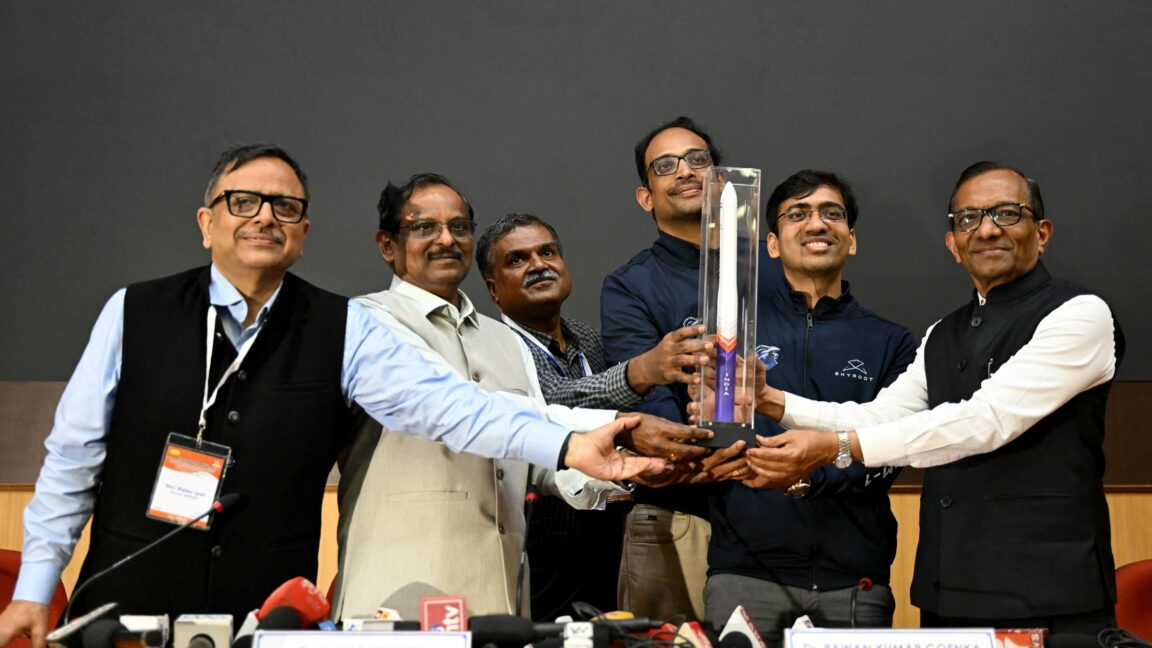 Caption: Skyroot Aerospace’s Vikram-1 rocket lifts off from the Satish Dhawan Space Centre in Sriharikota, India. Credit: R. Satish Babu/AFP via Getty Images
A Maiden Launch Record Even SpaceX Couldn’t Deliver
To appreciate just how remarkable a first-time orbital success is, consider the historical track record.
Elon Musk’s SpaceX launched the Falcon 1 rocket three times between 2006 and 2008—and all three ended in failure. The first launch lost control 25 seconds after liftoff and crashed; the second suffered a premature second-stage engine shutdown; the third disintegrated seconds before reaching orbit. It wasn’t until the fourth launch that Falcon 1 finally became the first privately funded liquid-fueled rocket to reach orbit. That grueling string of three consecutive failures remains the darkest chapter in SpaceX’s history.
New Zealand’s Rocket Lab fared little better. Its Electron rocket launched successfully in 2017 on its maiden flight, but ground telemetry equipment failures forced a safety destruction command just seconds before orbital entry.
Jeff Bezos’s Blue Origin achieved a successful debut with its heavy-lift New Glenn rocket in 2025—but only after its engineering team had spent over a decade conducting dozens of suborbital test flights with New Shepard.
Yet Skyroot Aerospace—a Hyderabad startup founded in 2018 by two former ISRO (Indian Space Research Organisation) scientists—reached orbit on its very first try. As CEO Pawan Kumar Chandana put it: “Reaching orbit on the first attempt… I never thought it was possible.”
Why This First Launch Is a Seismic Shift
1. Breaking the “Space Is Only for Governments” Monopoly
Orbital launch was historically the exclusive domain of super-nation states. Over the past 60 years, only a handful of countries have developed the capability to put rockets into orbit. And prior to Vikram-1, only three private companies in the world had accomplished orbital satellite delivery: SpaceX, Rocket Lab, and Blue Origin.
Now, India has become the third country in the world—after the United States and China—to possess private orbital launch capabilities.
This is far more than just adding one more competitor. India operates the world’s third largest active space program, long monopolized by ISRO. By 2019, the Indian government recognized that ISRO alone could not keep up with demand—manifest backlogs stretched over three years, leaving small satellite operators waiting indefinitely. In 2020, India established IN-SPACe (Indian National Space Promotion and Authorization Centre), an autonomous agency tasked with fostering private space initiatives.
The success of Vikram-1 is the direct fruit of this state-supported open-ecosystem strategy. ISRO provided solid motor test facilities and opened its launchpad at Sriharikota to Skyroot. Having a national space agency act as a logistical backbone for private startups is virtually unprecedented in space history.
2. A Price Disruptor Enters Commercial Launch
While official pricing for Skyroot launches has not been fully disclosed, industry analysts estimate Vikram-1’s launch cost will drop below $15,000 per kilogram. For perspective, a SpaceX Falcon 9 rideshare slot costs around $6,000 per kilogram—but that requires sharing a mega-rocket with dozens of payloads. For dedicated small satellites under 300 kg, dedicated small launcher prices have remained stubbornly high.
Rocket Lab’s Electron costs around $7.5 million per launch for a 300 kg payload capacity. Vikram-1 offers slightly higher payload capacity (350 kg) at a projected price point expected to be significantly lower. For thousands of universities, research labs, and small-sat startups worldwide, this translates to a much cheaper ticket into space.
 Caption: Vikram-1 standing on the launchpad. Constructed with a full carbon-fiber composite structure, it is India’s first all-composite orbital rocket. Credit: ISRO
3. Pragmatic Tech: “Less Is More”
Vikram-1’s technical architecture reflects smart engineering choices. It eschews reusability like SpaceX’s Falcon 9 and skips heavy-lift capacity altogether. Standing at 22 meters tall—less than one-third the height of Falcon 9—it features a four-stage configuration: three solid-propellant stages topped by a liquid-propellant fourth stage powered by a 3D-printed liquid engine for the final orbital burn.
Solid rockets offer simplicity, high reliability, and quick launch readiness, though their thrust cannot be throttled and they cannot be recovered. Skyroot took a pragmatic stance: solve the primary problem of getting payload into space first before tackling reusability.
Additionally, Vikram-1 incorporates an all-carbon-fiber composite structure, making it India’s first fully composite orbital rocket. The light weight of carbon fiber significantly reduces structural dead weight, allowing more payload to be carried per unit of fuel—an optimal engineering compromise.
The Counterview: Has the Game Really Changed?
Despite the milestone, a sober perspective is necessary.
First, Vikram-1 remains a small satellite launch vehicle. A 350 kg capacity serves entry-level payloads. It cannot launch heavy GEO communication satellites or space station resupply capsules. Its target market comprises Earth observation cubesats, IoT constellations, and scientific testbeds—a fast-growing market, but one with limited total addressable revenue.
Second, India’s commercial space ecosystem is still maturing. Skyroot enjoys ISRO’s backing, but its supply chain, engineering depth, and capital reserves lag behind U.S. competitors. A single successful launch does not guarantee commercial survival. SpaceX waited two full years after Falcon 1’s maiden success before securing NASA’s Commercial Resupply Services contract; Rocket Lab took nearly two years to return to flight after its initial launch anomaly.
Third, ISRO’s support is a double-edged sword. Skyroot relies heavily on ISRO’s launch pads, test stands, and talent pool (its founders are ISRO alumni). While an immense advantage today, Skyroot must eventually build independent supply chains and reduce state dependency to operate as a truly autonomous commercial operator.
The Parallel with China’s Commercial Space Boom
For observers tracking global commercial spaceflight, this event echoes developments in China.
Between 2024 and 2026, Chinese private launch startups—LandSpace, iSpace, Galactic Energy—have accelerated their orbital flight tests. China’s commercial space sector has similarly transitioned from state dominance to private innovation. However, one key distinction remains: no Chinese private rocket company has yet achieved orbital success on its very first launch attempt.
This does not imply inferior technology in China’s private sector; orbital rocketry is inherently an industry where first-flight failures are standard. Skyroot’s first-time success represents a rare alignment of engineering discipline and execution—making it all the more notable.
Just the Beginning
The successful orbital insertion of Vikram-1 proves a vital thesis to the world: a private startup from a developing nation can build an orbital rocket that works on day one.
Space exploration was once the exclusive realm of superpowers. Later, it became the domain of state space agencies. Then, Silicon Valley billionaires broke into the sector with venture capital. Now, an Indian startup has shown that the barrier to entry might be lower than previously believed.
Who will be the next “success on attempt one”?
By 2027, we might see private rocket startups from Indonesia, Brazil, or Nigeria repeating this milestone. Or perhaps an unsung team in Eastern Europe. Looking back, Vikram-1’s launch may well be remembered as the first domino to fall.
As Skyroot CEO Pawan Kumar Chandana remarked after the launch: “This mission was like a thriller movie. You never know the ending—until it actually happens.”
Reference Links
- Ars Technica deep dive: India’s first privately developed rocket reaches orbit on dramatic debut launch (Stephen Clark, Jul 20, 2026)
- Hacker News discussion: news.ycombinator.com/item?id=48973835 (448 points / 132 comments)
- Space.com report: Skyroot Aerospace India first private orbital launch Vikram-1
- The Hindu live report: Vikram-1, country’s first private orbital-class rocket
- Business Today analysis: India’s first private rocket reaches orbit — the space race has just changed forever
- Wikipedia: Vikram (rocket family) — Skyroot Aerospace — detailed technical parameters
- Skyroot Aerospace official statement: Mission Aagaman launch briefing
Image Captions
- Image 1: Vikram-1 rocket lifting off into the sky (Source: R. Satish Babu / AFP via Getty Images, via Ars Technica)
- Image 2: Vikram-1 rocket on the launchpad featuring all-carbon composite structure (Source: ISRO, via Ars Technica)