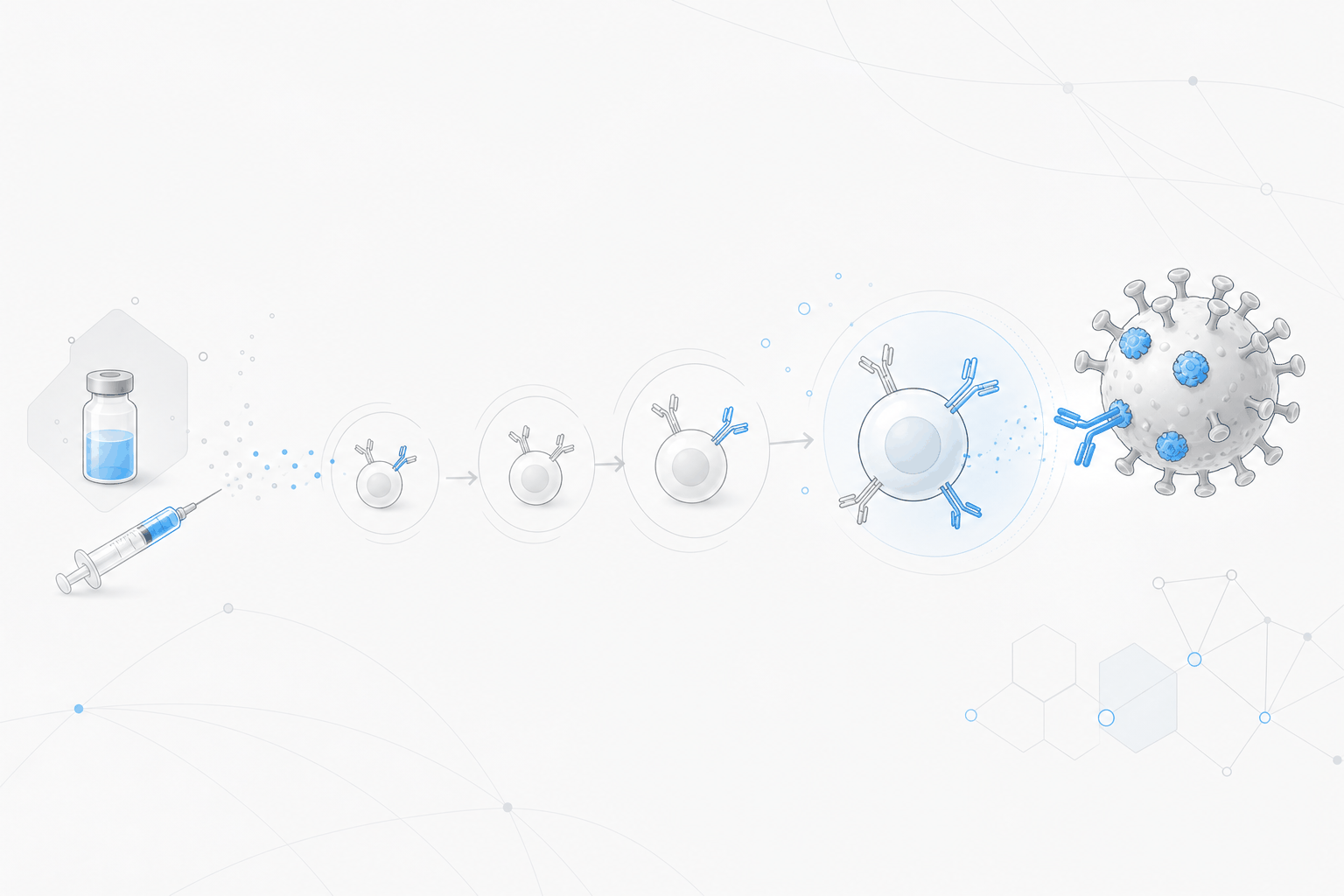
In July 2026, a paper published in Nature sent shockwaves through the HIV vaccine research community. A joint team from the La Jolla Institute for Immunology (LJI) and Scripps Research tested a novel HIV vaccination strategy in rhesus macaques—and 44% of the animals generated antibodies capable of neutralizing a wide range of HIV strains. For the first time in four decades, an HIV vaccine candidate has demonstrated results of this magnitude in non-human primates.
When news reached Hacker News, it garnered 532 points and 232 comments within ten hours. The discussion wasn’t limited to bioscientists; software engineers, hardware designers, and product managers actively analyzed the underlying methodology. They realized that the core logic behind this approach felt remarkably familiar.
HIV: The Immune System’s “Master of Deception”
Traditional vaccine design relies on a straightforward principle: introduce inactivated or attenuated pathogens into the body, allowing the immune system to recognize and remember them for future defense. This paradigm worked brilliantly for smallpox and polio, but fails completely against HIV.
The obstacle isn’t a lack of effort, but the unique nature of HIV as an adversary. The virus relies on three layers of protective armor.
First: Glycan Camouflage. The HIV envelope protein is shrouded in a dense layer of sugar molecules nearly indistinguishable from host cell sugars. B cells, trained not to attack self-tissue, find virtually no viable target.
Second: Rapid Mutation. HIV mutates at a rate an order of magnitude faster than influenza. A single infected individual can harbour a vast array of viral variants.
Third: Conformational Shape-Shifting. Upon infecting a cell, the HIV envelope protein changes structure. If a B cell happens to recognize a particular conformation, the target shape disappears instantly.
When these three armors combine, B cells attempt thousands of bindings against the HIV envelope, but the vast majority hit ineffective decoy targets—structures that look promising but are functionally irrelevant. The immune system works tirelessly, but in entirely the wrong direction.
A One-in-a-Million Hope
In rare individuals known as elite controllers—who harbour the virus for long periods without progressing to disease—scientists discovered a special class of immunoglobulins: broadly neutralizing antibodies (bnAbs). These antibodies target invariant core structures on the HIV envelope that remain constant regardless of viral mutation. Only about 15% of HIV-infected individuals naturally develop bnAbs over time.
More importantly, nearly everyone possesses precursor “seed B cells” capable of producing bnAbs. They carry the necessary genetic blueprint and could theoretically mature into bnAb factories. The challenge is their extreme rarity—accounting for roughly one in a million B cells.
During natural infection, HIV mutates so rapidly that these rare B cells cannot complete “affinity maturation”—the iterative process of mutation, screening, and optimization—before the virus shifts to a new variation.
Consider an analogy: ten thousand students sit for a mathematics exam. Nine thousand nine hundred and ninety-nine spend their time practicing “1+1=2”, while a single student works on differential calculus. Ranked by speed and volume, the calculus student produces answers too slowly, ranks at the bottom, and is eliminated. In the next round, the exam topic abruptly switches to literature, forcing everyone to start from scratch.
Traditional vaccines fail to solve this problem because they present the immune system with only a single, overly simple problem.
Not a Single Shot, but an “Immune Curriculum”
The LJI and Scripps Research team devised a counter-intuitive approach: instead of administering a single vaccine, they designed a multi-step “sequential vaccination” regimen. Known in academic literature as “germline targeting,” the strategy was vividly summarized by a top-voted comment on Hacker News: “This vaccination scheme is like a curriculum for the immune system, where each shot targets a different stage of B cell development.”
The core engineering logic: since HIV is too formidable for the immune system to figure out independently, scientists must design a step-by-step syllabus to guide B cells toward the correct neutralization strategy. The regimen unfolds in three distinct phases.
Phase 1: Priming. The initial dose delivers a precisely engineered protein antigen. Its sole mission is to locate and activate that one-in-a-million seed B cell—naïve B cells that carry germline genes capable of evolving into bnAbs. It acts as a hyper-specific selector.
Achieving this precision is extraordinarily difficult. With so few target B cells and vast numbers of off-target B cells, an imprecise antigen would be overwhelmed by non-productive immune responses. Dr. William Schief’s laboratory at Scripps spent years using computational structural biology and protein engineering to craft an immunogen that exclusively engages the correct germline precursors.
Phase 2: Shepherding. Once activated, seed B cells migrate to germinal centers in lymph nodes to begin affinity maturation. This is a Darwinian evolutionary process where B cells mutate their antibody genes to generate millions of variants, competing for antigen binding. The shepherding booster shots act as navigational milestones; each successive dose is slightly more complex than the last, guiding B cells along a viable evolutionary pathway.
This represents the most intricate part of the design. The team discovered that presenting native HIV envelope proteins too early causes B cells to stall—the intermediate conformational steps are too difficult to bridge. Scientists must engineer a series of intermediate antigens, stepping up complexity incrementally like climbing a staircase.
Phase 3: Polishing. As B cells approach their mature state as bnAb producers, final booster doses restore the full structural complexity of the wild-type virus—including glycan shields and conformational flexibility—training B cells to tackle real-world viral diversity.
Professor Shane Crotty, Chief Scientific Officer at LJI and co-leader of the study, described the effort as an Apollo-program scale undertaking. From initial concept to primate proof-of-concept, the project required 14 years of continuous innovation, solving previously unaddressed molecular engineering hurdles at every step.
44%: An Unprecedented Benchmark
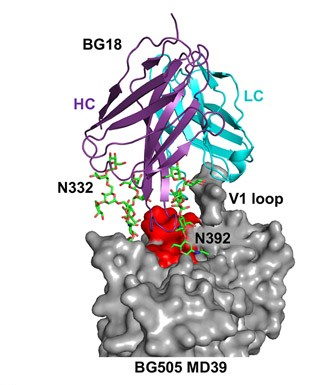
Cryo-EM structure of antibody BG18 bound to the HIV envelope protein. By resolving how this rare antibody binds to the virus, scientists reverse-engineered the series of vaccine immunogens to guide B cells to the correct destination.
Among the rhesus macaques that completed the entire sequential regimen, approximately 44% developed high titers of broadly neutralizing antibodies in their blood. The molecular structures of these antibodies closely mirrored those found in human elite controllers—confirming that the vaccine successfully guided the immune response to the intended destination.
In the context of HIV vaccine research, 44% is a historic figure. Prior candidate vaccines entering primate trials failed to induce detectable bnAbs. Moving from 0% to 44% represents a leap from theoretical impossibility to a validated engineering path.
As Dr. Crotty noted: “We turned an ultra-rare antibody response into a common response across the population.” His choice of words highlights an engineer’s pragmatism: acknowledging what has been solved while remaining clear about the work ahead.
Human Clinical Validation

Professor Shane Crotty, Chief Scientific Officer at LJI and co-leader of the study. His team’s years of research on B cell immune response mechanisms provided the key foundation for this breakthrough.
Crucially, components of this strategy are already undergoing evaluation in human trials. The priming immunogen completed safety testing in the HVTN 144 clinical trial and is progressing through the IAVI G004 Phase 1 study. The team is collaborating with IAVI and the HIV Vaccine Trials Network to advance the full sequential regimen into subsequent human clinical phases.
Concurrently, Crotty’s team published a sister paper in Nature Immunology detailing strategies to accelerate antibody maturation during sequential vaccination.
Nevertheless, several key constraints remain.
First, non-human primate models. While macaques share key immunological features with humans, differences exist. The authors note that based on immunogenetics, human populations possess even greater germline gene diversity, which may favor the regimen—but definitive proof awaits human trial data.
Second, 44% response rate. A 44% response rate is an outstanding proof-of-concept, but commercial products require higher consistency. The team’s stated objective is achieving responses across 100% of vaccinated cohorts.
Third, regimen complexity. The current protocol involves multiple immunizations over an extended timeline. Cold-chain logistics, patient compliance, and manufacturing costs present real-world challenges. Flexible mRNA delivery platforms may offer pathways to streamline production and administration.
Beyond HIV: Guided Immune Evolution
From an engineering perspective, the implications of this study extend far beyond HIV. It validates a fundamental paradigm shift: guided immune evolution is achievable.
Traditional vaccine and drug design follows a fixed sequence: identify target → design molecule → administer therapy. Germline targeting operates on a different logic: design an evolutionary pathway that enables the biological system to reach a targeted endpoint on its own. It is designing the learning process rather than prescribing a static answer.
If fully validated, this methodology could be applied to other rapidly mutating pathogens, such as influenza, hepatitis C, and dengue, as well as personalized cancer vaccines designed to train T cells against tumor neoantigens.
A comment on Hacker News encapsulated the significance of the accomplishment:
“What excites me most about this vaccine is that it’s a series of immunizations, each targeting a different stage of B cell development. I never thought a vaccine could work like this—it’s a completely new and impressive idea.”
HIV misled the human immune system for over forty years. Scientists have now demonstrated a systematic framework to fight back: a carefully engineered curriculum. The first version of any complex system is rarely final, but with the architecture validated, iteration can proceed at pace.
This is only the beginning.
Reference Links:
- LJI News: New HIV vaccine shows unprecedented success in preclinical study (July 6, 2026)
- IAVI Coverage: Vaccination induces HIV bnAbs in primates, bolstering germline-targeting strategy (July 6, 2026)
- Nature Paper: Vaccination elicits HIV broadly neutralizing antibodies in primates (Nature, July 2026)
- Hacker News Discussion (item?id=49083314): Community discussion on the paper
- aidsmap Overview: Is germline targeting the future of HIV vaccine development? (June 12, 2024)
- NIH Press Release: Novel vaccine concept generates immune responses that could produce multiple types of HIV broadly neutralizing antibodies (May 30, 2024)