As news headlines mark the 25th anniversary of September 11, many assume the tragedy has long since receded into history. But for the emergency crews who responded to the attacks and the residents who lived in lower Manhattan, the indelible marks of the disaster remain etched into their bodies. In September 2026, the City of New York declassified approximately 170,000 documents from that period. The records reveal that officials at the time withheld significant information from the public regarding the full scope of known environmental hazards.
By the summer of 2026, enrollment in the World Trade Center Health Program surpassed 154,000 individuals. Congress has authorized funding to extend the program through 2090, committing the federal government to care for survivors for nearly a century. That population rivals the size of a medium-sized city—all still seeking treatment for toxic dust inhaled twenty-five years ago.
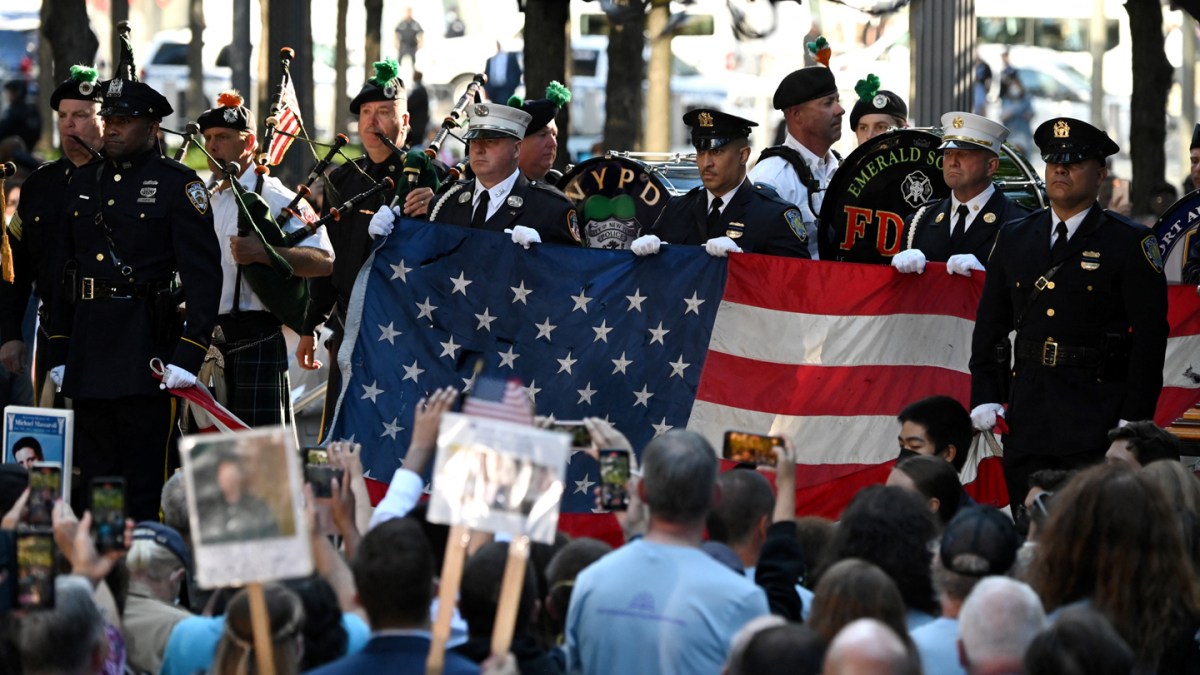 Figure: Police officers and firefighters march with American flags during the 20th anniversary ceremony of 9/11 in 2021. Source: Science News
Over 150,000 People Still Line Up for Lifelong Care
To address the enduring health fallout, the United States Congress passed landmark legislation in 2011 creating the World Trade Center Health Program (WTC Health Program). Administered by the National Institute for Occupational Safety and Health (NIOSH), the program delivers comprehensive, fully covered medical monitoring and treatment to rescue workers, recovery crews, and area survivors.
On the morning of the disaster, Bellevue Hospital in lower Manhattan cleared its emergency department in anticipation of an overwhelming influx of casualties. Physicians on duty recalled an eerily quiet trauma bay where doctors vastly outnumbered incoming patients. Most victims had perished instantly and never made it to emergency triage. The true medical marathon only began years later, as slow-developing and chronic diseases gradually surfaced.
As patient rosters expanded, the clinical spectrum shifted from acute coughs to chronic systemic illnesses and malignancies. As Denise Harrison, medical director of the WTC Health Program at New York University, observed: “Most disasters don’t end when the event ends.”
Toxic Dust Suspended for Weeks: How Exposure Reshaped Digestive Health for 39% of Workers
The catastrophic collapse of the Twin Towers lofted an enormous plume of pulverized debris that choked the air for nearly two weeks before heavy rain finally suppressed it. Months of subsequent debris clearance repeatedly resuspended fine particulates into the atmosphere. Subsequent laboratory analyses revealed that the dust contained heavy metals, lead, pesticides, and hundreds of volatile, highly toxic compounds.
Among the primary carcinogens embedded in the dust were asbestos (a fibrous mineral renowned for fireproofing yet notoriously dangerous when inhaled into deep lung tissue) and crystalline silica. In addition, the inferno ignited by thousands of gallons of jet fuel and severed municipal gas mains generated massive volumes of PAHs (Polycyclic Aromatic Hydrocarbons, potent carcinogenic chemicals produced during incomplete organic combustion).
This toxic cocktail inflicted widespread damage on human physiology. Within a long-term cohort of more than 27,000 rescue and recovery workers, the prevalence of GERD (Gastroesophageal Reflux Disease, a condition where stomach acid chronically regurgitates into the esophagus, causing severe inflammation and mucosal damage) surged dramatically. Incidence rates jumped from approximately 6% prior to the attacks to 39% nine years later. Nearly four out of every ten recovery workers now live with chronic acid reflux.
Firefighters from the Fire Department of the City of New York (FDNY) also developed obstructive airway disorders at alarming rates. Many responders who lacked classic risk factors, such as obesity or advanced age, subsequently developed obstructive sleep apnea. Iris Udasin, director of the Rutgers WTC Health Program, pointed out that the toxic aerosol severely compromised upper airway and sinus tissues. Chronic rhinosinusitis has since been confirmed as an independent and primary driver of sleep apnea among survivors.
Latent Cancers Emerge After Decades in the Shadows
Beyond respiratory and gastrointestinal conditions, dozens of cancers have been formally linked to Ground Zero exposure. These include prostate cancer, melanoma and non-melanoma skin cancers, thyroid cancer, and multiple myeloma (a malignancy originating in the plasma cells of the bone marrow).
A landmark study published in the Journal of the American Medical Association (JAMA) tracked 55,000 exposed individuals. The data revealed moderate increases in prostate cancer risk, a doubling of thyroid cancer rates, and a nearly threefold increase in the incidence of multiple myeloma among rescue and recovery personnel. By contrast, passive bystanders with limited exposure exhibited no statistically significant increase across 23 investigated cancer types—affirming that prolonged exposure to high particulate concentrations was the decisive etiological factor.
Malignancies of this nature often carry latency periods spanning ten to twenty years. Many responders only received sudden oncological diagnoses during routine physicals a decade or more after their service at Ground Zero had concluded.
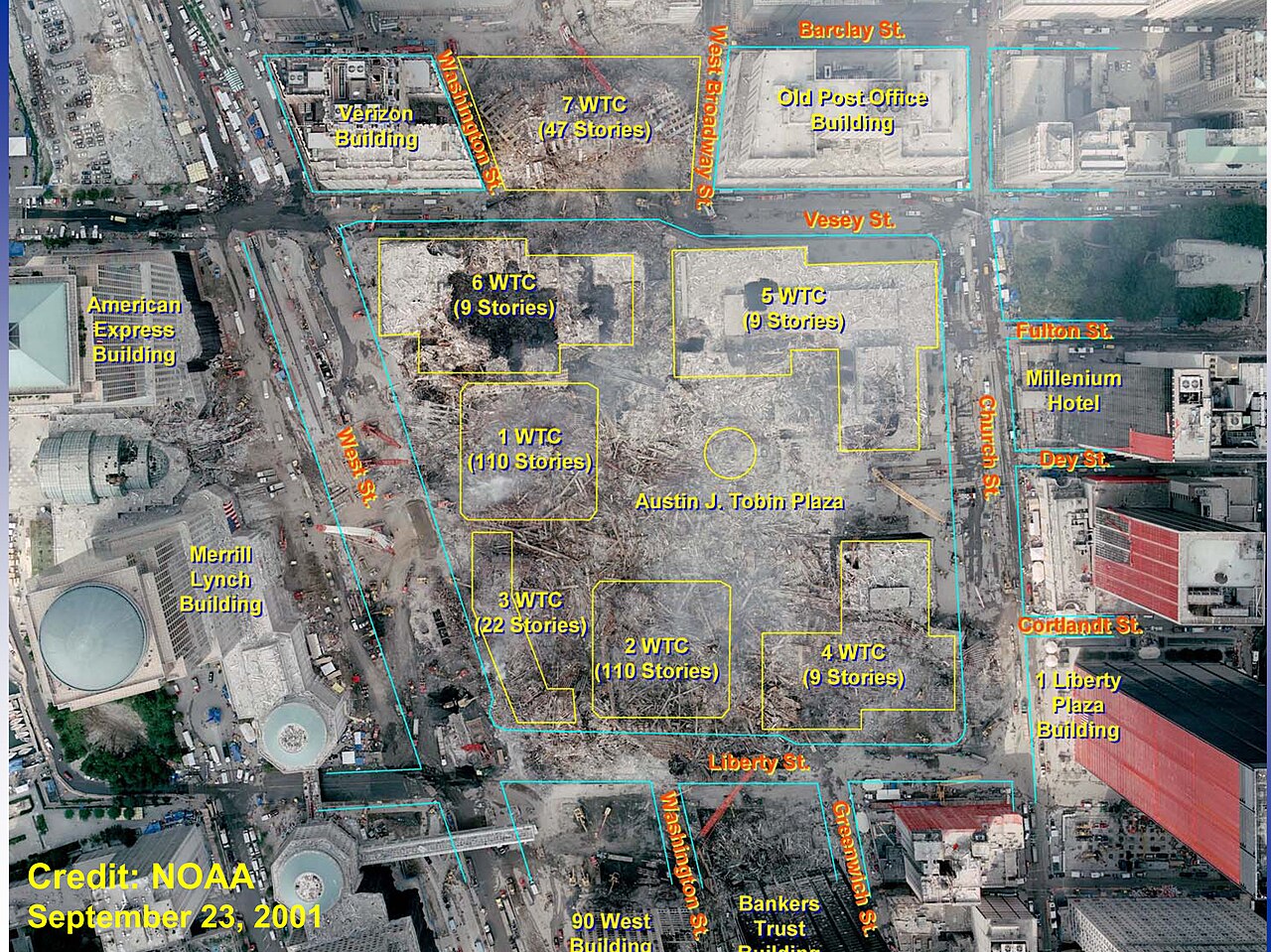 Figure: Aerial view of the World Trade Center site on September 23, 2001, marking the original footprints of the buildings. Source: Wikimedia Commons / NOAA
When Retirement Removes the Shield: The Resurgence of Hidden Psychological Trauma
The psychological toll of 9/11 has proven even more insidious than its physical manifestations. Responders exhibit disproportionately high rates of PTSD (Post-Traumatic Stress Disorder, an enduring mental health condition marked by intrusive trauma, hyperarousal, and debilitating anxiety), clinical depression, and generalized anxiety disorders.
Deeply ingrained first-responder cultures historically discouraged vulnerability. Many police officers and firefighters chose to endure psychological distress in silence, seeking clinical support only after reaching acute crisis points.
For decades, active employment served as an emotional shock absorber, offering structure, purpose, and camaraderie. When responders began retiring, the abrupt disappearance of their daily operational rhythm often triggered a delayed resurgence of dormant trauma. Lingering survivor guilt continues to plague countless veterans of the recovery effort.
One responder, left with severe facial disfigurement following surgery for oral cancer, struggled with intense anger and emotional volatility that alienated his family. Only after entering dedicated psychiatric care was he able to rebuild his domestic life. Jodi Streich, mental health director at the Rutgers WTC Health Program, stresses that anniversary coverage reliably reignites acute memories: psychological trauma does not quietly disperse once the commemorative ceremonies conclude.
Aging with Disaster: The Compounding Risks of Toxic Exposure and Chronic Trauma
Today, the majority of original Ground Zero responders have reached their fifties and sixties. Common age-related conditions, including hypertension, cardiovascular disease, and type 2 diabetes, now intersect directly with chronic 9/11 health conditions. This multimorbidity substantially complicates routine clinical management.
Recent neurological longitudinal studies have uncovered another troubling trend: an accelerating risk of cognitive dysfunction resembling early-onset dementia among exposed cohorts. Emerging clinical evidence attributes this to the dual burden of airborne particulate neurotoxicity and decades of chronic PTSD. The interplay of physical and psychological damage exerts compounded destructive power as survivors enter their senior years.
The true toll of catastrophic disasters on human biology unfolds across time horizons far broader than immediate structural destruction suggests. From the dense plume that hung over Manhattan for two weeks to decades of degenerative chronic disease, the impact of 9/11 lives on in the medical charts of over 150,000 people. Clearing the physical ruins took eight months; settling the full human health invoice will demand nearly a century.
References:
- Science News: 25 Years After 9/11, Health Consequences Still Emerge
- JAMA: Cancer Risk and Health Consequences in World Trade Center Responders


