Walk into any major supermarket today, look at the bagged loaves of soft, astonishingly shelf-stable white bread, and you are not looking at the unbroken lineage of thousands of years of artisanal baking. What you are witnessing is the end-state of a 1960s technological experiment that substituted brute mechanical force for a slow biological process.
In 1961, in the Hertfordshire village of Chorleywood northwest of London, a semi-state-funded body called the British Baking Industries Research Association (BBIRA) launched a project that would reshape global agriculture. Their objective was ostensibly simple: make British bread “better.” Here, “better” had little to do with artisanal flavor or crust; it meant raw industrial throughput and national supply chain security.
The Protein Barrier and Britain’s Agro-Climatic Dilemma
Understanding the origins of this technical revolution requires diving into the physics of dough at the microscopic level. The essential element that allows bread to rise into a soft, airy crumb is protein—specifically gluten. When hydrated and worked, gluten proteins cross-link into a tenacious, elastic matrix that acts like millions of microscopic balloons, trapping the carbon dioxide gas generated by fermenting yeast. Without this resilient network, baked dough collapses into a dense, unpalatable brick.
Under traditional baking wisdom, bread-making requires wheat with a protein content of at least 11% to 12%. For high-speed industrial lines demanding extreme consistency, that threshold pushes to 13% or higher. Producing wheat with 14% or 15% protein requires exceptional agricultural conditions: the hot, arid climates of the North American Great Plains, Manitoba, and Saskatchewan provide the ideal natural environment. Britain, by contrast, suffers from an excess of damp and rain; its domestic fields yield soft wheat that is naturally low in protein.
Postwar Britain faced a deeply vulnerable supply line. Around 65% of the wheat used by the British baking industry had to be imported from Canada across thousands of miles of ocean. Only about 5% of home-grown British wheat was considered fit for breadmaking. Figuring out how to push low-protein domestic grain through industrial bakeries without relying on favorable geography became the ultimate engineering challenge for the BBIRA.
Replacing Biological Time with Mechanical Violence
At the time, the reigning global heavyweight of industrial bread was the United States, whose standard method was the sponge-and-dough process. In this system, bakeries first mix yeast, flour, and water into a pre-ferment “sponge,” leave it to ferment for roughly five hours, and then mix it with the remaining ingredients into the final dough. Those five hours of rest are essential: they allow slow biochemical reactions to naturally develop the gluten matrix.
The British researchers chose an entirely different route: smashing through the barrier with physical engineering. The core breakthrough of what became known as the Chorleywood Bread Process (CBP) was bypassing the slow fermentation stage altogether. Instead of giving yeast hours to work, they subjected the dough to ultra-high-speed, high-shear mechanical mixing in massive specialized machines.
Inside these mixers, heavy blades ripped and recombined the dough with intense kinetic energy in just a few minutes. This violent agitation accomplished two things simultaneously: it mechanically drove tiny bubbles of air directly into the matrix, and its intense shear forces forced low-protein gluten molecules to rapidly cross-link into a cohesive network.
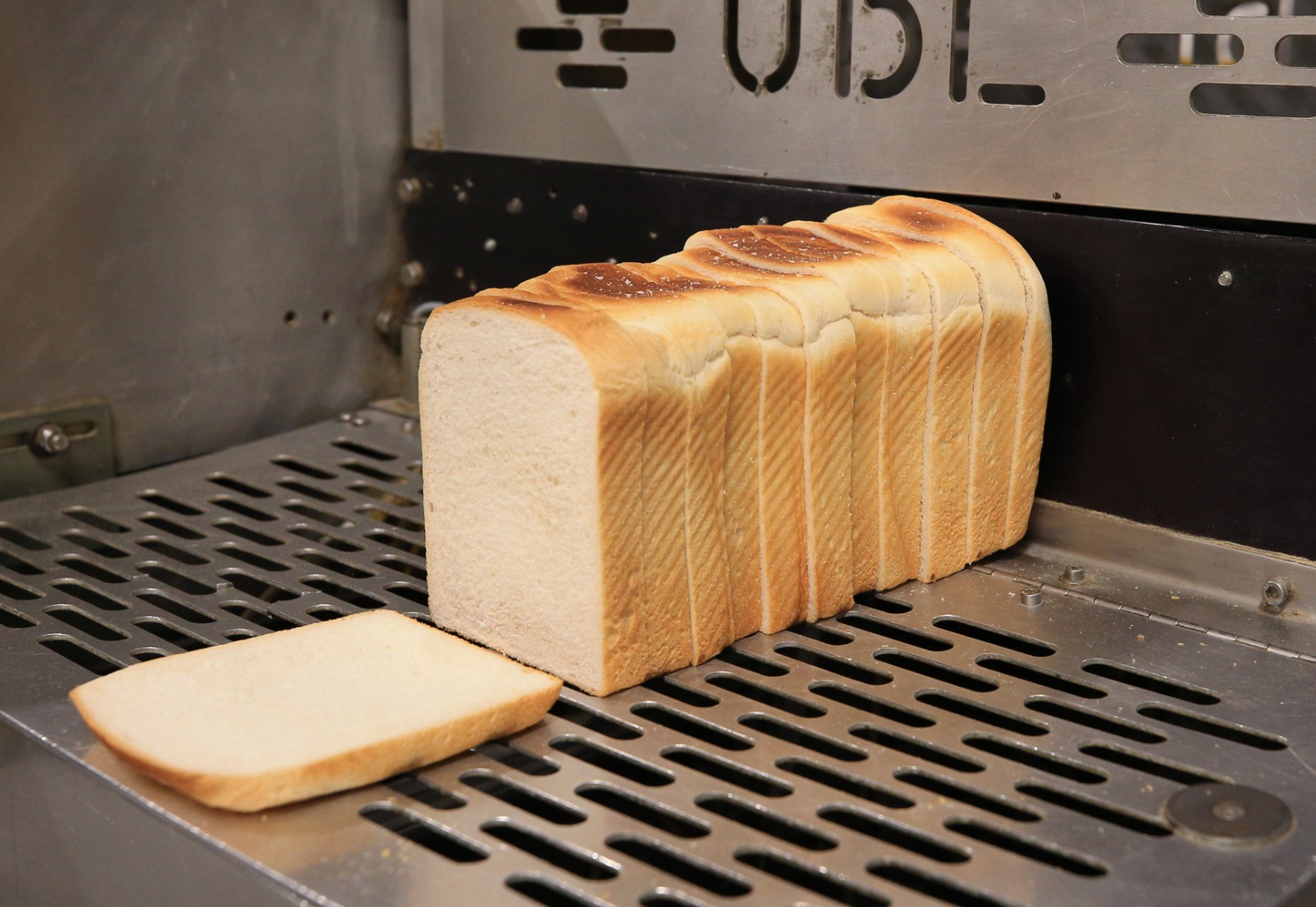 Figure: Comparison of crumb structure between Chorleywood bread (right) and traditional bread. Source: Ed Conway / Material World; Photography: Sergio Arze / Unsplash
By deploying this process, the total time required to produce a loaf of bread was roughly cut in half compared to the American method. As observers noted, it was a miracle of productivity: several minutes of mechanical fury substituted for more than five hundred minutes of slow yeast fermentation. For the first time in food history, humans used electrical grid power to directly purchase time. But the trade-off was clear: Chorleywood’s high-speed mixers drew massive amounts of electricity, significantly inflating bakery utility bills.
A Hidden Global Footprint
The greatest dividend of the Chorleywood process was its compatibility with Britain’s domestic low-protein wheat. By mechanically forcing gluten cross-linking, the strict protein requirements of raw flour fell away. In modern British supermarkets, a typical loaf of sliced white bread can contain up to 85% domestic wheat. Leaping from 5% to 85% represented a multi-decade overhaul of the nation’s agricultural supply chain.
| Metric / Feature | Sponge-and-Dough Process | Chorleywood Bread Process (CBP) |
|---|---|---|
| Primary Driver | Biological yeast fermentation | Ultra-high-speed mechanical mixing |
| Key Step Duration | ~5 hours | A few minutes |
| Protein Requirement | High (depends on hot, dry climates) | Moderate (compatible with wetter climates) |
| Domestic Wheat Ceiling | N/A | Up to 85% (in the UK) |
| Crumb Pore Structure | Rounded, irregular | Elongated, elliptical |
Virtually all mass-market sliced bread sold in the UK today is produced using the Chorleywood process. Yet you will never find it mentioned on the packaging—nor will you see clear disclosure that the loaf still relies on a blend containing high-protein Canadian grain shipped from 6,000 miles away.
The technology soon crossed borders, establishing an industrial rivalry with the American sponge-and-dough method akin to the competition between Coca-Cola and Pepsi. North America and Singapore largely stayed with sponge-and-dough, while industrial bakery lines in India and Shanghai adopted the high-speed whirling of Chorleywood. Telling the two apart is straightforward: slice the loaf and look at the crumb. Sponge-and-dough produces rounded, randomly distributed air pockets, whereas Chorleywood bread features elongated, elliptical micro-pores—the physical scars left behind as dough was whipped and stretched under extreme velocity.
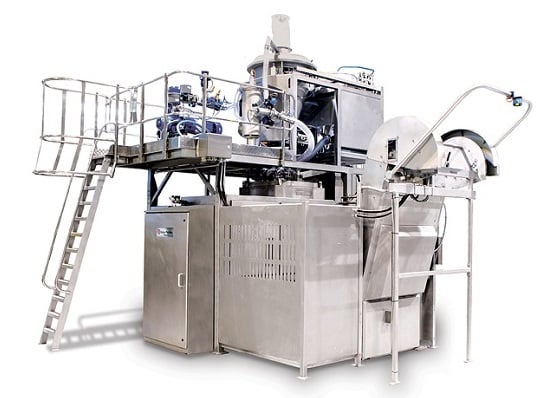 Figure: The core machinery behind the Chorleywood process—heavy industrial mixers capable of delivering extreme shear forces. Source: Baker Perkins
Efficiency, Controversy, and an Identity Crisis
As Chorleywood conquered commercial bakeries worldwide, it triggered an existential debate over what actually constitutes bread. To traditional bakers and purists, sponge-and-dough remains closer to the genuine article because it preserves hours of natural fermentation. The industry found itself facing an awkward question: does a product mechanically aerated and forced into shape in minutes genuinely deserve to be called bread?
Half a century into this debate, the birthplace of the technique has transformed. The building in Chorleywood that altered the course of industrial food history is now a quiet retirement home; after government funding dried up, the BBIRA itself eventually disbanded. Britain may no longer lead the world in basic baking research, but its legacy remains cemented as the home of the fastest mass-production bread method ever engineered.
This history resonated strongly on Hacker News, earning 93 points and 94 active comments. It illustrates a classic pattern in engineering: when resource constraints cannot be solved through conventional paths, engineers will often deploy another dimension of force to break down the wall.
The most mundane objects often conceal the most extraordinary technical histories. The story of sliced white bread reminds us that the everyday commodities we take for granted are rarely the products of slow cultural evolution. Instead, violent mechanical speed superseded millennia of biological patience, fundamentally redefining bread itself.
References:
- Ed Conway / Material World Research Notes
- Hacker News Discussion Thread
- Baker Perkins Historical Equipment Archives