On November 2, 2026, Oracle filed a registration statement with regulators outlining plans to issue up to $10 billion in common stock alongside $10 billion in senior notes. The combined $20 billion capital raise marks one of the largest single-day financing plans in recent memory. Oracle’s shares fell more than 6% in intraday trading immediately following the news.
The violent market reaction pulled back the curtain on the deepening cash crunch behind AI compute expansion. Traditionally, tech giants built out data centers on the back of relentless, high-margin cash flows from mature legacy businesses. Today, operating profits are no longer sufficient to close the compute shortfall. Capital-intensive cloud providers are increasingly turning to public debt and equity markets to borrow on a massive scale.
$20 Billion Raise Announced, Oracle Shares Drop 6%
In its filing, Oracle earmarked the proceeds for general corporate purposes, including capital expenditures (capex), debt repayment, and potential future investments. The 6% intraday drop underscored public market skepticism toward equity dilution and leverage expansion. Relying heavily on public equity and debt markets to build out infrastructure is forcing Wall Street to recalculate the payback periods on high-density data centers.
 图:CNBC 报道配图(Getty Images)。来源:CNBC
The filing arrived just days after Oracle’s upbeat Investor Day on October 28, where management projected fiscal 2030 revenue to surpass $225 billion. Crucially, executives stated that additional capital-market raises over the 2027 to 2030 cycle would be capped at around $20 billion. At the time, UBS analyst Karl Keirstead issued a research note arguing that management’s commentary had substantially alleviated market anxiety over rising borrowing costs and debt issuance.
The subsequent selloff disrupted that optimistic consensus. Investors are homing in on the true state of Oracle’s cash flow. Needing a sudden $20 billion external infusion just to keep pace with server deployments casts a long shadow of leverage across the company’s ambitious long-term forecasts.
$125 Billion in Debt, CDS Spreads Skyrocket 270% in a Year
As of August 31, 2026, Oracle carried $125.34 billion in total debt on its balance sheet, primarily consisting of fixed-rate senior notes. The rapid accumulation of debt obligations has drawn scrutiny from rating agencies. In July, S&P Global Ratings downgraded Oracle’s long-term issuer credit rating to BBB-, leaving it just one notch above speculative grade (junk status).
Derivatives markets have priced in even harsher risks. Five-year credit default swaps (CDS) on Oracle recently climbed to 296 basis points—a 270% surge over the past year. Gavan Nolan, an analyst at S&P Global Market Intelligence, observed that Oracle’s credit spreads are now trading in line with high-yield debt rather than investment-grade peers.
Rising debt costs are plainly visible in Oracle’s secondary bond prices: its 4.95% notes maturing in 2031 are currently yielding 7.267%. Meanwhile, Oracle’s stock is down roughly 33% year-to-date in 2026 and has shed 50% over the trailing 12 months.
Soaring CDS premiums directly elevate Oracle’s refinancing costs. Hardware procurement remains non-negotiable in the race to secure Nvidia GPUs. Yet with bondholders demanding much higher risk premiums, rolling over maturing debt while funding massive capex is putting the company’s balance sheet under persistent strain.
This leveraged, asset-heavy growth model has clear precedents among specialized “neocloud” providers. Companies like CoreWeave previously borrowed tens of billions of dollars to stockpile high-end GPUs, banking on the premise that compute demand would expand indefinitely. But if downstream cloud rental pricing softens even slightly, ballooning interest payments can quickly overwhelm operating margins.
Revenue Increments Shrink as Anthropic’s Monthly Growth Flattens
While upstream infrastructure giants lever up to expand capacity, revenue growth at key downstream customers is showing signs of exhaustion. Anthropic, one of the largest anchor tenants for Oracle Cloud Infrastructure (OCI), recently shared its latest operational numbers. While top-line figures appear massive, the trajectory of incremental gains is flattening out.
Anthropic posted $4.8 billion in revenue in Q1 2026. Revenue surged 141% sequentially to $11.6 billion in Q2. In Q3, however, revenue reached $16.8 billion—a sequential increase of 45%. After adding $6.8 billion in net new revenue during Q2, the sequential net addition dropped to $5.2 billion in Q3.
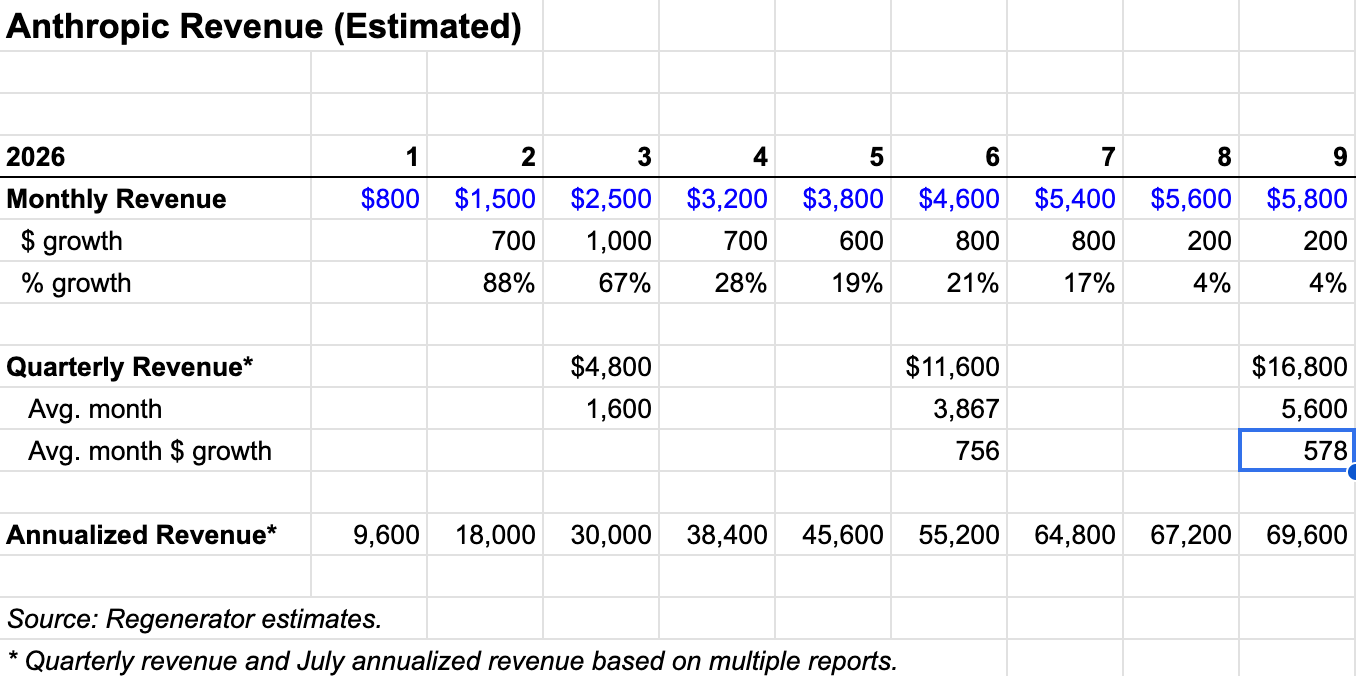 图:Anthropic 2026 年月度收入估算曲线。来源:Regenerator,数据基于 NYT DealBook 报道
Monthly estimates reveal an even clearer deceleration. Anthropic’s average monthly net new revenue fell from $760 million in Q2 to $580 million in Q3. Given management’s disclosure of an annualized run rate of $65 billion in July (roughly $5.4 billion for that month), revenue in August and September showed virtually no sequential expansion. The New York Times’ DealBook reported that Anthropic declined to provide an updated September run-rate figure during recent investor meetings.
Slowing monthly increments sound an alarm across the frontier model ecosystem. Training frontier LLMs requires enormous capital, meaning commercial revenue must grow exponentially to cover computing expenses. If leading model developers see their revenue trajectory level off, upstream cloud providers may find that customer demand cannot sustain the eye-watering compute bills they need to service their debt.
Seasonal Lull, Capacity Bottlenecks, or a Shift to Cheaper Models?
Industry observers and technical communities point to three competing explanations for the slowdown, spanning macro spending cycles, physical engineering constraints, and changing customer software preferences:
The first hypothesis points to standard enterprise software procurement seasonality. August is historically a dead period as corporate executives across the US and Europe take summer holidays. Enterprise procurement cycles and enterprise-wide technical budget approvals frequently pause, with hopes that Q4 budget deployments starting in October will reignite API volume growth.
The second explanation highlights severe physical bottlenecks in hardware delivery. Grid interconnection and liquid-cooling installations for high-density megawatts are failing to keep pace with demand. Anthropic’s newly procured GPU clusters reportedly cannot be powered on fully due to site-level power delays. In this view, customer demand remains robust, but physical infrastructure delivery lags behind.
The third perspective points to developers reallocating budgets toward lower-cost alternatives. With proprietary closed-source API pricing remaining high, enterprises and software vendors are increasingly adopting open-weight models or competitive, low-cost alternatives. Real-world usage metrics suggest that accessible, budget-friendly options are diverting substantial commercial inference workloads.
All three dynamics are playing out simultaneously. Whether caused by site deployment delays or budget diversification, one reality is clear: the actual pace of compute demand monetization is not nearly as frictionless as initial Wall Street models assumed.
Capex Built on Borrowed Capital: Operating Margins Cannot Cover Trillion-Dollar Promises
The core tension in AI infrastructure lies between the rigid upfront cost of physical assets and the uncertain returns on commercial software. Acquiring silicon and building hyperscale data centers requires tens of billions of dollars upfront. Every bond issue carries a strict schedule of principal and interest payments. When operating cash flow cannot keep up with capex appetites, tech companies have no choice but to tap public capital markets for continuous support.
Oracle is attempting to use $20 billion in fresh debt and equity to underwrite its $225 billion vision for 2030. Wall Street responded with a tumbling stock price and ballooning CDS spreads. Investor tolerance for aggressive corporate debt is wearing thin, and market participants are beginning to scrutinize free cash flow on every single data center cluster.
Model developers face an equally sobering commercial test. Borrowed billions can buy massive GPU clusters, but they cannot compel enterprise customers to accept high-cost APIs indefinitely. The moment downstream demand hesitates, the fragile financial balance of upstream cloud providers faces severe disruption.
The AI buildout has shifted from an organic expansion funded by operating profits into a high-stakes financing cycle powered by debt and equity issuances. As borrowing costs escalate and downstream revenue curves flatten, the entire AI supply chain is facing its most demanding financial test yet.
References:
- CNBC: Oracle files to sell $20 billion in stock and bonds to fund AI buildout
- NYT DealBook: Anthropic financial disclosures and revenue run-rate reporting
- Regenerator: Analysis and estimates of Anthropic’s revenue trajectory