Don’t Trash Your Old Kindle: How Open-Source Software Revives Legacy E-Readers
A first-generation Kindle Paperwhite declared “dead” by Amazon used to take several seconds just to turn a page. After flashing KOReader, one user remarked: “It feels like a brand-new machine.”
645 points. That was the score KOReader achieved on Hacker News last week, reaching the top spot of the day. Across 207 comments in the discussion thread, almost everyone was echoing the same sentiment—for old devices abandoned by their manufacturers, KOReader isn’t just an option; it’s the only solution.
After reading through the entire thread, a clear narrative emerges: this is an open-source battle against planned obsolescence. And the community won.
Act I: The Despair of Legacy Users
One comment stood out vividly. User Lalabadie wrote:
“My 1st gen Kindle Paperwhite took seconds for page turns on stock OS. Firmware update didn’t help, factory reset didn’t help. Stock reader was practically unusable.”
This is by no means an isolated case. Another user, porkloin, shared: “Clicking buttons in KOReader, the response time is under a second. I didn’t even realize how slow the Kindle stock OS was until I experienced truly responsive hardware.”
Notice the engineering logic here: The hardware itself isn’t broken. The software is.
When a device manufacturer halts software updates, the operating system naturally bloats over time—accumulating new features, background processes, and resource overhead—while the hardware remains fixed in stone a decade ago. This is the textbook playbook of planned obsolescence.
In May 2026, Amazon officially dropped support for all Kindle models released in 2012 or earlier. First-generation Paperwhite users can no longer purchase, borrow, or download new content. From Amazon’s perspective, these devices are effectively dead.
But the open-source community said: No.
Act II: What Exactly Is KOReader?
KOReader is an open-source document viewer software designed to run on alternative systems across devices like the Kindle, Kobo, PocketBook, and reMarkable. With over 28.2k stars, 1.8k forks, and more than 11,944 code commits on GitHub, its activity rivals many commercial products.
Its supported format list reads like a shopping list: EPUB, PDF, DjVu, MOBI, DOC, HTML, RTF, CHM, CBR/CBZ (manga/comics), TXT… While Amazon’s stock OS only natively recognizes AZW and converted MOBI, KOReader reads almost anything.
But what truly drives long-time users wild is the speed.
Act III: Why Is KOReader Faster Than the Stock OS?
Here is the underlying technical architecture, explained in plain language.
The Kindle stock OS is a heavy operating system. It runs a Java Virtual Machine alongside background Amazon stores, ad delivery services, sync daemons, and telemetry… While you turn a page in the foreground, a fleet of background processes is competing for CPU cycles.
KOReader, by contrast? It does only one thing: render text.
Architecturally, KOReader is built using a hybrid of Lua scripting and C. Its rendering engine splits into two main branches:
- MuPDF — Handles fixed-layout documents such as PDFs and comics.
- CREngine — Handles reflowable formats like EPUB and TXT.
Both engines are heavily optimized and customized specifically for E Ink display characteristics.
Even more critical is its intelligent caching framework. KOReader employs a page caching mechanism called DocCache (using an LRU—Least Recently Used—eviction algorithm). While you are reading page 10, the system is already pre-rendering pages 11 and 12 in the background. When you flip the page, it simply blits the pre-computed bitmap from cache to the screen without recalculating text layout.
Engineering analogy: Turning a page on the stock Kindle OS is like cooking a dish from scratch every time; KOReader pre-cooks the next dish and stores it in the fridge so you only have to serve it.
The official GitHub README provides hard data: On certain legacy devices, KOReader’s page-turn latency is less than half that of the stock OS.
| Comparison | Kindle Stock OS | KOReader |
|---|---|---|
| Page-Turn Latency | 2–5 seconds (legacy devices) | 0.5–1 second |
| Supported Formats | ~5 formats | 20+ formats |
| Background Processes | Store / Ads / Sync | None |
| Customizability | Extremely limited | Fully programmable |
This is a generational leap.
Act IV: The Villain — Planned Obsolescence
This is where the story gets really interesting.
What is the fundamental reason KOReader exists? Because hardware manufacturers refuse to maintain software for legacy hardware.
Amazon’s incentives are clear: a Kindle’s hardware lifecycle lasts at least 5 to 8 years, but software support cycles only last 3 to 5 years. Once support ends, page turns slow down, the storefront disconnects, and new formats fail to open—prompting consumers to buy new hardware. This is planned obsolescence, an open secret across consumer electronics.
The KOReader community’s counter-attack is hardcore: they maintain a compatibility list spanning hundreds of device models—from the 2010 Kindle Keyboard to the latest Kobo e-readers. Despite massive hardware variances (CPU architectures ranging from ARMv5 to ARMv8, screen resolutions from 800×600 to 1404×1872), KOReader developers adapt the code line by line in their spare time.
In the HN discussion, users noted that KOReader even supports SSH access. An e-reader running an SSH server might sound absurd—but isn’t that the ultimate pushback from open-source developers against closed walled gardens?
Act V: A Victory for Consumers
KOReader isn’t a new 2026 project. It originated around 2011 (originally as CoolReader) and has remained active on GitHub for over a decade, receiving new commits every week.
What does this mean?
It means that even if Amazon signs a death warrant for your old Kindle, the open-source community will keep building new capabilities for it. This isn’t charity or marketing—it’s a group of people who genuinely believe “software should serve users, not vendors” doing what they believe is right.
As one HN commenter summarized:
“KOReader proves once again that free software is superior to proprietary software. Free software grows to make users happier, not to hook them with bloatware to extract more value.”
That quote captures the core value of KOReader: it gives you ownership of your hardware.
When you purchase a Kindle, you feel like you own it. But in reality, Amazon controls the reading experience. KOReader hands that control right back to you.
Trade-offs to Consider
Of course, KOReader isn’t perfect.
Multiple HN users pointed out that its UI isn’t particularly intuitive, with a steep learning curve and an abundance of settings. As one user aptly put it: “KOReader trades ease of use for power and flexibility.”
Installation also requires a bit of hands-on effort—you must jailbreak your Kindle before installing KOReader. However, community guides are mature, and the entire process takes about 30 minutes.
Our verdict: A 30-minute setup investment can grant an abandoned, dust-collecting Kindle another 5 years of active life. That’s a high-return trade-off.
References
- KOReader Official Website — koreader.rocks
- GitHub Repository — github.com/koreader/koreader (28.2k Stars / 11,944 Commits)
- Hacker News Original Post — news.ycombinator.com/item?id=49095865
- KOReader Rendering Architecture Documentation — deepwiki.com/koreader/koreader/5.3-rendering-pipeline-and-caching
- Amazon Discontinues Support for Legacy Kindles — einkkindle.com/ebook-news/amazon-discontinues-old-kindles
- CREngine Repository — github.com/koreader/crengine
- KOReader User Guide — koreader.rocks/user_guide
Author’s Note: Article written based on KOReader v2026.03 release features. Open-source projects iterate rapidly; specific capabilities may evolve across versions.
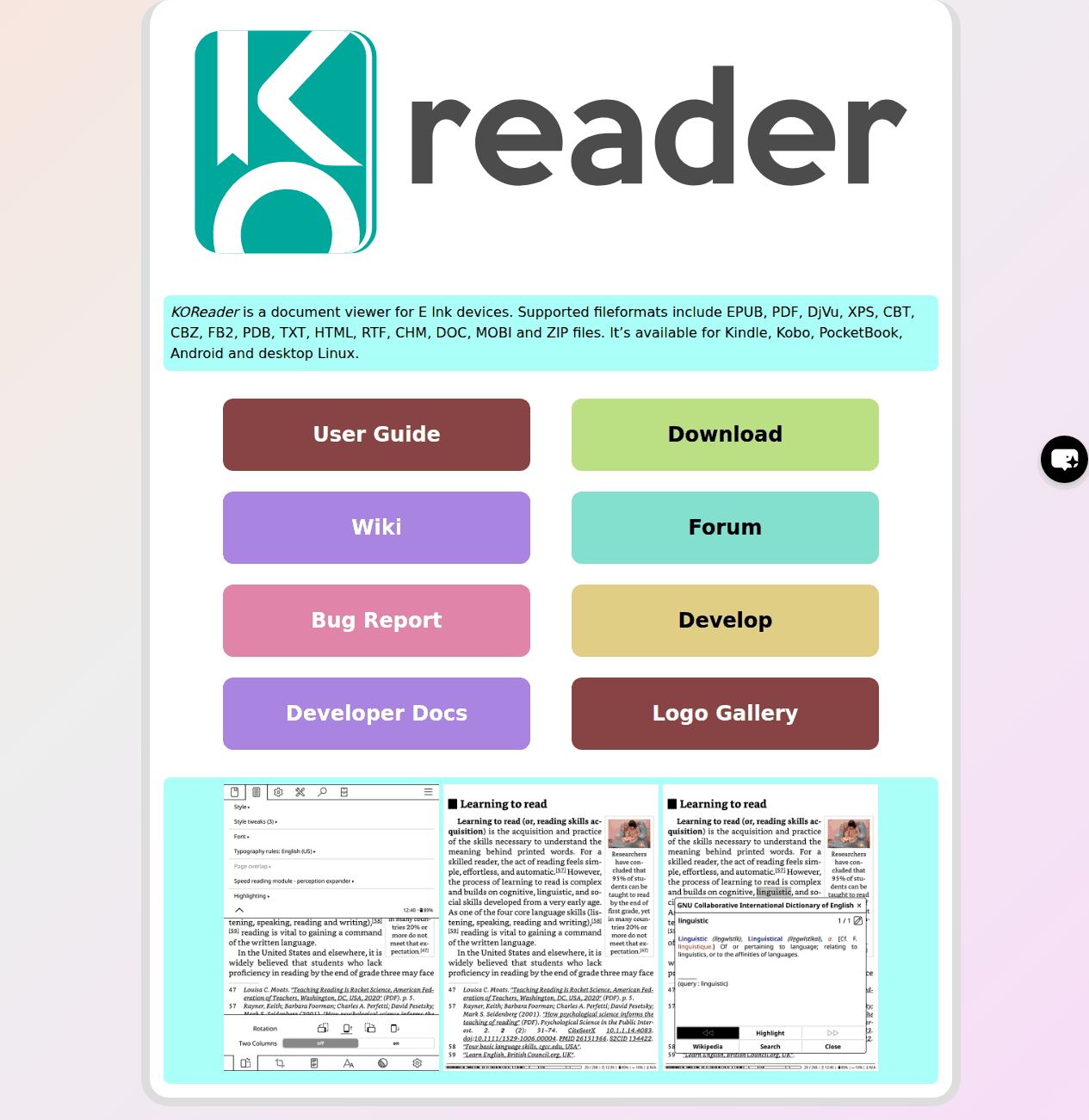 KOReader official homepage showcasing key features: multi-format support, cross-platform compatibility, plugin extensibility, and more.
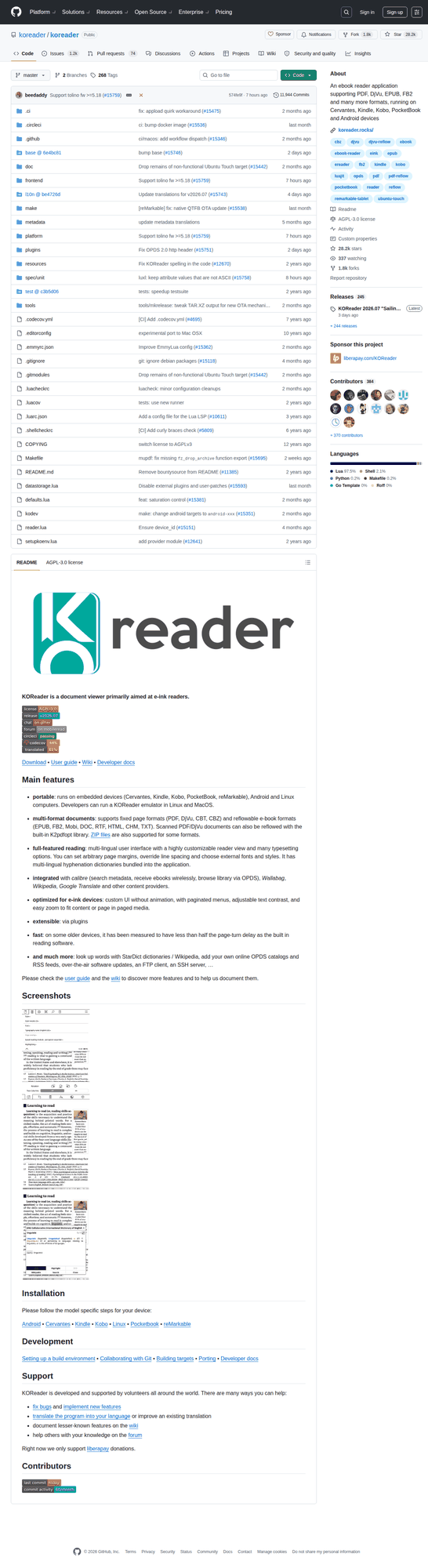 KOReader on GitHub with 28.2k Stars, 1.8k Forks, and 11,944 Commits.