On the evening of August 14, Alibaba’s Qwen team released Qwen3.8-27B, a 27-billion parameter model available under the Apache-2.0 license for anyone to download. On the official benchmark suite, its score on the DeepSWE 1.1 coding benchmark jumped from 13.3 in the previous generation to 42.2—a more than 3x increase—outperforming several commercial closed-source models with trillion-plus parameters. The news quickly surged on Hacker News, earning 819 points and 539 comments in a single day, becoming one of the top trending technical discussions.
This isn’t just another routine model release. It directly challenges the dominant intuition of the past two years in AI: that bigger parameters always mean smarter models.
27 Billion Parameters: A Lightweight Contender
To put “parameters” into perspective: think of a large language model as a massive machine with control knobs. Each parameter is a tweakable knob, and the more knobs it has, the more capacity the machine possesses. For years, AI labs have competed on sheer parameter scale, pushing top closed-source models to 2 trillion or even 2.4 trillion parameters—nearly 90 times the size of Qwen3.8-27B.
However, more knobs mean burning vastly more GPUs and electricity during training, and requiring expensive cloud compute instances during inference. This “bigger is better” arms race ultimately trickles down to end-user bills—monthly subscriptions and per-token API pricing. For most developers and users, accessing AI has meant only one path: renting a giant brain in the cloud.
Qwen3.8-27B takes a different approach: refining parameters rather than blindly stacking them.
The Scorecard: 3x Gain and Beating Commercial Giants
In Alibaba’s benchmark comparison table, Qwen3.8-27B went head-to-head with the previous-generation Qwen3.6-27B, the larger Qwen3.7-Plus, the peer-sized Muse Glimmer-30B, and the closed-source powerhouse Opus 4.6 Max. The 27B model achieved impressive results:
- Coding task DeepSWE 1.1: 42.2 (up from 13.3 in Qwen3.6-27B, a >3x increase, and nearly triple Qwen3.7-Plus’s score of 14.2);
- Software engineering benchmark SWE-bench Pro: 61.7, surpassing Opus 4.6 Max’s 53.4;
- Office automation benchmark CoWorkBench: 70.7, beating Opus’s 68.2;
- Terminal operations benchmark Terminal Bench 2.1: 73.0, closing the gap with Opus’s 78.2 to within 5 points.
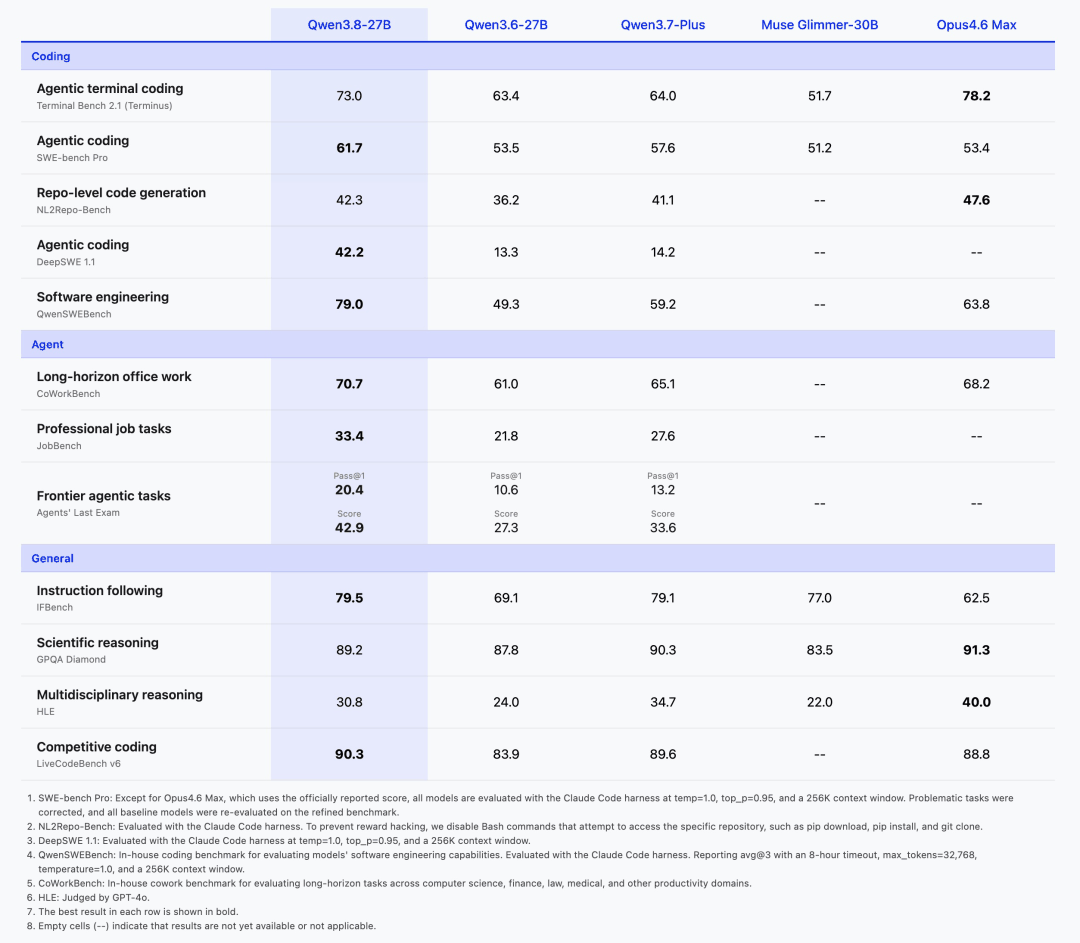 Figure: Official Qwen3.8-27B performance benchmark comparison across coding and office tasks against previous generations and closed-source models. Source: Qwen Team (reposted by IT Home).
To be clear, it is not a complete landslide victory. Opus still retains a lead in repository-level code generation, and trillion-parameter giants remain superior across various complex scenarios. But the paradigm has shifted—when a 27B model can go toe-to-toe with models tens of times its size, winning is no longer a one-sided story. That was unimaginable two years ago.
How Did a Smaller Model Catch Up?
This is the most noteworthy aspect of the release. According to the official model card and community discussions, Qwen achieved this through three key engineering innovations:
First, a hybrid attention mechanism. Transformer LLMs rely on self-attention to determine context relevance, which is the primary compute bottleneck for GPUs. Qwen3.8-27B replaces roughly three-quarters of its 64 layers with a linear attention mechanism called Gated DeltaNet, keeping traditional high-precision attention in only the remaining one-quarter. Think of it like reading a textbook: scanning most chapters quickly, but doing a word-by-word deep read on key sections. The saved compute budget allows the 27B parameter footprint to digest far more knowledge efficiently.
Second, multi-token prediction (MTP). Traditional models predict only one next token at a time. Qwen3.8-27B was trained with Multi-Token Prediction (MTP) to forecast several tokens simultaneously. Like a chess player anticipating multiple moves ahead, this results in smoother generation and faster inference speeds.
Third, controllable reasoning effort. While the model defaults to a “think before answering” paradigm, a new reasoning_effort knob allows users to dynamically adjust reasoning depth based on task difficulty: quick answers for simple queries, and deep step-by-step reasoning for tough problems. In community tests, a prompt asking for “a pelican riding a bicycle” caused it to execute over 20,000 reasoning steps for 21 minutes, generating a stunning SVG drawing. Meanwhile, simple queries respond in seconds. Handing the choice of reasoning duration back to the user saves substantial compute resources.
These design choices reflect a key premise: optimizing training data quality and architectural techniques yields far better returns than raw parameter scaling. While third-party verification will further test this, public evidence shows it has become the foundation of Qwen’s small-model philosophy.
Book-Length Context Memory and Native Multimodal Vision
Beyond coding, Qwen3.8-27B introduces two highly practical capabilities for everyday usage.
First, an ultra-long context window: native support for 260K tokens, roughly equivalent to reading a 200,000-word novel in one go while retaining full contextual memory (with technical extensibility up to 1M tokens). Long-document and long-video AI processing, once exclusive to cloud giants, is now accessible in a compact model.
Second, native multimodal vision and video understanding. Images and videos are treated as first-class citizens—from scientific charts and scanned documents to multi-hour video streams. Official multimodal benchmarks place Qwen3.8-27B ahead of several larger models.
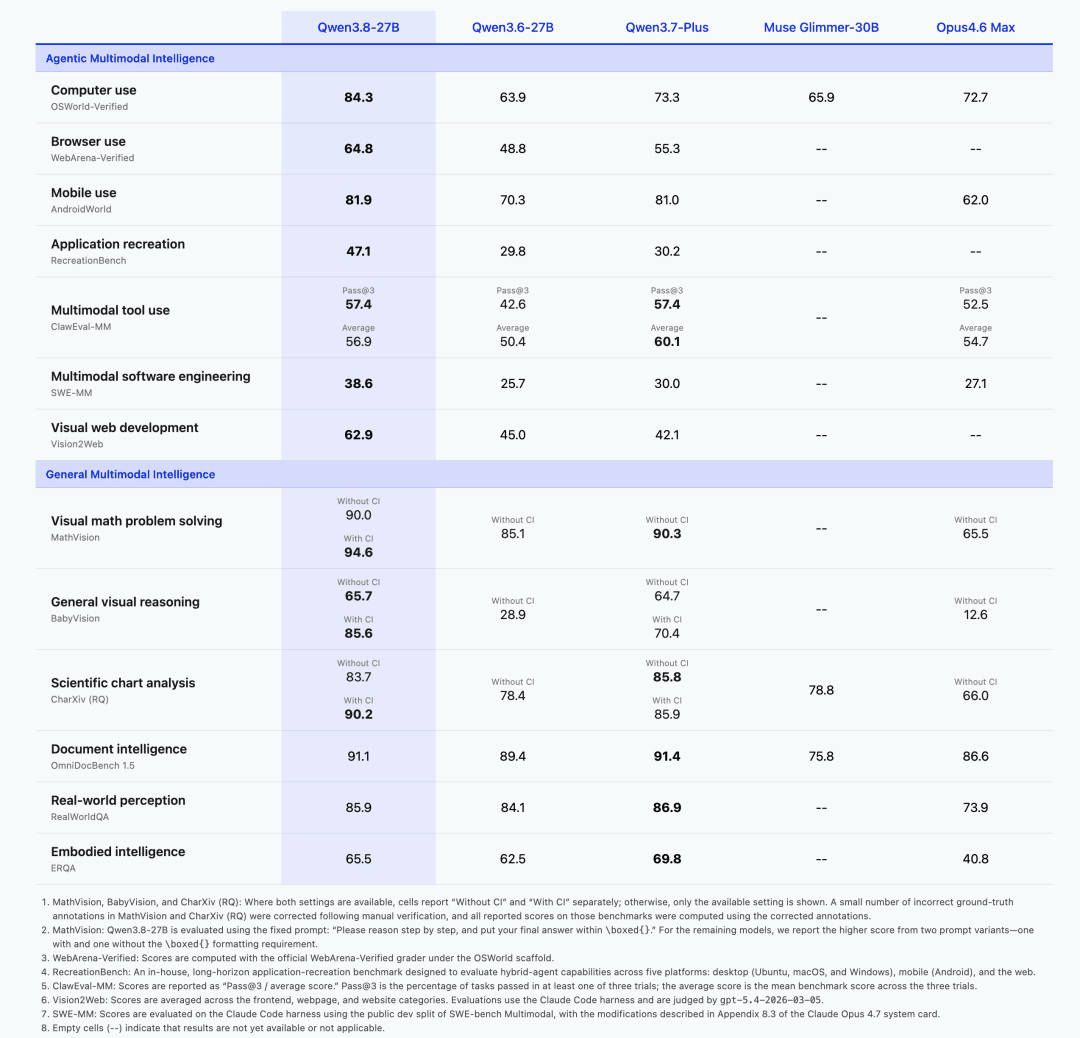 Figure: Qwen3.8-27B multimodal performance benchmark comparison for vision and video understanding tasks. Source: Qwen Team (reposted by IT Home).
Running on Laptops: The True Gift of Open Source
The reduced parameter footprint pays off immediately on hardware efficiency. Self-hosting a trillion-parameter model requires dozens of enterprise GPUs. In contrast, the FP8 quantized version of Qwen3.8-27B weighs only about 17GB, with official benchmarks showing virtually zero performance degradation compared to the unquantized baseline—much like compressing a high-res photo to standard resolution with barely visible loss. Developers are already running it on consumer MacBooks using free open-source tooling, as well as on home desktop GPUs.
This is what “free open source” under Apache-2.0 really signifies: freedom to download, modify, and deploy commercially without licensing fees. Small businesses can integrate AI into internal workflows without paying per-token cloud API fees or sending proprietary data off-site. Researchers and students can inspect the inner mechanics of the model directly. On Hacker News, developers noted deploying Qwen’s earlier models in production and testing the 3.8 release on night one.
The community also maintains realistic expectations: some note that reasoning traces can occasionally be overly verbose or overthink simpler prompts. High benchmark scores do not guarantee perfect day-to-day UX in every edge case, and pitting a 27B model against top-tier cloud APIs requires setting realistic boundaries. Yet these discussions underscore a milestone: compact open-source models have officially earned a seat at the table alongside trillion-parameter giants.
Moving from a single parameter race to a balanced ecosystem, Alibaba’s release places control back in users’ hands: rent cloud giants for extreme peak capabilities, or run the efficient 27B model locally for cost-effective, private, and controllable performance right on your laptop.
Reference Links:
- Hugging Face Model Page: Qwen3.8-27B (Official model card with architecture & full benchmarks)
- Hugging Face Model Page: Qwen3.8-27B-FP8 (Quantized FP8 weights)
- Hacker News Discussion: Qwen 3.8 27B (819 points / 539 comments)
- IT Home: Alibaba open-sources Qwen3.8-27B, outperforming Qwen3.7-Plus in coding and office tasks
- Zhihu Column: Qwen3.8-27B released and open-sourced!