On August 10, 2026, Meta unveiled Muse Glimmer, a brand-new model designed specifically as an “AI residing on your local device.” Featuring 30 billion parameters and open weights, Meta claimed it could easily run on a standard home PC. The announcement sparked massive interest on Hacker News (HN), accumulating 984 points and 558 comments overnight. However, the tone in the comment section diverged significantly from Meta’s press release. Upon scrutinizing the benchmark data, tech enthusiasts discovered that the new model barely beats the 4-month-old Chinese open-source model Qwen 3.6—even losing in specific benchmarks—just days before Qwen’s upcoming version launch this week.
 Figure: Official Muse Glimmer diagram. Source: Meta Research
Let’s break down two key technical concepts first.
What does “30 billion parameters” mean? You can roughly think of model parameters as neural connections in a digital brain. A 30-billion-parameter model contains 30 billion “knowledge switches”—equivalent to roughly a quarter of the human brain’s 86 billion neurons, making it a medium-weight model in the AI landscape. More parameters mean a larger capacity and stronger performance, but also a heavier footprint. The uncompressed Muse Glimmer takes up 55GB of VRAM/RAM, well beyond average consumer hardware. Using quantization techniques, Meta compressed it down to under 20GB, allowing it to run on a consumer-grade gaming GPU.
“Resident local agent” is an even more pivotal concept: instead of sitting inside a cloud web browser tab, the AI moves into your local phone or PC to live 24/7. It retains your schedule, opens applications, organizes files, books tickets, and responds to emails—all while functioning offline without uploading your private logs and documents to external servers. Meta framed this as AI’s transition from a “cloud brain” to a “personal local butler.” For example, when you step out in the morning, your phone’s AI has already organized your day based on your habits, silently rescheduling conflicting meetings and delaying package deliveries without touching the internet or cloud servers.
It sounds promising, but the developer community cares about one core question: how powerful is it actually?
Meta benchmarked Muse Glimmer against two main open-source peers in the same weight class: Google’s Gemma4 and Alibaba’s Qwen3.6. In Meta’s official evaluation tables, Muse Glimmer ranked first across several categories. However, after technical users thoroughly analyzed the raw metrics, they arrived at a subtly different conclusion. As one top-voted HN comment put it: “Barely beats Qwen3.6 except tool calling.”
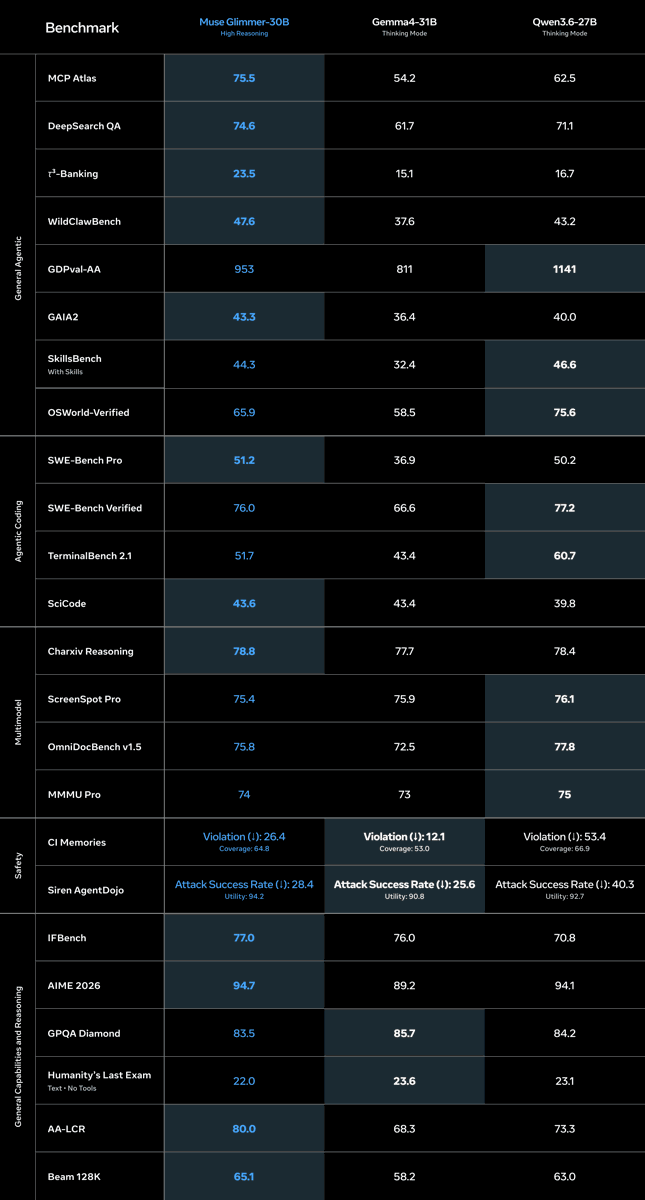 Figure: Meta’s official comparison table for Muse Glimmer vs. Gemma4 and Qwen3.6. Source: Meta Research
“Tool calling” refers to an AI’s ability to drive a computer system—opening software, clicking buttons, and filling out forms. This is the cornerstone capability of a “local butler,” and Meta indeed took the lead here, scoring 75.5 on MCP-Atlas. But switching to a different arena exposed clear limitations: on TerminalBench, which simulates real-world desktop terminal operations, Qwen3.6 outperformed Muse Glimmer by nearly 10 points (75.6 vs. 65.9). Another commenter put it bluntly: “Glimmer got crushed by 3.6 on TerminalBench.”
This created an awkward comparison. Meta’s model has more parameters (30B vs. 27B) and arrived four months later, yet its edge over Qwen 3.6 was mostly limited to tool-calling workflows while trailing in desktop control. Moreover, Meta benchmarked against Qwen’s previous-generation model, omitting top-tier contenders that dominated recent headlines—such as DeepSeek V4 Flash, Moonshot’s Kimi K3, and Qwen 3.8-Max.
Skepticism toward official benchmarks is common in the AI community. A Reddit user remarked: “I don’t trust Meta’s benchmarks one bit; they cherry-pick evaluations that favor them.” Because models can be overfitted to popular benchmark datasets, technical communities place far greater weight on independent third-party evaluations, where Muse Glimmer’s advantage over Qwen 3.6 appears marginal at best.
What truly energized the comment section was the release timing.
Qwen 3.8 27B is scheduled for release later this week, and Meta dropped Muse Glimmer just two days prior. The most widely quoted HN comment noted: “I’m not surprised they’re releasing now — they’re afraid they can’t beat Qwen3.8.” Community members recalled Meta’s rushed launch of Llama 4 during the height of DeepSeek’s momentum, which suffered from quality issues and community backlash. Rushing out announcements to hijack media coverage ahead of a rival’s launch is a familiar playbook in the AI industry. Some researchers further pointed out that Meta distilled Muse Glimmer from a larger teacher model, noting that Meta had previously published papers detailing the use of Qwen models for synthetic data generation and distillation. Training on Chinese model outputs and then rushing a launch to beat a Chinese model highlights the intense competitive race.
Market dynamics also explain this urgency. Over recent months, global AI headlines have been heavily dominated by Chinese open-weight models, leaving fewer dominant U.S. open-source alternatives. One commenter summarized the broader geopolitical dynamic: “Any push for ‘anti-Chinese models’ ultimately benefits Meta, because there’s almost no other U.S. contender at the open-source frontier.”
On the same day, Mark Zuckerberg made public statements criticizing “closed” AI competitors—referring to companies that keep model weights proprietary and sell access purely via APIs—positioning Meta as the flag-bearer of open source. This comes after a year-long hiatus in open-weight releases since Llama 3, during which critics questioned Meta’s commitment to open source. Returning to open weights right at this moment appears closely tied to Qwen’s release schedule. Meta also teased that weights for its largest model, Muse Spark 1.2, will be released “soon”—a teaser that HN users viewed as the true flagship event capable of competing directly with OpenAI and Anthropic. Releasing a mid-sized model first to capture headlines while dangling the flagship model creates a complete PR sequence.
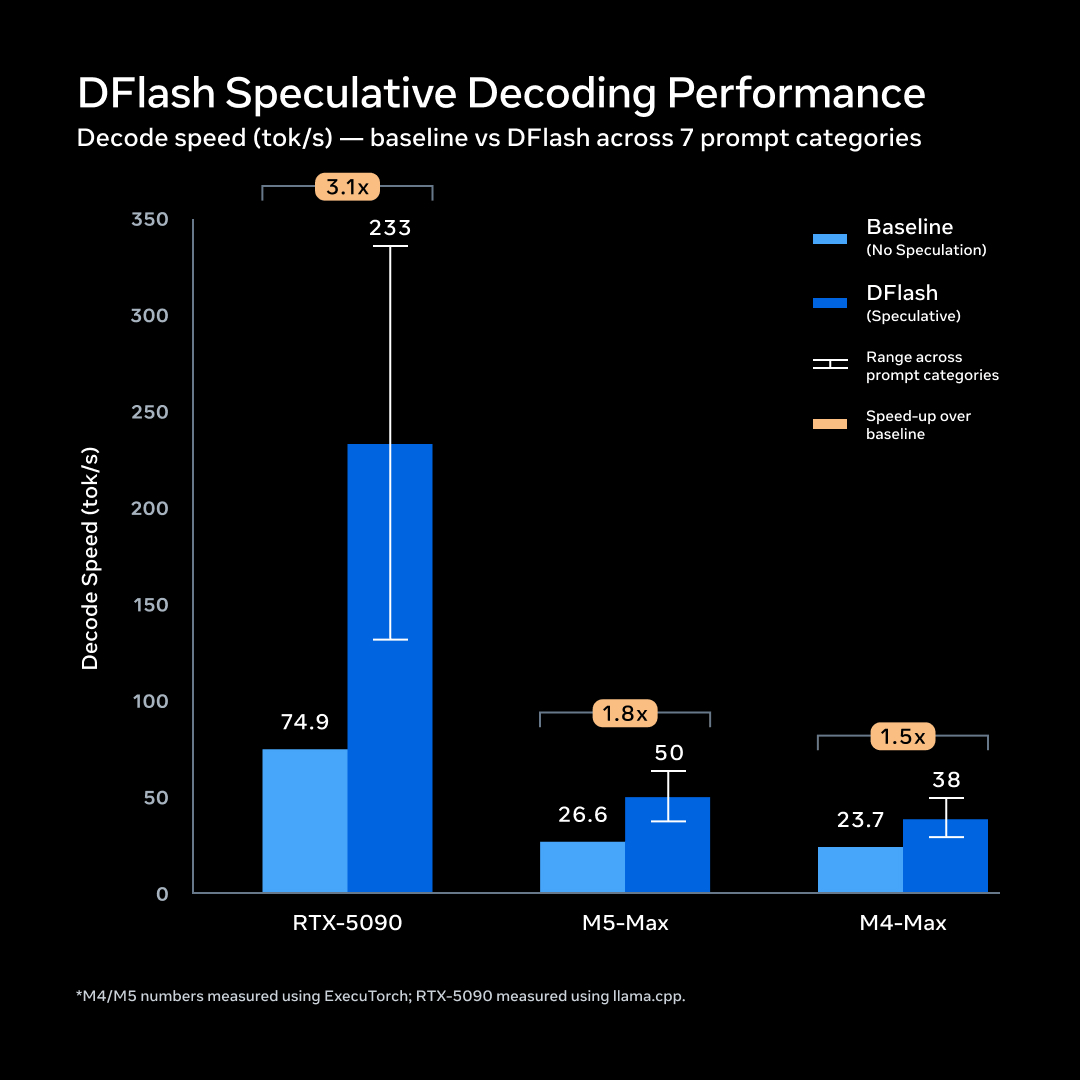 Figure: Meta’s demonstration of local generation speedup effects. Source: Meta Research
Despite the corporate rivalry, end users stand to benefit. Fierce competition drives down compute costs, improves model performance, and accelerates the trend of moving AI off the cloud and onto local devices. For users, this means private files stay local and offline-capable intelligent assistants become practical. However, the claim that a “home PC can run it easily” comes with caveats: community testing indicates smooth execution requires at least 32GB of unified memory, and a 64GB MacBook Pro costs over €4,000 in Europe—putting it out of reach for average consumer laptops.
Whether Meta rushed its release out of fear or Qwen is genuinely pressuring U.S. tech giants will become clear in a matter of days when Qwen 3.8 lands. Regardless of who takes the top spot on leaderboards, users benefit from the rapid pace of open-source AI innovation.
Reference Links:
- Meta Research: Introducing Muse Glimmer
- Hacker News Discussion (item?id=49241679)
- The Register: Zuck rekindles open weights Llama drama with Muse Glimmer
- Financial Times: Mark Zuckerberg attacks ‘closed’ AI rivals as Meta returns to open models
- OfficeChai: Muse Glimmer local model benchmark review