A Natural Space Heater Beneath Our Feet
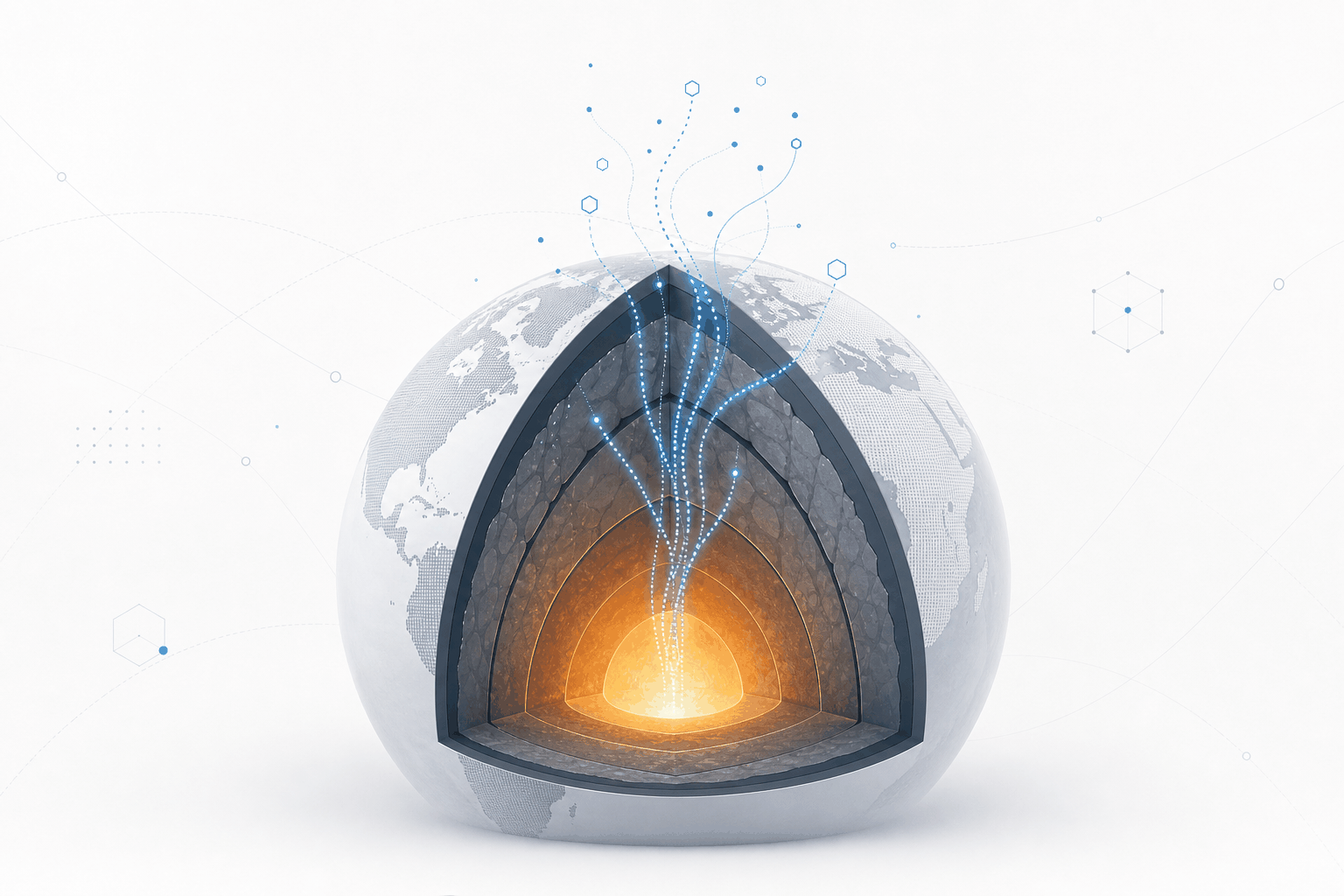
When you switch on a 1,000-watt space heater on a cold winter night, the ground thousands of kilometers beneath your feet is also constantly dissipating heat. If all the thermal energy released from Earth’s interior were spread evenly across the surface, every square meter would continuously emit energy into space. This underground heat source is the fundamental engine sustaining our active planet, driving plate tectonics and powering the geodynamo that generates Earth’s magnetic field.
Geophysicists estimate that internal terrestrial heat comes from two primary sources: primordial heat leftover from the planet’s formation 4.5 billion years ago, and radiogenic heat produced by the radioactive decay of elements like uranium, thorium, and potassium deep in the mantle. Without continuous radiogenic heating, Earth’s interior would have cooled and solidified long ago, becoming a dead world like the Moon—devoid of volcanoes, earthquakes, and a protective magnetosphere. Heat generated by radioactive decay accounts for roughly half of Earth’s total heat loss, equivalent to the power output of tens of thousands of nuclear power plants operating simultaneously.
Traditionally, geophysics has relied on seismic waves to peer into the deep Earth. By tracking changes in seismic wave speeds through different media, scientists can construct structural maps of subsurface density and rigidity—much like taking an ultrasound of the planet. However, seismic waves cannot decipher chemical composition. Exactly how much uranium and thorium reside deep within the mantle has historically remained impossible to quantify.
Ghost Particles That Pass Through Walls
The tool to break this deadlock came from a microscopic particle originally studied in astrophysics. Neutrinos—subatomic particles with minuscule mass, no electric charge, and almost zero interaction with ordinary matter, trillions of which pass through your body every second—possess extraordinary penetrating power. As uranium and thorium decay deep within Earth, they emit a specific variety: geoneutrinos (neutrinos released during the radioactive decay of natural elements such as U, Th, and K inside the planet).
Geoneutrinos serve as direct chemical signatures originating from the mantle depths. Unhindered by miles of dense rock, they travel unimpeded through the 2,900-kilometer-thick mantle and crust out into space. By capturing these particles at the surface, scientists can directly calculate the actual abundance of subterranean radioactive elements.
As Ryan Bayes, an SNO+ experiment scientist at Queen’s University, noted, this is the only neutrino research program focused specifically on Earth itself, whereas other observatories target signals arriving from deep space. Detecting these ghost particles provides geology with an instrument capable of directly assaying the planet’s chemical composition.
A Massive Sphere Two Kilometers Underground
Capturing geoneutrinos is an immense technical challenge. Because neutrinos rarely collide with ordinary matter, global detectors have recorded hundreds of thousands of cosmic and solar neutrinos over recent decades, but only a few hundred geoneutrinos in total. To escape the background noise of surface cosmic rays, detectors must be built deep underground.
In November 2025, the SNO+ experiment located 2 kilometers beneath the surface in the Creighton Mine near Sudbury, Canada, successfully detected geoneutrinos. This marked the first recording of deep-Earth neutrino signals in the Western Hemisphere, adding approximately 50 precious events to the global dataset. The SNO+ detector contains 780 tons of liquid scintillator—a specialized liquid that emits faint flashes of light when hit by high-energy particle interactions—surrounded by nearly 10,000 highly sensitive photomultiplier tubes mounted on a spherical shell.
To prevent contamination from surface impurities, protocol for entering the underground laboratory is rigorous. All personnel must take thorough cleanroom showers and suit up in dust-free garments. Detector technician Matt Depatie often explains to visitors that the showers exist purely for scientific purity: even a single speck of surface dust carries enough natural radioactivity to ruin the experiment. Previously, only Japan’s KamLAND experiment and Italy’s Borexino experiment had successfully detected geoneutrinos; the achievement at SNO+ marks a crucial step forward for the global observation network.
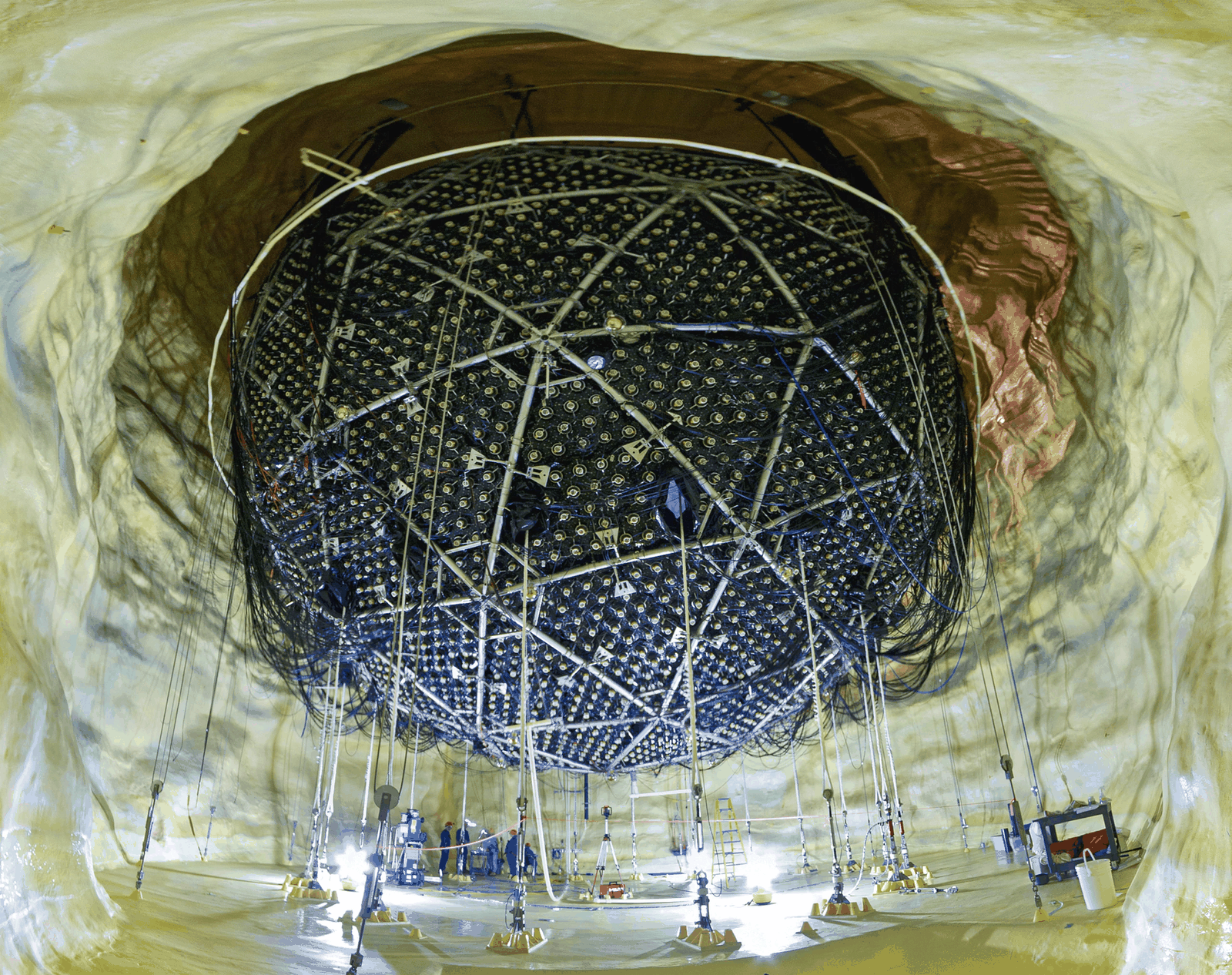 Image: Workers stand beneath the giant spherical detector 2 kilometers underground at Canada’s SNO+ experiment. Credit: Leo Duquette / SNOLAB
A Patchy Mantle Puzzle
With the release of the SNO+ data, scientists comparing results across the three global detectors uncovered an unexpected anomaly. Italy’s Borexino measured the highest geoneutrino flux, Japan’s KamLAND measured the lowest, while Canada’s SNO+ recorded values intermediate between the two.
This regional variation overturned conventional scientific assumptions. Traditional mantle models depicted the mantle as a vigorously convecting, thoroughly mixed soup where long-term fluid circulation would homogenize chemical compositions over time. The neutrino data, however, revealed distinct chemical discrepancies in the mantle beneath different continents.
Further analysis indicated that areas with higher geoneutrino fluxes roughly correlate with two giant structures at the base of the mantle known as Large Low-Shear-Velocity Provinces (LLSVPs)—continent-sized rock structures at the core-mantle boundary characterized by elevated temperatures and higher densities. One sits directly beneath the African continent, and the other lies under the Pacific Ocean. Mark Chen, director of the SNO+ collaboration, remarked that this could be the first direct evidence of chemical heterogeneity deep within the mantle, suggesting that unknown element-enriched reservoirs remain hidden far beneath our feet.
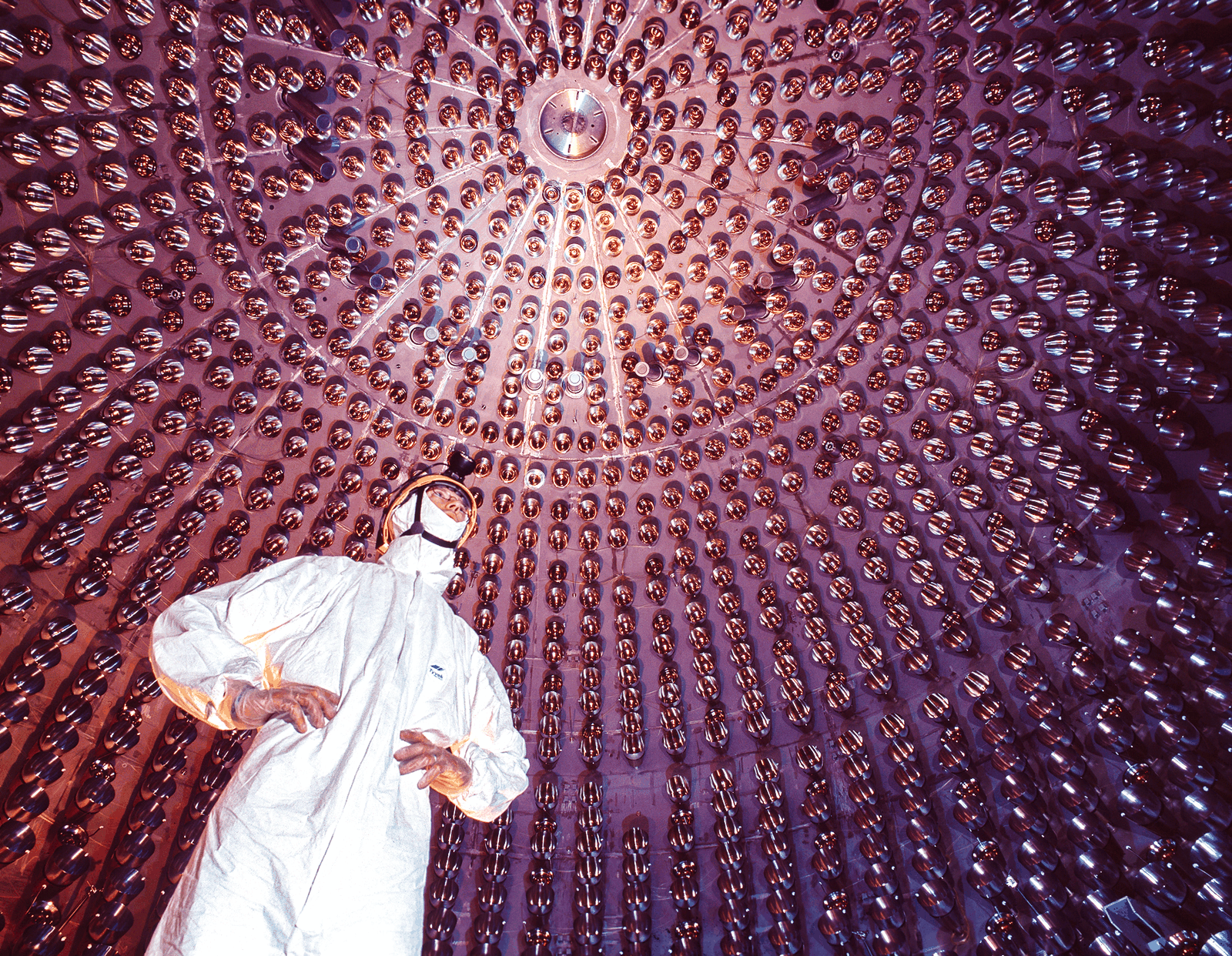 Image: Inside the Borexino detector in Italy, workers stand before the inner wall of photomultiplier tubes. Credit: Volker Steger / LNGS-INFN
The “High-Definition Era” of China’s Jiangmen Giant
Over the past two decades, all subterranean detectors combined have caught only a few hundred geoneutrinos—akin to using a faint pocket flashlight to illuminate a sprawling underground cavern. Unraveling the exact distribution of mantle radiogenic heat requires vastly larger and more sensitive instruments.
Enter the Jiangmen Underground Neutrino Observatory (JUNO), located in Kaiping, Guangdong Province, China. Housing 20,000 tons of liquid scintillator, JUNO officially began operations in August 2025 and is projected to release its first geoneutrino flux dataset within 2026. Its colossal scale means that in its very first year of operation, JUNO will capture more geoneutrinos than all previous global detectors accumulated over decades.
William McDonough, a geochemist at the University of Maryland and visiting researcher at the Chinese Academy of Sciences, highlighted that JUNO’s avalanche of data will allow researchers to truly start constructing a 3D chemical map of Earth’s interior. Scientists are already envisioning deploying detectors thousands of meters onto the ocean floor, bypassing continental crust rocks altogether to measure pristine neutrino signals straight from the mantle.
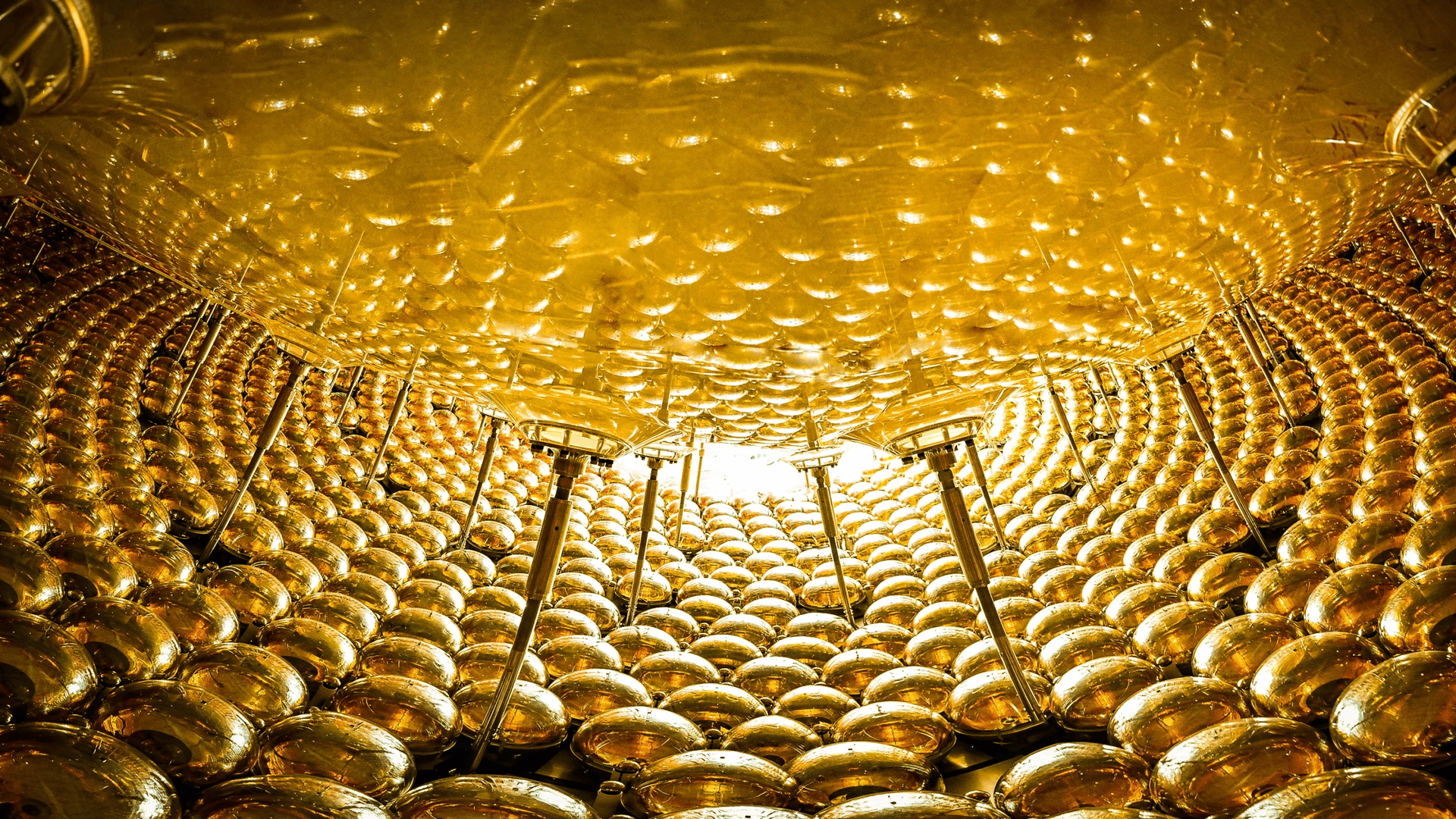 Image: Inside China’s JUNO detector, where the spherical wall is lined with golden photomultiplier tubes. Credit: JUNO Collaboration / Quanta Magazine
Listening to the Planet’s Deep Heartbeat
The maturation of geoneutrino detection technology is transitioning mantle science from indirect geophysical inference to direct geochemical measurement. Where scientists once relied on seismic reflections to guess at deep structures, they can now read the mantle’s actual elemental code through ghost particles streaming directly through the crust.
Decaying uranium and thorium in the mantle not only set the power level of planetary cooling but also govern the long-term evolution of plate tectonics and the geodynamo. Mapping the flux of geoneutrinos grants humanity a clearer understanding of the engine sustaining life on Earth.
As unprecedented particle datasets merge into global networks, a comprehensive subterranean chemical map is coming into focus. Standing on the surface, we are holding the key to unlocking the deepest chapters of Earth’s history through the faint trails of microscopic particles.
Reference Links:
- Quanta Magazine Report
- SNO+ Collaboration Research Report
- JUNO Collaboration Published Data