Many of us recognize the scene from spending an afternoon with a toddler: a tub of modeling clay rolled out across the living room carpet, an adult guiding tiny, chubby fingers to roll spheres and press out flat shapes. Soft clay yields under small hands, leaving behind an interlocking web of deep and shallow prints. It is an instinctual interaction that transcends language and culture.
That generational bridge was just as commonplace in deep prehistory. In a new study published in PLOS One, archaeologists exploring prehistoric sites in Israel identified 15,000-year-old clay sculpture fragments. Under high-powered magnification, the tiny surfaces—scarcely larger than a fingertip—bear crisp, unmistakable prints left behind by prehistoric children.
Sifting 40 Kilograms of Sediment: Microscopic Traces of Prehistoric Fingerprints
The figurines belong to the Natufian culture, a prehistoric population that inhabited the Levant between roughly 15,000 and 11,600 years ago, building some of the world’s earliest sedentary villages before the advent of agriculture. Living toward the tail end of the Upper Paleolithic, roughly ten millennia before construction began on the pyramids of Giza, these communities had given up migratory foraging to build clustered circular stone dwellings overlooking fertile valleys.
Archaeologist Laurent Davin launched the investigation around a lingering question: Did ancient humans create portable art with clay long before mastering ceramic firing? Davin’s team sifted through stored excavation material from three settlement sites in Israel, inspecting tens of thousands of clay chunks that together weighed more than 40 kilograms.
Forty kilograms of crumbled clay is roughly the heft of two heavy sacks of flour. Working through the sediment piece by piece, the researchers isolated approximately 150 figurative sculpture fragments, fifteen of which clearly outlined birds and gazelles. To the excavators’ astonishment, around 60 pieces still preserved distinct human fingerprints pressed into their surfaces.
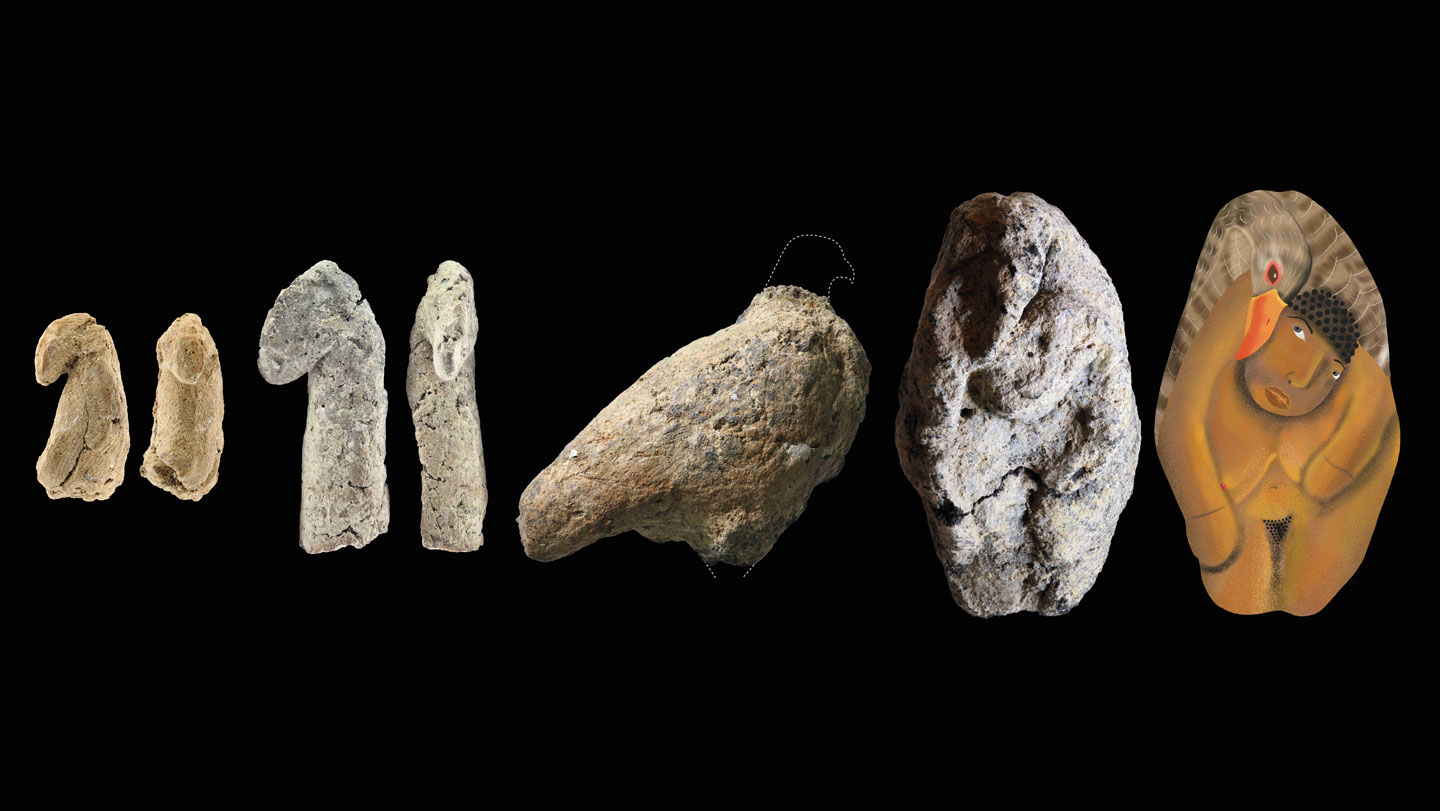 Figure: Small clay sculpture fragments unearthed from Natufian sites, showing profiles of birds and gazelles. Source: Science News
Ridge Breadth Reveals Age: Women and Children Were the Village Sculptors
A fingerprint is a permanent biological seal, but in archaeology it also functions as a developmental chronometer. The team borrowed a standard forensic metric known as epidermal ridge breadth—the average distance between the raised friction ridges on the skin, which widens as hand bones grow and serves as a reliable proxy for age. Young children have delicate, narrow fingers with tightly packed ridges; as the skeleton matures, the spacing expands, with adult males generally exhibiting the widest tracks.
Davin’s team conducted precise microscopic measurements across the impressions on all 60 clay pieces. When the data were aggregated, the results defied longstanding assumptions: the vast majority of the figurines had been fashioned by women and children, with some makers younger than ten years old. Adult male fingerprints were extraordinarily rare across the entire assemblage.
Popular depictions of Paleolithic art have long gravitated toward male big-game hunters, frequently framing cave paintings through the lens of hunting rituals and shamanism. The Natufian microscopic evidence turns that narrative on its head, demonstrating that women and young children formed the artistic core of these early villages. Fifteen thousand years ago, the hands gathered around the mounds of fresh mud were mothers and their children.
A Two-Centimeter Torso: Overlapping Prints of Adult and Child
Among the recovered pieces, a humanoid torso measuring less than two centimeters long stood out. Two centimeters is roughly the width of an ordinary shirt button. Under the scanning lens, this unassuming fragment unveiled an intimate moment frozen in time: its left side bore the broad, mature ridges of an adult, while the right side was pressed with the fine, dense prints of a toddler.
While the clay was still wet, adult and young fingers moved together over the miniature torso. An adult appears to have shaped the foundational mass before handing it off to the child to pat, squeeze, and prod. As the adult stepped in to guide or steady the child’s hands, their fingerprints overlapped and fused into the clay. These layered impressions provide direct material evidence of deliberate, structured skill transmission during the Stone Age.
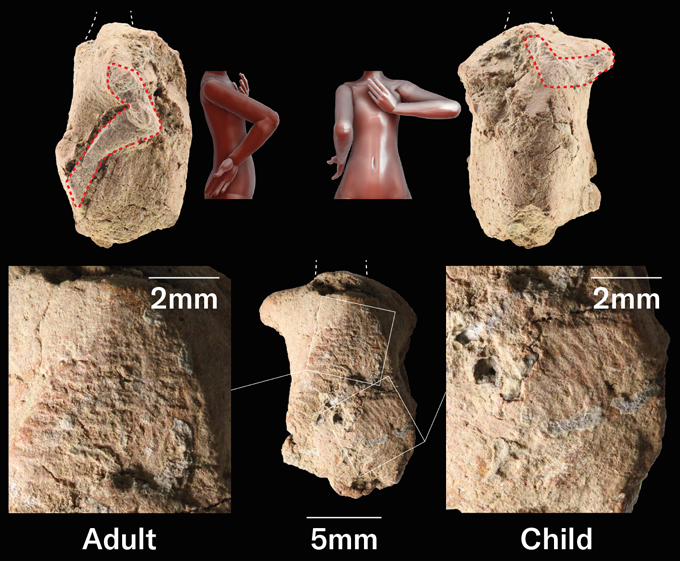 Figure: Humanoid torso figurine dating back roughly 14,500 years, featuring overlapping fingerprints from both an adult and a young child. Source: Laurent Davin / Science News (CC-BY 4.0)
Archaeology has occasionally caught fleeting glimpses of children engaging with art in deep antiquity. Hand stencil outlines made roughly 200,000 years ago have been reported on the Tibetan Plateau, and child finger impressions were identified at 30,000-year-old sites in the Czech Republic. Yet most prior finds represented isolated, solitary marks left as curious children explored their environment. The Natufian composite prints are fundamentally different: they trace an active social bond and pedagogical interaction between mentor and child.
Sculpted and Cast Aside: Clay Figures as Vehicles for Ancient Lore
Most of the figurines measure under two centimeters in length, showing casual, almost spontaneous craftsmanship. Microscopic analysis revealed no trace of long-term handling, wear, or suspension. They were neither sacred temple offerings nor cherished family heirlooms kept for generations.
If these items carried little material value, why did adults spend time teaching young children to fashion them? Davin suggests a compelling answer: the miniature figures likely served as storytelling props. Modern parents frequently draw cartoon figures while telling bedtime tales, where the illustration matters far less than the thrilling narrative it carries. An elder might have pinched a gazelle’s curved horns into shape while recounting tales of the wilderness to an eager toddler.
Unfired clay was an abundant, virtually free play material during the Paleolithic. Scooped from a streambank, molded to bring a narrative to life, and dropped into the campfire ash or camp dirt, a lump of mud could be discarded without a second thought. The fragile clay was merely a temporary medium; what actually endured was the shared wisdom and identity of the community. The miniature figurines crumbled back to dust, but the tribe’s oral traditions took deep root in the minds of the next generation.
Shifting Focus to Children: Stone Age Education Comes to Light
Steven Dorland, an archaeologist at Grand Valley State University who has long studied juvenile finger impressions on indigenous ceramics in the Great Lakes region, praised the findings. Dorland noted that the collection offers rigorous physical proof of early intergenerational learning. By shifting the archaeological spotlight from adult male hunters to children, researchers are beginning to recover vast stretches of overlooked daily life.
In traditional prehistoric excavations, children have remained nearly invisible. Research historically focused on razor-sharp flint spearpoints and heavy ground-stone implements—objects celebrating adult male hunting prowess and the fierce physical struggle against the wild. Yet any technology, craft, or social practice requires a successor generation capable of carrying it forward.
Humanity’s journey out of nomadic foraging into settled village life rested not only on flint-knapping and hunting prowess, but on the patience of elders mentoring the young. The overlapping fingerprints on Natufian clay breathe vivid life into an ordinary lesson taught 15,000 years ago. Long before the dawn of agriculture, structured learning was already quietly shaping our collective future—leaving behind the simplest, most human testament to how civilization survives.
References:
- Science News: Stone Age children made art from clay
- PLOS One: Fingerprint evidence of intergenerational clay sculpting in the Natufian Levant
- Phys.org: Symbolic clay objects shed new light on prehistoric Near Eastern communities