
Most people strolling along the beach on a weekend might pick up a few shells or sea glass. For south Wales resident Jonathan Bow, searching the rocky foreshore for intriguing stones has been a decades-long pursuit. In the spring of 2012, while walking beneath the coastal cliffs of Lavernock Beach near Penarth, he noticed a row of tiny, sharp teeth embedded in a fragment of rock. Assuming it might be the jaw of a “miniature crocodile,” he slipped the coin-sized specimen into his pocket and took it home.
Little did he know that this modest find would, fourteen years later, unravel an anatomical conundrum that had puzzled paleontologists for nearly two centuries. Resting quietly at the tide line, the small jaw would become the critical piece of physical evidence required to reorganize a tangled web of ancient marine predators.
 Figure: Jonathan Bow and his son fossil hunting on Lavernock Beach, with the fossil-bearing cliffs in the background. Credit: BBC / Amgueddfa Cymru
Isolated Teeth Stalled Paleontology for Nearly Two Centuries
Paleontology frequently grapples with an inherent preservation bias: durable teeth fossilize far more readily than delicate skeletal frames. Beginning in the 1830s, quarries and coastal cliffs across Britain and Europe yielded abundant isolated, sharply pointed fossil teeth from the Late Triassic—a geological interval roughly 200 million years ago, when the earliest dinosaurs were just beginning to establish themselves on land. Without intact skulls or jaws, early naturalists were forced to deduce animal identities solely from loose teeth.
For generations, these scattered finds were lumped under a single broad taxonomic umbrella: Severnichthys, a genus erected in the 19th century to accommodate isolated fish teeth across Europe. By the 20th century, anatomical confusion deepened to the point where some researchers mistook the large, grooved teeth for the remains of giant labyrinthodont amphibians. European museum drawers accumulated hundreds of such specimens, bearing identical index cards despite stark discrepancies in tooth morphology, enamel fluting, and cross-sectional geometry.
Isolated teeth are like disassembled jigsaw pieces without a reference box. Without the surrounding cranial framework, paleontologists had no way of knowing whether the teeth came from varying positions within the mouth of a single polymorphic predator, or from entirely separate species occupying different ecological niches.
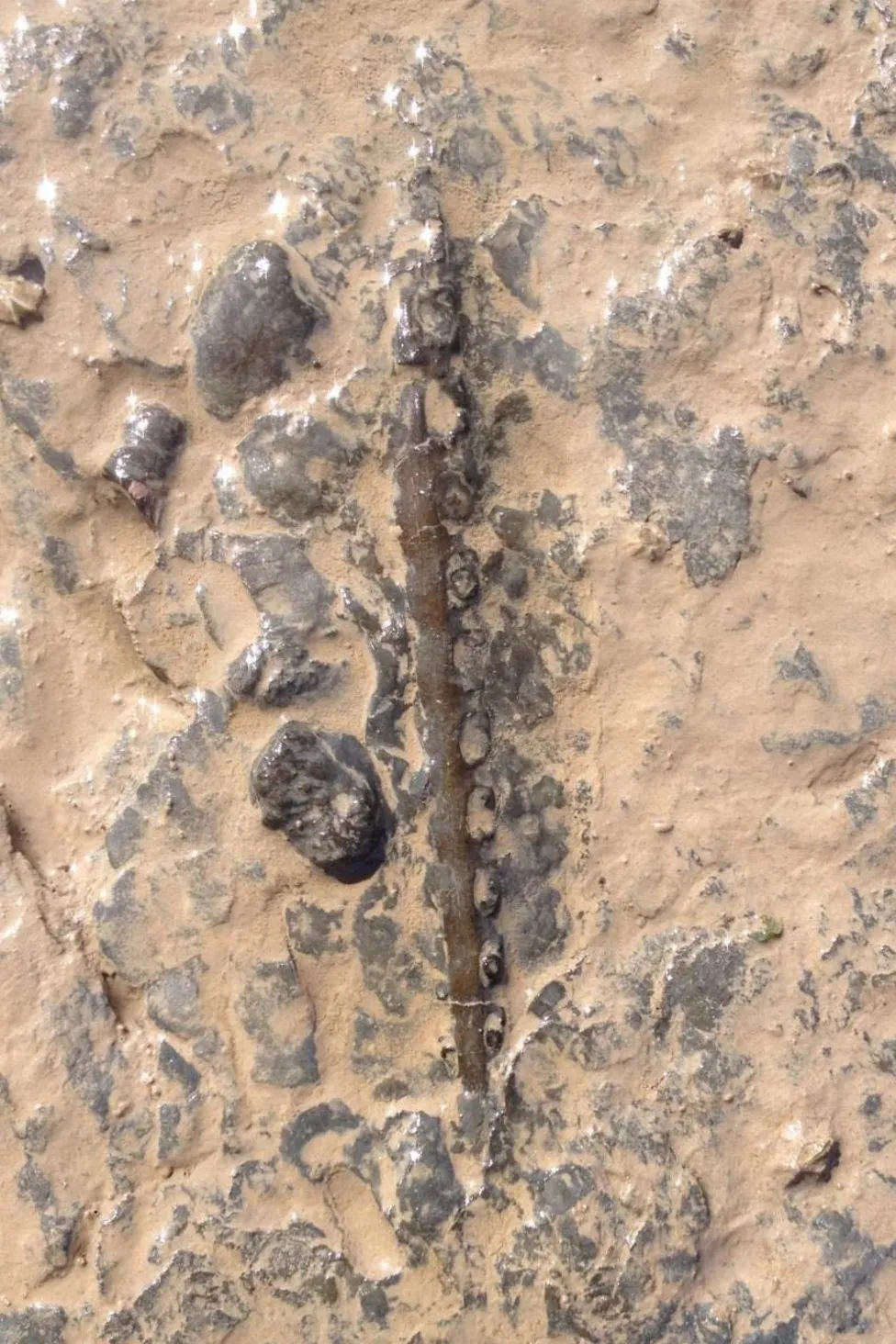 Figure: The fossilized jaw with exposed teeth, photographed in situ within beach rock. Credit: BBC / Jonathan Bow
An Amateur Collector Unearths Crucial Evidence at Low Tide
The turning point came in 2022 when Jacob Quinn, a researcher from the University of Bristol, visited Bow to examine his personal collection. Quinn immediately recognized that Bow’s Lavernock specimen preserved an exquisite, articulated lower jaw, with several sharp teeth still anchored firmly in their natural bone sockets. Such anatomical articulation is exceptionally rare in the turbulent depositional strata of the Bristol Channel.
Geologists determined that the fossil originated in a 200-million-year-old storm deposit. During the Late Triassic, the Bristol Channel was a shallow tropical sea punctuated by low limestone archipelagos. Severe tempests frequently tore marine animals apart, yet rapid burial under tempestite mud and calcareous silt locked this delicate jawbone into a protective sedimentary matrix before scavengers or wave action could destroy it.
Cindy Howells, Curator of Geology at Amgueddfa Cymru (National Museum Wales), recalled that the specimen initially baffled specialists when it arrived in the laboratory. It bore no obvious resemblance to any known species previously confirmed from the regional bone beds. The research team consequently partnered with colleagues at the State Museum of Natural History Stuttgart, initiating a systematic comparative study of hundreds of archival museum specimens across the UK and Germany.
Slender Snouts and Robust Teeth Untangle Conflated Species
The breakthrough came because the articulated jaw provided an indispensable morphological anchor. Anatomical analysis confirmed that the jaw belonged to Saurichthys—a genus of predatory, elongated ray-finned fish often compared to modern needlefish or gar, equipped with a slender, beak-like rostrum. Despite more than two centuries of intense fossil hunting in the Bristol Channel, this was the very first diagnostic cranial bone of Saurichthys ever confirmed in the regional Late Triassic rocks.
With a definitive jawbone in hand, the team re-examined the centuries-old collections of loose teeth. They realized that the teeth historically dumped into Severnichthys actually originated from two completely separate predators with contrasting feeding adaptations:
- Saurichthys: An agile, streamlined pursuit predator armed with rows of slender, sharp, needle-like teeth engineered to seize slippery fish and soft-bodied cephalopods in open water.
- Birgeria: A larger, heavier predatory fish possessing robust, deeply fluted fangs adapted to pierce and crush armor-scaled fishes and hard-shelled invertebrates.
For generations, researchers had mistakenly assumed both tooth types belonged to a single, highly variable apex fish. The discovery of Bow’s articulated jaw decisively severed that connection, showing that two different evolutionary lineages had been crammed into one historical taxon.
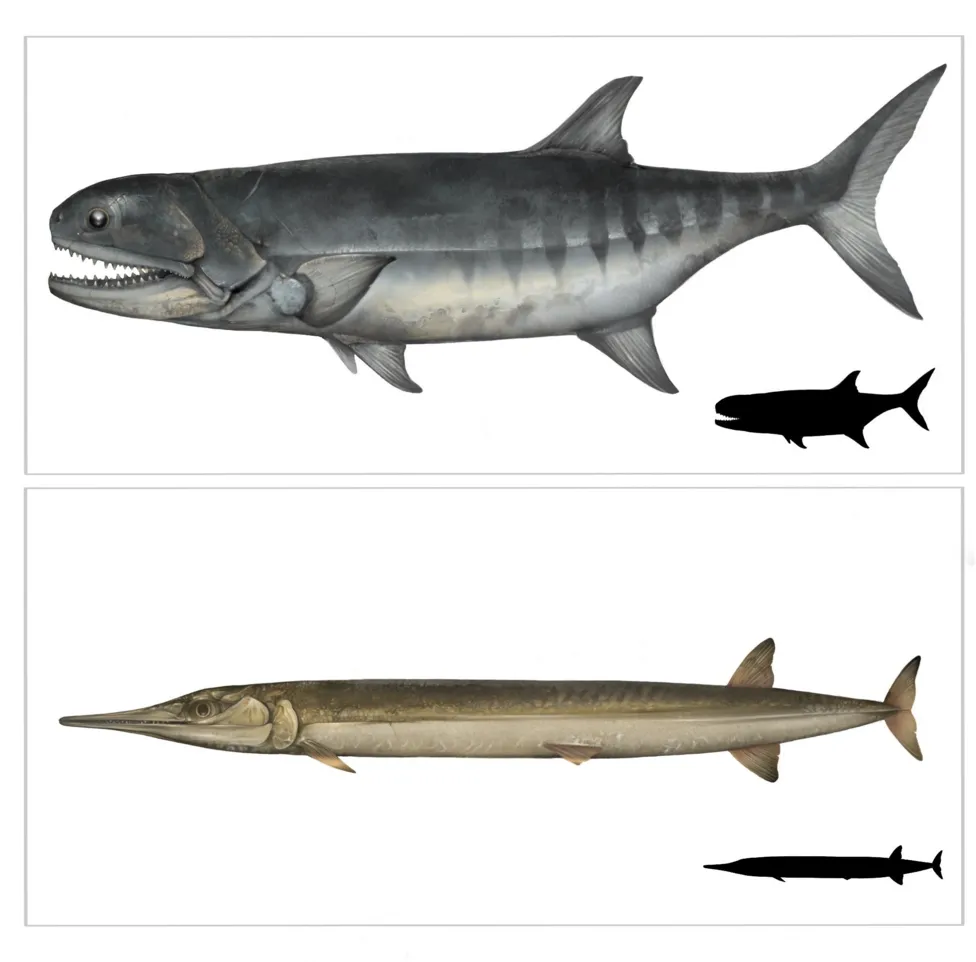 Figure: Life reconstructions of Birgeria (top) and Saurichthys (bottom) illustrating their distinct anatomical forms. Credit: BBC / Amgueddfa Cymru
Retiring a Redundant Genus Restores a 200-Million-Year-Old Marine Ecosystem
The study’s findings were formally published in the Journal of Vertebrate Paleontology. The authors concluded that because the type material underpinning Severnichthys represents a chimaera of mixed skeletal elements from two distinct genera, Severnichthys constitutes a nomen dubium (a doubtful name) and should be officially retired from scientific literature.
Removing this taxonomic error reveals a far richer ecological portrait of the Late Triassic seas just before the end-Triassic mass extinction. As study co-author Dr. David Whiteside noted, these two ancient predators partitioned their resources within the same warm lagoonal waters: Saurichthys patrolled the upper water column with high-speed strikes, while the larger Birgeria hunted across deeper zones, tackling armored prey. This niche differentiation demonstrates that marine food webs of the era were far more structurally intricate than previously recognized.
Clarifying two centuries of taxonomic entanglement corrects textbook records and museum displays across Europe, turning drawers of ambiguous fossil teeth into positive evidence of marine apex predator biodiversity.
Complete Skeletal Specimens Provide the Missing Anatomical Anchor
Co-author Dr. Sam Cooper emphasized the remarkable role of chance: a single stone picked up by Jonathan Bow during an extreme low spring tide finally cleared a two-hundred-year-old backlog in vertebrate paleontology. The historic fossil is scheduled to go on public display at National Museum Cardiff later in 2026, allowing visitors to view the modest jawbone that reshaped prehistoric taxonomy.
While durable enamel ensures that isolated teeth dominate the vertebrate fossil record, their explanatory power is fundamentally constrained. Without articulated skeletal frameworks, analyzing standalone teeth is fraught with the risk of grouping disparate animals together into composite chimaeras.
The Lavernock jaw demonstrates that the resolution to long-standing taxonomic puzzles often hinges on finding rare articulated specimens. As more complete material emerges from coastal cliffs and museum basements, paleontologists will continue to liberate ancient life from historical misconceptions.
References:
- BBC News: Saurichthys fish fossil found in Wales resolves teeth confusion
- Journal of Vertebrate Paleontology: Redescription of Late Triassic predatory actinopterygians


