A single Reddit recommendation comment sells on the underground market for $9.99. A bundle of one hundred goes for $699.99. Armed with a fine-tuned named-entity recognition model, knife enthusiast Peter Vijeh scraped 51,129 comments across Reddit’s knife communities, expecting statistical analysis to catch paid astroturfing red-handed.
A Data Refresh Filters 50,000 Real Comments
Peter Vijeh runs New Knife Day, a knife collector site. He knows all too well the widespread habit: when buying a knife—or almost anything else—people type their query into Google and tack on the word “reddit.” He selected six core communities: r/knives, r/knifeclub, r/chefknives, r/japaneseknives, r/FixedBladeEdc, and r/KnifeSteels, covering a total of 6,675 submissions. Initially, his scraper captured each post immediately after publication. But that preliminary test revealed nothing. Across more than 800 buying-advice threads collected right at launch, brand mentions were far too sparse: the concentration among outlier accounts was 7.6%, virtually indistinguishable from the 7.1% expected purely by chance.
It was a scrape failure that matched human intuition but clashed with community behavior. “What should I buy” threads do not ignite instantly. Instead, high-quality recommendations accumulate slowly over the subsequent 24 to 48 hours. In the largest community, r/knives, fresh posts yielded an average of just 1.5 comments each.
Vijeh decided to go back and re-scrape 3,607 posts that were older than 48 hours. This time, the corpus expanded from roughly 20,000 comments to 51,129. That time buffer filtered out genuine buying advice. Within those 50,000-plus comments, 987 authors had posted 10 times or more. Vijeh wrote regular expressions to capture buying threads—matching queries with phrases like “should I buy,” “recommend,” or “best knife.” In that specific subset, those 987 accounts generated 1,471 brand mentions.
Ranking authors by “brand-heaviness”—the share of their comments naming a brand, weighted toward repeatedly naming the same brand—the top 5% were designated as tail accounts: 49 accounts in total.
1,000 Random Permutations Reveal Anomalous Tail Concentration
To determine whether these 49 accounts represented genuine concentration or merely statistical noise, Vijeh ran a Monte Carlo permutation test. He kept every brand mention in place—unchanged by post and brand—and shuffled author names across those mentions at random, repeating the process 1,000 times.
Under random distribution, that 5% of accounts should have produced roughly 7.9% of brand recommendations, with the vast majority falling between 6.3% and 10.1%. In the actual data, however, they accounted for 11.3%. Across 1,000 random permutations, that threshold was reached only twice. In plain terms: roughly one in every nine buying recommendations originated from these 49 accounts, compared to an expected one in thirteen. In this sample, about 50 extra targeted recommendations appeared out of thin air.
Breaking down the numbers by brand revealed even more striking disparities. For one chef’s knife brand, recommendation concentration reached 31.2%, against a chance expectation of 8.0%. Two other brands stood at 26.1% versus 8.2%, and 20.4% versus 11.8%. Only one major brand came in lower than chance at 8.1% versus 9.5%, while three other brands showed no statistical signal at all.
Across subreddits, the anomaly was far from uniform. In r/chefknives, the tail accounted for 14.9% versus 7.7% expected by chance; in r/japaneseknives, it was 15.2% against 14.3%. Meanwhile, the largest general forum, r/knives, registered 6.7% against a chance baseline of 6.4%, virtually hugging the expected distribution. If the entire knife community were systematically manipulated by paid astroturfing, every subreddit would sit above chance. The extreme concentration in specific subreddits points instead to targeted, localized activity.
For rigor, Vijeh coded the brand names. Concentration statistics can only demonstrate that certain brands are heavily recommended by a tiny cluster of users; they cannot prove that any brand paid for those endorsements. In fact, the brand exhibiting the strongest signal happens to command a large and vocal fan base.
Examining Full Histories: Paid Shills and Devoted Fans Share the Exact Same Face
Within the localized corpus of these six subreddits, the tail accounts exhibited a remarkably thin profile: a median of just 12 comments and a median score of 1 point, meaning hardly anyone upvoted them. In their commentary, they were intensely loyal, directing two-thirds of their brand mentions to a single maker.
To uncover their true identity, Vijeh retrieved the full Reddit history for the 23 tail accounts behind the three brands with strong signals. This included up to 2,000 comments, submissions, account creation dates, and karma scores. For comparison, he randomly sampled 23 regular accounts falling within the exact same comment-count bracket.
The findings overturned every intuitive assumption about paid astroturfing. Median account age was identical across both groups at 4.5 years. Tail accounts posted only 3.2% of their total comments in the six knife subreddits, compared to 10.3% for the control group. Furthermore, tail accounts were active across 66 different subreddits, versus 47 for the control group. Across their entire Reddit lifespan, tail accounts mentioned 7 different knife brands on median, while the control group mentioned 12. As for commercial store links, they appeared in only 0.3% of tail comments and 0.2% of control comments.
Under a Mann-Whitney test, not a single feature separated the two groups at p < 0.05. Even more tellingly, 8 tail profiles and 7 control profiles had hidden their histories, been suspended, or deleted their accounts altogether. Mature accounts, activity spanning dozens of disparate subreddits, and an absence of spammy store links: these classic markers of high credibility were displayed flawlessly by all 23 tail accounts.
This matches the commercial standards of the underground marketing industry.
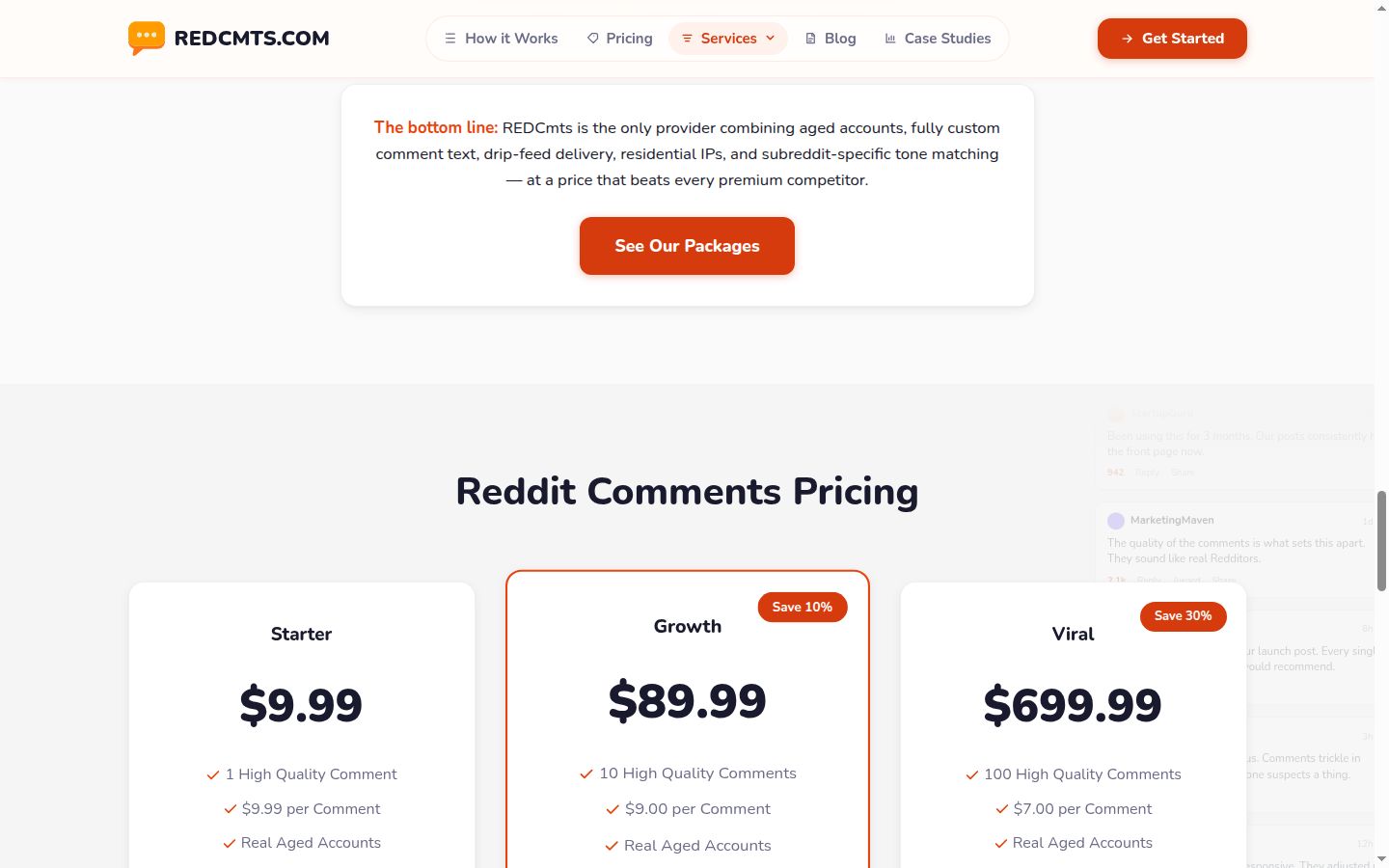 REDCmts price list: one comment $9.99, ten $89.99, one hundred $699.99, September 2026. Source: Peter Vijeh’s Investigation Report
Paid astroturfing has an explicit market price. REDCmts sells single comments for $9.99 and bundles of 100 for $699.99, explicitly advertising “real, aged accounts.” Another vendor, Soar, openly states that its accounts are aged and manually warmed for weeks before posting a single brand mention. Meanwhile, services like Bazzly advertise automated replies targeting any thread that resembles consumer shopping.
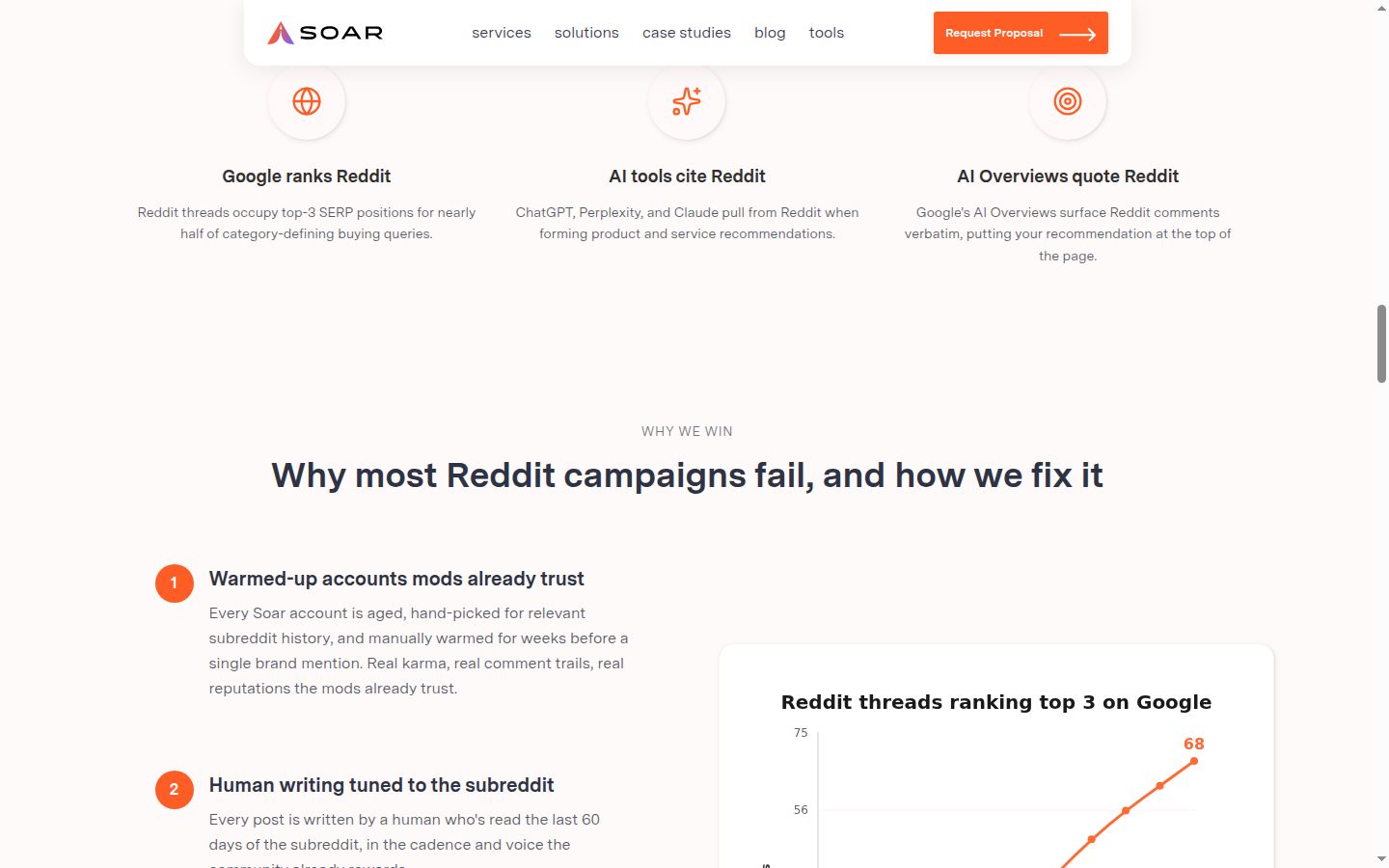 Soar marketing page describing accounts aged and manually warmed before posting brand mentions. Source: Peter Vijeh’s Investigation Report
These commercial sales pages prove that high-quality astroturfing exists. But as Vijeh emphasizes, no evidence connects these marketing vendors directly to specific accounts in the knife subreddits. In the charts, an account nurtured for 4.5 years that pushes a single brand looks indistinguishable from a genuine enthusiast who browses dozens of hobbies and buys exclusively from one favorite craftsman.
Data Can Outline Suspicion, but It Cannot Prove Intent
For a small handful of brands, one-quarter to one-third of all purchase advice undeniably flows from accounts with a single, dedicated preference. Yet after reviewing their complete comment histories, Vijeh loosely leans toward the conclusion that they are simply passionate fans.
For everyday readers, this investigation offers a practical defensive rule of thumb: when an unfamiliar account recommends a knife in a buying thread, click into their profile and check whether they have ever mentioned any other brand. Across this 51,129-comment corpus, that single check separated tail accounts from regular users far more effectively than karma scores. But when confronted with a meticulously aged account operating on a paid retainer, an everyday reader remains essentially powerless.
At the conclusion of his analysis, Vijeh candidly outlines several methodological limitations: brand detection relied on an off-the-shelf named-entity model without hand-labeled validation; buying threads were identified solely through regular expressions; and findings regarding specific brands ultimately rested on data from just 15 to 20 accounts. Furthermore, his personal involvement with a knife collector site and the fact that an AI draft assisted in early writing were openly disclosed.
Public data can conclusively show that recommendations are heavily concentrated in a handful of accounts. Statistical tests can delineate suspicious clusters and quantify anomalies in buying advice, but they cannot prove motivation. A paid shill on a marketing retainer and a die-hard superfan produce the exact same statistical silhouette. When faced with 4.5-year-old accounts active across 66 subreddits, data science collides with its hard physical limits.
Reference Links:
- Peter Vijeh’s Investigation Report