
In 577,000 Postings, Real Urgency Closes in a Week
In September 2026, a report examining roughly 577,000 job postings across corporate career pages sparked outrage across professional networks. Unlisted analyzed public APIs from major Applicant Tracking Systems (ATS) and uncovered a striking figure: 163,057 open listings had been sitting on career pages for more than 90 days, accounting for 28.3% of all postings with visible publication dates. Over 94,000 of them had been live for more than six months. These numbers immediately fueled workplace conspiracy theories, with job seekers pointing to them as undeniable proof that companies fabricate fake jobs to project false health and growth.
 Figure: Header banner from the Unlisted report. Source: Unlisted Ghost Jobs Report page.
Yet the most revealing insight from the report is buried in the short-term data that few people bother to examine. Among the 88,895 postings closed within the past 30 days, 14.6% (13,013 roles) were taken down within a single week of going live. When a company faces an urgent, well-scoped hiring need, the role moves through the funnel and comes down within days.
The vast long tail is not an army of maliciously manufactured ghost listings, but operational residue from how recruiting systems actually work. The 577,000 listings form a clear age distribution curve: nearly half (45.1%) survive fewer than 30 days, the median age across all active postings sits at 36 days, and only 16.3% exceed 180 days. Labeling every persistent opening as fraudulent misunderstands the operational realities of modern talent acquisition.
Hiring at Scale Is Hard Drive Maintenance
To make sense of why nearly 30% of postings remain indefinitely on company websites, one must abandon the linear view of corporate hiring. In an extensive Hacker News discussion on the findings, veteran developer mort96 offered an insightful systems analogy: hiring strategies differ in the same way hard drive maintenance does.
When a hard drive fails in your home computer, it is an isolated, urgent incident. You buy a replacement immediately and install it. But in a Google data center, hard drives fail every single day at scale. Drive failures are not discrete emergencies; they are a predictable, continuous statistical rate. Google never routes a one-off purchase approval for a single failed drive—it maintains a continuous replenishment pipeline.
Recruitment for senior engineers at large tech companies operates on the exact same logic of probability distributions and employee turnover. In an organization of ten thousand people, talent churn is a constant background friction. Companies do not post ten discrete listings to fill ten senior engineering vacancies; they keep an evergreen pipeline open year-round to collect relevant resumes. A community member added a sobering real-world note: after experiencing the sudden loss of colleagues in unexpected accidents, team turnover ceases to be an abstract HR statistic—it becomes a harsh operational reality.
At the other end of the spectrum, small businesses generate stale listings for entirely opposite reasons. A 50-person team leaves a listing up that was published six months ago, on a careers page that looks like it was built in 2009. In all likelihood, nobody ever bothered to log into the dashboard and click the archive button. The person who managed job listings left the company and was never replaced.
Your ATS Determines How Long Your Job Stays Alive
Far more decisive than corporate intent is how underlying software governs the lifespan of information. Rather than the industry sector a company operates in, the specific ATS vendor it procures offers the most accurate predictor of whether a job listing will rot into a zombie post.
The report reveals that among employers using Lever, 48.2% of open listings have been active for more than 90 days. For BambooHR and Teamtailor, that figure reaches 47.9% and 42.3%, respectively. In stark contrast stands Workday, where only 17.2% of postings exceed 90 days and the median age is just 26 days. Whether a software platform enforces strict lifecycle management mechanisms directly governs how frequently a company’s job postings are refreshed.
Most organizations harbor no malicious intent; they simply exhibit institutional inertia when confronted with automation toolchains. When publishing a role requires just a single click for multi-channel distribution, but archiving an expired posting demands cross-departmental approval, the path of least resistance is obvious. These tool- and compliance-driven disparities also appear across geographic borders: Sweden and the Netherlands show 40.9% and 39.2% stale postings, whereas Australia stands at just 21.5%.
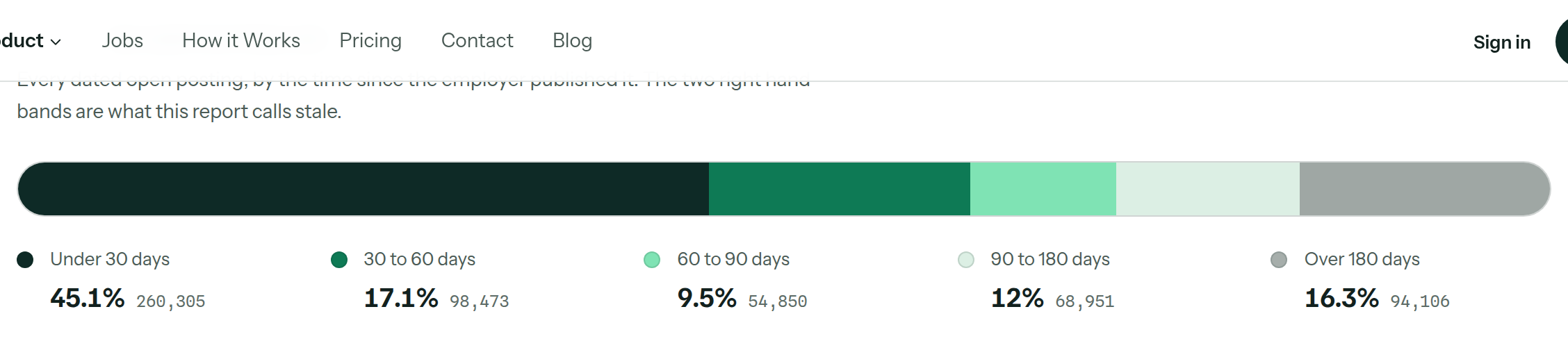 Figure: Job posting age distribution chart. Source: Unlisted Ghost Jobs Report 2026-09.
Tooling inertia produces bizarre polarities on employer leaderboards. At the American Logistics Authority, 100% of its 2,597 active postings have lasted over three months. At fast-food chain Whataburger, the median listing age reaches a staggering 239 days. Conversely, home improvement giant Lowe’s maintains 12,225 active listings, yet precisely 0.0% of them exceed 90 days. The difference comes down to whether the organization configures and enforces strict automatic cleanup rules.
The Asymmetry Tax: Pushing System Friction onto Candidates
The explosion of the “ghost job” narrative is ultimately a defensive coping mechanism by job seekers confronting an opaque information black box. Across sectors, hospitality features the stalest listings, with 43.9% exceeding 90 days; healthcare turns over the fastest, with only 19.7% crossing that threshold. Employers and candidates are operating on entirely different planes of information, locked in a misaligned game.
The report highlights a subtle refresh mechanism that easily escapes notice: 4.2% of closed positions were reposted within 30 days by the same employer for the exact same role, while another 4,576 postings were closed and immediately reopened in place. By resetting the system timestamp, companies effortlessly strip away the “stale” badge. Job seekers eagerly submit applications to what appears to be a brand-new opening, only to step right into an automated data loop.
Modern recruitment software has drastically lowered the cost for employers to publish information, but it has done nothing to improve the veracity of those listings. The byproduct of low friction is an endless accumulation of digital debris across the web. Companies pay no economic penalty for leaving dead links and defunct postings active indefinitely, shifting the entire screening burden onto applicants. This asymmetric empowerment breaks down trust across the entire hiring market.
The 28% stale posting figure lays bare an ecosystem trapped in deep information asymmetry. Tech giants defend their evergreen pipelines, while small businesses let legacy systems collect digital dust. Under current architectural frameworks, the full cost of discerning whether an opportunity is real is pushed onto the individuals standing at the very bottom of the information food chain.
Reference Links:
- Unlisted Ghost Jobs Report 2026-09
- Hacker News Discussion