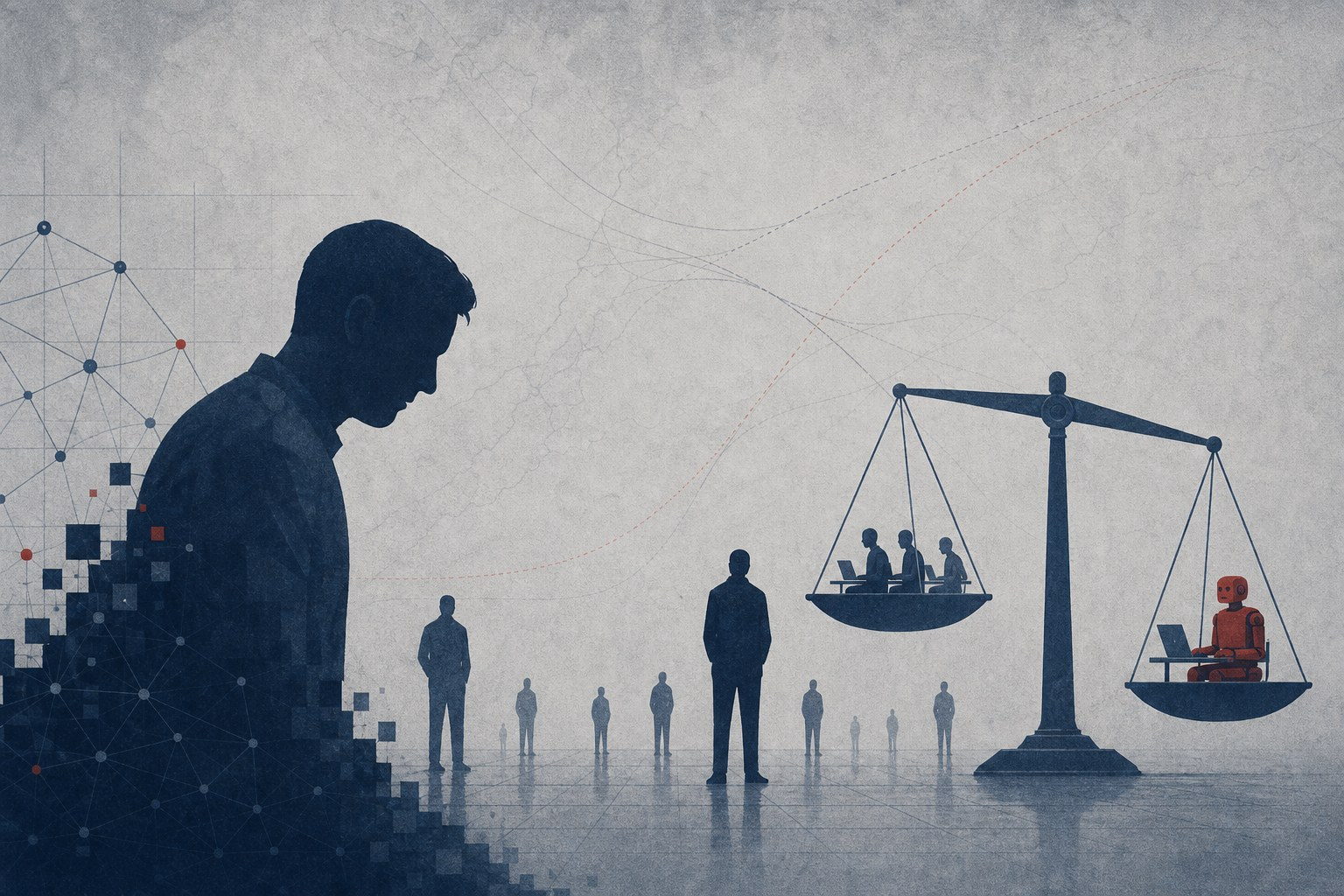
Why Tech Workers Panicked First: Is AI About to Replace 40% of White-Collar Jobs?
An article titled “Why Is Everyone in Tech So Sad?” reached 965 points on Hacker News, a community frequented by software engineers. It quickly became one of the most fiercely debated posts on the platform: 1,134 comments arguing over the exact same question—is our high-paying job really about to be taken over by AI? The sheer score demonstrated that within the developer community, this topic can no longer be bottled up.
Most members of this community are engineers and founders earning six-figure or even seven-figure salaries, who appear to outsiders as the primary beneficiaries of the AI wave. Ironically, they are the very first group to experience collective anxiety.
Knitting Sweaters on the Commuter Train
Author Aaron Horwath, who leads AI implementation at a tech firm, described a scene from his daily commute: Sitting across from him was a young man in his early thirties, dressed in a suit and dress shirt, wearing AirPods and working on a MacBook. For half an hour, he spoke about corporate financial jargon in a completely flat, emotionless tone. Right before his stop, he reached into his bag—not for a book, but for two knitting needles and a ball of pink yarn. He was knitting a winter hat for his niece.
“I wanted to make something real,” the young man said.
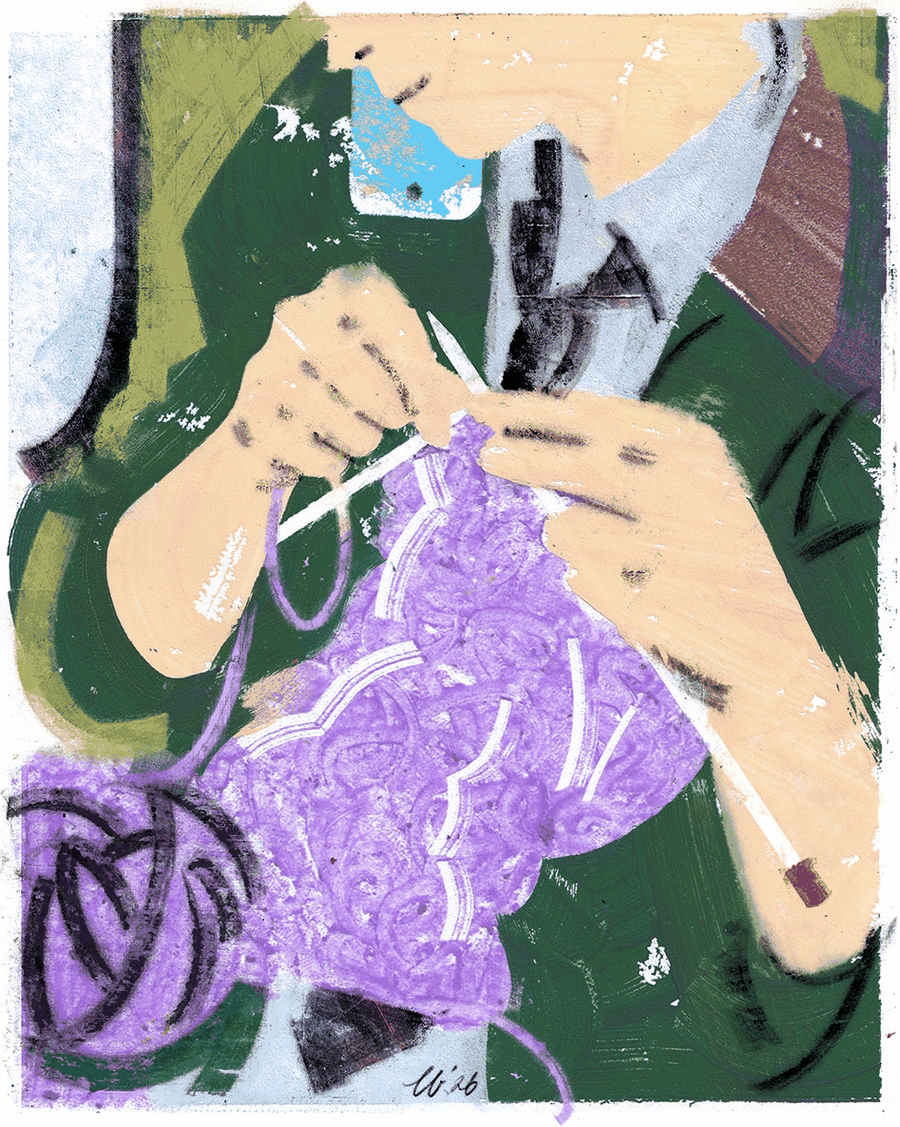
Illustration for Noema Magazine. Source: noemamag.com
The author noted that more and more peers around him are talking about old-school hobbies like ceramics, painting, and knitting, or fantasizing about “disappearing,” “moving to the countryside to start a farm,” or “becoming a surf instructor by the beach.” There is no humor in their tone, only deep exhaustion. Many woke up one morning and suddenly felt that their work was utterly meaningless.
He named this phenomenon Workism. First coined by The Atlantic in 2019, Workism describes how America’s most elite, highest-paid workers treat work as a religion: looking to their jobs for community, identity, and life purpose, much like churchgoers going to service every Sunday. This faith operates on belief—as long as you believe the work matters, it matters.
The rise of AI is now shaking this very foundation.
AI Makes “Fake Work” Suspicious
The author observed a fundamental shift. Previously, no matter how meaningless a job might have felt, at least a human was doing it: humans held meetings, drafted proposals, built slide decks, and replied to client emails. Even the dullest tasks retained a touch of human connection. Now, AI agents are stepping in to handle those tasks. Many tech companies are already envisioning a future where every employee acts as a “supervisor for a swarm of AI agents.”
The problem arises when AI makes output both fast and cheap: the uncomfortable question of whether the job had any real value in the first place can no longer be hidden. While executives attribute tech layoffs to AI efficiency gains, the author points out that current efficiency boosts are nowhere near sufficient to justify such massive headcount cuts. The true underlying motive is testing whether companies can operate without so many people. Management increasingly views human-to-human collaboration as an “inefficient middle layer” that should be trimmed whenever possible.
Here lies a counter-intuitive catch: what executives are cutting is precisely what keeps employees engaged—collegial relationships, the joy of collaboration, and shared problem-solving. Decades of research by Harvard Business School scholar Teresa Amabile show that people are most creative when motivated by the intrinsic appeal of the work itself, rather than the whip of KPIs.
The Typesetter Analogy: A Heated Debate
The liveliest argument in the Hacker News thread revolved around the “typesetter analogy.”
Optimists (the historical norm view) argued: Typesetting was a skilled trade that flourished for centuries before vanishing. Phototypesetting took over high-end work, desktop publishing captured low-end production, computer-controlled presses replaced machine operators, and eventually the entire newspaper industry collapsed. Former craftsmen ended up reminiscing about the good old days outside fast-food restaurants. “Knitting won’t solve survival,” they argued, implying that job displacement is a historical norm that society has repeatedly weathered.
Pessimists (the magnitude view) countered: It took centuries for printing technology to eliminate typesetters, who at their peak represented perhaps only 0.01% of the workforce. If 40% to 60% of white-collar workers are displaced by AI within 10 to 20 years, the scale is entirely different. As one commenter put it: It’s like asking “what happens if a car hits a wall at 90 mph,” and someone replies, “I scratched my bumper while parallel parking today, and I was fine.”
Both sides have flaws in their arguments. Commenters noted that at its peak, the US printing industry employed roughly 1.9 million workers—about 1% to 1.5% of the workforce, not 0.01%. Industry veterans also pointed out that the collapse of printing occurred in a concentrated window of about five years—driven by prepress digitalization, offshore manufacturing in China, and remote prepress work in India. Printing giants that were once among America’s largest manufacturers fell to penny stocks within a decade. Furthermore, “society surviving” is vastly different from “individuals surviving”—many displaced industrial workers never financially recovered.
What 40% to 60% Really Means
The statistics cited by pessimists are not pulled from thin air. According to Goldman Sachs research, roughly 300 million jobs globally are exposed to AI automation, with AI capable of automating task loads equivalent to 25% of total US work hours. By occupation, administrative support (46%), legal (44%), and engineering (37%) rank at the top—all desk-bound office roles.
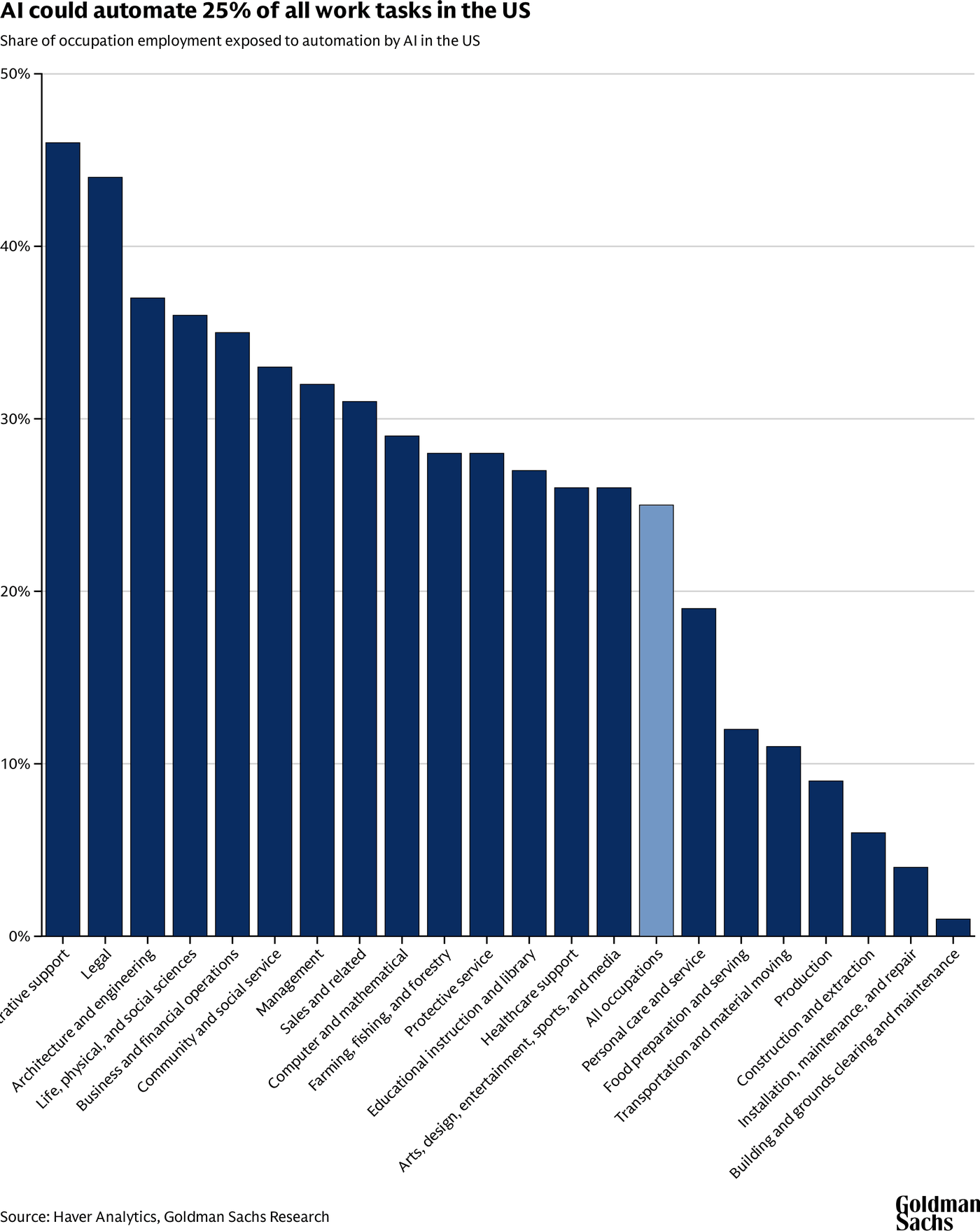
Goldman Sachs research estimates AI could automate ~25% of US work tasks, with admin and legal leading. Source: goldmansachs.com
The 25% figure measures “tasks,” not entire “jobs.” A job consists of dozens of distinct tasks; AI first consumes the standardizable portions, leaving humans with what remains. In the short term, most employees will not be laid off overnight. Instead, roles will be incrementally hollowed out: junior hiring freezes, shrinking workloads, and eroding bargaining power. Roles most vulnerable to early hollowing out are highly repetitive, non-face-to-face positions—junior copywriters, data reporters, customer support agents, paralegals, and administrative clerks.
AI leaders are voicing similar outlooks. Anthropic CEO Dario Amodei predicted that AI could replace half of junior white-collar jobs within five years, while other tech executives suggest that most white-collar tasks could be fully automated in one to two years. Regardless of exact timelines, technological displacement is never uniform. The printing collapse accelerated within a five-year span because outsourcing, capital pressures, and margin demands converged; technology was merely one catalyst. If AI deployment coincides with a broader economic downturn, the pace could be faster than anyone expects.
Will Your Industry Be Next?
Although this discussion originated in a developer community, the underlying question applies to everyone working at a desk. The assessment metric is straightforward: How much of your work involves “processing information in front of a computer,” versus “interpersonal interaction and hands-on physical problem-solving”?
Current data indicates that roles closest to screens and standardized workflows face the highest exposure. In contrast, trades requiring physical presence, manual dexterity, and human trust—such as plumbers, electricians, nurses, and barbers—remain far more resilient. Clients want a living human standing before them; whether the technology exists is secondary.
The true value of the typesetter analogy is that it shifts the debate from “Will AI displace jobs?” to “How broad will the impact be, how fast will it hit, and is society prepared?” Right now, no one can give a definitive answer. Optimists point to historical precedent, while pessimists point to real-time trends. The inability of either side to convince the other suggests that this transformation is genuinely unprecedented—and no one knows the ultimate outcome.
One reality has already emerged: the collective anxiety of software engineers has spread like a contagion. The question developers are asking themselves today will likely be asked by every white-collar worker tomorrow—what is my job actually creating?
Reference Links:
- Noema: Why is everyone in tech so sad?
- HN Discussion (item?id=49209539)