Before heading out in the morning, a quick glance at a smartphone reveals an air quality index cleanly displayed at the top of the screen. Whether measuring fine particulate matter or ground-level ozone, sensor networks translate invisible atmospheric burdens into simple single-digit readings. Modern society has grown accustomed to trusting instruments to safeguard every breath. Yet over a century ago, when factory smokestacks billowed plumes of dark smoke day and night, no one truly knew what toxins drifted through the air.
Systematic air quality monitoring networks did not begin taking shape until the mid-twentieth century. In the era before sensors and regulatory standards, where did all those airborne heavy metals end up?
The answer has remained frozen beneath the Arctic ice. On November 3, 2026, a research team led by environmental scientist Joseph McConnell at the Desert Research Institute published a study in Nature Sustainability. By analyzing polar ice and snow, the researchers extracted an unusually granular, century-old archive of industrial atmospheric contamination.
Drilling Through Millennia of Snow: Unlocking a Frozen Atmospheric Diary
McConnell and his colleagues examined 10 ice cores drilled from glaciers across the Canadian Arctic, Greenland, and the Russian Arctic. These cylindrical pillars of compacted ice act much like tree rings, trapping airborne dust, particulate emissions, and chemical residues inside annual layers of compressed snowfall. The deepest sections of the analyzed cores preserve particulates dating back as far as 210 BCE.
Each time snow blankets a glacial ice sheet, microscopic airborne particles settle with the flakes. As successive annual layers compact under immense pressure into solid ice, atmospheric chemistry from each individual year is preserved in chronological sequence. For climatologists and geochemists, an ice core functions as a cryogenic atmospheric flight recorder.
The team concentrated its geochemical analysis on arsenic—a highly toxic metalloid whose chemical oxides form the classic poison known historically as white arsenic. In natural settings, airborne arsenic originates primarily from volcanic eruptions and localized windblown mineral dust. Prior to the explosive rise of industrial-scale copper metallurgy, background arsenic concentrations in polar ice remained vanishingly small.
Between 1870 and 1914, however, arsenic levels recorded in Arctic ice spiked dramatically. The steepest increase occurred in Greenland, where arsenic concentrations surged to 15 times preindustrial levels.
Tracing the Plume Upwind: Greenland Ice Core Shows a Fifteen-Fold Arsenic Surge
Pinpointing the origins of this contamination required meteorological forensic analysis spanning across more than a century. During the late 19th century, heavy industry surged across both Western Europe and North America, with factory chimneys proliferating on both sides of the Atlantic.
At high northern latitudes, prevailing westerly winds blow continuously from west to east. Jet streams and weather systems sweep eastward across North America and the North Atlantic, traveling over Europe and into Asia. If Europe had been the primary culprit behind the Arctic contamination, ice cores retrieved from the Russian Arctic downwind should have captured the highest concentrations of fallout.
The chemical evidence told the exact opposite story. Greenland ice cores registered the steepest arsenic anomaly by a wide margin, showing heavier pollution than Arctic sites situated far closer to European industrial centers. As McConnell noted, the only mechanism consistent with this deposition pattern was an enormous emission source located in North America.
Working backward along the prevailing westerlies across the Atlantic and the Great Plains, the researchers traced the trajectory directly to western Montana.
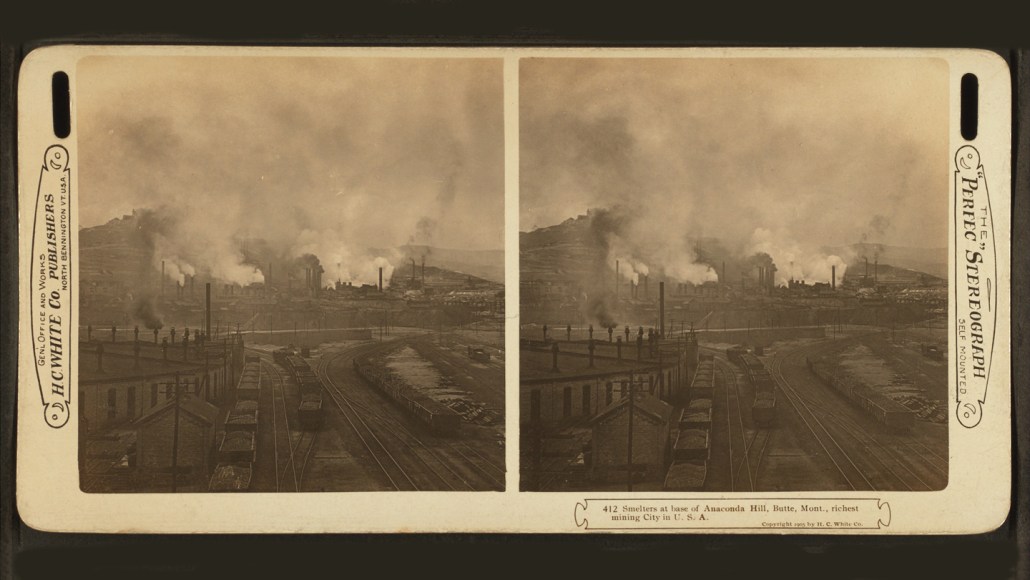 Figure: Panoramic view of the Anaconda smelter complex in Montana. Source: Science News
A Single Smelter Emitting 30 Tons of Arsenic Daily: Four Times Modern Chile Combined
The investigative trail pointed squarely at the Anaconda Copper Mining Company. The late nineteenth century saw rapid global electrification, driving an unprecedented surge in demand for copper wiring and electrical machinery. Anaconda expanded aggressively in Butte and Anaconda, Montana, constructing one of the largest metallurgical smelting operations in the world.
The local copper ore, however, was heavily contaminated with exceptionally high concentrations of arsenic-bearing minerals. As colossal reverberatory and blast furnaces smelted the ore at white-hot temperatures, the volatile arsenic vaporized, shooting straight out of massive smelter stacks into the troposphere.
At peak production, McConnell’s team calculated that the Anaconda smelter complex discharged approximately 30 tons of arsenic into the atmosphere every single day. Discharging 30 metric tons of pure poison daily is a scale difficult to fathom in modern terms. Chile is today the world’s largest copper producer; yet all 20 of Chile’s modern smelting operations combined release barely one-fourth of the arsenic volume that Anaconda alone poured into the sky each day.
Lofted upward by immense thermal plumes, fine toxic dust hitched a ride on high-altitude westerlies. The prevailing winds ferried the airborne particles thousands of kilometers eastward across North America and out over the Atlantic, until they ultimately precipitated with falling snow across the Greenland ice sheet.
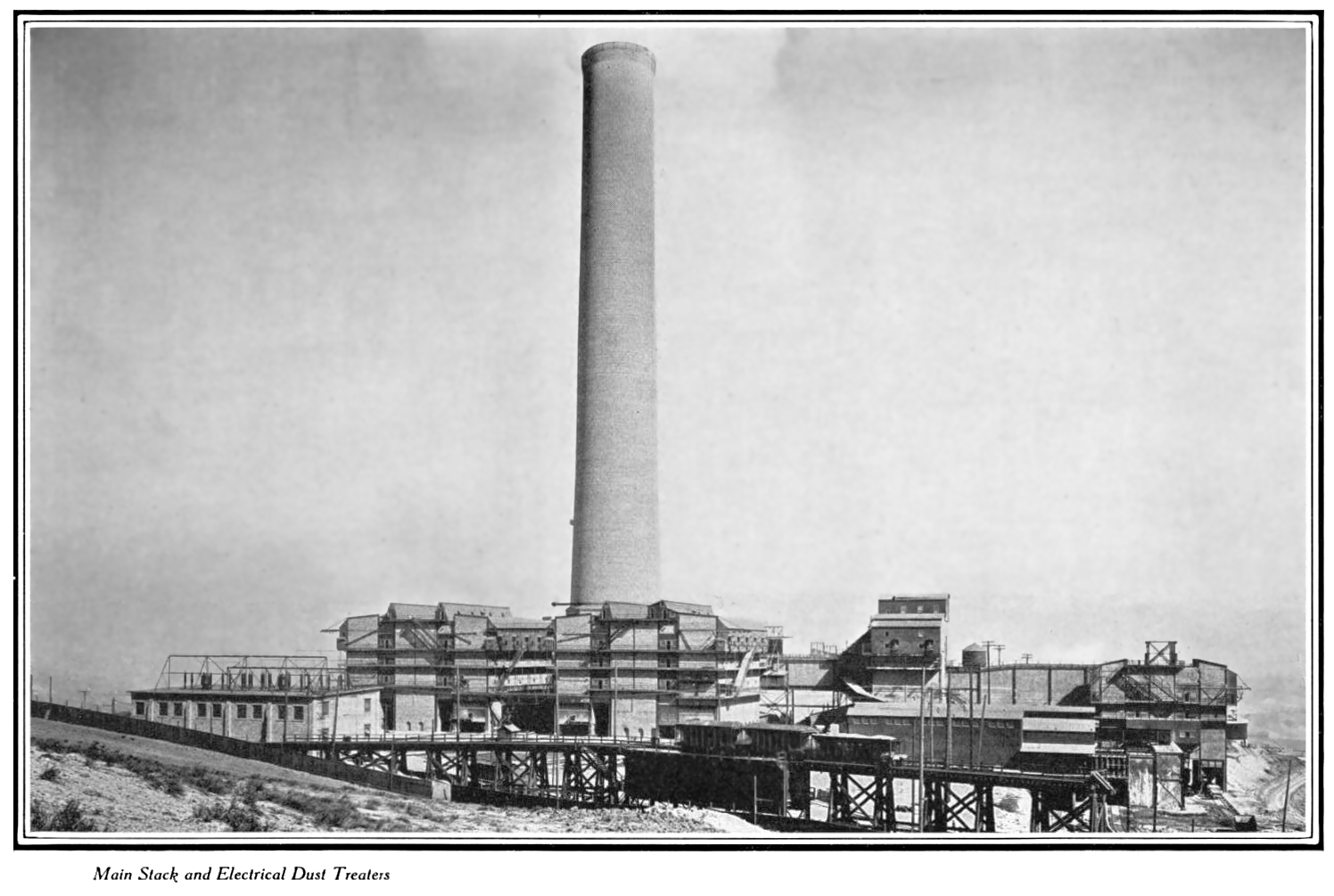 Figure: Historic photograph of the Anaconda smelter stack, 1920. Source: Wikimedia Commons (Public Domain)
Flue-Gas Cleaning Arrives a Decade Late: The Ice Records the Turning Point
While lighter particulate fractions traveled thousands of miles into the Arctic, the heaviest industrial fallout blanketed the immediate valleys surrounding the smelter. Environmental historian Fred Quivik detailed the devastation in his study Smoke and Tailings. Nearby ranchers and farmers watched livestock collapse across pastures in staggering numbers, killed by acute arsenic poisoning after grazing on contaminated forage.
Smelter workers and tens of thousands of neighboring residents breathed caustic metallic fumes year after year. Modern toxicology has thoroughly documented the devastating consequences of chronic heavy metal exposure, which triggers elevated cancer rates, severe cardiovascular damage, and irreversible neurological deficits in developing children.
Facing mounting protests and legal threats from ranchers, Anaconda finally installed electrostatic precipitator dust-collection systems around 1919. The Arctic ice cores faithfully recorded this environmental turning point: immediately following 1919, arsenic deposition in Greenland ice plummeted by roughly 60 percent.
The abatement technology proved remarkably effective, yet it arrived more than a decade after the pollution had peaked. Tens of thousands of residents had already endured decades of toxic exposure. Today, the smelter has long since ceased operations, and the surrounding basin remains designated as one of the largest federal Superfund sites in the United States.
Researchers now plan to cross-reference ice core records with historical census and health registries. Epidemiologists will investigate the lasting multigenerational health impacts inflicted on communities living downwind during the smelter’s heyday.
Thawing Permafrost: Frozen Toxic Legacies Fuel a Modern Environmental Crisis
The toxic heavy metals locked in northern cryospheres are far from ancient history. Arctic ice sheets and permafrost—ground that remains frozen continuously for two or more years, acting as a planetary cold-storage vault—have sequestered massive volumes of heavy metals over millennia.
Beyond industrially emitted arsenic, northern permafrost soils hold immense reserves of naturally accumulated toxic mercury. As global warming accelerates bank erosion along major waterways like Alaska’s Yukon River, collapsing permafrost washes heavy metal loads directly into aquatic ecosystems. The resulting bioaccumulation in fish and wildlife poses severe long-term risks to roughly five million residents across the Arctic circle.
For more than three million of those inhabitants, the underlying permafrost is projected to thaw completely by 2050. The toxins buried beneath snow and frozen earth never disappeared; climate change is actively mobilizing them back into the biosphere.
The Arctic ice core record proves that industrial pollution became a truly planetary phenomenon decades before humanity ever learned to measure it. Emissions from a late-19th-century copper smelter in Montana traversed half the globe to imprint themselves on Greenland’s glacial ice—marking the first time scientists have reconstructed this century-old pollution narrative directly from nature’s cryogenic archives. It serves as an unvarnished physical reminder: as long as smokestacks burn, no corner of the planet remains truly isolated.
References:
- Science News coverage
- Nature Sustainability paper