Snap a photo with your smartphone on a dimly lit street late at night, and the viewfinder often shows a noisy mess. Night-mode algorithms quietly kick in, inferring missing details and occasionally tracing out edges that were never there. Staring at the polished scene on the screen, a nagging question crosses many minds: is this outline the genuine nightscape, or just a synthetic brushstroke added by software?
For the past four years, that everyday uncertainty cast a long shadow over one of the defining astronomical achievements of our era. On April 10, 2019, a glowing reddish-orange ring swept across global headlines and social feeds. It was the first-ever image of a black hole, pieced together after years of international collaboration. To the public, that luminous “doughnut” became an enduring symbol of humanity peering across the cosmic abyss.
Within the scientific community, however, the ring’s authenticity was never treated as settled law. Several prominent astrophysicists voiced skepticism, warning that the ring might be an artifact spawned by computers filling in sparse, incomplete radio signals. That four-year dispute finally reached a definitive resolution on November 11, 2026, when an Australian research team published their findings in Nature.
Stitching an Earth-Sized Telescope: How the First Black Hole Image Sparked Four Years of Debate
To understand the controversy, one must understand how the original picture was taken. Conventional cameras focus light onto a sensor with glass lenses. A black hole cannot be captured that way. The supermassive black hole at the center of the galaxy Messier 87 (M87*) sits roughly 55 million light-years from Earth. The light arriving here began its journey over 50 million years ago, long before human civilization existed.
The object packs the mass of roughly 6.5 billion suns into a region roughly the size of our Solar System, creating a gravitational abyss of extraordinary intensity. Yet despite its staggering bulk, its immense distance makes resolving it from Earth akin to spotting a doughnut resting on the surface of the Moon with the naked eye.
No single dish on Earth could provide such resolving power. Instead, astronomers linked eight radio observatories scattered across the globe into the Event Horizon Telescope (EHT)—a virtual instrument spanning the diameter of our entire planet. Using Very Long Baseline Interferometry (VLBI), which synchronizes signals from distant stations with atomic clocks, researchers turned Earth itself into a colossal computational lens.
Japanese Astrophysicists Challenge Assumptions: When the Ring Collapsed into a Featureless Blob
Yet this Earth-sized synthetic telescope still has wide gaps. Eight sparse stations leave vast blind spots across the virtual mirror. Reconstructing the black hole image is like assembling a massive jigsaw puzzle with only a tiny fraction of the pieces in hand. To fill the yawning gaps, scientists had to rely on mathematical models, imaging algorithms, and physical priors.
The debate centered precisely on those puzzle-filling assumptions. In computational imaging, algorithmic artifacts are well known: when incomplete data is reconstructed, algorithms can invent spurious patterns based purely on their own mathematical priors. If an algorithm implicitly assumes astronomical sources are symmetric, the reconstruction routine will naturally favor circular shapes. The very mathematical priors designed to aid imaging risked conjuring the very doughnut everyone anticipated.
In 2022, astrophysicist Junichiro Makino and his colleagues at Kobe University challenged the finding. Re-analyzing the publicly released EHT raw data, they adjusted a few prior assumptions—such as the expected smoothness of the brightness distribution. The result surprised researchers: the radiant doughnut disappeared, replaced by an unstructured, centrally peaked glow without a central shadow. The paper ignited intense debate, fanning fears that the iconic image might have been an algorithmic hallucination.
Triangles Across the Globe: Closure Invariants Strip Away Atmospheric Turbulence
Rather than simply defending past conclusions or endorsing the contrarian critique, a four-member team at Australia’s Commonwealth Scientific and Industrial Research Organisation (CSIRO) stepped in to rebuild the analysis from the ground up. Led by Samuel Lai, with Nithyanandan Thyagarajan, Ivy Wong, and Foivos Diakogiannis, the researchers sought an unshakeable mathematical footing directly within the raw measurements.
Conventional radio interferometry pairs telescopes in baselines. Two stations measure the arrival time difference of a cosmic radio wave to deduce its phase. But Earth’s atmosphere is a churning medium of water vapor and temperature shifts that violently distorts faint cosmic waves. Minor mechanical jitter within the telescope hardware introduces additional, stubborn errors.
The Australian team bypassed conventional pair baselines altogether. They turned instead to closure invariants—mathematical combinations that connect three or more telescopes into closed loops. Much like noise-canceling headphones, closure phases and closure amplitudes automatically cancel out atmospheric phase errors and station-specific instrumental gains. By relying on closed loops, the researchers stripped away complex telescope calibration assumptions, isolating pristine interferometric information untouched by atmospheric distortion.
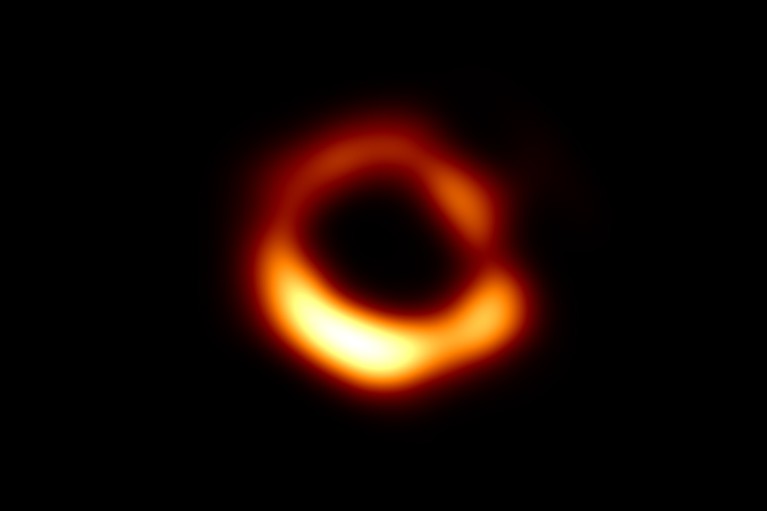 Figure: The M87 black hole reconstructed by the Australian CSIRO team using a new algorithm, clearly showing the persistent glowing ring. Source: Lai et al. / CSIRO (via Nature).
Trained on Cats, Dogs, and Trucks: AI Recreates the Ring Without Ever Seeing Space
Isolating clean closure invariants was only the first step; turning them back into an image posed the next hurdle. To eliminate subjective bias, the team developed an independent machine-learning imaging framework named GenDIReCT, engineered to reconstruct sparse signals by learning generic structural rules from images.
To ensure the model could not “cheat,” the researchers imposed a strict data firewall during training. The neural network was fed exclusively everyday terrestrial imagery: domestic cats, dogs, delivery trucks, city streetscapes, and buildings. It was never shown a single astronomical image. It had no prior knowledge of what a black hole ought to look like. Its sole capability was connecting discrete, sparse data points into coherent scenes based on objective statistical likelihoods.
To guarantee complete impartiality, the team froze the entire pipeline once training concluded, barring any further manual tuning. On December 4, 2025, they fed the actual 2019 observational data into the model for the first time. The result was unmistakable: a sharply defined ring emerged at the center of the frame. Both the ring’s angular diameter and its azimuthal brightness asymmetry closely matched the original 2019 findings.
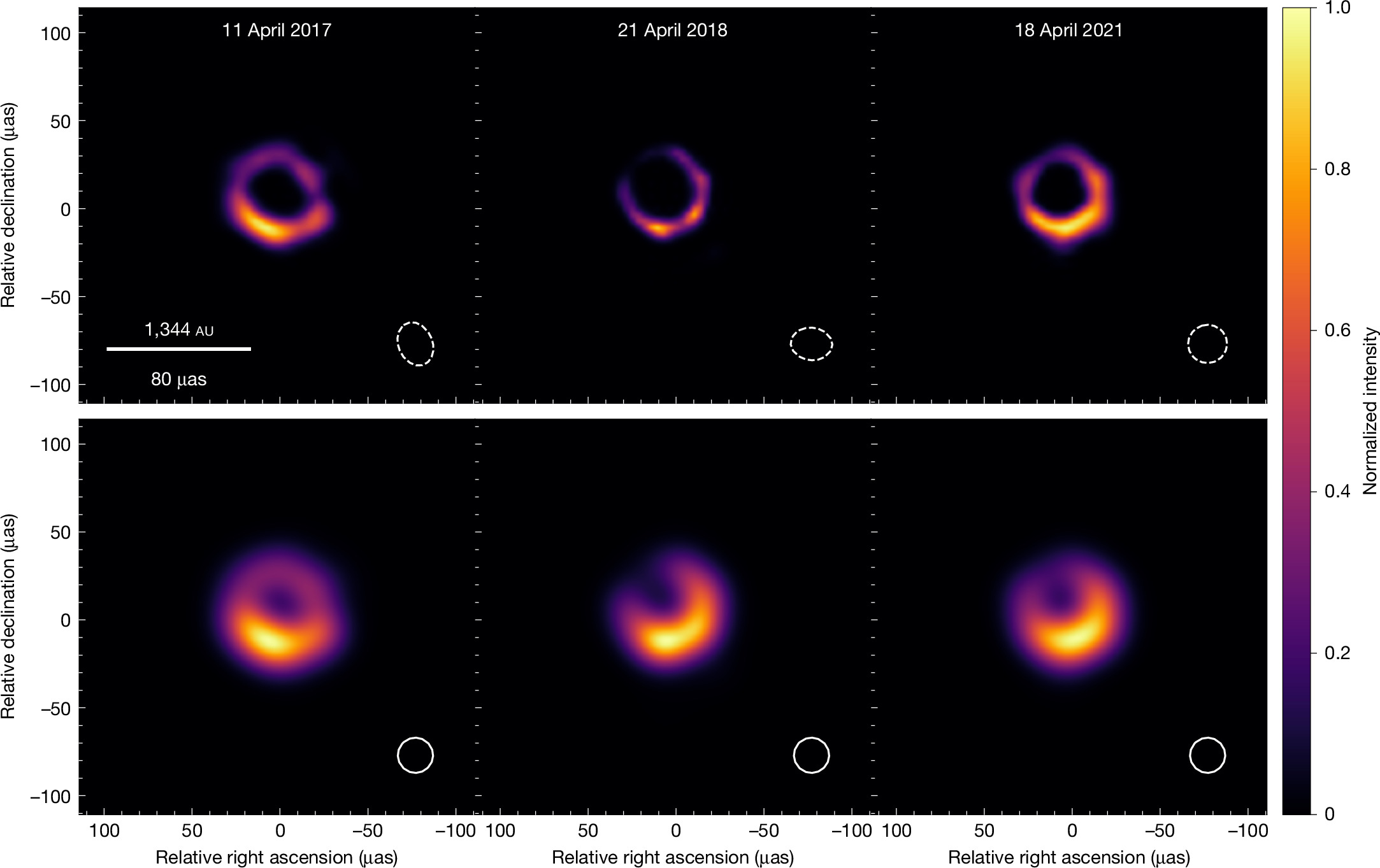 Figure: Observational data partitioned into independent closed loops, comparing reconstructions across multiple independent imaging methods. Source: Lai et al., Nature 2026.
Independent Verdict Clears Artifact Suspicions: Sparse-Signal Imaging Beyond Astronomy
The rigorous examination by an independent four-person team delivered the most credible verdict yet in the four-year controversy. Before unveiling the image in 2019, the EHT collaboration had tasked four internal teams with independent reconstructions; subtle differences among their results reflected slight algorithmic bias. Now, an external team using an algorithm free of astronomical priors has confirmed that the radiant ring is a real physical structure.
The implications reach well beyond astrophysics. Reconstructing complex imagery from sparse, distributed sensors is a core challenge across modern science and engineering. Medical MRI scans must map internal lesions from faint radio frequency signals, while geophysical exploration relies on seismic sensors scattered across terrain to delineate subterranean faults. Combining closure invariants with bias-free machine learning points the way toward robust reconstruction in any regime where data is severely undersampled.
That majestic ring, glowing across 55 million light-years, is indeed the physical portrait of the universe peering back. When a neural network schooled only on cats and trucks reproduces that exact ring from raw radio waves, the first black hole image is finally cleared of algorithmic suspicion. This independent audit not only reaffirms the rigorous foundation of modern science, but gives humanity renewed confidence as we gaze into the cosmic abyss.
References:
- Nature News: Iconic first image of black hole holds up to scrutiny
- Nature Paper: Independent interferometric observable confirms black hole shadow in M87*
- The Conversation: Is this iconic black hole image accurate? New study delivers an independent result