A Thousand-Mile White Ribbon at 45 Kilometers: Not a Single Dust Grain in Sight
Boil water in your kitchen on a winter morning, and steam billows upward; step out of a hot shower, and a layer of mist blankets the bathroom mirror. These airborne plumes never materialize out of nothing. Every tiny droplet demands a microscopic foothold—a fleck of floating dust or a grain of salt. If you boiled water in completely sterile, hyper-filtered air stripped of all particulates, the vapor would dissipate invisibly, leaving not even a wisp of white steam behind.
Yet hundreds of millions of kilometers away on Mars, nature puts on an exhibition that shatters ordinary intuition. The European Space Agency’s Mars Express orbiter has cataloged an enigmatic spectacle. Every year, around the southern hemisphere’s spring and summer solstice, a colossal white ribbon emerges punctually over the 9°S volcano Arsia Mons. Scientists call it the Arsia Mons Elongated Cloud (AMEC).
It stretches across an astonishing 1,800 kilometers—roughly the flight distance from Beijing to Guangzhou, or four Grand Canyons laid end to end. This colossal cloud hovers more than 45 kilometers above the Martian terrain, over three times higher than typical commercial flight altitudes. Up here, Mars’ atmosphere is so thin it borders on a vacuum, completely lacking the cloud-making conditions familiar to Earth.
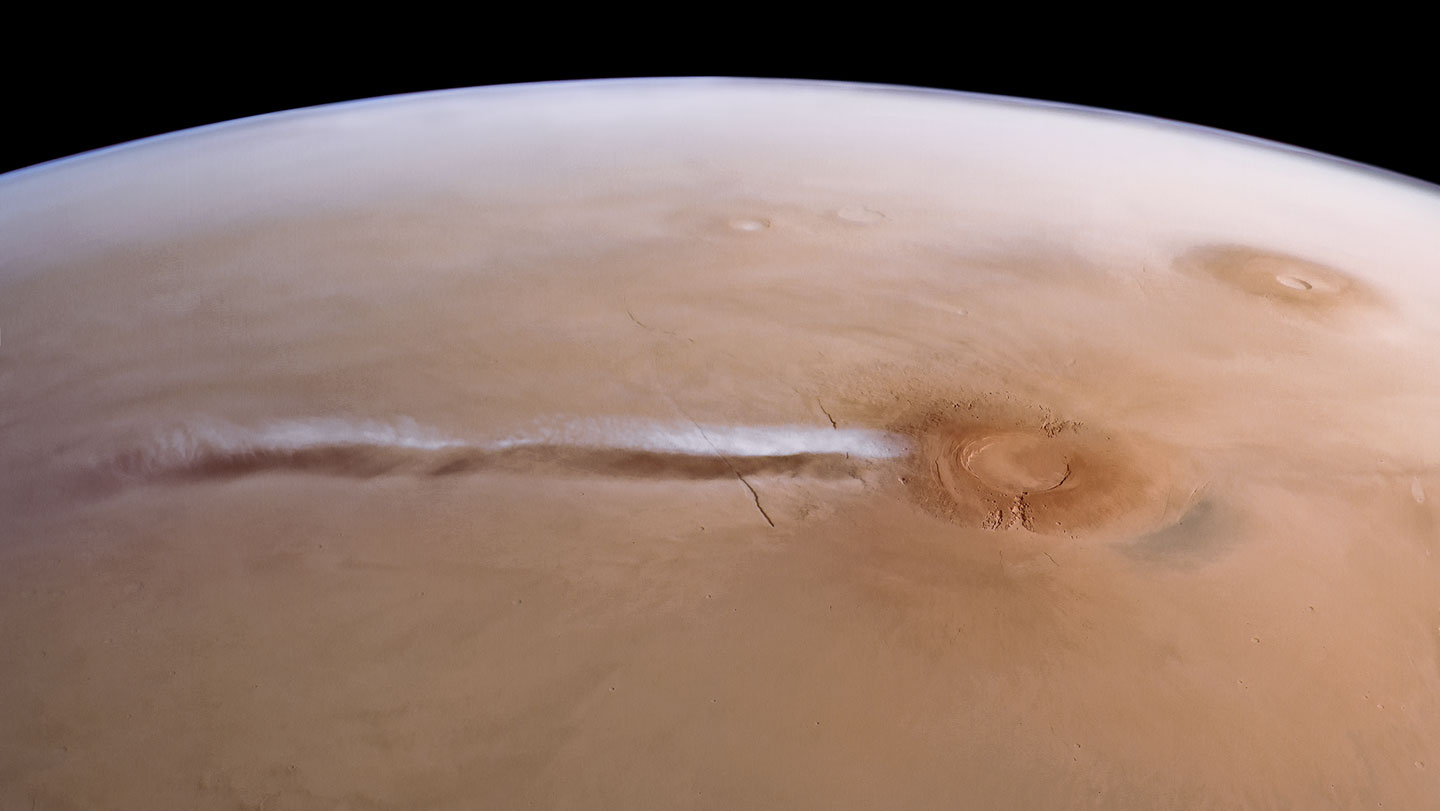 Figure: The Arsia Mons Elongated Cloud observed by the Mars Express orbiter. Source: Science News (ESA / GCP / UPV / EHU collaboration).
The behemoth rises on the volcanic slopes each morning, barreling westward on ferocious winds to unfold thousands of kilometers in a matter of hours. As afternoon temperatures climb, it vanishes just as rapidly, only to repeat the cycle at dawn. Sand and mineral dust have long since settled out of the atmosphere at 45 kilometers. Without dust grains to serve as scaffolding, how on Mars does an 1,800-kilometer cloud ever assemble?
Kitchen Steam Needs Floating Dust as a Crutch; So Does Ordinary Rain
To untangle this mystery, one must first look at how clouds form on Earth. Middle-school textbooks teach that water vapor condenses into droplets as it cools. At the molecular scale, however, water molecules face an immense barrier to bunching together on their own. When two solitary water molecules collide in mid-air, they bounce off each other like billiard balls, completely unable to lock into solid ice.
Earth’s atmosphere solves this dilemma by seeking outside help. Airborne dust, sea spray, and soot act as natural condensation nuclei (microscopic particles on which water vapor condenses to form cloud droplets or ice crystals). Water molecules cling to these solid surfaces much like a rock climber securing a foothold on a rocky ledge. In physics, this process of relying on foreign dust to build clouds is known as heterogeneous nucleation (the standard physical process where vapor condenses onto pre-existing foreign surfaces).
Every cubic centimeter of the air we breathe contains tens of thousands of microscopic particles. Water vapor has no trouble finding a surface to cling to. Earth’s cumulus clouds and stratus decks are, in essence, legions of ice crystals and water droplets encasing tiny specks of dust. For decades, planetary scientists imported this exact formula straight to Mars.
While dust storms frequently engulf the Red Planet, that dust remains concentrated in the lower atmosphere. At 45 kilometers altitude, atmospheric pressure drops to a tiny fraction of surface levels, and floating dust has virtually all settled out. Samuel Atwood, a researcher at NASA’s Goddard Space Flight Center, notes that the density of available condensation nuclei above Arsia Mons is practically zero. When applied to this high-altitude Martian cloud, conventional meteorological formulas crumble at their foundational premise.
Fierce Winds Drive Moist Air up a 20-Kilometer Volcano, Spiking Supersaturation to 100,000x
Deprived of foreign impurities, water molecules must fend for themselves. The crucial clue to the riddle lies in the immense topography of Arsia Mons itself. Standing nearly 20 kilometers tall—two and a half times the height of Mount Everest—this ancient shield volcano forms a massive wall against Martian winds. Around the southern spring and summer, strong prevailing winds slam into the volcano’s windward flanks.
Moist air surges up the 20-kilometer mountain slope in a phenomenon meteorologists term orographic lifting. As the air mass rises rapidly, it expands and cools drastically. Near the peak, temperatures plunge dozens of degrees Celsius within minutes, causing the atmosphere’s capacity to hold water vapor to drop off a cliff.
This triggers an astronomical surge in supersaturation (a state where the concentration of water vapor vastly exceeds the theoretical equilibrium limit at a given temperature). On Earth, as soon as relative humidity nudges past 101%, excess moisture immediately latches onto ambient dust, condensing into cloud droplets. But atop Arsia Mons, with no dust specks to grab onto, water vapor is trapped in limbo, driving supersaturation up to an astounding 100,000-fold.
A supersaturation factor of 100,000 represents an extraordinary physical boundary. In the bitter Martian chill, water molecules become so densely crammed together that head-on collisions skyrocket. When thermodynamic forces finally overpower molecular repulsion, water molecules no longer require dust: they lock directly into solid ice crystals through their own hydrogen bonds.
Standard Climate Models Failed; a Neglected Textbook Equation Cracked the Code
This spontaneous aggregation of water molecules into ice without any foreign particulate scaffolding is known as homogeneous nucleation (the pure crystallization process where molecules spontaneously assemble into ice embryos under extreme supersaturation). For over a century, textbook chapters relegated it to a theoretical curiosity. Natural environments rarely generate such extreme supersaturation, leading scientists to assume it could only ever happen in specialized laboratory nozzles.
To resolve the Martian paradox, researchers Jorge Hernández-Bernal and François Forget at the Laboratoire de Météorologie Dynamique in Paris conducted comprehensive simulations using a global Mars climate model. The team fed years of wind fields, temperatures, and solar radiation profiles gathered by Mars Express directly into their numerical models.
Initially, the researchers deployed standard heterogeneous nucleation algorithms. But no matter how they tweaked wind speeds and variables, as long as the code relied on dust nuclei, the simulated cloud broke apart halfway through. The computations could never reproduce a continuous 1,800-kilometer cloud plume, leaving a gaping discrepancy between the model and orbital photographs.
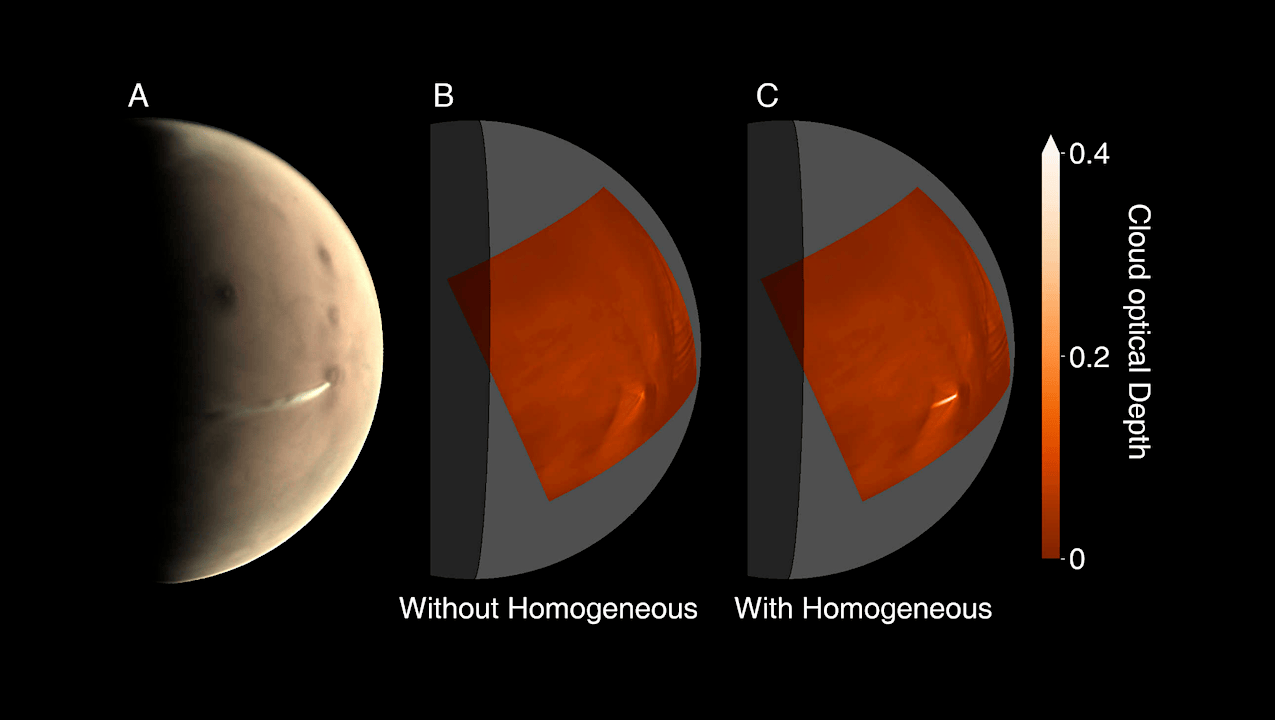 Figure: Comparison between Mars Express observations (A), traditional heterogeneous nucleation models (B), and the new model incorporating homogeneous nucleation (C). Source: Hernández-Bernal et al., Nature Geoscience 2026.
The team made a decisive leap: they implemented homogeneous nucleation equations into the atmospheric code. Once that physical switch was flipped, everything changed. A crisp white plume unfurled along the volcanic ridge on the screen, matching the altitude, trajectory, and diurnal cycle captured by satellite cameras with stunning fidelity. On October 7, 2026, their findings were officially published in Nature Geoscience.
Earth’s Eerie Noctilucent Clouds Await a Meteorological Recalculation
This discovery on Mars also carries profound implications for atmospheric science back home. In Earth’s mesosphere, roughly 80 kilometers above the surface, ethereal blue noctilucent clouds (tenuous ice clouds shimmering in high-latitude twilight) appear during polar summers.
Atmospheric scientists have long assumed noctilucent clouds rely exclusively on meteoric smoke particles to seed their ice crystals. While homogeneous nucleation had occasionally been hypothesized, Earth lacks a clean, dust-free natural laboratory to verify it. The mechanics of the Arsia Mons cloud offer high-altitude atmospheric physicists an invaluable cosmic mirror.
Science must always reckon with nuances. The French team acknowledges subtle discrepancies between simulations and orbital observations, hinting at additional dynamic perturbations in Mars’ atmospheric circulation. Atwood also cautions that matching simulations is only the first milestone; definitive proof will require future orbiters to carry spectrometers capable of measuring ice crystal microphysics in situ.
The Arsia Mons Elongated Cloud shatters long-held meteorological dogma. It demonstrates that under extreme atmospheric conditions, water vapor can span thousands of kilometers of sky without a single dust grain to guide it. Where fierce winds collide with towering volcanic peaks to forge 100,000-fold supersaturation, a pure crystallization process dormant in textbooks for a century has etched a brilliant white ribbon across the Martian heavens.
Reference Links:
- Mars’ mysterious mountain cloud may form without dust specks — Science News
- Formation of the Arsia Mons Elongated Cloud on Mars through homogeneous ice nucleation — Nature Geoscience (DOI: 10.1038/s41561-026-02089-9)
- Homogeneous ice nucleation in the Martian atmosphere — arXiv (arXiv:2609.37259)