On October 30, 2026, European AI lab Mistral officially open-sourced the weights of its flagship model, Mistral Large 4, codenamed “Le Chonk.” Boasting 1.05 trillion total parameters and built on a sparse Mixture-of-Experts (MoE) architecture, the model was pre-trained from scratch on European soil. Natively supporting multimodal understanding across images, documents, and code, it instantly enters the top tier of open-weight models.
On Artificial Analysis’s Coding Agent Index, Le Chonk scored 48%, virtually matching open-source contemporary GLM-5.3. More strikingly, the engineering telemetry revealed a counterintuitive result: when completing equivalent software engineering tasks, Le Chonk burned an average of 47% fewer output tokens. Mistral describes this efficiency band as the inference “sweet spot.”
The frontier of LLM evolution is shifting from benchmark scoreboards to real-world engineering inference overhead. When candidate models achieve comparable pass rates, interactive throughput and VRAM footprint dictate whether an agent can actually be deployed to production. This release provides compelling evidence that the open-source ecosystem can compete head-on in compute cost economics.
Frontier Parity on Benchmarks, 47% Fewer Tokens Burned per Task
As autonomous agents embed deeper into production pipelines, long contexts and multi-turn iterative reasoning have emerged as the primary cost drivers. On the Coding Agent Index, Le Chonk’s 48% score matches GLM-5.3. However, the operational difference lies in token economics: consuming 47% fewer tokens cuts inference expenditure for long-horizon tasks nearly in half.
According to Mistral, on Cognition’s FrontierCode 2.0 benchmark—which uses actual pull request merges by repository maintainers as its evaluation criterion—Le Chonk posted a 19.7% merge rate, edging out GLM-5.3’s 19.3%. In comparison, Kimi K3 scored 17.8%, GLM-5.3 Flash registered 17.3%, Beam 1.0 landed at 14.2%, and DeepSeek V4.1 Flash trailed at 2.9%.
This marginal lead in merge rates reflects stronger engineering discipline and code coherence. Automated code submissions are frequently rejected by maintainers due to redundant comments or fragile test harnesses. Maintaining benchmark accuracy while slashing output volume by nearly half indicates that the model’s policy has effectively pruned unguided trial-and-error and over-engineering tendencies.
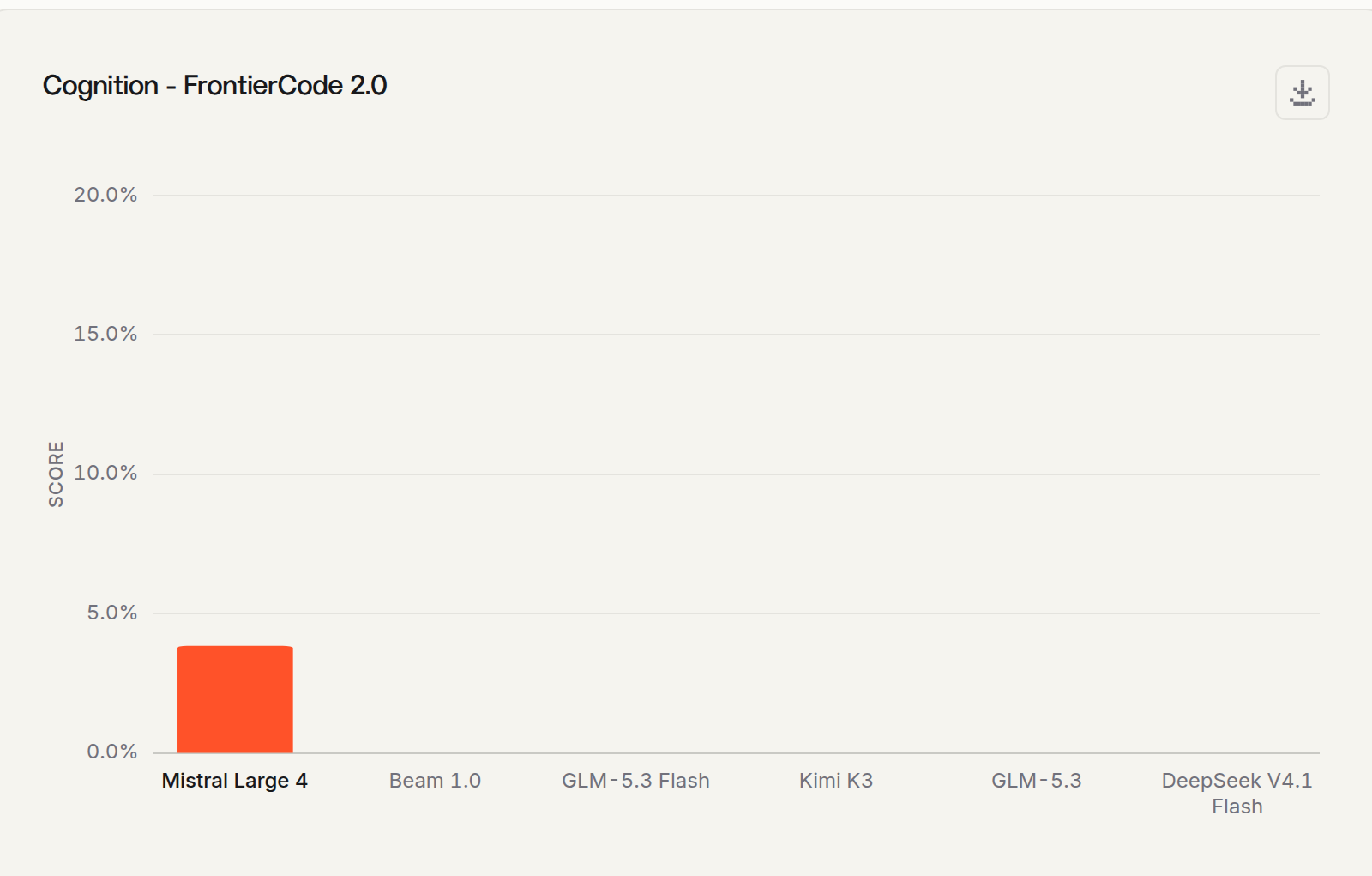 Figure: FrontierCode 2.0 benchmark comparison, evaluated by whether repository maintainers merged code changes. Note the score dispersion across models under strict engineering standards. Source: Mistral official blog.
Three Weeks of Post-Training RL Tightens Terminal Trajectories
The dramatic reduction in output length stems from targeted post-training optimization. On top of its pre-trained base, Mistral applied an extra three weeks of reinforcement learning (RL) explicitly engineered to compress agent action trajectories. On the interactive command-line evaluation Terminal-Bench 4.0, Le Chonk hit a 41% pass rate—a notable 13-percentage-point jump over its preview predecessor.
Crucially, as pass rates climbed, reasoning bloat contracted. The model generated 30% fewer output tokens across terminal tasks. Mistral stated in its announcement that RL gains continue to accelerate without signs of saturation. Reward models tailored specifically for interactive environments have effectively excised superfluous conversational padding.
To cater to varying compute budgets, Le Chonk introduces three distinct reasoning tiers: Low, Medium, and High. High is enabled by default for deep, long-horizon deliberation, while Low completely replaces the unreasoned baseline. This tiered approach turns reasoning depth into a tunable operational dial. Lightweight troubleshooting workflows no longer incur the latency and memory overhead of dense chain-of-thought traces, preserving critical VRAM under high concurrency.
96% Malicious Request Refusal: Hardening for Enterprise Deployment
A model’s defensive perimeter often sets the threshold for enterprise on-premise adoption. Pitched under the banner “Built for Coders, Trusted by Defenders,” Le Chonk achieved an average refusal rate of 96.6% on adversarial cyber prompts. Mistral notes that this puts the model at the forefront of open weights, while underscoring that legitimate security and defense workflows remain unhindered.
On Artificial Analysis’s Cyber Index benchmark, Le Chonk registered 51%, compared to DeepSeek-V4.1-Flash at 57% and MiMo-V2.6-Pro at 56%. Meanwhile, in Surge Code double-blind human preference evaluations, its performance ranked second only to Claude Opus 5.5, outscoring all other contemporary open-source rivals in blind developer testing.
The divergence between raw refusal rates and domain-specific safety scores illustrates the classic trade-off in safety alignment. A 96.6% intervention rate reliably blocks the generation of automated offensive exploit scripts, meeting corporate compliance standards. However, during deep vulnerability reverse-engineering and adversarial testing, strict guardrails can narrow the deductive workspace. Practical deployment tuning inevitably navigates this tension between mitigating exploit generation and preserving analytical depth.
Private Deployment for a 1T Architecture: Europe’s Sovereign Compute Counts the Costs
With 1.05 trillion total parameters, Le Chonk relies on a sparse Mixture-of-Experts architecture. Activating only a subset of parameters during each forward pass makes running a trillion-parameter architecture technically viable on specialized hardware clusters. Mistral emphasizes that the model was pre-trained from scratch within Europe, positioning this release as a flagship milestone for European technological autonomy in generative AI.
Model weights are available immediately on Hugging Face, with first-class support for self-hosting via inference runtimes like vLLM and SGLang. Model cards and licensing terms have been released alongside the weights, with a comprehensive technical report slated for upcoming publication. Local deployments ensure that sensitive enterprise workflows avoid leaking proprietary source code to third-party cloud endpoints.
Mistral’s announced partner roster spans global technology leaders including NVIDIA, Cisco, Cloudflare, and CrowdStrike. European enterprise adopters feature ASML, Orange Cyberdefense, Crédit Agricole, and the European Space Agency (ESA). The participation of industrial manufacturing and defense institutions highlights a growing imperative among strictly regulated organizations for sovereign control over their AI infrastructure.
Yet the vision of sovereign autonomy must ultimately withstand the physical economics of modern data centers. Even with sparse activation, a 1.05T model represents hundreds of gigabytes of raw weights, making VRAM allocation and storage I/O unavoidable overhead. Sustaining on-premise clusters with ultra-high-throughput interconnects and significant power draw imposes severe demands on physical infrastructure. Enterprises must carefully weigh hardware capital expenditures against long-term operational costs.
 Figure: Official partner and customer roster published by Mistral, spanning chip manufacturing, cybersecurity, and European aerospace. Source: Mistral official blog.
Beyond the Benchmark Plateau: Inference Economics Dictate Open Source Viability
The competitive dynamics of open-source AI are entering a pivotal inflection point. Early phases were dominated by scaling compute datasets and chasing peak benchmark leaderboards. But when leading models converge on comparable task pass rates, operational compute budgets take center stage. The number of tokens consumed per unit of functional output directly determines whether an enterprise deployment remains financially viable over the long haul.
Le Chonk charts a pragmatic blueprint: achieving equivalent code delivery quality while burning nearly half the tokens yields substantial hardware cost reductions. Enterprises demand architectural sovereignty, but their balance sheets demand compute sustainability. By delivering frontier capabilities alongside superior token efficiency, open-weight architectures are finally securing their passport into production engineering.
 Figure: The official mascot “Le Chonk” chosen by Mistral for this flagship model. Source: mistral.ai.
参考链接:
- Mistral 官方博客:Mistral Large 4 开源权重发布说明
- Mistral 官方博客:Mistral Large 4 模型架构与基准评测
- Hugging Face 官方权重仓库:Mistral-Large-4-1T-A52B