Cambridge Simulates the Collisions: Cosmic Delivery Burns on Entry
When cooking, if the oil gets too hot, chopped scallions thrown into the pan char to a crisp within seconds. Faced with intense heat, fragile organic structures cannot survive even an instant. Four billion years ago, in the orbital path of the early Earth, a vastly more violent thermal crucible was playing out daily.
For generations, many grew up reading a romantic tale. The newborn Earth was a sterile wasteland, and comets served as cosmic couriers—screaming through the atmosphere to deposit the seeds of life into primordial oceans. On October 28, 2026, a team from the Institute of Astronomy at the University of Cambridge published computer simulations in Scientific Reports. Led by corresponding author Richard Anslow, the researchers modeled the full collision process, using raw physics to cast cold water on this century-old hypothesis.
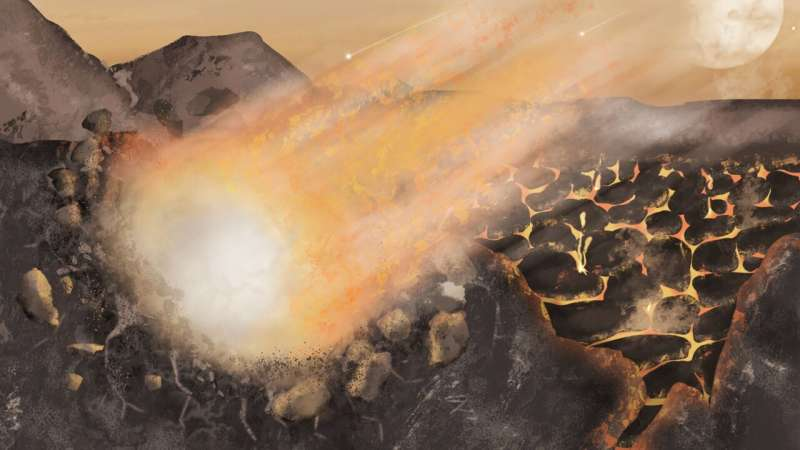 Figure: High-speed impact of a comet striking early Earth’s atmosphere and surface. Source: phys.org (Credit: Scarlett White).
In past research, comets were often treated as a convenient “get-out-of-jail-free card.” The scientific community seemed to assume that outsourcing chemical dilemmas to outer space made every hurdle vanish. Anslow’s team’s 3D hydrodynamic simulations revealed the opposite. Comets smash into Earth at speeds typically exceeding 11.2 kilometers per second—Earth’s escape velocity. Beyond that threshold, the kinetic energy released is more than enough to tear complex molecules apart. At that speed, traveling from Beijing to Shanghai would take barely two minutes.
Striking the atmosphere and surface at such velocities produces shock-wave temperatures easily reaching tens of thousands of degrees. Water ice on the comet’s surface flashes into steam instantly. Organic compounds packed inside vaporize and decompose within microseconds. Before this cosmic courier can even touch down, the delivery has been incinerated into nothingness.
Even the Toughest Molecules Cannot Survive 10,000-Degree Heat
To test whether organics could survive an impact, researchers focused on hydrogen cyanide (HCN). Composed of carbon, hydrogen, and nitrogen, its chemical bonds are exceptionally sturdy, leading researchers to treat it as the most impact-resilient life-building block. In biochemistry, it is a crucial prebiotic precursor—the fundamental raw material needed to assemble amino acids and genetic material.
Earlier deep-space exploration missions detected high concentrations of hydrogen cyanide across multiple comets, serving as the cornerstone for the exogenous delivery hypothesis. Hydrogen cyanide features a robust carbon-nitrogen triple bond, among the strongest microscopic skeletons in organic chemistry. If even HCN cannot endure the trauma, more delicate sugars and amino acids stand zero chance of survival. The 3D molecular simulations yielded an unambiguous verdict: under impact compression, hydrogen cyanide inside the comet is almost completely broken down.
Shock waves tear through the comet’s icy core at supersonic speeds, instantly converting immense mechanical pressure into thermal energy. Simulation logs show chemical bonds snapping cleanly in the 10,000-degree inferno. They scatter into drab inorganic gases like nitrogen and carbon monoxide. Before life’s basic parts have any chance to assemble, they degrade back into free atoms inside the fireball.
An Improbable Trifecta: A One-in-a-Billion-Year Fluke
The Cambridge team ran extensive simulations across parameter spaces, searching for theoretical exceptions where molecules might endure. Calculations showed that only when a comet simultaneously satisfies three rare, hyper-strict boundary conditions could minuscule amounts of hydrogen cyanide be preserved. If any single condition fails, the impact turns into wholesale molecular destruction.
First, the comet must exceed 100 meters in diameter; otherwise, it explodes and disintegrates high in the dense atmosphere. Second, its entry speed must sit right at Earth’s escape velocity (11.2 km/s). Most crucially, the entry angle must be an extremely shallow 15 degrees, skipping across the surface like a flat stone across water. Stacked together, these strict conditions meant that across Earth’s first billion years, only an average of one impact would meet the mark.
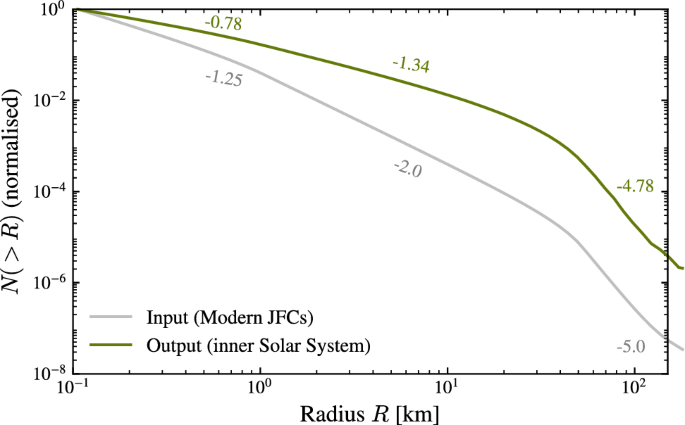 Figure: Molecular survival simulations across various impact velocities and entry angles. Source: Scientific Reports.
Corresponding author Anslow described such events as a “one-in-a-million roll of the dice.” Even if it happened once or twice across geological epochs, it would remain an irreproducible fluke. Compounding the issue, early celestial bombardment concentrated primarily in the planet’s first 500 million years. The impact frequency plummeted shortly after, leaving an exceedingly narrow window for miracles.
Crashing into Primordial Oceans: Diluted Beyond Reaction
Even granting that a few fortunate comets grazed past the surface and brought trace molecules down, they would still face an insurmountable barrier. The early Earth’s surface was predominantly submerged under primordial oceans, with very little exposed landmass. The vast majority of impactors from space ended up plunging straight into the abyss.
Immense ocean volumes bring catastrophic dilution. Imagine dumping a single teaspoon of sugar into an Olympic-sized swimming pool—no swimmer could taste even a hint of sweetness. Trace prebiotic molecules dispersed into the vast ocean are diluted instantly, rendering molecular collisions far too rare to sustain chemical reactions. Chemical synthesis relies on collision probability. When effective concentrations drop infinitesimally close to zero, the chemical reaction cascade leading to the origin of life cannot get off the ground.
When the research team plugged the same physics model into other planets, they uncovered a counterintuitive comparison. Mars is substantially smaller than Earth, with only one-tenth the mass, and its thinner atmosphere offers less aerodynamic drag. Calculations revealed that Mars’s weaker gravity results in significantly lower relative impact speeds, making molecular survival rates higher than on Earth. The neighboring Red Planet was actually far more hospitable to cosmic deliveries than early Earth ever was.
The Workshop of Life Was Inside Earth All Along
With the comet delivery hypothesis crumbling under physical modeling, where did early Earth’s abundant raw ingredients for life come from? The scientific community is shifting its focus back toward two far sturdier alternatives. The first is carbonaceous chondrites—porous asteroid fragments rich in carbon and water. Being softer and traveling at much lower relative velocities, these fragments acted like sponges absorbing the shock energy. Scientists have already extracted intact amino acids and nucleobases from multiple retrieved meteorites.
An even more compelling answer lies beneath our own feet. Four billion years ago, Earth was brimming with geothermal vitality. Deep-sea hydrothermal vents crisscrossing the ocean floor continuously spewed mineral-rich, superheated fluids. The natural thermal gradients and metallic catalysts surrounding these vents provided the ideal reactor, allowing carbon monoxide, hydrogen sulfide, and ammonia to spontaneously combine into complex organic molecules.
Life’s precursors never needed to hitch a ride on perilous cosmic transport across hundreds of millions of kilometers. Their true cradle was rooted directly in terrestrial geology. From mineral lattices inside volcanic fissures to scorching vents in the deep ocean, our planet possessed a complete organic workshop from the very beginning. The genesis of terrestrial life never depended on outer space handouts; Earth’s own land and oceans were the fertile ground that brought forth life.
References:
- Comets probably didn’t deliver life’s building blocks to Earth — Science News
- Cometary impacts an unlikely pathway towards the origins of life on Earth — Scientific Reports (DOI: 10.1038/s41598-026-74214-y)
- Comets probably didn’t seed life on Earth after all, new study suggests — phys.org